
Assessing Scratches in Greenhouse Powder Coating
GREENHOUSE REPAIR GUIDE
A mark on a greenhouse frame may be a removable scuff, a scratch in the powder coating or damage to the aluminium beneath it. The right response depends on that distinction: cleaning is not coating repair, and a generic paint pen is not automatically compatible. Inspect gently, record the model and finish details, then follow the manufacturer’s instructions before touching up.

What a scratch can tell you about the finish
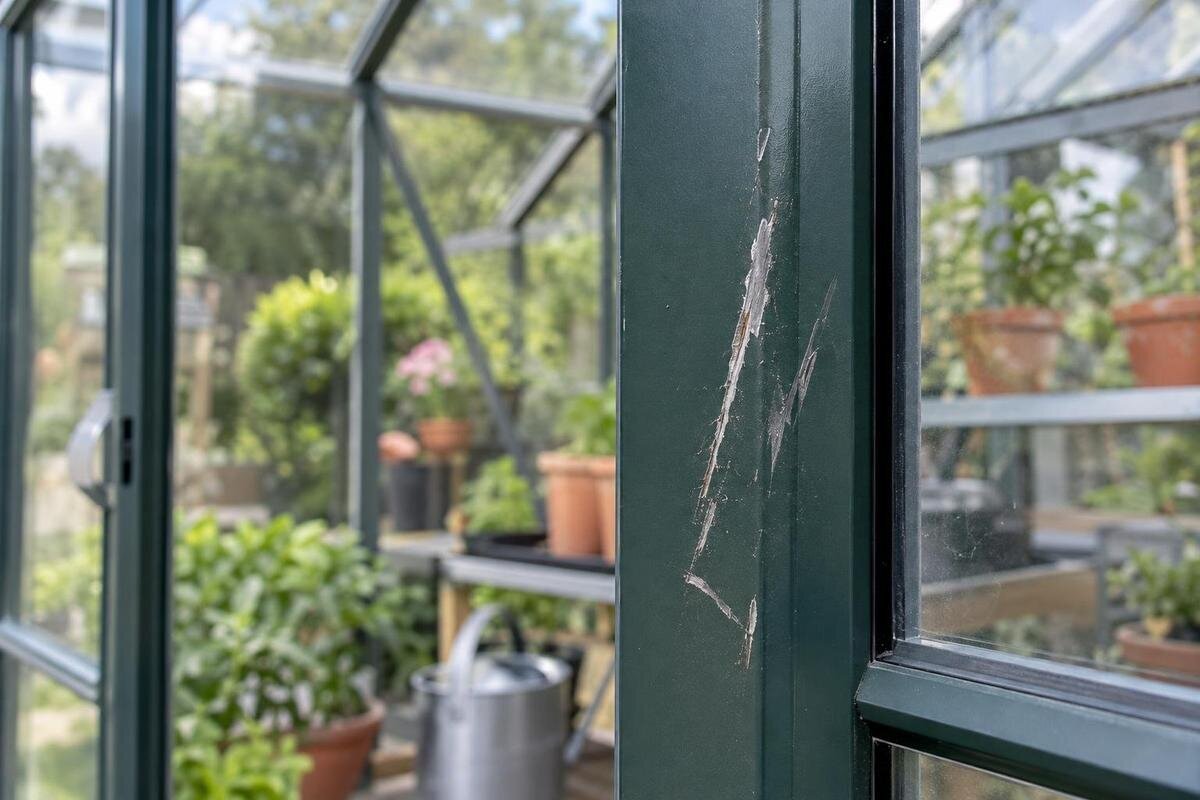
Powder coating is the coloured finish on a frame, not the frame itself. A light rub may leave a grey line or transfer from a pot, tool, cloth or packaging without cutting the coating. A scratch can also disturb the finish without exposing the metal, so the line’s colour alone cannot show how deep it is. Where the coating has been removed, the material beneath is exposed and a manufacturer-approved repair may be needed. A cosmetic mark does not by itself prove the frame has lost strength; equally, an intact-looking surface does not rule out a bent or loose member. Assess the finish and structure as separate, though related, questions.
Look for a sharp edge, a change in texture or sheen, and any lifting or flaking. Note whether the mark sits on a rail, corner or beside a joint, but do not infer the cause from its position alone. Dust, moisture and reflected light can alter what you see, so inspect the area dry and in even light. Avoid scraping or pressing a tool into it to test its depth. Keep the first inspection visual and non-destructive. If the frame itself appears distorted, a connection moves or glazing has shifted, treat that as a separate issue for the manufacturer or installer, not as a coating question.
Clean gently before inspecting
Follow the greenhouse manufacturer’s care instructions before applying any cleaner. Where they permit it, use a soft, clean cloth and water, working lightly over the mark and a small area around it; remove residue and dry with a separate soft cloth. Avoid an abrasive pad, metal brush, polishing compound or solvent unless the manufacturer explicitly specifies it. Grit caught in a cloth and hard rubbing can add scratches, while an aggressive cleaner may affect the coating. Do not mix household cleaners or flood joints. If the care guide is missing or you are unsure about a cleaner, ask before experimenting rather than trying several products in succession.
Inspect only when the area is dry and evenly lit. Look from more than one angle: a smear may change or fade as the light moves, whereas a chip often has a definite boundary, though appearance is not conclusive. Keep the cloth clear of grit and do not use a blade, screwdriver, fingernail or scouring pad to lift a mark. Do not polish the area to make it shine; changing the surface can obscure the evidence the manufacturer needs. If gentle cleaning does not clarify it, stop and photograph the mark rather than increasing the pressure. If reaching it requires climbing or leaning over glazing, leave the inspection to an installer.
How to recognise a surface scuff
A surface scuff sits on top of the coating: it may be transferred rubber, dirt, plant residue, packaging pigment or a rub mark that changes appearance when gently cleaned. A smear may have uneven edges or follow the direction of contact, but that pattern is only a clue. When the surface underneath remains continuous, with no visible chip, bare metal or lifted edge, the mark may be superficial. A stubborn stain can remain even when the coating is intact, and a small loss can be hard to see in glare. Record what the mark looks like before and after any approved gentle cleaning.
If the mark fades or disappears and the finish still looks continuous, touch-up paint may add an unnecessary patch and a colour mismatch. Keep a photograph if you want to monitor it, and otherwise follow the manufacturer’s normal care advice. A removable scuff alone is not a reason to replace the greenhouse. If you were already considering a new unit, use the Bloomcabin Prestige Greenhouse product page for that separate comparison. List what you want to change about the existing greenhouse, rather than letting a cosmetic mark determine a purchase that should meet your wider needs.
Clues that the coating has been breached
More convincing signs of coating loss include a sharp-edged chip, flaking or peeling, a line where the underlying material is clearly visible, or a scratch that interrupts the finish’s sheen. Do not pick at a loose edge to see how far it goes. Note whether the damage is local or appears on several frame members, and whether there are new marks around a joint or fixing. That pattern can help the manufacturer decide what to inspect, but it does not identify the cause by itself. A photograph in even light is safer and more useful than a scratch test; include nearby frame details without taking anything apart.
Surface damage is not the same as structural failure. A small isolated chip can be a coating issue, while a bent profile, a loose connection, repeated movement or displaced glazing needs assessment beyond touch-up. Do not try to straighten or secure frame members as part of a cosmetic repair, and do not disturb glazing to reach a hidden edge. Where damage affects several areas, establish the scope of repair before comparing it with a new greenhouse. The Bloomcabin Orangerie Spacious Greenhouse listing can help you explore a replacement option, but keep the assessment of the existing frame separate from the choice of a new model.

Record the greenhouse model and the damage
Before asking for a coating repair, identify the greenhouse as precisely as possible. Check the original invoice, order confirmation, model label, assembly manual and any part or colour code supplied at purchase. Write down the model name exactly as shown, plus an approximate purchase date if known. The Aluminium Classic Greenhouse listing may help you recognise a catalogue name, but similar-looking frames can belong to different versions. A current listing cannot establish an older frame’s profile, coating colour or spare-part compatibility. Keep a note of any uncertainty rather than selecting the closest-looking model and treating it as a confirmed match.
Take one photograph of the whole greenhouse and close-ups of the mark, including a view that shows which rail, corner or door-area member is affected. A close-up taken square to the surface is easier to interpret than one dominated by glare. Put a ruler or other scale beside the mark only if you can do so safely from ground level; never climb, lean on glazing or remove a panel for a clearer picture. Include a nearby joint or fixing without dismantling it. Keep the original images and label details together so the manufacturer or installer can compare the damage with the correct records.
Check warranty and manufacturer guidance first
Read the warranty information and care instructions before applying anything. Repair routes depend on the product and its documentation, so do not assume a scratch is covered, excluded or harmless to a claim. If you may ask the seller or manufacturer to assess it, send the photos and purchase details first and ask whether they want to review it before you do more than routine, permitted cleaning. Keep any replies and product labels. When browsing the Wall Greenhouse listing, distinguish the sales information from the warranty and care guidance you need for an installed unit. Record which instructions apply to your own model before choosing a repair.
Ask focused questions: is the coating actually breached, does the manufacturer approve a touch-up for this model and colour, and is there an approved product or service? Confirm the exact preparation and application instructions, any limits on where the product may be used, and whether a qualified installer should handle the work. If a replacement component is recommended, request its precise part identifier and confirmation that it belongs to your model. Do not accept a generic colour description or household paint as a substitute for model-specific guidance.
Use only a touch-up approved for that finish
Use a touch-up product only when the manufacturer confirms it is suitable for the particular coating and mark. A colour that looks similar on a screen or in a shop may differ in shade, sheen or texture once applied; even the same broad colour name does not guarantee a match between versions. Ask for the exact colour or finish reference and whether a touch-up option exists at all. For an enquiry about a model shown on the Limited Edition Aluminium Greenhouses page, include the installed unit’s finish details as well as its model name. Those details answer different questions: which greenhouse you own and which coating needs attention.
Follow the approved instructions for cleaning, surface preparation, application, drying and aftercare; details can differ between products. Do not assume that sanding, a solvent, brush-on paint, an aerosol or a clear coat is appropriate. Avoid covering seals, drainage routes, moving parts or connection details unless the manufacturer explicitly directs otherwise. A local touch-up may improve the appearance of a small defect, but it should not be presented as a factory-equivalent recoating or a repair to a damaged frame member. If an instruction is unclear, pause and ask before applying the product.
When touch-up is not the right repair
Touch-up is not the right answer when a profile is bent, cracked, loose or no longer aligned, or when coating is peeling across a large area or the damage keeps recurring. Nor can a coating product repair a failed joint, damaged fixing or glazing problem. A long scratch across several members may also be outside the scope of a small local repair, even if the frame looks straight. Have these concerns assessed by the greenhouse manufacturer or a qualified installer. Do not remove panes, loosen frame connections or improvise a brace to reach damaged coating; work around greenhouse glazing can create a more serious hazard.
An installer can establish whether a local coating repair, an exact replacement member or a wider replacement is appropriate. Give them the model record and photographs, and ask them to identify any part by the manufacturer’s number rather than by resemblance. If the assessment points to a complete new unit, you can consider alternatives such as the T-Model Orangery Greenhouse as a separate purchase. Ask about the proposed unit’s base requirements and installation arrangements rather than assuming it can take the place of the damaged greenhouse without other work. Establish what needs replacing before requesting a quotation for the new installation.

Compare repair and replacement on equal terms
Compare the remedy with the actual scope of damage, not with the word “scratch” alone. Ask for a repair estimate based on the confirmed product, finish and affected members; if parts or professional labour are involved, make sure they are included. Consider how much coating is affected, whether compatible touch-up is available, what else needs attention and how the repaired appearance may differ. A small patch may remain visible, even when the repair is approved. If you are comparing that estimate with a new unit from the Pyramid Greenhouse range, request a quotation for the complete proposed replacement. Keep the expected appearance of a local repair separate from the cost and features of a new greenhouse.
For a fair replacement comparison, check the complete specification with the seller or installer: footprint, frame arrangement, glazing, base or foundation interface, access for installation and the features you actually need. A greenhouse’s name or stated area does not establish that it fits the old position or reuses existing parts. Confirm separately whether an existing base can be used. Include the condition of unaffected components in your repair estimate, too. The aim is not to buy a new unit because touch-up is inconvenient, but to compare like with like when repair is no longer reasonable.
Keep the repair record model-specific
If the manufacturer approves a touch-up, keep the product name, colour code, batch or lot details if supplied, instructions and date with the greenhouse records. Take a photo before treatment and another afterwards, following the specified drying or curing interval rather than judging the finish too early. Record whether an installer carried out the repair. For later maintenance, use the same approved care guidance and inspect for changes during ordinary visual checks; do not repeatedly rub or coat the area in an attempt to improve a match.
Keep parts enquiries with the existing greenhouse’s records. Include the model and serial details, a clear photograph of the damaged member, the relevant manual or drawing reference and any known part identifier. Do not order a generic rail or assume a new model shares the old greenhouse’s profile. If you instead choose a replacement from the Aluminium Greenhouses with Storage – Limited Edition range, keep its quotation and specification separate from the old unit’s repair information. Confirm dimensions, configuration and fit for your site as part of that purchase, and retain the new model and finish details for future maintenance.
Frequently asked questions
How can I tell whether a scratch has gone through the coating?
First remove loose dirt using only the care method the manufacturer permits, then inspect the dry area in even light. A mark that wipes away while the finish remains continuous may be a surface scuff; a clear chip, flaking edge or visible metal suggests coating loss. These clues are not a substitute for manufacturer advice.
Can I use a generic touch-up pen or enamel paint?
Not unless the manufacturer approves that exact product for the greenhouse’s coating and colour. Generic paints can differ in shade, sheen, texture and preparation requirements. A broad colour name or product photograph cannot confirm a match.
Does visible metal mean the frame is unsafe?
Not by itself. Visible metal suggests the coating has been breached, but a scratch does not establish whether the frame has been weakened. If a member is bent or cracked, a joint moves, or glazing is displaced, stop at a visual assessment and ask a qualified installer to review it.
Should every coating scratch be repaired immediately?
No. A removable scuff with the coating intact may only need routine cleaning. Document a chip or peeling area and check the manufacturer’s guidance before choosing a repair. Seek professional assessment if the frame itself is distorted, loose or affecting the glazing.
What should I send with a repair enquiry?
Share the model name, serial or label details, purchase record if available, and clear photographs of both the whole greenhouse and the damaged area. Identify the affected frame member and include any known colour or part code. Ask which repair is approved and whether an installer should assess it first.
The useful distinction is whether the mark sits on top of the finish, cuts through it or accompanies damage to the frame. Clean only as the manual allows, document what you see and get model-specific approval before using a touch-up. That keeps a simple scuff from becoming an unnecessary paint repair, while ensuring a deeper coating defect or structural concern is handled through the right channel.
