
How to Prepare a Parts Enquiry for a Discontinued Greenhouse
Greenhouse repair guide
When you need a spare part for a discontinued greenhouse, your enquiry must identify both the structure and the component. Collect original records first, then document the component’s location, profile, measurements and condition with labelled photographs. Ask the manufacturer or supplier to confirm the part against the exact version before ordering; a model name alone is not proof of fit.

Find the greenhouse’s original records
Begin with anything that ties the structure to its purchase or installation: an invoice, order confirmation, retailer correspondence, assembly guide, parts list, technical drawing or a label still attached to the frame. Write down the manufacturer and exact model wording as printed, together with any size code, series, serial or reference number, and the purchase or installation date if recorded. Mark missing details as unknown rather than estimating the age or variant from appearance. A catalogue title such as T-Model Orangery Greenhouse can help you recognise a model name, but it is not an identifier for an individual rail, pane or fitting. Keep model identity and part identity in separate notes. If one record shortens a name used in another, preserve both and note where each came from.
Search paper files and emails from the original seller or installer. If the greenhouse was bought second-hand, ask the previous owner for any manuals or order records they still have. Record who supplied or installed it only if known; do not assume the retailer was the manufacturer. Photograph a surviving label in place, without removing trim or disturbing glazing, and copy its wording carefully, including hyphens and suffixes. Keep the full page or scan, not a cropped number: a nearby revision note or model table may distinguish one version from another. Note the manual page naming the model as well as the parts page, and include conflicting records rather than choosing one silently.
Separate the model name from its size and version
Keep the greenhouse family, overall size, variant and assembly revision in separate fields. A model name may cover more than one size or configuration, while the external width and length do not identify the rail or fitting in a particular opening. Copy each detail exactly and note its source: model on manual cover, size on invoice, or revision on drawing. If records disagree, list both with their sources instead of choosing the one that looks most likely. Preserve the units shown and label what each measurement describes; a footprint or overall greenhouse dimension is not the length of a replacement member. If you measured the structure yourself, identify that as your measurement, not as a figure from the original records.
Exact names and suffixes matter, especially if the greenhouse has changed hands or has been altered. If your records name a Pyramid Greenhouse, preserve that wording alongside any size, series or revision details rather than shortening it to a general description. Record any known extension, replacement door, changed glazing or other work separately, because the current arrangement may not match the original paperwork. If you are unsure whether a feature is factory-fitted, say so. Copy unexplained codes as printed rather than guessing what they mean. This gives the parts team a traceable set of clues and lets them ask for a particular drawing or measurement instead of relying on a visual guess.
Describe one component at a time
Describe one item at a time, using the plainest name you can support: a door handle, hinge, runner, vent part, glazing-retaining strip, pane, frame member or connector, for example. These are possible descriptions, not assumptions about what your model contains. State how many are needed and where each is: front, side, roof, a particular bay or beside a named opening. Give left or right only from a fixed viewpoint, such as standing outside and facing the main entrance, and state that viewpoint. If you cannot name the item, call it item 1 and explain what it joins, supports or operates. Use the same number in your message, photographs and measurements.
Say whether the part is missing, cracked, bent, loose, worn or difficult to operate, and whether another matching item remains in place. A photograph beside an intact neighbour may help distinguish a missing fastener from a larger assembly; describe what you can see rather than diagnosing the cause. For a greenhouse recorded as Aluminium Greenhouses with Storage – Limited Edition, specify whether the component is on the greenhouse itself or the storage section. Mention nearby damage separately from any guess about how it happened. Do not dismantle a frame joint or glazing to identify a part. If the item supports the frame or a panel is broken, ask an installer to assess it rather than removing it for inspection.
Photograph the part in context
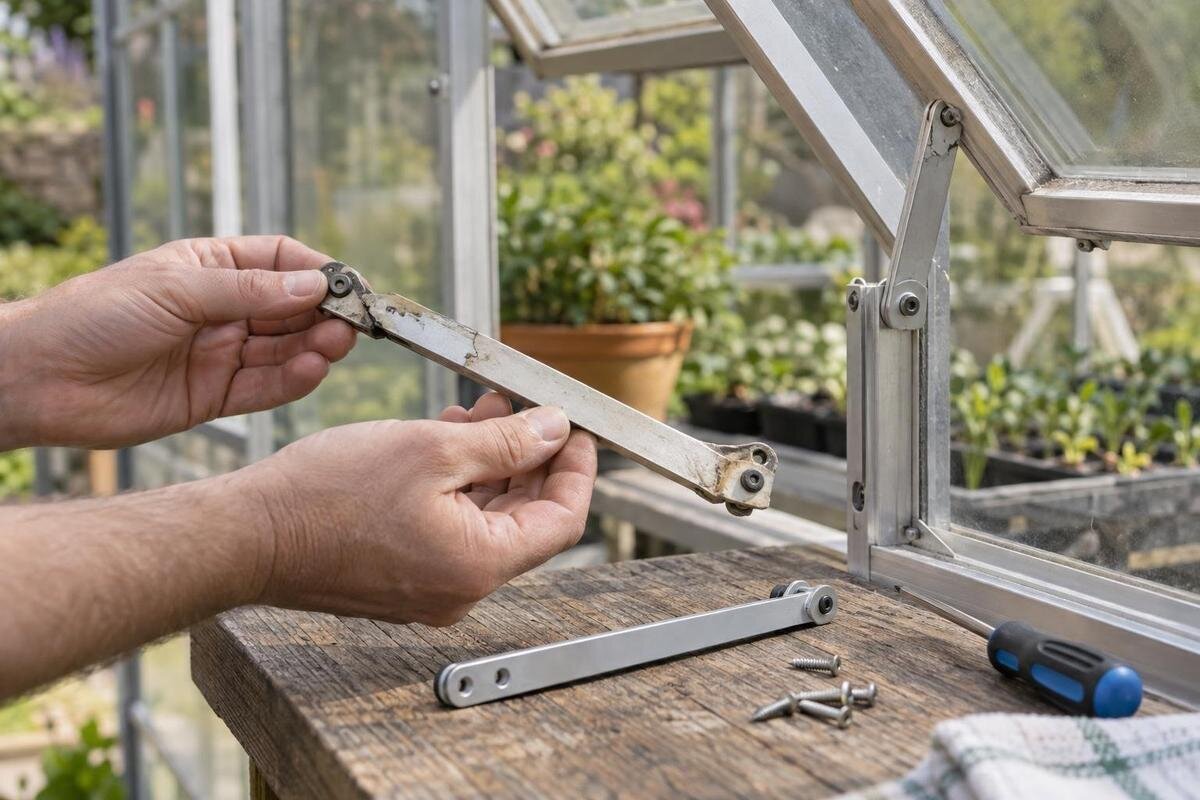
Take an overview that shows the greenhouse and a second view that locates the item within a side, roof, door or other opening. If the area can be reached safely, an interior view can help the supplier understand which way the part faces. Then take close-ups with the whole component and its connections visible; include both ends, slots, holes, clips or retaining grooves where relevant. A wide view establishes location, while a close view reveals shape, so one photograph rarely does both jobs. Photograph the model label separately. Include a reference point, such as the main entrance, in the overview and name it in the caption. Avoid sending only a loose fragment with no indication of where it came from.
Use clear light and keep the camera square to a profile or joint so perspective does not distort its shape. For scale, place a ruler beside an accessible, undamaged component in the same plane; do not press it against glass, sharp edges or a part still under strain. If you cannot do that safely, leave the scale out and ask an installer to measure. If your paperwork identifies a Bloomcabin Prestige Greenhouse, put the exact name in the caption; the photograph must still show the position and condition of your own part. Keep original-resolution files, number them in order and label each view, such as overview, location and end profile.

Record profile details and measurements
For an exposed frame profile, overall length is only one measurement. Record the cross-section as well: overall width and depth, the position and shape of channels or grooves, lips, returns and visible fixing slots. Say whether a dimension is inside, outside or centre-to-centre; if you report the spacing of holes, state how you measured it. Use millimetres for small parts, or copy the units shown on the original drawing, and do not round away a small difference. Two profiles can look similar from the front yet differ at an edge that locates them in the frame. Describe which face is uppermost or outermost if orientation matters, and add a simple labelled sketch only if it makes the measurements clearer.
Measure only what is accessible without releasing a frame connection, moving a panel or forcing a component. If a part is bent or damaged, say the measurement may not represent its original shape; use another part or a manual drawing only if you know it is the same version. Keep overall greenhouse dimensions, even if recorded under a name such as Spacious Greenhouse, separate from component measurements. For glass, do not remove a pane or measure broken edges: give its position and any drawing or part reference, then ask a qualified glazing installer or the manufacturer to confirm the required dimensions and type before ordering. Mark every figure as measured, copied from a drawing or estimated.
Match the enquiry to a manual or drawing
Look for the original assembly manual, parts schedule, exploded drawing or technical drawing. A purchase folder may contain a document version that differs from material you find elsewhere. When a page assigns a callout or part number, copy the figure and item number together with the page, drawing title and revision, if shown. Send the relevant page and enough of the cover or contents to show which greenhouse the document describes. Do not copy a number without its labels: the same number can mean different things in different drawings. If a scan is incomplete or hard to read, say so rather than reconstructing a code. Keep an unaltered copy even if you mark a duplicate to point out the item.
When comparing paperwork with a catalogue entry such as Aluminium Greenhouses, keep the printed model wording separate from drawing references and spare-part identifiers. This makes clear which details describe the greenhouse and which identify the component. If the manual is missing, say that and provide the strongest alternatives: order references, a label photograph, a location view and measurements. Ask whether the manufacturer or supplier can identify the component from its records, and whether an old number has been replaced by a new one. If you receive a new identifier, keep both numbers together with the reply and the drawing that confirms their relationship.
Ask for compatibility to be confirmed
Compatibility cannot be established by colour, overall length or a similar-looking shape alone. Differences in profile cross-section, fixing position, end machining, handedness, seal channel or glazing retention can affect whether a part is the right one. These are details to ask about, not a checklist for modifying the frame yourself. Request a match against the exact greenhouse name, size and version you have documented. If your records use a broad label such as Wall Greenhouse, include any more precise model code or revision you can find. A photograph can help locate the item, but it does not replace the model and version details.
Ask whether the proposed item is the original part or a successor, and whether it has been checked against your stated model and version. Also ask whether matching clips, seals or other pieces are required and whether there is a relevant drawing or fitting instruction. Ask the supplier to identify any assumptions behind the match. If an option would require cutting, drilling or altering a frame, do not treat that as an ordinary replacement; have a qualified installer or technical professional assess it. Save the response, particularly if the replacement number differs from the old callout, so it can be checked against the same evidence later.
Separate a parts enquiry from a greenhouse replacement enquiry
A greenhouse being discontinued does not by itself tell you whether a particular part can still be supplied, whether a successor exists or whether an alternative has been checked. If you know the part number, ask about that exact number against the model and version; if not, ask the supplier to identify it from your photographs and records. Request confirmation of the quantity and any companion items needed, rather than assuming that a clip, seal or connector is included with a larger assembly. A missing catalogue page is not enough information to conclude that a part is unavailable, so ask directly about the item you have identified.
If no confirmed part is available, say whether you want an assessment of alternatives or a separate enquiry about replacing the greenhouse. Keep those questions distinct: a newer model name does not establish that its parts fit your existing frame, or that old parts fit it. If you also enquire about Limited Edition Aluminium Greenhouses, label that as a separate replacement option so its details are not confused with those of your existing greenhouse. If the affected item is glass or a structural member, ask an installer to assess the repair or replacement route before work is planned.
Assemble a clear parts enquiry
Make one compact enquiry for each greenhouse, particularly if you have more than one structure or model. Put the manufacturer, exact model wording, size or variant and revision at the top, writing not known where necessary. Number each item and give its description, quantity, location, condition and measurements with units. State whether each measurement is actual, copied from a document or estimated. Attach a labelled overview, close-up, label photograph and the relevant manual or drawing page. Use matching item numbers in the message and image captions. If one photograph shows several parts, label each one clearly; keep unrelated structures out of the same image set.
State what you want the recipient to check: identify the spare part, confirm the model and version match, advise whether the old identifier has a successor, and say what information is still missing. Ask about supply or a quote only after the item is clear, and state whether you need one component or a complete set. If a manufacturer or installer needs a clearer measurement, ask which points or dimensions are required instead of sending another batch of unlabelled pictures. Include contact details needed for a reply, but leave out unrelated personal documents. This keeps follow-up focused and makes later replies easier to compare.
Check the reply before ordering parts or arranging work
Read the reply against each numbered item, not just the greenhouse name. Check that it gives the correct model or variant, component number, quantity, orientation and any replacement code. Ask whether a new number formally replaces the old one or is only a suggested alternative. If the reply says a part fits without identifying the version checked, request clarification before ordering. Confirm which related clips, seals or fixings are included and whether a manual or drawing applies to the proposed part. Keep the confirmation with the original enquiry so another person can see exactly what information was checked.
Do not test a match by taking apart a frame or removing a pane. Work involving glass, broken glazing or a component that contributes to the frame structure should be reviewed by a qualified installer; ask them to verify the measurement, part identification and appropriate method of work. This matters especially when no original part number or drawing can be found. If the installer cannot confirm the item, send that specific uncertainty back to the manufacturer or supplier rather than making a substitute from an approximate profile. Keep any open question visible in your records until it has a clear answer.
Frequently asked questions
What if I cannot find a model label?
Use the invoice, manual, order emails or records from the previous owner or installer. Send the exact details you can verify and mark the model as unconfirmed if necessary. A few clear photographs may help identify the greenhouse, but do not identify its version from appearance alone.
Are the greenhouse’s overall dimensions enough to identify a replacement profile?
No. Overall width and length describe the structure, not the profile’s cross-section, fixing details or position. Give the component’s location and any safely obtained measurements, with units, and include the relevant drawing or part number if you have one.
Should I remove a pane or frame section to measure it?
No. Do not dismantle a frame connection or remove glazing to identify a part. If the item is inaccessible, broken or structural, say so in your enquiry and ask a qualified installer to verify its identity and measurements.
Which photographs should I attach?
Include a view of the whole greenhouse, a photograph showing where the part sits, and close-ups of its shape and connections. Photograph the model label separately. Number and caption each image so the supplier can match it to the relevant part in your message.
What if the original part number is obsolete?
Ask whether the original number has a successor and whether that item has been checked against your exact model and version. If there is no confirmed match, request a separate assessment of alternatives or a replacement greenhouse; do not assume parts are interchangeable because they look similar.
A clear parts request lets the recipient trace each detail back to a record: the model and version, the component’s location, its measurements and any relevant drawing or manual. Where the evidence stops, say so. That is more useful than a confident but unverified part name, and it keeps identifying a possible replacement separate from deciding how it should be fitted.
