
Understanding Outdoor Sauna Warm-Up Times
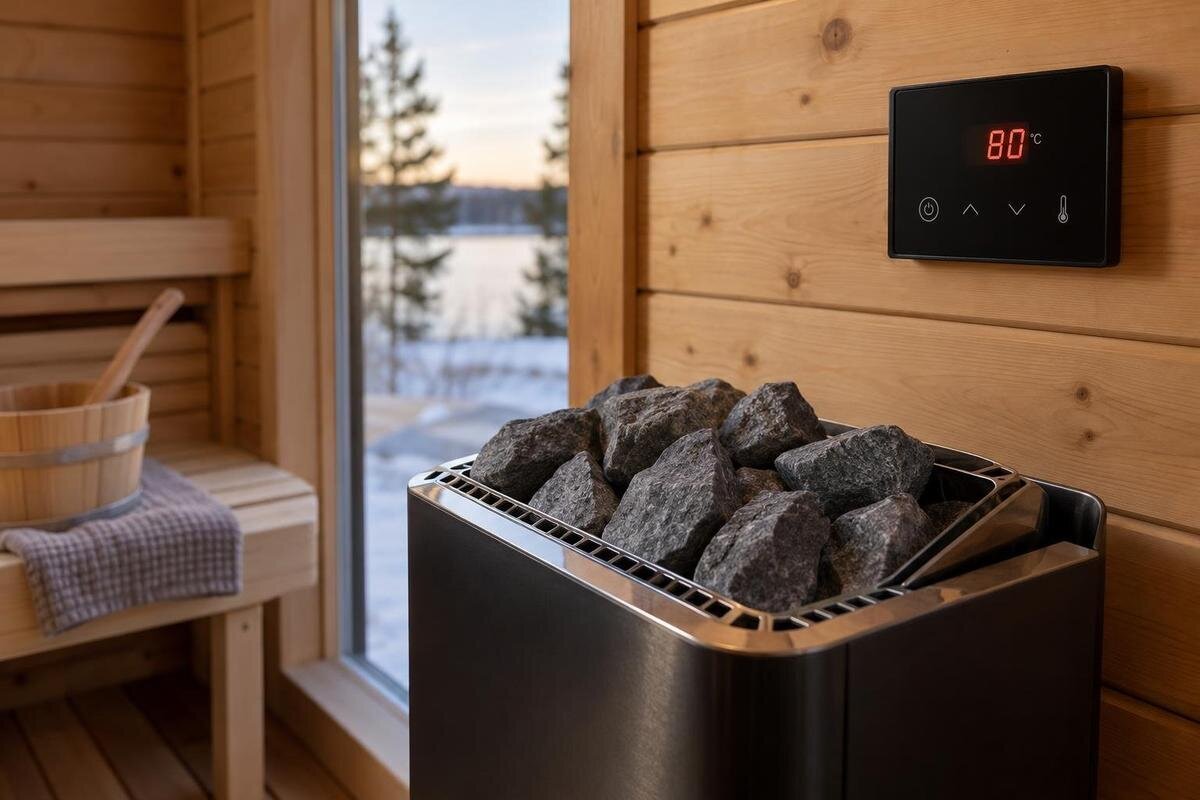
SAUNA HEATING GUIDE
An outdoor sauna warm-up figure is only meaningful when the starting conditions and finish line are clear. A cabin beginning from a cool, unused state is not equivalent to one that still holds heat; a reading at one sensor is not the same as an even, stable temperature throughout. This guide explains how to read the test behind the number without turning one result into a promise.
What a warm-up time actually measures
Warm-up time is an interval between two declared events, not an intrinsic number attached to a sauna’s name. A report should say when timing begins: when the heater is switched on, when its control becomes active, or after a preparation period has already taken place. It should also state whether the cabin was cold throughout, had been used recently, or was partly warm. If one test includes start-up and another begins after preheating, their reported minutes cover different work. A precise-looking figure without those details can answer a narrower question than a buyer assumes. Before comparing two claims, make sure both clocks start at the same point.
The stopping point matters just as much. A single sensor touching the chosen target briefly is not the same result as a reading that stays near that target, or as several positions reaching a defined range. Some reports mean ‘first reading at target’; others include time for temperatures to settle. Check whether the timer stops at a thermometer reading, a control-panel display, or a stated stability point. These measure different things. Also ask whether the result covers only the cabin’s heating period or includes preparation such as getting controls ready. The useful question is not simply how many minutes were recorded, but what happened during them.
Starting temperature and outdoor conditions
Record the cabin-air temperature immediately before switching on the heater, and record outdoor air separately at roughly the same time. Do not substitute the day’s forecast for conditions at the sauna: a weather station farther away may not reflect shelter, sun or wind at the site. The cabin’s surfaces and stones may also hold residual heat when the air feels cool, so note whether it has been unused for a long period, was warmed earlier that day, or is being restarted after a pause. A test beginning at 10°C indoors is not equivalent to one beginning at 20°C, even if both aim for 70°C. Those are example readings, not recommended settings.
Weather is more than one outdoor-temperature reading. Wind can increase heat loss around an exposed structure or make gaps more relevant than they would be in a sheltered position; direct sun may warm the cabin before the heater starts. Record the test date, approximate wind and whether the site was exposed or protected, alongside both temperatures. Rain or damp conditions can coincide with different starting conditions too, but they are not a fixed correction to the time. A forecast-only comparison misses the conditions around the cabin itself. There is no reliable universal number of extra minutes to add for each degree of colder weather: construction, ventilation and heater operation also affect the result.
Why cabin area is not enough
An area figure is useful context, but it does not state how much air the heater must warm. Ceiling height, internal shape and the space above the benches all affect volume; cabins with the same footprint can enclose different amounts of air. The store identifies Sauna S-140 as a Thermowood Barrel Sauna and lists 1.93 m² Sauna S-140 listing. Treat that as one catalogue descriptor, not a measurement of heated volume or a warm-up result. For heater selection, use the manufacturer’s stated room-volume method and any adjustments specified for the exact cabin. If the information available gives only an area or external dimensions, do not convert it into a heating-time estimate.
Warm-up also depends on how readily the cabin retains heat. Insulation, air leakage at doors and joints, glazing and the thermal mass of interior surfaces can change the load on the heater. The relevant information is the exact build and configuration, not a broad label such as barrel or outdoor sauna. Comparing listed areas can help you understand relative cabin size, but it cannot rank two models by warm-up speed. Check the drawings and manuals for internal measurements and the heater maker’s accepted volume. A smaller-looking plan does not automatically mean a faster warm-up if other parts of the setup differ.
The heater and cabin work as one setup
The heater must be suitable for the actual cabin configuration under its manufacturer’s guidance. For a meaningful test record, note the exact heater type and model, its stated output, the control setting and any other setup details that affect heating. The heater maker’s instructions for stones, controls and room-volume limits are relevant; changing the setup between tests makes the results harder to compare. Different heater types can also have different start-up and measurement conventions, so a cabin name alone is not enough to identify what was tested. Confirm whether a heater is part of the chosen configuration or selected separately rather than assuming that a catalogue cabin includes a particular unit.
The store listing identifies Sauna HC-150 as a Thermowood Barrel Sauna and gives an area of 2.97 m² HC-150 product page. That catalogue figure does not establish which heater is fitted to a particular configuration, whether it matches a specific test setup, or how long heating takes. Before relying on a quoted time, match the cabin and heater details to the configuration you are considering. Follow the relevant manufacturers’ documentation; installation, supply and any changes to heater arrangements should be assessed by a qualified professional.
Where the temperature is measured
A thermometer reading describes the temperature at its own position, not automatically the whole cabin. Air temperature can vary with height and location, so a sensor near the ceiling may give a different result from one at bench level. The sensor position specified by the cabin or heater manufacturer is the sensible reference for a test; there is no universal position to assume. Reports should say where the sensor was placed and whether the endpoint used one probe or readings from several points. Without that information, two figures may appear to disagree even though each records a different part of the room.
Use the same suitable thermometer or temperature logger, and the same position, for repeat tests. Note how often readings are recorded and whether the instrument’s calibration and resolution are appropriate for the comparison. Do not treat a controller display as interchangeable with a separate thermometer unless the method explains how they relate. When keeping records for a shortlisted model, such as the HC-225 barrel sauna, listed at 4.4 m², keep the instrument details alongside the cabin and heater information. This separates the identity of the product from the measurement method. If two reports use different instruments or positions, identify that difference before interpreting a shorter recorded time as faster heating.
How to compare measured tests
A useful comparison record identifies the cabin and exact heater, gives the indoor and outdoor starting temperatures, states the chosen target and sensor position, and explains when the clock starts and stops. It should also note whether doors and ventilation were in their stated positions, whether the cabin or stones were already warm, and whether the test was interrupted. Repeat runs from similar starting states are more informative than a single fastest result. For example, the store names Sauna N-210 as a Thermowood Barrel Sauna and lists 4.43 m² N-210 catalogue entry; model identity helps label a log, but a name and area do not amount to a measured heating test.
The product details available for these models do not provide verified warm-up measurements, so they cannot support a model-by-model timing comparison. To show what comparable records look like, consider a fictional example, not a real test or product result: two runs begin with cabin air at 10°C and outdoor air at 5°C, use the same heater, sensor position, ventilation and closed-door conditions, and aim for 70°C. If one records 62 minutes to the first reading at that target and the other records 66 minutes, the matching method makes the two fictional readings interpretable as repeat runs. They are not typical times or a prediction for any sauna. If the endpoint instead means a stable reading, keep that result separate.
Ventilation and door openings during a test
Ventilation and door use form part of the test method, rather than incidental details to leave out of the record. Note the ventilation positions used and follow the relevant manufacturer’s instructions; do not change them simply to make a warm-up figure look shorter. Opening the door, leaving it ajar or repeatedly going in and out changes the conditions being measured. If an interruption happens, record when it occurred and explain what happened. A run with several door openings should not be presented as an uninterrupted test. Keeping these details with the temperature readings makes it easier to distinguish a change in operating conditions from a difference between heater or cabin configurations.
For a cabin you are considering, ask what door and ventilation conditions accompanied any quoted warm-up time. The Sauna N-250 product page identifies a model listed at 5.27 m², but a timing claim for that model would still need its operating conditions stated separately. A closed-door test answers a different question from a run interrupted by repeated entry. Keep both records if they are useful, but label them clearly rather than combining their results into one figure. When comparing repeat runs, look for the same ventilation settings and a similar pattern of door use. Do not assume that an interrupted run can be made comparable simply by subtracting the time the door was open.
Glass, stones and moisture in the test
The amount of glass and other heat-losing surfaces can affect the heating load. A cabin with a large glazed section may need a different heater selection from one with less glazing, according to the heater manufacturer’s method. There is no universal correction to apply to a quoted warm-up time: the exact cabin, heater and configuration matter. When comparing tests, identify the glazing arrangement rather than assuming that two cabins with similar listed areas have the same heat loss. If you are selecting a heater, use its manual and the cabin documentation instead of deriving a size adjustment from another sauna’s timing.
The condition of the stones and whether water was used during the test also belong in the record. A test starting with a cold heater and stones is not the same as one that has been partly warmed, while water use changes the conditions and can affect what a temperature reading represents. When reviewing a quoted time for the LC-260 barrel sauna, listed at 5.12 m², check whether the record describes these starting conditions. Note any water use during the timed period rather than leaving the reader to assume a dry test. Keep dry-start results separate from tests where water is used, and follow the heater maker’s instructions throughout.
Matching a quoted time to a product listing
Use the product listing to establish which cabin a quoted time refers to, then match the configuration described in the test. For example, the Sauna HCF-300 product listing gives an area of 6.89 m². Record that catalogue detail with the model name, but look separately for the heater, controls and glazing arrangement used in the reported run. A time quoted alongside a product name is only useful for your purchase if you can tell which setup it describes. Check the configuration information, drawings and relevant manuals rather than assuming that every version of a named cabin shares the tested arrangement. This is particularly important when a heater is selected separately.
Keep the published product details separate from the reported test conditions when reviewing a quotation or comparing shortlisted cabins. Internal measurements and heater specifications describe the setup; starting temperatures, sensor position and the endpoint describe how its warm-up was measured. Neither group replaces the other. Two cabins with the same listed area need not have the same internal dimensions, glazing, heat-retaining surfaces or heater arrangement. Equally, a detailed cabin specification does not supply missing information about a test. If a timing claim leaves its starting temperature, target or measurement method unstated, mark those details as unknown. That is more useful than filling the gaps with assumptions drawn from a similar-looking listing.
Using a test to plan for your own sauna
For your own sauna, keep a simple log that separates fixed setup details from the conditions of each run. Record the cabin identity, heater model and sensor position once, then note any changes rather than assuming the setup stayed the same. If you are considering the Sauna LCF-300, its listed area of 6.89 m² can sit alongside the model name in that record. For each run, add the heater settings, indoor and outdoor starting temperatures, target, door and ventilation state, and the times of the first target reading and any later stable reading you choose to observe. Follow the product and heater instructions throughout; the purpose is to understand the prescribed setup, not alter it to chase a shorter time.
If you repeat a test under comparable conditions, keep the individual results and describe the range rather than presenting the quickest run as a promise. A test from one starting temperature or weather condition may not represent another, and there is no dependable formula for correcting it by a fixed number of minutes. A manufacturer’s quoted time is most useful when its cabin configuration, start point, target and sensor method match your own. The aim is a realistic planning estimate with visible assumptions, not a guarantee that every outdoor warm-up will take exactly the same length of time.
Frequently asked questions
How long does an outdoor sauna usually take to heat up?
There is no dependable single time that applies to every outdoor sauna. The result depends on the cabin’s starting temperature, weather, heater and setup, and what the test counts as ready. Use a figure only when its conditions and measurement method are clear.
Does the outside temperature determine the warm-up time?
It is one factor, but not the only one. The cabin’s initial temperature, wind exposure, construction, ventilation and heater configuration also matter. A weather reading alone cannot be used to calculate a reliable warm-up time.
Should I stop timing when a thermometer first reaches the target?
That is one possible endpoint, but it should be identified as a first reading at the target. A result that waits for a stable reading, or checks more than one position, measures something different. Compare tests only when their endpoints match.
Can I estimate warm-up time from the sauna’s listed area?
No. An area figure does not tell you the cabin’s internal volume, heat retention or heater setup. Treat it as one catalogue detail, then check the cabin and heater documentation for the information needed to interpret a heating test.
What details should a warm-up test include?
Look for the cabin and exact heater configuration, indoor and outdoor starting temperatures, chosen target, sensor position, clock start and stopping point, door and ventilation settings, and relevant weather conditions. Without these details, the reported minutes are difficult to compare.
There is no useful warm-up time without context. A clear result states the starting temperatures, exact heater setup, target, sensor position and stopping point. Compare those details before comparing minutes, and treat missing information as uncertainty rather than a reason to guess. That makes a measured figure more useful for planning while recognising that outdoor conditions and configurations vary.
