
Can Your Home’s Electricity Supply Support a Sauna?
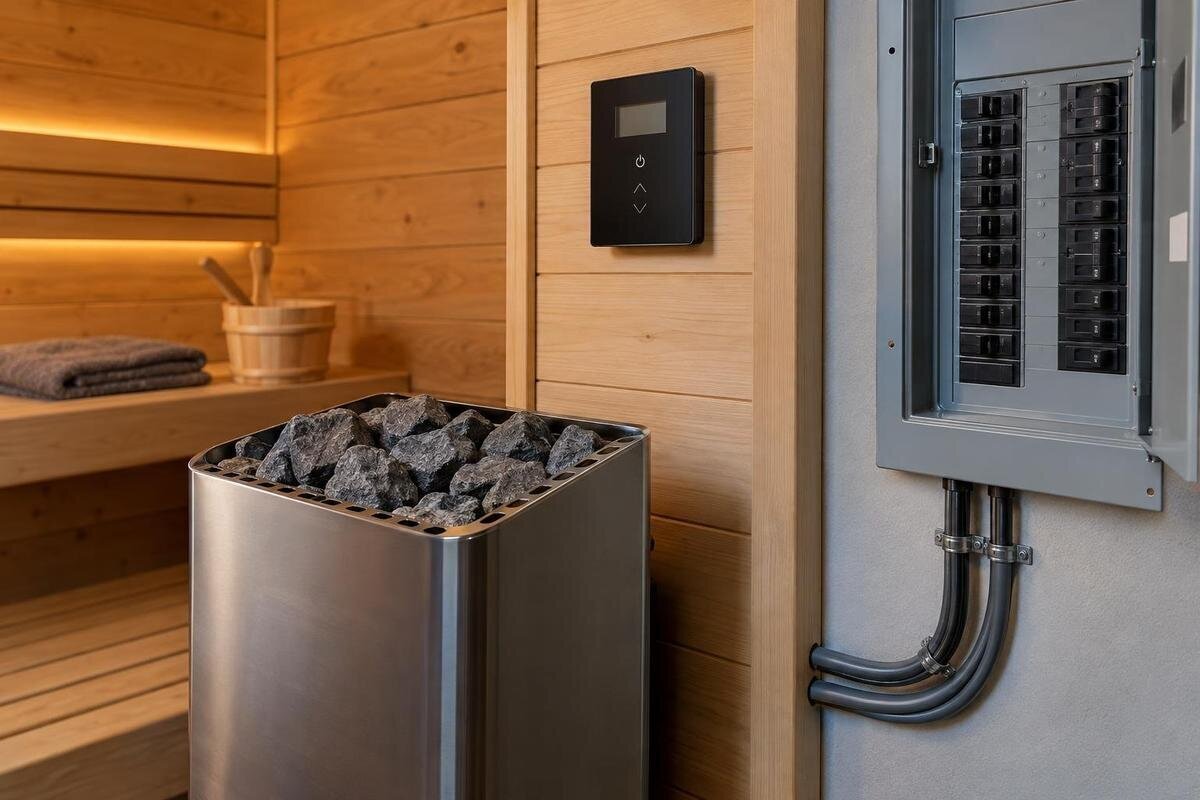
Sauna electrical planning
Before choosing an electric sauna, find out whether the exact heater proposed for it can be supplied at the intended location without exceeding what the home can support. A cabin name or floor-area figure cannot answer that, and an electricity bill is not a capacity assessment. Gather the manufacturer’s electrical information, describe the home’s supply and normal appliance use, and ask a qualified electrician to assess the match. The aim is to choose a model with verified requirements, not to guess from appearance.
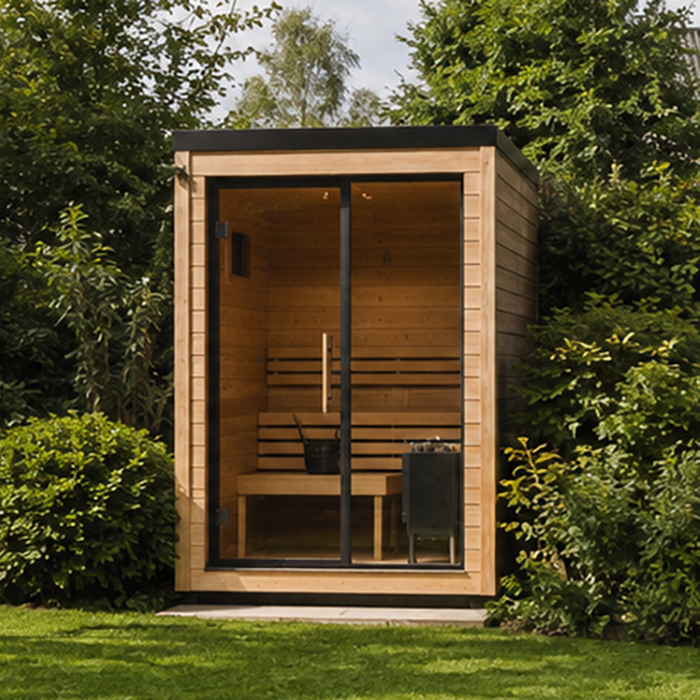
Identify the exact sauna and heater
An electrician needs a defined proposal rather than a general question about whether a sauna can be connected. Record the exact sauna model and intended heater’s make and model, along with the configuration you are considering. If a quotation uses shorthand or one item is not yet selected, ask the supplier to spell it out before sending the brief. The electrical requirement belongs to the selected heater and its approved setup; it cannot reliably be read from a barrel shape, product-family name, floor-area figure or photograph. If you have not chosen a heater, request the compatible options and technical documents for each. An initial view based on a placeholder may need to be revisited once those details are fixed.
Use the Thermowood Barrel Sauna HC-150, listed at 2.97 m², as a precise product reference rather than an electrical specification. Put the cabin model on the electrician’s brief and attach the matching heater documents separately. Make clear whether the heater is already selected or is one of several options under consideration. This distinguishes a proposal that is ready for assessment from an early enquiry about possible equipment. If the quotation names only the cabin, ask the supplier to identify the intended heater explicitly. The electrician should not have to infer which equipment you mean from a product photograph or a model suffix.
Read the heater’s electrical requirements
Ask for the manufacturer’s manual or technical sheet for the exact heater model, not only a general sauna brochure. Look for its rated input and required supply characteristics, such as voltage and phase, as well as the manufacturer’s stated connection, protective-device and control requirements. The electrician uses those instructions to decide whether the home’s supply and proposed installation can match them. Do not substitute a figure from a heater that looks similar or assume one product-family name covers several variants. If a requirement is unclear or the documents are missing, ask the supplier or manufacturer to identify the intended unit and provide the correct information before the assessment.
For the Thermowood Barrel Sauna HC-225, listed at 4.4 m², keep the cabin reference alongside the technical sheet for the proposed heater. Check that the heater model named in the quotation matches the model covered by that sheet. Ask whether controls, lighting or accessories in your intended configuration have separate electrical requirements, and include their documents where relevant. This does not assume that any particular component is included in the offer. It gives the electrician a consistent set of information to assess, rather than a mixture of a cabin listing, a general brochure and specifications for an unconfirmed heater.
Have the home’s supply assessed
Only an electrician who can assess the property’s actual electrical supply can say what capacity is available for the proposed heater. Depending on the installation, they may need to verify how the home is supplied, its relevant distribution board and protective arrangements, existing circuits and the condition of the electrical installation. An apparently unused space in a distribution board, a nearby socket or a high electricity bill does not by itself prove that a sauna can be added. Conversely, a crowded board is not enough for you to conclude that no option exists. The findings need to be considered against the heater’s stated requirements and the property as it is.
Before an assessment, gather any available records about the electrical installation and recent changes, such as alterations or new major appliances. A bill can help identify the account or show overall energy use, but it records consumption over time; it does not show how much capacity is available when a heater operates. If you have a meter or board label that is readily visible, ask the electrician whether its details or a photograph would help. Do not remove covers, test a circuit or try to interpret technical labels as a substitute for professional assessment. If records are missing, say so rather than filling the gaps with guesses.
Describe other electrical use in the home
Home use matters because a sauna would operate alongside other equipment, not in isolation. Give the electrician a practical list of high-demand electrical appliances and when you usually use them: cooking equipment, water heating, air-conditioning, laundry appliances, pumps or other large loads, if they are present. Include equipment likely to run at the same time as the sauna, not just items you own. The concern is the combined demand at relevant times, rather than only the total electricity used across a month. You do not have to calculate a house-wide load yourself; accurate details about appliances and ordinary routines are more useful than an unsourced estimate.
Also mention changes already planned, such as a new heating or cooling system, charger, extension or other major appliance, even if it has not yet been installed. If the electrician needs appliance ratings, provide model information or photographs of labels that are safely accessible; do not dismantle equipment to find them. Describe which loads can overlap and whether your household’s pattern varies across the week. A preferred sauna-use schedule may be useful context, but do not assume that switching other equipment off will make the sauna compatible. The electrician should assess the proposed arrangement and explain any limits that matter for your home.
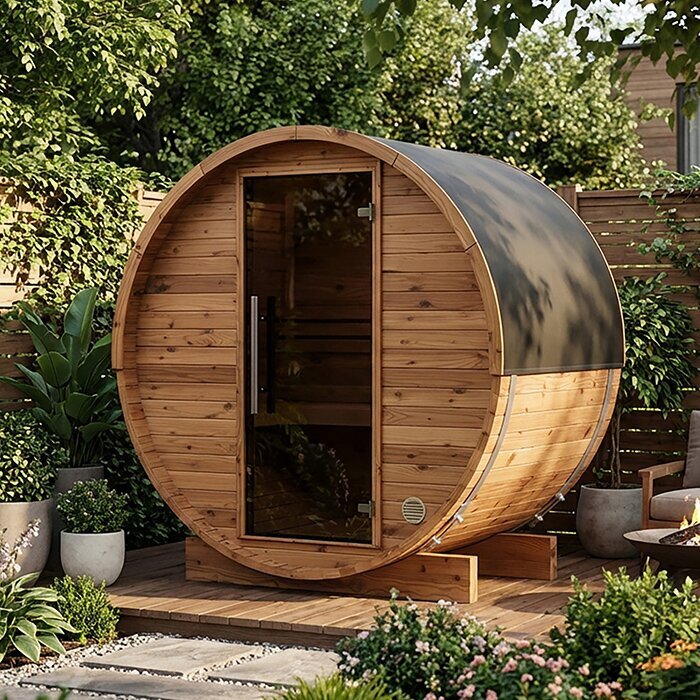
Show the intended sauna location
Mark the planned position on a simple site or floor plan and show its distance from the home’s electrical equipment as accurately as you can. Tell the electrician whether it is indoors, in a separate building or in an exposed part of the property; do not assume that an existing socket or a connection serving an outbuilding is suitable for a heater. The location and route can affect what needs to be assessed, including the practical route for a supply and access to the equipment. This is not a request for you to design that route. If you are considering more than one position, mark them separately and let the electrician decide what needs to be inspected for each.
If you are considering the Thermowood Barrel Sauna N-210, listed at 4.43 m², label your sketch with that model name rather than simply “barrel sauna”. Show which position the sketch represents, especially if you have discussed several possible locations with the supplier. Add notes about access and nearby structures where they help explain the site, supported by photographs taken from places you can reach safely. Keep questions about the electrical supply route separate from your preferred cabin position: the sketch explains your intentions, while the electrician assesses the practical implications. Share any revised position before relying on advice given for the original site.
Do not estimate electrical demand from floor area
Floor area helps you compare cabin sizes, but it is not an electrical rating. A larger-looking cabin does not let you calculate the heater requirement, and a compact model is not automatically compatible with a home’s supply. The heater has to be matched to the sauna under the manufacturer’s specifications; the home’s available capacity then has to be checked against that exact requirement. Product images, model suffixes and broad descriptions such as “small” or “large” cannot fill in missing technical information. Keep space planning and electrical assessment as two related but separate checks, and do not select a heater from an informal rule based only on area.
That distinction matters when comparing listings. The Thermowood Barrel Sauna N-250 is listed at 5.27 m², but its area alone cannot tell you which heater is specified or how the electrical supply must be assessed. Use the product listing to keep track of the cabin you mean; use the manufacturer’s heater documents for the electrical facts. If you compare candidates, ask for the exact proposed heater and requirements for each, then have the electrician assess each setup separately. Do not assume that a conclusion about one model transfers to another because the names or dimensions appear similar.
Include every specified electrical component
Build the brief around the intended setup, not only the heater in isolation. If the manufacturer specifies electrical requirements for a controller, lighting, ventilation equipment or another component in your proposed configuration, provide the relevant model information and instructions as well. Ask the supplier which items are included or selected and which have their own requirements; a photograph or broad package title may not resolve that. Do not assume that a controller draws from the heater or that an optional item needs no separate consideration. The aim is to let the electrician review the electrical demands of what you actually plan to install, not to ask them to choose sauna features.
For the Thermowood Barrel Sauna LC-260, listed at 5.12 m², organise the proposed equipment by component rather than treating the cabin listing as an equipment schedule. Record the heater, selected controls and any other electrical items, with the relevant document beside each entry. Mark anything the supplier has not yet confirmed so that an unknown item does not disappear from the assessment brief. This keeps the equipment list useful without assuming that optional accessories are included. It also separates a purchasing question—what the offer contains—from the electrician’s task of assessing the electrical requirements of the complete proposed setup.
Options when available capacity is insufficient
An assessment may find the proposed arrangement suitable, identify work or further information needed, or point towards a different heater or sauna configuration. Ask the electrician to explain which part of the proposal drives the result and what assumptions it depends on; do not treat a provisional comment as approval for a different model. If work to the home’s installation is proposed, ask for its scope and arrange a separate quotation where appropriate. If you are considering another heater instead, ask the sauna supplier to confirm that it is approved for the cabin and provide its electrical requirements. A lower stated rating on its own is not enough to confirm that a substitute is suitable.
If the Thermowood Barrel Sauna HCF-300, listed at 6.89 m², is your preferred cabin, distinguish between changes to the home’s installation and changes to the proposed sauna equipment. Ask which option the electrician’s assessment addresses and what remains unresolved for the other. For any alternative heater, obtain confirmation from the sauna supplier that it is suitable for the cabin before asking the electrician to assess its requirements. Keep quotations for electrical work separate from equipment quotations so you can see what each proposed option involves. This makes the comparison more useful than a general request for a sauna that uses less electricity.
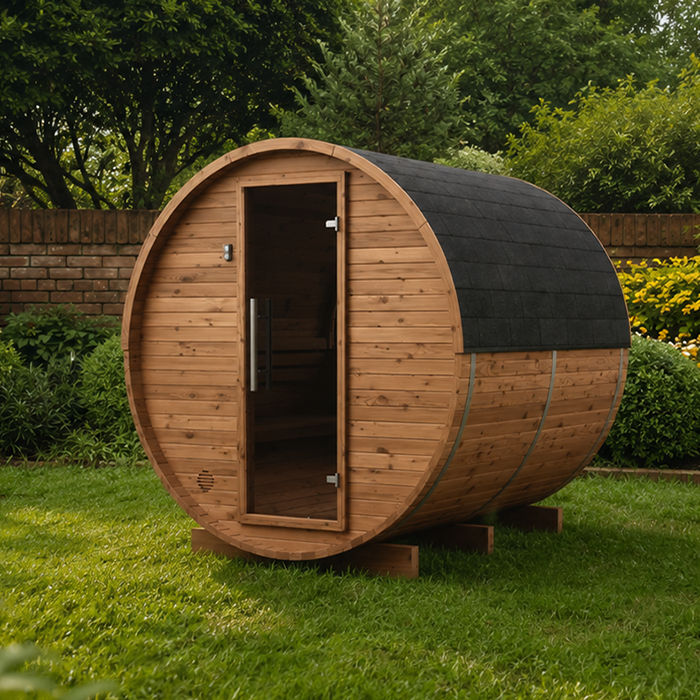
Ask for a clear, model-specific conclusion
Before the assessment, explain what you need to know: whether the named heater can be supported at the proposed location under the household’s expected use, and whether any conditions or further work have been identified. Ask for a written note or email recording the sauna and heater considered, the documents reviewed, assumptions about other loads, any unresolved information and the next step. If the conclusion is conditional, make sure the condition is recorded so it is not lost during ordering. If advice is given remotely, ask whether it is based on enough information or whether a visit is needed to assess the property properly.
A model-specific record is particularly useful where two listings show the same area. The Thermowood Barrel Sauna LCF-300 is listed at 6.89 m², just like the HCF-300, but equal areas do not establish equal heater requirements or electrical compatibility. The assessment should identify the selected cabin and heater by name, leaving no doubt about which combination it covers. Keep the electrician’s conclusion with the relevant quotation and manufacturer documents, rather than alongside several undifferentiated product enquiries. If there are outstanding questions, retain them with that record so a conditional conclusion is not later mistaken for an unconditional one.
Keep the paperwork aligned before ordering
A short comparison sheet can bring the decision together without attempting electrical calculations. For each candidate, record the exact sauna model, proposed heater, manufacturer document reference, listed floor area, planned location and any unresolved questions. Add the electrician’s assessment beside that entry, including any conditions or work still to be addressed. Before ordering, compare the chosen entry with the final quotation: the equipment being purchased should be the equipment that was assessed. Note which versions of the technical documents apply, and flag any substitution or accessory change rather than allowing it to pass unnoticed between the assessment and the order.
For the Thermowood Barrel Sauna S-140, listed at 1.93 m², the final comparison should distinguish confirmed choices from open questions. If the cabin is selected but no heater has been specified, record that clearly rather than treating the electrical assessment as complete. If the electrician has identified work or a condition to be met, keep it visible beside the chosen configuration. You can then see whether the proposal is ready to proceed or still depends on a decision, clarification or further assessment. The useful outcome is a clear record of what you intend to buy and what the electrical advice actually covers.
Frequently asked questions
Can my electricity bill show whether I have enough capacity?
Not by itself. A bill records energy used over a period; it does not establish how much electrical capacity is available when a sauna heater and other appliances are operating at the same time. A qualified electrician needs to assess the home’s actual supply against the heater’s requirements.
Does a smaller sauna necessarily need less electrical capacity?
No reliable conclusion follows from floor area alone. The electrical requirements depend on the exact heater and the configuration specified for the sauna. Get the manufacturer’s documents for the proposed equipment and have an electrician assess that particular setup.
Can I use an existing socket for a sauna heater?
Do not assume that a nearby socket or an existing circuit is suitable. The heater’s instructions and the home’s electrical supply both need to be assessed by a qualified electrician. Ask them to confirm the connection requirements for the exact heater and proposed location.
What should I give the electrician?
Provide the sauna’s exact model, the proposed heater model and its manufacturer’s manual or technical sheet. Add any documents for other electrical equipment in the planned setup, details of appliances that may run at the same time, and a plan or description of the proposed location. Share available installation records and note any planned changes to the home.
Should I order the sauna before getting an electrical assessment?
You can compare models and make a shortlist first, but avoid treating a general estimate as approval for a particular setup. Before finalising a choice, confirm the exact heater requirements and ask an electrician to assess them against the home’s supply, household use and intended location. Recheck if any of those details change.
A sound choice brings four things into line: the exact sauna model, its specified heater, the home’s actual supply and the planned location. Treat a shortlist as provisional until the electrician has assessed that combination alongside the household’s other electrical use. If the assessment leads to a different heater, site or model, update the documents and have the revised proposal checked. That gives you a decision based on the requirements of the setup you intend to buy, rather than an estimate drawn from its shape or area.
