
Viewing a Sauna: What to Try, Measure and Ask
Sauna buying guide
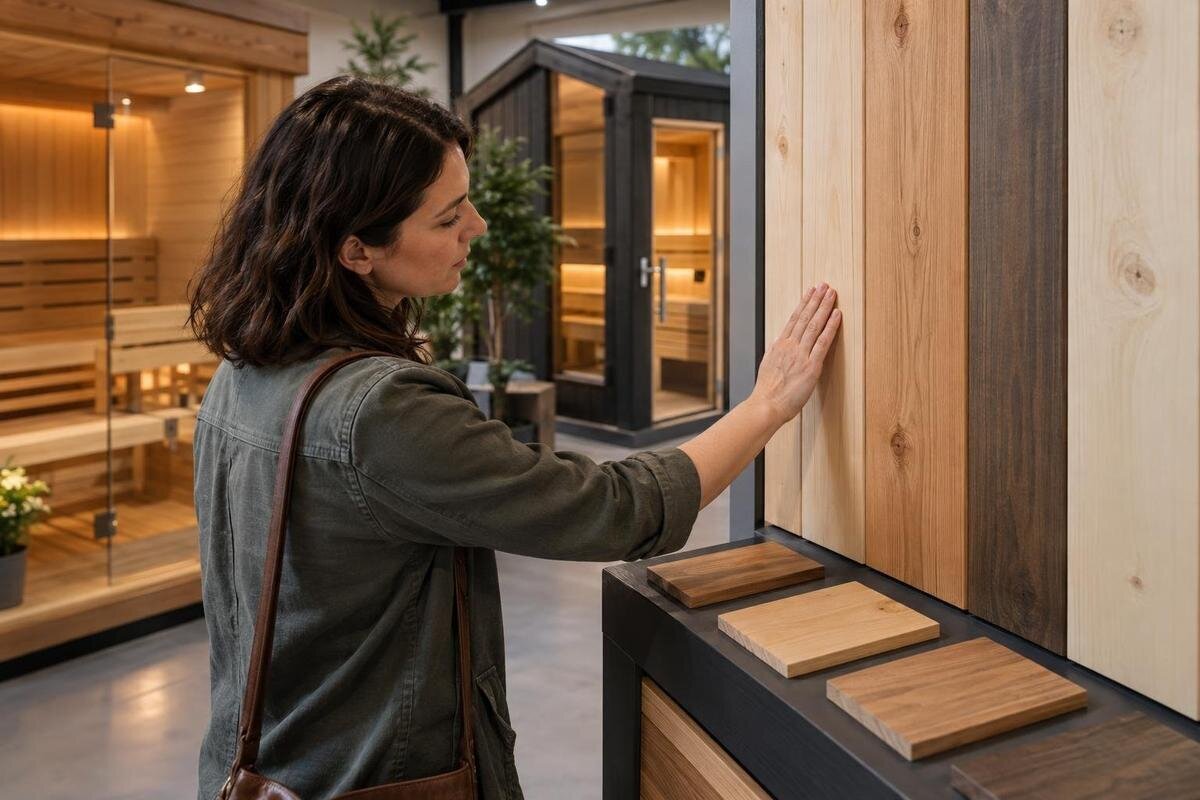
An in-person look is most useful when it answers questions a photograph cannot: can the people who will use the sauna get in and sit comfortably, will the layout fit the intended site, and do the documents describe the exact model on display? Use the visit to assess the unheated layout, note relevant measurements and inspect visible finishes. Follow up with matching drawings, inclusions and care guidance. A seller may not have a display available, so confirm what can actually be viewed rather than assuming a showroom exists.
01
Confirm which model you can view
If you have arranged to see a sauna, confirm beforehand whether there is an actual display unit you can enter, rather than only a material sample or photographs. Ask for its model code and configuration, which options are fitted, and whether you may open the door and sit inside. Displays can differ from the model being quoted or omit items supplied separately, so the visit shows what is physically present, not what your order will contain. Bring the model name and any written quote or product-page printout. Ask whether you may take measurements and photographs, and whether staff can identify the unit from a label or accompanying paperwork. If a display is unavailable, request a current drawing or another way to see the relevant details.
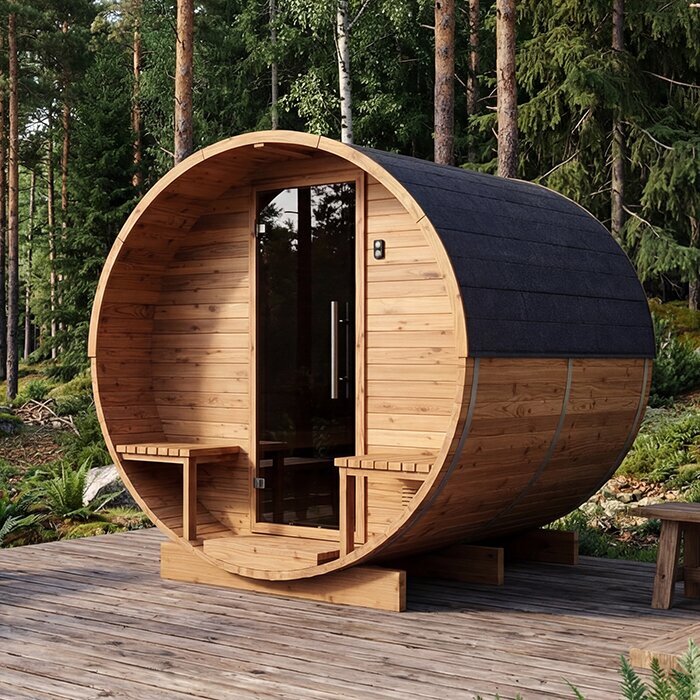
Record the exact code, not just a description such as barrel sauna: the catalogue has a separate Sauna HCF-300 product page. That listing identifies one model; it does not show that the model is available to view or establish the layout of another unit. Note who confirmed the display details, then write down your priorities: who will use the seats, what entry arrangements matter, which dimensions affect the site and what remains uncertain. Ask whether differences between the display and your quote, such as a changed option or finish, will appear on the written specification. This makes it easier to compare what you saw with what you might order.
Try the seating in your usual posture
Use the display only when the seller permits it; it does not need to be heated for this assessment. Sit on each bench you expect to use, in your normal posture, and notice whether your feet rest comfortably, your knees have room, your head clears the ceiling and your back settles against a backrest, if fitted. Try shifting position and getting up without leaning awkwardly on a heater or the door. Use the posture you actually prefer: an upright position makes head and knee clearance easy to notice, while a supported position draws attention to backrest shape and foot placement. Ask before touching fittings or stepping onto a bench, and follow the seller’s instructions about what is available to try.
Have each regular user try the layout if possible; body height and preferred posture differ, and a bench that looks long does not automatically provide comfortable places for several people. Check whether the intended seated positions work at once, where each person can place their feet, and whether one person must move for another to enter or leave. Ask which spaces are intended as seating rather than inferring capacity from bench length. Record seat height, depth and clear length from the manufacturer’s drawing instead of estimating by eye. If comparing the Sauna LCF-300 listing, request that model’s own interior plan; do not borrow measurements from a similar-looking display. A brief sit checks personal fit, but does not establish comfort during a heated session or the manufacturer’s stated capacity.
02
Check the entrance and the way the door moves
Approach the entrance as you would at home, not just from a clear aisle around the display. Check the threshold, opening width, handle position and how far the door moves. Ask permission to open and close it, then try the latch gently from both sides. Notice whether a bench edge or fitting constrains movement, whether the doorway feels awkward to cross, and whether there is room outside to stand while another person exits. Consider whether the handle is easy to reach after you sit down and whether users can get in without stepping around an obstacle. Stay clear of the heater, and do not test a hot display.
Distinguish the door leaf width from the clear opening available when the door is open, and ask for the latter in the drawing. Confirm the threshold height, which way the door opens, and whether the displayed hinge and handle arrangement is part of the quoted configuration. At home, mark the full door movement and the space needed to approach it, including any nearby wall, fence, path or furniture. If you are considering the Sauna S-140, use its drawing to compare the entrance details with those you tried. If the route is narrow or access needs adapting, ask the seller or installer to confirm the required opening and handling space before you plan around it.
Check internal and external dimensions
Do not rely on the overall appearance or footprint to decide whether the interior will work. Ask for outside dimensions and clear internal dimensions separately, with the drawing’s orientation and measurement points explained. Check the usable floor area, bench length and depth, space between levels, and clearance around a seated position. With a curved wall, the widest internal span does not tell you how much room is available at bench height. Ask where each measurement begins and ends, and whether it includes projections, door hardware or trim. If you are permitted to measure the display, label your figures as measured rather than manufacturer-verified, then compare them with the drawing for the exact configuration.
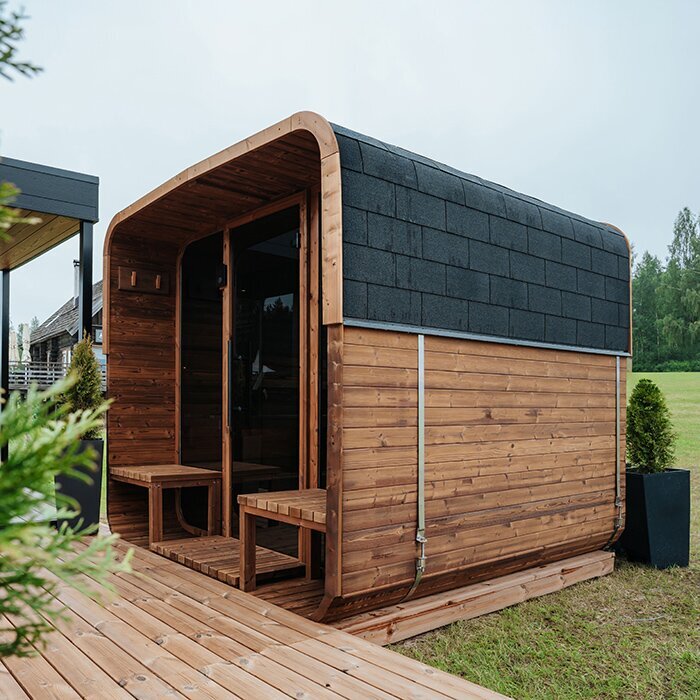
Take the dimensions that matter back to the intended site: full external length, width and height; positions of the door and windows; and room to approach and maintain the sauna as its instructions require. A square-metre figure on a listing is not a substitute for a dimensioned plan or proof of usable interior area. For the Sauna HC-150, request a drawing that matches the quoted configuration before assessing fit. Note any differences in the base, supports or options between the display and the quoted build. If space is tight, get the manufacturer’s dimensions confirmed in writing rather than scaling them from a screen image.
03
Inspect the surfaces and ask about their finish
Inspect the display close up, but separate its appearance from evidence about how every unit will perform over time. Look along accessible bench edges, corners, joins, the door frame and visible fixings for rough areas, gaps, loose parts or signs of impact. View surfaces from different angles and in good light, and ask if a detail you cannot see clearly is covered by a panel or trim. Do not dismantle anything, press on loose-looking parts or handle a surface that may be warm. If a door rubs or a bench feels uneven, point it out and ask whether it is wear, an adjustment or a feature of that sample. Record the observation rather than treating one mark as a general conclusion about the product.
Ask which timber and finish are used on the interior benches, backrests, wall surfaces, exterior and trim, and whether those surfaces are treated. Thermowood in a product-family name does not identify every part or explain how it should be cleaned; the Sauna HC-225 listing is a model reference, not a material schedule. Request written details for surfaces that touch skin, any coatings or preservatives, and the manufacturer’s cleaning and re-treatment guidance. Do not rely on colour or grain to identify a wood species. Confirm that the finish you saw matches the one quoted, and ask how ordinary variation is distinguished from damage when the delivered unit is inspected.
Ask about windows, lighting and ventilation
Notice what the windows and lights let you see from inside and outside. Consider glare, privacy and whether their positions would suit the planned setting at different times of day. A display may have its lights on or a particular view through the glazing, but neither establishes what your site will look like. Ask which window and lighting components are included in the quoted configuration and which, if any, are optional. Have staff demonstrate controls only if they are authorised to do so; do not open covers, handle wiring or operate an unfamiliar heater. Write down questions about visibility, controls or glare for follow-up instead of trying to diagnose equipment during a viewing.
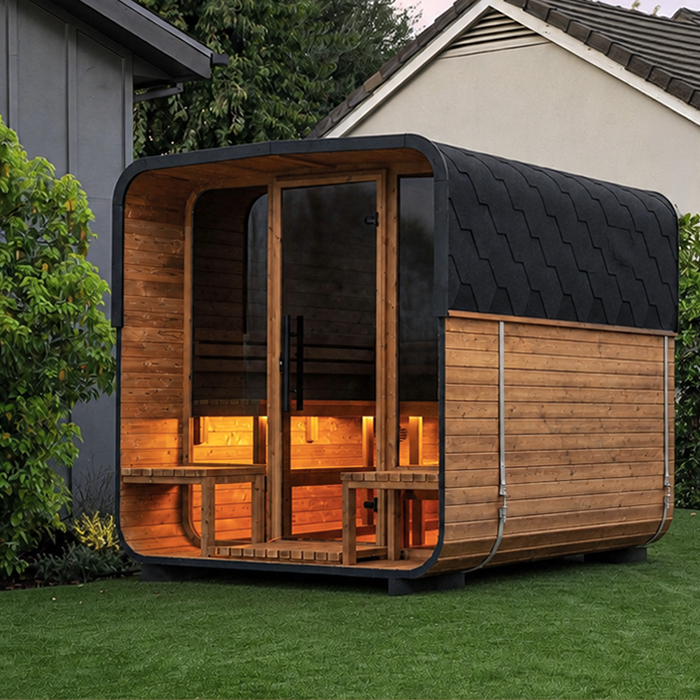
Ask where ventilation openings are shown on the manufacturer’s drawing and how the current manual describes the arrangement for the selected model. If the Sauna N-210 is on your shortlist, request the drawing and manual for the specified options rather than copying the display’s ventilation layout. A visible grille alone does not establish performance. Have a qualified sauna installer or electrician confirm installation requirements, including electrical compatibility, from current manufacturer instructions. A showroom observation cannot replace those checks, and the visit is not a test of operating temperature or ventilation effectiveness.
04
Confirm what is included in the quoted configuration
Use the display to make an item-by-item list, not to guess what a package includes. Ask which components are physically on this unit, which are in the exact quote and which would be optional or supplied separately. Depending on configuration, points to confirm may include the heater, controls, protective fittings, lighting, glazing, benches, floor or base components, roof covering and accessories; do not assume any are standard or absent. Ask the seller to identify the make and model of each important included component and provide its documentation. Note any substitutions. If a part has no label or paperwork, mark it as unconfirmed rather than treating a demonstration as a specification.
Ask for a written schedule tied to the sauna model, configuration and component codes, then compare it with the display and quotation line by line. If you are considering the Sauna N-250, check that its model code appears consistently on the drawing, quotation and options schedule. Clarify who supplies, installs and commissions each item, and which questions belong to the heater manufacturer or installer. Have a qualified professional verify that the proposed heater and electrical arrangement suit the selected cabin and site. This keeps the viewing focused on identity and inclusions rather than informal assurances about performance.
Check the site and delivery route
Walk the delivery route and intended position with a tape measure and sketch if you can do so safely. Note gates, steps, corners, narrow passages, overhead obstructions, changes of level and the space needed to turn or handle the largest component. Ask whether the sauna arrives assembled or in parts and what dimensions or lifting access the delivery and installation team will need; do not assume the product footprint equals the transport size. For the Sauna LC-260, use the matching drawing when discussing delivery access, and ask which transport measurements must be checked separately. Have the seller confirm handling and access requirements before relying on a route that looks clear.
At the site, mark the proposed external outline and the space needed to open the door, move around the unit and maintain it, following the installation instructions rather than choosing an arbitrary clearance. Ask a qualified installer or other relevant professional to assess the surface and surrounding conditions for the actual location. Support, drainage, weather exposure and nearby services may all need to be considered, but a showroom conversation is not a substitute for that assessment. Do not calculate structural capacity or decide electrical or fire separation from the display. If the location raises questions, ask the appropriate local professional or authority what must be verified before you commit.
05
Request drawings, manuals and care guidance
Ask for the current dimensioned drawing and installation manual for the exact model and option set, not just a general brochure. The drawing should make clear which figures are external and which are internal, as well as the door position and clear opening, bench arrangement and footprint of fitted features. Ask for its revision or date and whether it matches the configuration being quoted. Request the parts or inclusions schedule too, with model codes for components where applicable. If you measured a display, put your figures beside the manufacturer’s and ask about any difference; do not resolve conflicting measurements by choosing the smaller one. A written clarification prevents you from relying on display measurements that may not apply to your order.
Request the operating instructions and care guidance before buying. Look for clear directions on routine cleaning, drying, inspection and maintenance for each relevant surface, along with products or treatments the manufacturer permits or rules out. Ask how the cabin should be prepared and operated, who may install and commission the heater, and where questions about electrical or other specialist work should go. Request the applicable purchase and installation terms in writing, including what support is offered and what is excluded; do not infer terms from a display sign. Keep these documents with the quote so you can later check that the model and stated components match what you agreed.
Compare your observations with the written details
Make a separate record for each unit or configuration: model code, date, displayed options, seat positions tried, door movement, measurements and anything you could not test. Mark each note as observed on the display, stated by the seller or confirmed in a manufacturer document. That distinction matters: sitting on a bench tells you how it fits in that moment, while a statement about included materials or installation needs written confirmation. If photographs are allowed, take wide and close views to explain your notes, not to replace dimensioned drawings. Ask permission before photographing staff, other customers or private areas. Write down unanswered questions while the details are fresh.
Compare models against the same requirements, not only the overall impression of one display. Give each regular user’s seating fit, entry, measured clearances, site access, documented finish, confirmed inclusions and care requirements their own place in your notes. Decide which facts are essential and which are preferences, then request missing information in writing, tied to the model code and configuration. Ask for a current quotation that states what is supplied and what installation work is included, and confirm local availability separately; seeing a unit confirms neither. If two options remain close, compare their matching drawings side by side and resolve practical questions that could change fit or setup before placing an order.
Frequently asked questions
Can I make a useful assessment if there is no sauna to enter?
Yes, but mark what you could not test. You can still inspect a material sample or exterior and discuss the model. Ask for the matching dimensioned drawing and current instructions, and do not treat photographs as evidence of seating comfort or access.
Which measurements matter most at a viewing?
Compare the clear interior dimensions and bench layout with the exterior dimensions, door opening and threshold. For your site, note the full footprint, height, door movement and route for delivery. Use the drawing for the exact configuration to confirm measured figures.
Should I test the heater during the visit?
You can assess seating and entry on an unheated display; a heated test is not needed for this checklist. Ask staff to demonstrate controls only if they are authorised to do so. Confirm operating and installation details from the current manual and a qualified professional.
How can I tell whether the display matches the model in the quote?
Write down the display’s exact model code and configuration, then compare these with the quote, drawing and inclusions schedule. Ask the seller to confirm any differences in writing. A similar appearance or product-family name does not confirm an identical layout or set of components.
Which documents should I request before deciding?
Ask for a current dimensioned drawing, installation and operating instructions, a schedule of included components and options, and care guidance for the relevant surfaces. Keep these with the written quotation, which should identify the exact model and configuration being discussed.
A good viewing leaves you with fewer assumptions, even if it does not settle every technical question. You know how the entry and seating feel, which measurements need checking and which details remain unconfirmed. Keep the model code, drawings, options schedule and site notes together. If the display and paperwork disagree, pause the comparison until the seller confirms the exact configuration in writing. That gives you a sound basis for choosing between models without relying on a first impression.
