
What Should You Verify in a Sauna Warranty Before Buying?
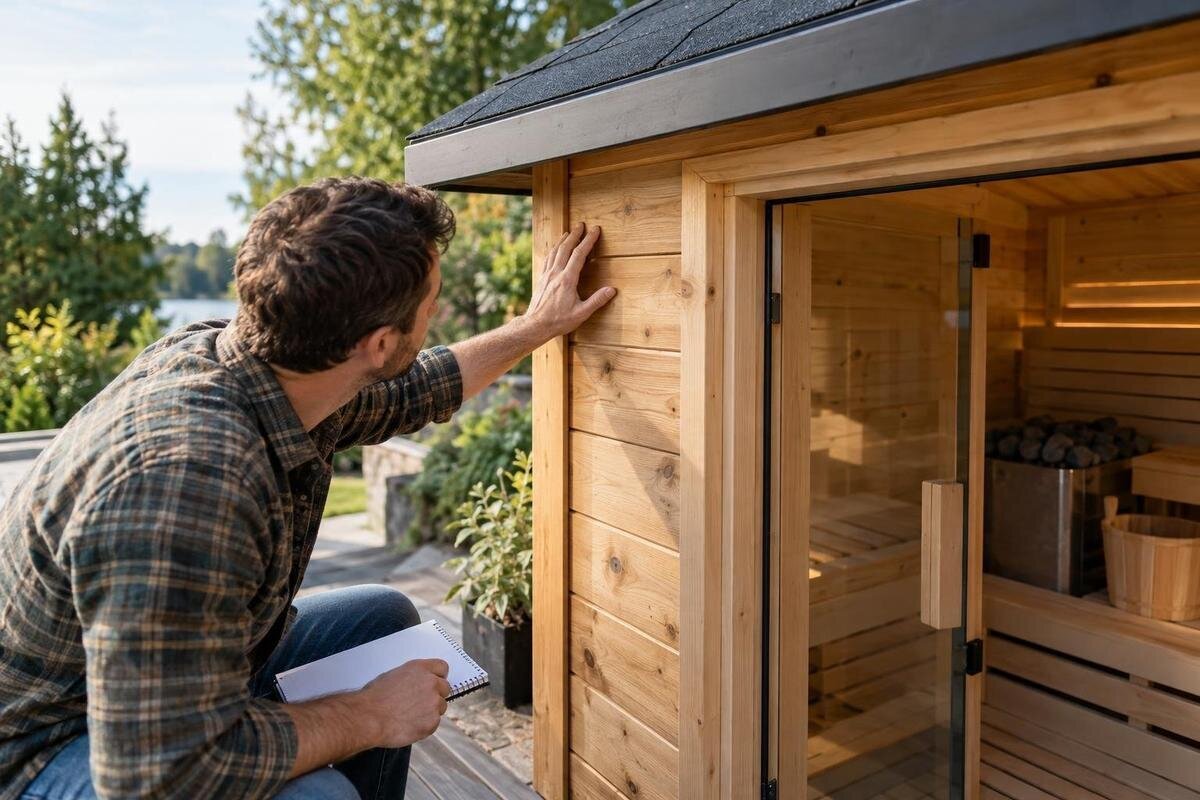
Sauna warranty guide
A warranty headline can sound reassuring while the useful details are spread across a cabin document, heater manual, installation terms and sales conditions. The practical questions are which item is covered, by whom, under what conditions and how a fault must be reported. Ask for the documents that apply to the model and options on your quotation before paying. This guide is a checklist, not a statement of current store warranty terms: no coverage period or remedy is assumed here. Use it to review the current written documents for the exact order.
01
Get the current warranty for the exact configuration
Ask for the full, current warranty wording before placing an order, rather than relying on a product-page headline or an oral summary. Match the document to the quotation by checking the product name and model, the party giving the warranty, its date or version, and any selected heater, controls or other options. For an order specifying the Thermowood Barrel Sauna HC-150, ask the seller to confirm that the terms apply to that model, its quoted configuration and the planned location. Check whether separate terms accompany any part of the purchase. If the document describes a model family rather than individual models, get written confirmation that your exact variant is included.
Ask the seller to identify every relevant document. There may be one warranty for the whole order, separate terms for the cabin and heater, or additional conditions for installation or accessories; do not assume which arrangement applies. Find out which document governs if two use different definitions or claim routes, and whether any manual is referred to as part of the terms. Save the dated files and written answers with the quotation. If a summary uses phrases such as ‘full cover’ or gives one period for the whole sauna, ask for the clause that explains what it includes. You should be able to name each covered item, its warrantor, its period and its claim contact without guessing.
Check the cabin and heater separately
Keep the cabin and heater as separate entries in your comparison until the written terms say otherwise. Ask for a component schedule naming the cabin and each supplied part, such as benches, a door, glazing, roof elements or fitted accessories where these form part of the order. Find out which document and period apply to each item, and identify optional equipment separately. When reviewing a quotation for the HC-225 Thermowood Barrel Sauna, use that schedule to distinguish the cabin from any separately specified equipment. The actual quotation, rather than an example of what a sauna might include, should define the items you are checking.
For the heater, record the manufacturer and exact model shown on the quotation, along with any controls or sensors supplied with it. Ask whether its terms come from the same party as the cabin warranty, which components and faults they describe, and whether a heater issue should be reported to the seller or directly to the manufacturer. Check whether the heater manual contains care or operating conditions referred to by the warranty. Do not assume that a whole-sauna warranty automatically includes every fitted electrical part, or that heater terms cover the timber cabin. If the documents describe overlapping cover, ask which party coordinates a claim and what happens if responsibility is disputed.
02
Confirm when cover starts and what deadlines apply
A stated duration is meaningful only when its start point and covered item are clear. Ask whether the period for each component starts when you place the order, on delivery, at installation or commissioning, or at another named event, and how that date is recorded. Check whether different parts have separate periods and whether registration or a particular document is needed. If you are comparing a quotation for the Thermowood Barrel Sauna N-210, record the applicable start-date rule beside each quoted component. Use the current terms rather than calculating dates from a general brochure or assuming that all cover begins on delivery.
Distinguish the warranty period from any deadline for reporting a fault. Ask whether a problem must be notified within a stated time after discovery, what proof establishes the delivery or installation date, and whether there is a particular process for raising a claim near the end of a period. If a repair or replacement is made, check how the terms treat that part afterwards: the original period may continue, or the document may set out another rule. Do not infer the answer from the headline number of years. Record the start date, any notification deadline and any registration step in one place so they can be checked if an issue arises.
Clarify installation conditions and responsibility
Establish who is responsible for assembling and installing the sauna, and what the warranty requires of that work. Ask whether self-assembly is permitted, whether an installer must meet a stated requirement, and whether the seller or manufacturer needs to approve the arrangement in advance. Keep installation scope distinct from the cabin warranty: preparation of the base, positioning and service connections may be covered by a separate agreement. If the quotation names the N-250 Thermowood Barrel Sauna, make sure the documents and installation scope match that exact order rather than a similar model or a generic drawing. Also ask who is responsible for confirming that the site is ready before the work begins.
Find out what evidence shows that the installation conditions were met. The terms might refer to an installer’s record, commissioning paperwork or another document, so ask which records you should retain rather than assuming. For electrical work, consult the sauna and heater instructions and have the work assessed or completed by a suitably qualified professional; this guide does not provide wiring instructions. For warranty purposes, ask who handles a fault that could relate either to a product defect or to installation workmanship, who arranges an inspection and who pays if the cause is disputed or the issue is not accepted as covered. Get the contact and approval route in writing before work starts.
03
Check exclusions for your site and intended use
Read the exclusions with the planned site and use in mind. Ask how the document defines damage linked to weather or water exposure, the surrounding environment, an unsuitable base or site, accidents, or events outside normal use. A broad phrase such as ‘environmental damage’ may leave important questions unanswered, so ask what it means for the proposed position and what evidence would be considered. When discussing the LC-260 Thermowood Barrel Sauna, describe the intended location so the seller can address any relevant site conditions in the terms. Have specific location limitations confirmed in writing before you buy, and keep that answer with the order documents.
Check for exclusions relating to household versus commercial or rental use, relocation, unauthorised alterations, third-party repairs, misuse and normal wear. For a timber product, ask how the terms distinguish a defect from changes in appearance or movement over time; do not assume that every change in colour, surface or fit is either covered or excluded. Ask for the exact wording on maintenance-related exclusions and whether a missed care task must be shown to have caused a fault. Avoid relying on an exclusions list copied from another model or market. The answer that matters is in the current terms for the configuration you are buying and the use you intend to make of it.
Match care requirements to the supplied manuals
Use the care instructions as part of the warranty check. Request the manual for the exact cabin and heater, confirm its version, and identify each task the warranty makes a condition of cover. Ask which products or methods are allowed for cleaning or treatment, which parts need inspection and how often any stated task must be done. Follow the supplied instructions rather than generic online advice. If you are considering the Thermowood Barrel Sauna HCF-300, put its model name beside the matching manual and warranty on your comparison sheet; do not borrow care requirements from a different sauna model or assume they are identical.
Find out what records may be expected if care is later questioned. A dated checklist or service receipt could help explain what was done, but do not assume a particular record is mandatory unless the terms say so. Ask whether routine upkeep is recommended or a condition of cover, what happens if care was handled by a previous owner or installer, and whether third-party treatment or repair needs approval. Separate ordinary maintenance from work intended to correct a fault. Before altering or dismantling a component, check the claim process: doing so without the required approval could make it harder to establish what happened or whether the warranty conditions were followed.
04
Understand how to report a fault
Ask for the claim route in practical steps: whom to contact first, whether notice must be sent through a portal, by email or in another specified way, and what information to provide. Confirm whether the seller coordinates with the manufacturer or directs you to it, and whether the cabin and heater use different contacts. For an order specifying the LCF-300 Thermowood Barrel Sauna, check which order number, serial number or other product identifier the claim contact will need and where to find it. Ask how receipt of a claim is acknowledged and what to do if you are unsure which component is affected.
Check what may happen after you report an issue: remote questions, photographs, an inspection, an authorised technician or return of a component. Ask whether you should wait for written approval before arranging a repair or disposing of a replaced part, and who pays for inspection, collection or shipping if the issue is not accepted as covered. Do not assume diagnosis, labour or travel is included simply because repair is listed as a remedy. If a fault makes safe operation uncertain, stop using the affected equipment and contact the supplier or an appropriate professional; do not attempt electrical repair yourself. Find out whether the terms give a separate route for urgent issues.
Compare remedies and possible costs
Compare what the warranty promises, not only how long it lasts. Ask whether the stated remedy is repair, replacement of a component, replacement of the cabin or another outcome defined in the terms. Find out who decides, whether an inspection is required and how the document deals with unavailable parts or a recurring fault. If repair or replacement is offered, ask whether it concerns the failed part alone or includes the work needed to remove and refit it. The wording should make clear what the warrantor will do if a claim is accepted; do not infer a refund, replacement unit or any other remedy that is not stated.
List costs that may sit outside the promise: diagnosis, technician time, travel, lifting or dismantling, return freight, reinstallation and any other charge identified in writing. Ask who bears each cost if a claim is accepted, partly accepted or rejected, and whether a visit is chargeable when no defect is found. If the quotation names the Sauna S-140, use that exact product reference when comparing its documents and any selected options. A simple table of component, duration, start point, remedy, exclusions and possible charges makes offers easier to compare. It also shows whether a longer stated period comes with conditions or expenses that matter to you.
05
Keep purchase, installation and care records
Set up a file before delivery, because warranty questions are easier to resolve when the product and timeline are clear. Keep the quotation and invoice, order confirmation, current warranty documents, manuals, model and serial identifiers, delivery record, and any installation or commissioning paperwork. Photograph the delivered items and any visible condition concerns before assembly or first use, then follow the supplier’s process for reporting a delivery issue. Ask which details identify the cabin and heater separately and whether serial labels should remain accessible. Do not rely on a webpage that may later change as your only record of the terms supplied for the purchase.
Keep a dated record of maintenance, service visits, fault symptoms and conversations about a claim. Note when the problem first appeared, what changed beforehand and what the supplier asked you to do; stick to observable facts rather than guessing at the cause. If ownership may change or you might move the sauna, ask whether the warranty transfers, whether notice or permission is required and whether relocation affects the terms. Do not assume that an answer given to the original buyer automatically applies to a new owner or a different address. Obtain the relevant answer before resale or relocation, and retain it with the original documents.
Put unanswered questions in writing before buying
Before paying, ask the seller to answer the key points against the actual quotation: which current documents apply; who warrants the cabin, heater and any installation; when each period starts; which site, use and care conditions apply; what is excluded; and who receives a claim. Then ask what remedy is promised and which labour, travel, removal or freight costs may remain yours. If an answer refers to a separate manual, policy or installer document, request the document itself and its relevant version, not just a verbal summary. This makes it easier to see whether you have a complete set of terms or are still waiting for an important part.
Review the answers beside the product quote. The model name, selected heater and other options should match, and each open question should point to a clause or a clearly stated condition. If a point cannot be confirmed before purchase, treat it as unknown rather than reading certainty into a general phrase. Compare offers only when you have the same information for the cabin, heater, installation and claim route. If you cannot explain who handles a fault, what evidence is needed and which costs could remain yours, the warranty is not yet clear enough to compare fairly. Resolve those gaps before deciding which written terms suit your purchase.
Frequently asked questions
Is a longer warranty always better?
Not necessarily. Compare what is covered, when each period starts, the available remedy, the conditions you must meet and any costs that remain yours. A longer period may still leave an important component or installation issue outside the written terms.
Does the cabin warranty include the heater?
Do not assume that it does. Check whether the heater, its controls and any other supplied equipment are named in the cabin document or covered by separate terms. Ask who handles a heater claim and which manual applies.
Can I assemble the sauna myself?
The answer depends on the current terms for the exact order. Before assembly, ask whether self-assembly is permitted, whether any installer requirements apply and what records the warranty requires. Get the answer in writing rather than relying on a general statement.
What should I keep in case I need to make a claim?
Keep the quotation, invoice, warranty documents, manuals, model and serial identifiers, and any installation or commissioning records. A dated record of care, fault symptoms, photographs and communications can also help explain what happened.
Can I rely on a product page or verbal assurance?
Use a product page to identify the model, not to infer its warranty. Ask for the current written terms that apply to the quoted configuration, and have any important verbal assurance confirmed in writing with a reference to the relevant document or clause.
A useful warranty is one you can map to the exact cabin and heater, understand before installation and follow if a fault arises. Keep the current documents with your quotation, clarify gaps in writing, and compare the remedy, costs and conditions as well as the stated period. If a part of the setup is not named, treat it as an open question rather than assuming it shares the cabin’s cover.
