
Buying a Small Greenhouse on Black Friday: Choose a Size You Won't Outgrow
Black Friday greenhouse buying guide
Shopping for a small greenhouse on Black Friday can feel like a quick decision when listings are easy to compare, but the right size depends on more than the space occupied by today's pots. A greenhouse that suits a few trays now may feel crowded when seedlings mature, seasonal crops overlap or you add a bench. Plan your growing layout and measure the site first; then compare each listing against those requirements. This keeps the decision centred on capacity you can use, rather than on a photograph or a seasonal label.

Before you buy 1
Define what the greenhouse must hold
Write down what the greenhouse is for before looking at dimensions. Separate the plants you intend to grow from activities that take up room: starting seedlings, potting, holding pots between seasons or keeping hand tools nearby. Note how many trays or containers you expect to have at one time, not the total number you might use across a year. A single bench can serve several crops in succession, while overlapping batches may need space together. This inventory turns “small” into a practical brief: a particular set of plants and tasks you want to fit. Add whether you expect to work inside or mainly tend plants from the entrance; that choice changes how much clear floor space your plan needs.
Sort that list into essentials and credible additions. Essentials are plants or tasks you already know you want; additions are specific interests you are likely to pursue, such as raising another batch of seedlings or keeping a few more pots under cover. Mark vague possibilities as optional. A greenhouse should leave some breathing room for a real change of plan, but reserving space for every imagined future hobby can push you towards a footprint that dominates the site. Keep the brief short enough to compare against each listing, and decide which addition would matter most if you had to prioritise.
Plan for plants at mature size
Plant size changes the answer. Seedlings and small pots occupy little room at the beginning, then need more floor, bench or support space as they grow. Check mature spread and spacing guidance from the seed packet or a reliable growing reference; do not calculate capacity from the number of pots currently on a windowsill. Group plants by the space they need at the same time and sketch their positions. Separate floor area from shelf area: a bench can hold trays if that is part of your plan, but it cannot also count as clear floor for a large pot. Leave access to plants you tend often, rather than drawing a tight grid you cannot reach.
Make a simple capacity table with a row for each group—seed trays, larger pots or climbing plants if they are part of your plans—and note where each will sit. The purpose is not to claim an exact crop count, but to expose clashes: a tray area that disappears when larger pots arrive, or plants that need the same bench at once. If a product is on your shortlist, record any dimensions actually stated on its page; the Prestige greenhouse listing can be added to that comparison sheet. Use figures provided in the listing, not the product name, as a measure.
Before you buy 2
Measure the site and access route
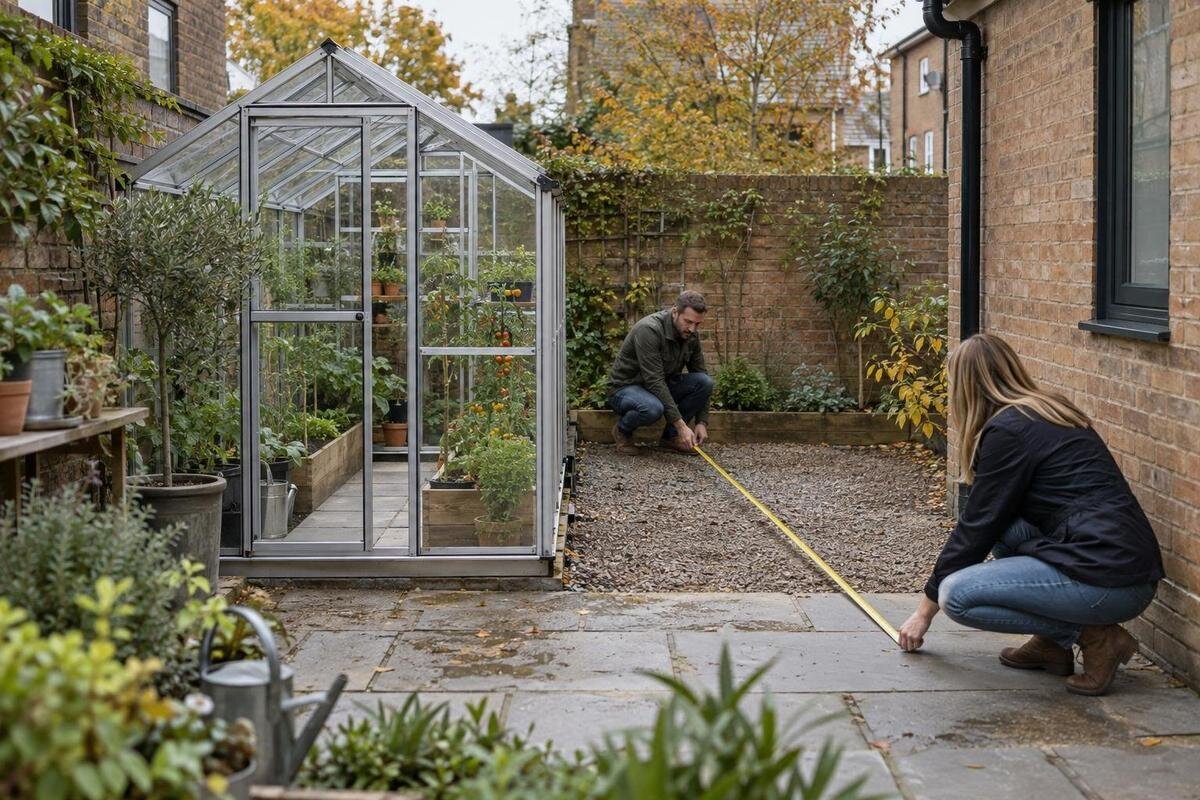
Measure the intended site as a rectangle, or break an irregular outline into smaller parts. Note the usable length and width, then mark fixed obstacles such as a boundary, paving edge, drain, tap, steps, tree or a path that must stay clear. The garden's overall dimensions are not the area available for a greenhouse: the route in, the space to carry pots and room to approach the entrance count too. Measure at the narrowest point and write down any sections that cannot be covered. This stops a generous-looking corner on paper from hiding a real bottleneck.
Add the space needed to reach and use the entrance. If the listed design has a door that opens outwards, allow for its swing; if it uses another arrangement, plan according to the product information. Consider whether you can stand outside with a tray, open the entrance and turn without moving plants each time. Draw candidate footprints at the same scale on your site sketch instead of comparing a product image with the garden by eye. You can add the Orangerie product page as one line in this exercise, but use only the dimensions and layout details explicitly provided for it.
Allow space for beds, benches and movement
External size does not tell you how much interior area can be devoted to plants. A walkway, shelves, benches, larger containers and a place for a watering can or potting tray all compete for room. Decide which items must stay in the greenhouse and which can be stored elsewhere. Draw the route you will use to reach plants and carry a tray through; an aisle is useful space when it allows regular work, not empty area to be filled at any cost. If a bench would block access to a bed or pot, choose a smaller bench or a different layout before adding more plants.
Make a simple floor plan on squared paper: outline the internal layout if the listing provides one, then add the depth of your bench, pot widths and the aisle you intend to use. Check how many plants remain reachable and whether you can move a tray without shifting another group. Repeat the drawing for each candidate instead of relying on the most compact-looking product photograph. You can compare the Classic Plus 385 product page in the same way; the model name and image are not substitutes for stated dimensions or a measured layout.
Before you buy 3
Make future capacity specific
Future capacity is most useful when it answers a likely change. Ask what you may add over the next few seasons: more seed trays in spring, a second batch of a crop, containers to keep under cover at a particular time, or a work surface. Choose one or two probable changes and add them to the drawing. If they fit only by removing something essential or blocking the route, the size may not give the flexibility you want. If they fit comfortably, further expansion may be unnecessary. A named possibility is easier to plan for than a general wish to grow more.
Test two versions of the layout: what you will grow now and a realistic fuller version. In the fuller plan, keep the same access space and show where added plants go; do not count the entire remaining floor as spare capacity if it must stay open for movement or work. A greenhouse's shape can influence how you arrange plants, but a name does not establish the usable area. For example, include the T Model greenhouse listing only after checking the dimensions and layout details shown, then test it against both drawings. This makes the comparison about your plan rather than assumptions from a title.
Match the greenhouse footprint to the site
Separate the greenhouse footprint from the full area needed to bring it into position and use it. Measure from the actual proposed edges, not from a point inside a path or against a wall; include any route that needs to remain clear and the space required at the entrance. Check nearby levels, doors, fixed structures and access points that could affect where you plan to put it. If the spot has an irregular outline, record each side rather than rounding the available area up to a convenient rectangle. Measure on the ground itself, not from memory or a garden plan that may be out of date.
Compare your drawing with the exact outside dimensions stated on the product page, including height if it matters to the chosen position. Check what the listing says about its base, supporting surface and installation requirements; do not infer these from a name or photograph. Where the ground, a wall or another structural feature raises questions about suitability or preparation, ask the retailer or a suitably qualified professional before ordering. The Pyramid greenhouse listing is another option to measure against the site plan; its title alone cannot confirm a fit for your particular position.
Before you buy 4
Compare dimensions on the same basis
Compare dimensions on a like-for-like basis. A quoted outside width and length describe the footprint; internal measurements, if supplied, show more closely what can fit, while height affects whether the intended plants and working arrangement make sense. Check what each figure measures because listings may present dimensions in different ways. A usable-area figure and an overall external measurement answer different questions. If a number is missing or unclear, ask for clarification before placing an order rather than deriving it from a model number, photo or product category. Do not assume products with similar titles share dimensions.
Put the details in a table: stated external width and length, internal dimensions where available, height, entrance arrangement and any stated base requirements. Add a note beside each point still needing confirmation. This keeps the comparison about usable fit, not a single headline dimension. The Aluminium Classic greenhouse listing can be logged alongside the others using the same columns; do not infer capacity, construction details or performance beyond what its product information states. When a page lacks a figure that matters to your plan, pause the comparison until you can obtain that measurement.
Black Friday checks for greenhouse size
Black Friday can make it tempting to decide quickly, especially when several greenhouse pages are open at once. Set your non-negotiables before comparing: the minimum plant groups to fit, a usable route, a footprint that fits the marked site and any details that still need confirmation. Then sort candidates into “fits the brief”, “needs clarification” and “does not fit”. An option in the second group is not ready for a decision simply because its title or seasonal label looks appealing. Keep the size plan unchanged while you compare listings.
Keep the selected product consistent from research to checkout. Reopen the correct page and check its exact model, stated dimensions, listed contents and any current order terms before submitting an order. If an offer appears, verify its terms on the live page and at checkout; do not let a promotion alter the measurements in your plan. The aluminium lean-to listing can be assessed against the same footprint criteria, without treating its type name as evidence of capacity. Check the current listing for any offer or availability information rather than assuming seasonal wording applies to every greenhouse.

Before you buy 5
Test the layout against everyday tasks
Before ordering, walk through an ordinary day in the planned layout. Imagine carrying a tray in, opening the entrance as shown, placing the tray, reaching the plants and putting tools away. Ask whether routine access would require moving pots, and whether the narrowest part of the route remains usable once shelves and containers are present. If another person will use the greenhouse, include their comfort and way of entering in the test. A plan that works only when the space is empty is not a reliable guide to everyday capacity. Try drawing at least one common task.
Repeat the walk-through with the fuller future layout, then remove any addition that would make regular tasks difficult. Keep the site sketch beside the listing when comparing options, so that the dimensions are considered in context rather than on their own. The Limited Edition aluminium greenhouse page may be part of a shortlist, but assess its stated measurements and entrance arrangement rather than reading extra space or particular features into its name. Choose only after the path, plants and routine jobs fit together on the same drawing. This is a practical test of whether a compact footprint will work for you.
Set a clear limit for future space
Use a clear final rule. If your current planting plan, one realistic addition and a workable route fit within the stated usable dimensions and measured site, the greenhouse can meet the brief without spare space for every possibility. If essentials fit only by removing the access route, leaving out a necessary work surface or keeping planned plants elsewhere, compare another size or rethink the layout before ordering. The right choice may be the smaller candidate, but “small” is useful only when its working area matches your plan. This helps avoid choosing capacity you do not expect to use.
Avoid treating future-proofing as a reason to buy the biggest footprint available. Write down which likely future use justifies any extra area, then confirm the site can accommodate it without sacrificing the route or space needed elsewhere. If those additions remain uncertain, plan for a layout you can manage now and reassess when your interests become clearer, rather than selecting empty floor with no defined purpose. On Black Friday as on any other shopping day, a measured fit and realistic growing plan are better guides than urgency.
Frequently asked questions
How do I work out the right size for a small greenhouse?
List the plants and tasks you expect to have at the same time, allowing for mature plant size rather than just seedlings. Draw where they will go, add the route you need for access and work, then compare that layout with the measured site and the dimensions stated on each product page.
Should I buy the largest greenhouse that fits my site?
Not automatically. A larger footprint is useful only if it supports a realistic growing plan and leaves the access you need. Choose extra space for specific likely additions, rather than for every possibility, and check that the site can accommodate it.
How much extra room should I allow for future plants?
There is no single extra measurement that suits every plan. Name one or two changes you are likely to make, such as adding another batch of seedlings or a few containers, and include them in a second layout. Keep the route and work area clear in both versions.
Can I judge greenhouse capacity from a product photo or model name?
No. A photo can help you recognise a product, but it does not show reliable measurements or how much room your own layout will leave. Check the dimensions and layout information stated on the product page; ask for clarification if a measurement you need is missing.
What should I check before ordering on Black Friday?
Recheck the exact product, its stated dimensions and how those compare with your site sketch. Confirm any base or installation requirements shown in the product information. If an offer appears, read its terms on the current product page and at checkout rather than assuming the seasonal label applies to every listing.
The best small greenhouse is one that supports today's real planting plan, allows for a clearly defined next step and still fits the measured site and routine access. Carry the same sketch from your search to checkout, and change the shortlist if a listing cannot be reconciled with it. That way, you choose for usable capacity rather than urgency, and are less likely to outgrow the space as your plants or interests expand.
