
Small Greenhouse: Size, Location, Layout & Growing | Bloomcabin Malta
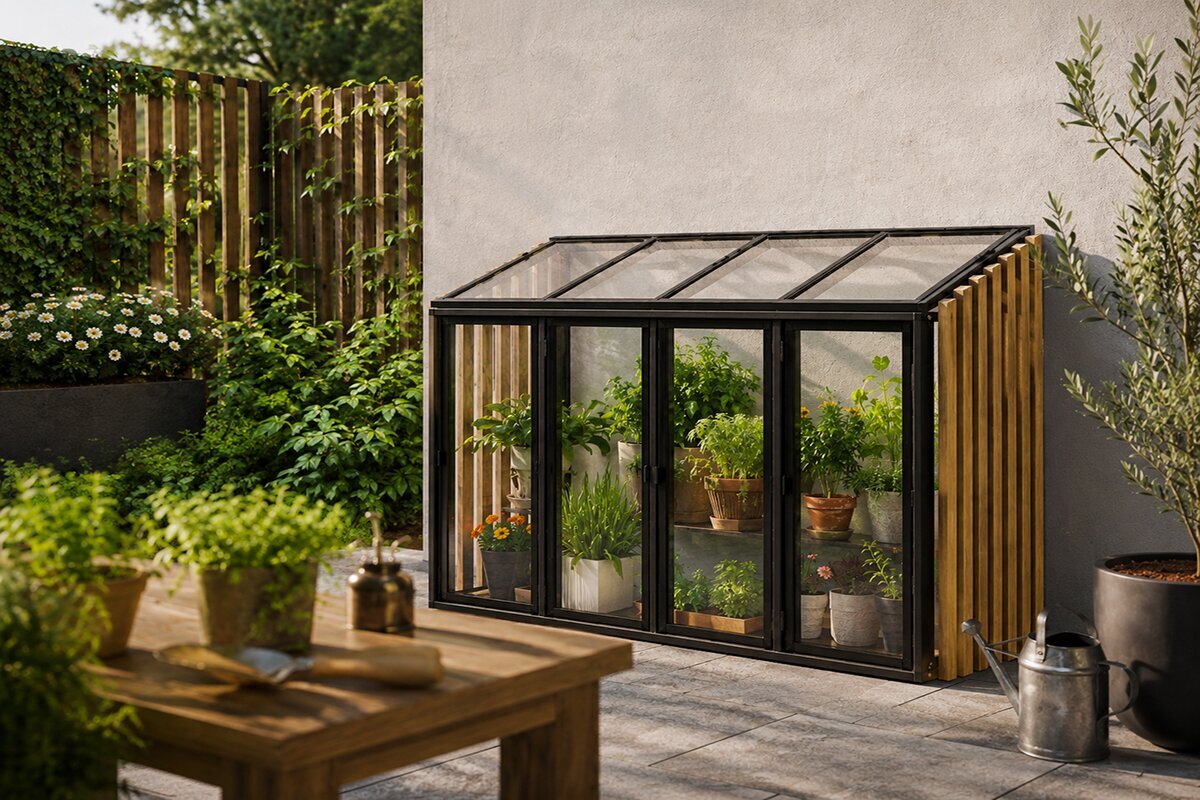
The benefit of limited space
The best small greenhouse turns an awkward garden area into useful growing space.
A narrow side of the house, a sunny strip beside a garage, a compact urban terrace or an unused garden corner can all work well for a greenhouse. The aim is not to squeeze in the biggest possible model, but to choose a shape that makes the most practical use of the available area.
Small greenhouse covers very different concepts. A mini wall greenhouse mainly uses height and needs little floor space. A lean-to greenhouse creates walk-in space without taking over the garden centre. A compact freestanding glass greenhouse needs more room around it, but can become a garden feature with light from several directions.
Before choosing square metres, decide what the greenhouse is for. Raising young plants in spring and later growing herbs requires a different layout from cultivating tomatoes, cucumbers and peppers for months under cover. A small seating area or permanent worktop also changes the necessary footprint considerably.
A small greenhouse works best when it remains easy to reach every day. The easier it is to carry water, pots, compost and harvests between house and greenhouse, the more often the space will be used. A seemingly perfect corner at the far end of the garden soon loses value if every visit is inconvenient.
Three compact formats
Mini against a wall, walk-in at the façade or compact and freestanding: start with the plot shape.
01 / Minimal footprint
Mini wall greenhouse
For very small gardens, terraces and narrow house sides. Shelves and stacked growing zones make use of vertical space.
02 / Walk-in, space-saving
Lean-to or wall greenhouse
Ideal where a sunny wall is available and a genuine interior is wanted without occupying the middle of the garden.
03 / Stand-alone garden feature
Compact freestanding greenhouse
For plots with a little more clear space around the model. It offers classic greenhouse use, access all round and strong architectural presence.
How small is practical?
Usable planting and circulation zones, rather than external dimensions, determine the right size.
Two greenhouses with a similar footprint can feel entirely different inside. Door position, wall height, roof shape, shelf depth and the essential central path decide how much area is truly available for plants.
In a mini greenhouse, height is often more valuable than floor area. Several shelf levels can hold propagation trays, herbs and small potted plants. Taller crops stand below while shallow pots fit above, using the same footprint at several levels.
Once a greenhouse is walk-in, allow room to move. A path that is too narrow makes watering and carrying plants awkward, while an oversized aisle consumes too much precious growing area. Balance matters more than achieving the smallest external dimensions.
Mark out the proposed site at full scale. String or tape can show the outer edge, door, shelves, planters and route through the space. Walk the layout with an empty crate or watering can to discover whether it will work in everyday use.
The smallest suitable greenhouse is the one that still leaves enough room for planned gardening. If tomatoes block the only route, a door cannot fully open or watering always means moving pots, space has not really been saved; the layout is simply too compressed.
Location
On a compact plot, the location is often more important than the greenhouse size.
A small greenhouse can fit in many places, but every empty space is not automatically suitable. Consider light, access, water, wind and drainage together. The site need not receive sun all day, but it should provide sufficient light for the crops you plan to grow.
Watch the site at several times of day. A fence, neighbouring building or tree can cast long shadows in the morning or late afternoon. The sun sits lower in spring and autumn than at midsummer, so a sunny July position may be surprisingly dark in March.
Nearness to the house brings practical benefits. Water, electricity, tools and the kitchen are easier to reach. With daily crops such as herbs or tomatoes, this convenience can be decisive because small care tasks are carried out more regularly.
For wall models, also consider windows, doors, downpipes, exterior lights, taps and façade ventilation openings. The greenhouse must not obstruct an existing function or make important building components difficult to access.
Drainage is part of location planning too. Roof water and excess irrigation water should not run back towards the house. Even with good light, a mini greenhouse at the lowest point of a paved terrace can become impractical if water gathers there after rain.
Allow for maintenance access as well. Glass needs cleaning, gutters need checking and plants need cutting back. A model fitted exactly between a hedge and wall may become difficult to reach after only a few years.
Plan the interior first
Plan a compact greenhouse for movement, plant height and working routines before choosing furniture.
A common mistake is filling the interior with shelves before knowing how large plants will become. A small footprint needs flexible zones that can change during the growing year.
A removable shelf can hold propagation trays in March and be removed in June when a tomato grows tall beneath it. Such multi-purpose use is more valuable than fixed fittings.
Planning rule 01 Keep the main path clear The route from the door to the back should remain clear, direct and usable with a watering can or seed tray.
Planning rule 02 Use vertical space wisely Narrow shelves and varied heights create extra growing space without filling the entire floor.
Planning rule 03 Reserve a flexible zone At least one area should switch with the season between propagation, tall plants, pots or a work surface.
Planning rule 04 Keep vents unobstructed Shelves and plants must not block roof vents, doors or planned airflow routes.
What can you grow?
In a small space, crop duration and intensity matter as much as plant size.
Tomatoes suit small walk-in greenhouses because they can be trained vertically. Rather than crowding in many plants, a smaller number of well-tended plants is usually more useful. Adequate spacing improves airflow, care and harvesting.
Cucumbers also use height well, but develop large leaves. Train them so they do not completely shade lower crops. A rear wall or dedicated climbing area can use the space efficiently.
Herbs are excellent for mini wall greenhouses. Basil, parsley, coriander and chives need relatively small pots and can be picked regularly from shelves near the kitchen.
Lettuces and leafy crops are particularly useful in the cooler parts of the Maltese growing year. They can occupy space later given to warm-season crops, allowing the same shelf to work across several seasons.
Peppers and aubergines benefit from protected conditions in sunny sites. When planning, allow for the size of the mature plant, not the small nursery pot placed in the greenhouse in spring.
Propagation may be the most efficient use of a very small greenhouse. Several levels of seed trays can hold dozens of plants. Once they move into beds or containers, the space becomes available for other crops.
Sensitive potted plants can also benefit during transitional weather. What matters is the temperatures the particular greenhouse reaches without extra heating and whether the plants can tolerate them.
The most productive small greenhouse changes through the year. Seasonal rearranging usually delivers more than a static planting scheme left unchanged for twelve months.
Ventilation
Small greenhouses respond quickly to sunshine because they contain less air volume.
Even a short sunny spell can change the temperature sharply in a compact greenhouse. This is welcome in cooler weather but can quickly become excessive in Malta. Ventilation is therefore part of the basic plan, not an optional extra.
Roof vents, doors and existing openings need clear space. Dense tomato foliage in front of a window can restrict airflow just as much as an overly deep shelf. Allow for the plant mass that will develop later.
For walk-in models, the door can provide additional ventilation on warm days. Keep the route in front clear of pots and tools, and make sure the door can open fully.
Automatic window openers can make daily care easier when compatible with the model and correctly fitted. They do not replace well-planned airflow and shading.
The aim is not to keep the greenhouse as warm as possible at all times. Good conditions come from balancing warmth, air exchange and, where needed, shade for the crop and season.
Glass or polycarbonate?
In a small greenhouse, glazing affects not only the growing climate but also the way the structure looks in the garden.
Clear glass creates a direct visual link between plants, garden and house. When the greenhouse stands close to a terrace, kitchen or main path, this transparency becomes an important design element.
Polycarbonate has different visual and climatic qualities. Choose according to the greenhouse model, desired light distribution, local weather and your design preferences.
On a small plot, the greenhouse is often always in view. Its appearance can therefore matter more than it would for a purely functional polytunnel at the far end of a garden.
Glazing never works in isolation. Roof vents, orientation, shade, frame, foundation and plants form one system. The right material is the one that works sensibly with the entire concept.
Small greenhouses in Malta
Coastal exposure, urban courtyards and sheltered gardens call for different priorities.
Coastal locations Wind, sea spray and driving rain require careful anchoring, sheltered siting and effective drainage.
Hot summer sites Long hot periods make ventilation and seasonal shading especially important.
Exposed gardens Strong winds and sudden downpours make a robust base, maintenance access and sheltered siting important.
Urban courtyard Low wind and stored heat can warm a small greenhouse quickly; generous ventilation becomes more valuable.
Suburban garden The best balance is often short distance from the house, good light and adequate clearance from hedges or boundaries.
Sheltered inland site Consider summer heat, shade and water management when selecting the site, base and model.
Foundation & ground
Even a mini greenhouse needs a precise, stable base.
Small does not mean temporary. An aluminium frame with glass panels performs best on a level, permanently stable base. Wind, ground conditions and drainage influence the appropriate solution.
Existing terrace slabs may look solid but are not automatically a structural foundation. What matters is what lies below the visible surface and how loads are transferred.
For timber decking, assess the supporting substructure rather than only the deck boards. Wall greenhouses also require attention to the connection between base, façade and water management.
The interior floor may be hard-surfaced, planted or arranged flexibly with containers. A solid surface is easy to clean, beds maximise direct growing area and pots allow seasonal rearrangement.
Excess irrigation water needs somewhere to go. Wet corners become troublesome faster in a small interior, so drainage should remain visible and easy to inspect.
Shelving without overcrowding
Extra levels are valuable until they deprive one another of light and air.
It is tempting to fill every wall with deep shelves. That may increase the theoretical number of pots, but lower levels become darker and air circulation deteriorates.
Narrow upper shelves are often more useful than equally deep benches everywhere. They hold herbs or propagation pots without blocking the whole light zone beneath.
Removable shelves increase flexibility. Use them for sowing in spring, then remove them in summer when taller plants need the space.
The floor below a higher shelf can also be used temporarily. Large containers below and shallow propagation above can share the same footprint at different heights.
Shelves must not hinder maintenance or ventilation. A small greenhouse is efficient only when every area remains accessible.
Watering
Small greenhouses are easy to reach, and for that reason easy to overwater.
Hand watering works very well in a compact greenhouse because every plant can be checked quickly. Rather than watering by calendar, observe the moisture level of individual pots.
Upper shelves can dry out faster than large floor containers. Plants beside sunny glass behave differently from pots in shade below. One identical amount of water is rarely right for every plant.
With drip irrigation, route pipes neatly. A hose across the only path is an everyday nuisance in a small greenhouse and can become a trip hazard.
The great advantage of a small area is control: wilted leaves, standing water or a blocked dripper are noticed quickly and can be corrected early.
Common planning mistakes
Most problems arise when too many functions are planned for too little space at once.
1. Buying by outside dimensions only
The internal path, door and growing zones determine genuine usefulness.
2. Underestimating mature plants
A small tomato plant can shade the entire path later in the season.
3. Filling every wall with shelves
Too much fixed furniture reduces light, air and flexibility.
4. Choosing the easiest but darkest corner
An empty space is not automatically a good greenhouse site.
5. Considering the foundation too late
Glass, doors and frames work only as accurately as their base.
When should you choose larger?
A small greenhouse stops being right when paths or plant height require permanent compromise.
If several large tomatoes, cucumbers, propagation shelves, a work surface and tools are all planned at once, the smallest model can soon feel overcrowded.
Two people also need more room to move. A path comfortable for one person does not necessarily suit shared gardening with trays, watering cans and planters.
If you want to include a chair or a small resting place, plan larger sooner. Seating needs not only its own footprint but also room to move around it.
More space is not an end in itself. It makes sense when it enables a workable path, better airflow or the number of plants you intend to grow.
Before buying, compare a mini wall greenhouse, a walk-in wall model and a compact freestanding greenhouse. The ideal solution is often one size above your first instinct.
Design
A small greenhouse often stands close to the home and therefore becomes more part of its architecture.
Compact greenhouses often sit beside a terrace, kitchen window or main garden entrance. Their colour, glazing, plinth and frame are visible every day.
Match the frame colour to windows, doors, railings or garden furniture. Even a very small model then feels like a deliberately planned part of the property.
The transition to the ground also shapes the overall impression. A neat paving edge or precisely finished plinth looks far more refined than an improvised surface.
A well-designed mini greenhouse need not be hidden. In a small garden, it can create structure, organise sightlines and still provide intensive growing capacity.
When mini becomes too small
The next step need not automatically be a large freestanding greenhouse in the middle of the garden.
A walk-in wall or lean-to greenhouse is often the logical extension. It retains efficient use of the plot edge while providing a real interior.
With a longer façade or stable garden wall, a larger wall model can provide much more growing space without taking over the lawn or central seating area.
A compact classic greenhouse is useful when there is some free space around it and you want to choose the site independently of the building.
The best progression is not necessarily from small to huge, but from mini to walk-in to the format that suits your plants, routes and plot.
Quick decision
Choose according to the constraint on your plot that you cannot change.
Almost no floor space? Choose a mini wall greenhouse and use height with flexible shelving.
A sunny house wall available? Compare lean-to and wall greenhouses.
Want access from every side? A compact freestanding model is the natural choice.
Mainly propagation and herbs? Vertical shelf space can matter more than a walk-in floor.
Planning tomatoes, cucumbers and a worktable? Allow enough size for a real path and mature plants.
Greenhouse directly beside the terrace? Treat glazing, colour and foundation as part of the garden design.
Bloomcabin Malta / Compare models
From mini models to walk-in greenhouses: the right size comes from real garden routines.
These Bloomcabin pages help compare greenhouse types and sizes for Malta.
Compact View greenhouse →
Wall model Discover Bloomcabin model →
Classic Compare aluminium greenhouse →
More space View more greenhouse options →
Design Open product details →
Collection View greenhouse collection →
Alternative Check a suitable model →
FAQ
Questions about small greenhouses
What size is suitable for a small greenhouse?
The right size is the smallest area where plants, paths and ventilation work without constant conflict.
Is a mini greenhouse worthwhile?
Yes, especially for propagation, herbs, compact crops and small plots where a large model would be unnecessary or impossible.
What can I grow in a small greenhouse?
Herbs, lettuces, young plants, peppers and well-trained tomatoes and cucumbers are typical options.
Is a wall greenhouse suitable for small gardens?
Very often. It uses the plot edge and can create a walk-in interior without occupying the garden centre.
Does a small greenhouse heat up faster?
Yes. Its low air volume responds rapidly to sunshine, so good ventilation and seasonal shading are important.
Are shelves recommended?
Yes, provided they remain flexible and block neither light nor ventilation openings.
Where should a small greenhouse stand?
In a sufficiently bright, accessible, well-drained place with enough room for maintenance.
When should I plan a larger model?
When desired plants, work space or circulation cannot function sensibly together in the compact model.
Small footprint / serious greenhouse
A small greenhouse is powerful when every square metre has a clear purpose.
Location first, garden use second, size third: this order leads to a compact greenhouse that feels considered rather than cramped and remains easy to use every day.
View compact greenhouse Explore all greenhousesMalta: This guide offers general planning information. Foundations, anchoring, wind, drainage, boundaries, planning permission and local requirements vary by site and model. Ask a perit to classify your proposal with its footprint, height, enclosure, land designation and existing permit conditions before proceeding.
