
Thermowood or Untreated Timber for an Outdoor Sauna?
Sauna buying guide
Thermowood and untreated timber are not simply “durable” and “not durable” options. Thermal modification describes a process; untreated is a less precise label, and neither tells you on its own how an entire sauna will cope with the weather. For a site in Malta, compare the timber used on each exterior component with the actual pattern of sun, rain, shade and, where relevant, coastal air. Then check the manufacturer’s care guidance. The right choice is the one whose material description and maintenance requirements are clear enough for the exposure and upkeep you can manage.
Buyer checklist 1
What the treatment labels mean
Thermally modified timber has undergone a controlled heating process intended to alter the wood’s properties. “Untreated” is less precise: it may mean no thermal modification, no preservative, no factory-applied finish, or a combination. Ask the seller exactly which meaning applies and whether the word describes the raw boards or the finished exterior. Keep thermal modification, chemical preservative treatment and surface coating separate; each describes a different process or layer. A coating might be added after manufacture, so do not assume that “untreated” means nothing has ever been applied unless the supplier confirms this. These distinctions matter when comparing an unfinished board with a ready-to-use exterior. Clarifying them prevents two offers being compared as if their labels describe the same thing.
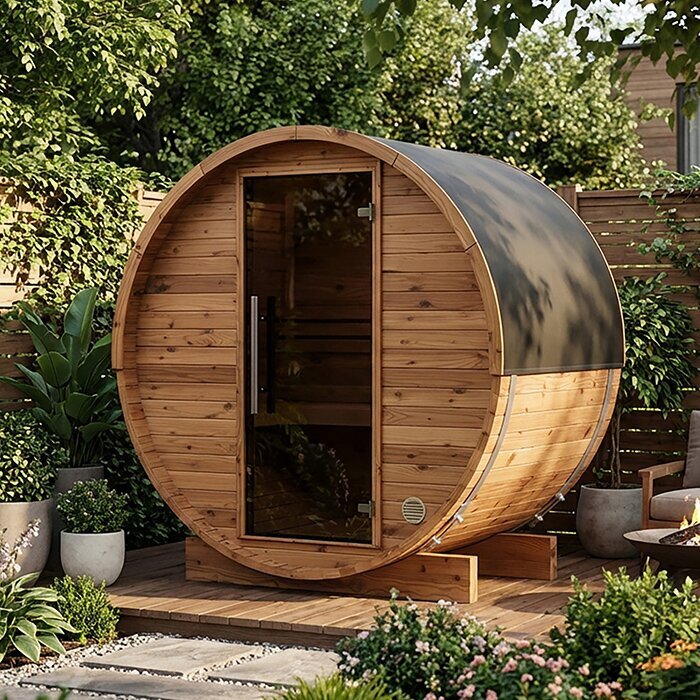
Thermowood in a product title signals how the item is presented, not a complete technical specification. It does not, by itself, identify the species, treatment process, any additional preservative, exposed components or a performance rating for a particular climate. Ask for those details in writing and check what any stated rating covers. The catalogue names the Thermowood Barrel Sauna HC-150 as a Thermowood barrel sauna; use that exact model when asking what the term covers on the configuration offered. Keep the answer with the product documents, because a sales label cannot tell you which boards share the treatment or whether a finish was added later.
Species, grade and assembly matter too
The species and grade remain important whether the timber is thermally modified or untreated. Different species have different natural characteristics, while a grade describes selected aspects of the timber’s quality; the grading basis can vary, so ask what system is used. Board thickness, profile, grain and knots also affect the material you are buying. Ask about the condition in which timber is delivered and whether the manufacturer gives handling or acclimatisation guidance. If a product description says simply “timber”, request a named species or commercial designation and a grade rather than trying to identify them by colour or appearance.
Compare equivalent components across offers. One sauna might use a modified board for its exterior cladding and a different material or finish for the trim, door parts or frame; a broad product label will not tell you which. Request a drawing or component schedule that links each part to a material description, and note any exclusions. When discussing the HC-225 Thermowood Barrel Sauna, cite the exact model so the supplier can answer about that configuration. A specification that identifies the cladding but says nothing about other weather-exposed parts leaves an important gap in an exterior comparison.
Buyer checklist 2
Assess sun exposure at the proposed site
For a sauna in Malta, assess the sun at the exact spot rather than assuming every local site has the same exposure. Note which sides receive direct sun and how that changes from morning to afternoon. Nearby walls, trees and awnings can create shade, while an exposed elevation may receive much more sunlight than boards under an overhang. A shaded corner may also dry more slowly after rain. These are site observations, not a reason to assume shade always improves timber life. Consider airflow and whether you can inspect the exterior easily when deciding if the manufacturer’s care plan is manageable.
Sun can alter colour and warm the exterior, while repeated wet and dry conditions can affect finishes and joints. Ask what exposure a general claim such as “weather resistant” actually covers and which material or components it refers to. A product photograph cannot reproduce your site’s orientation or shade pattern. If you are considering the N-210 Thermowood Barrel Sauna, use the model name to request the manufacturer’s siting and exterior-care guidance, then compare that information with the sun pattern where the sauna will stand.
Rain, runoff and splashback
Map where water can reach the sauna before comparing timber treatments. Rain may run off a roof edge, collect beside a threshold or splash up from paving; irrigation and routine cleaning can wet lower boards too. Note nearby drains, ground levels, surfaces and the direction from which rain reaches the proposed position. If possible, observe the area after rain rather than relying only on how it looks when dry. The aim is to identify conditions to compare with the installation guidance, not to redesign the structure from a general article. A heat-treated label is not a waterproofing claim, and timber treatment cannot resolve water being trapped against a component.
If the site is near the coast, ask separately about the materials and fixings intended for that exposure; salty air is a site factor, not a property established by a timber label. Check written guidance for drainage, clearances and any restrictions on contact with ground or nearby paving. Distinguish water reaching the timber from water collecting around it: describe both the source and the affected area when discussing the position with an installer. This gives a more useful picture than simply calling the site exposed or sheltered. Ask a qualified installer to assess changes to the design. For the N-250 Thermowood Barrel Sauna, focus your enquiry on how the specified exterior and installation details address the runoff, splashback or coastal conditions you have identified.
Buyer checklist 3
Consider colour changes over time
Appearance is one of the differences buyers may notice, although the exact result depends on the species and process. Thermal modification can change timber’s starting tone, often making it appear darker than the same species before treatment. Untreated timber starts with its natural colour. Sunlight and weather can then shift either surface over time, sometimes unevenly between shaded and exposed areas. Ask for an offcut or sample that matches the actual species, treatment and proposed finish. A small sample viewed indoors, or a website image, is a limited guide to how an exterior may look after extended local exposure.
Decide whether you prefer the initial colour, a gradual weathered appearance or a finish intended to retain a particular look, then check whether the manufacturer supports that approach. Treatments and coatings can alter shade and texture, and colour consistency between boards should not be assumed. Consider how much variation you would accept between the entrance, a sunny side and a more sheltered face. If an even appearance matters more than preserving the original tone, make that preference clear when discussing finishes. If you prefer natural weathering, ask what variation to expect rather than choosing from a new sample alone. Lighting, screens and camera processing can also make product photographs misleading. For the LC-260 Thermowood Barrel Sauna, ask for a physical sample and the finish specification if appearance is important; the model title does not describe its colour or surface coating.
Compare maintenance, not marketing claims
Plan for maintenance as well as the initial material choice. Thermally modified timber is not automatically maintenance-free, and untreated timber is not automatically unsuitable outdoors. The kind and amount of care depend on the specified species, construction details, finish, exposure and the manufacturer’s instructions. Some owners may accept natural weathering, while others want a more even colour; neither preference settles what the maker allows. Check whether the care guidance describes raw boards, a finished surface or the complete sauna, since these may not be equivalent. Treat a low-maintenance claim as a reason to ask for the conditions and schedule behind it.
Ask how often the exterior should be checked, which cleaning methods are allowed, whether a finish is recommended or prohibited, which products are compatible and when renewal is due. Separate routine inspection and cleaning from the less frequent work associated with a finish. When comparing care plans, note what each task involves and whether you intend to do it yourself or arrange help. A short list of tasks may still be inconvenient if access is difficult, so judge the work rather than the length of the instructions. Do not apply a coating simply because it is sold for outdoor timber; confirm its suitability for this material and assembly. Keep the manual and finish records with the sauna documents so future work follows the same specification. For a named option such as the HCF-300 Thermowood Barrel Sauna, request care guidance for the exact configuration instead of relying on general advice for a different species or process.
Buyer checklist 4
Timber specifications and supporting documents
Useful documentation names the species and grade, identifies the component and explains what treatment or finish has been applied. For modified timber, request a process description and the supplier’s stated end use; for untreated timber, ask what the term excludes and what care is expected. If a seller quotes a durability class, standard, test result or certification, ask which exact material it covers, who issued it and whether the stated use includes outdoor exposure. A certificate for a raw material does not automatically certify the completed sauna or its installation. Where a claim affects your decision, do not rely on verbal shorthand.
Request the technical data sheet, care guide, installation drawings and, where available, a component schedule. Read them together: a drawing may show where timber is used, while a care guide explains what the supplier expects you to do. If documents use different names for the material, ask the seller to reconcile them in writing and confirm that they apply to the same configuration. A request about the LCF-300 Thermowood Barrel Sauna should name the model so the information can be tied to the product under consideration. Missing information is a reason to ask further questions, not proof of good or poor performance.
Check which sauna components use each material
Check the boundary between exterior and interior materials. An outdoor sauna can include cladding, trim, a supporting frame, door components and roof-related parts, and a single listing may not describe all of them. Confirm which surfaces use the material being compared, which remain exposed to weather and whether a separate finish is present. Ask whether interior hot-room components follow different material instructions; exterior suitability does not automatically answer questions about the inside surfaces. Keep the comparison focused on the specific product rather than assuming that the whole building is made from the timber named in its range.
Before ordering, compare the current specification and included parts with the drawings, not just a product title or general category page. Confirm whether options change exterior boards or finishes, and ask how substitutions affect care instructions. The store listing identifies the S-140 Thermowood Barrel Sauna by model and product type; use that identity to ask which named parts are thermally modified and which, if any, are not. Confirm the configuration and local availability before relying on a product-page description, since a catalogue label alone does not settle the material scope.
Buyer checklist 5
Plan for repairs and replacement boards
Consider eventual repairs even if maintenance seems straightforward now. Ask whether replacement boards can be specified by species, grade, profile and treatment, and whether the supplier can identify a compatible finish. Keep product records, documents and colour notes so a future replacement can be compared with what was originally installed; a board that looks similar when new may not weather in the same way. Record which component each material description belongs to, rather than keeping an unlabelled sample or a finish name on its own. This makes it easier to explain a repair request without guessing from appearance. Also distinguish replacing a board from renewing its coating, since these are different maintenance enquiries. If a damaged part is structural or its replacement could change the assembly, follow the manufacturer’s instructions and use a qualified installer rather than improvising. A repair should preserve the intended drainage and clearances, not merely cover a visible mark.
Think about how accessible all sides will be for inspection and touch-up, and whether plants, storage or fixed screens could make routine care awkward. The easiest material to own is often the one whose upkeep fits the space and the time you are willing to give it. If the sauna is close to salty air, check fastener and connector specifications separately, because timber treatment says nothing about metal components. Ask how matching materials are identified before work begins; a similar-looking replacement is not necessarily the same specification. These are whole-product maintenance questions, not evidence that one timber choice always needs more repairs.
Compare the options on the same basis
Put the two options side by side using the same questions: which parts use which timber, what species and grade are specified, how the material has been processed, what finish is present, and what conditions the manufacturer allows. Add the care requirements and the documents that support each answer. Keep the exterior cladding, trim and other exposed components on separate lines so a clear answer about one part does not conceal an unanswered question about another. Distinguish what is supplied from work you would need to arrange after delivery, such as a specified finish. This makes gaps visible and prevents a detailed specification for one option being compared with a broad label for the other. If you prefer one appearance or are willing to do more regular upkeep, record that as a preference rather than treating it as proof of better timber performance.
Then weigh the information against the actual site: direct sun, shade, water pathways and, where relevant, coastal exposure. Decide which care routine you can realistically follow and whether the expected weathering suits you. Leave any unanswered item marked as unknown instead of filling it in from a product name or photograph. If a seller cannot clarify a material claim, treat it as an unresolved specification. The more suitable choice is the one whose documented materials and care requirements make sense for your position and routine, not the one with the most confident-sounding label.
Frequently asked questions
Is Thermowood waterproof?
No. Thermal modification is not waterproofing, and the label does not establish how the whole sauna handles rain or standing water. Check the manufacturer’s information on exterior components, drainage, clearances and any required finish; a suitable material still depends on the details of the structure and its position.
Does untreated timber have to be painted or oiled?
Not in every case. The right approach depends on the timber, its intended use and the manufacturer’s instructions. Ask whether the exterior is intended to weather naturally or needs a particular finish, and confirm which products are compatible before applying anything.
Does Thermowood always need less maintenance?
There is no universal answer. Maintenance depends on the species, treatment, finish, construction details and exposure. Ask for the care guidance for the exact sauna configuration, rather than relying on a general claim about thermally modified timber.
Can I use any outdoor wood finish on a sauna exterior?
No. An outdoor finish is not automatically compatible with every timber or sauna assembly. Check the manufacturer’s guidance for approved finishes, preparation and renewal. If the documents do not answer the question, ask the supplier before applying a product.
What documents should I request before buying?
Ask for the timber species and grade, which components use it, details of any thermal modification or preservative, the finish specification, installation drawings and care instructions. If a rating or certification is claimed, check which specific material and intended use it covers.
Thermowood and untreated timber can only be compared fairly when the terms refer to clearly specified materials and components. Let the documents explain the process, exterior use and care requirements, then judge those against the sun, water exposure and maintenance you can provide at your site. The label matters less than knowing what is fitted to the sauna and how to look after it.
