
Using Compost in Greenhouse Beds Without Nutrient Excess
Greenhouse growing guide
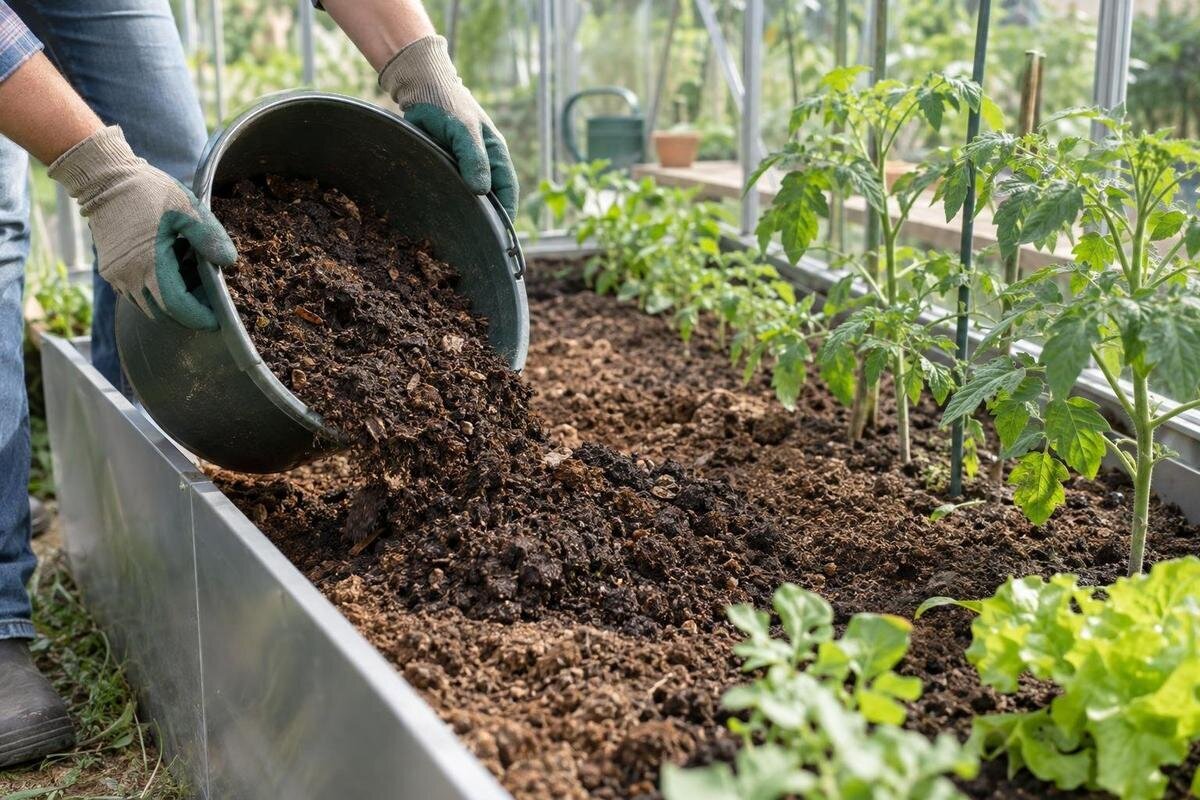
Compost can improve a greenhouse bed, but it also brings nutrients and soluble salts into a growing area. The risk of overfeeding comes less from one measured addition than from repeating additions without knowing what earlier compost and fertilisers have already supplied. Check that a batch is mature and suitable for the bed, then read its analysis alongside a test of the existing soil. Measure the planted beds—not the greenhouse’s total listed area—before calculating any quantity. The aim is not to avoid compost; it is to use it where it has a clear purpose and stop when the bed does not need another input.

Compost adds nutrients as well as organic matter
Compost is often added for organic matter, but it is not a nutrient-free conditioner. Depending on its ingredients and processing, it can supply nitrogen, phosphorus and potassium, influence pH, and add soluble salts. Those contributions differ between batches. A roofed greenhouse bed receives little or no direct rainfall, so nutrient movement and removal differ from an open plot; irrigation, drainage and the bed medium still matter. Nutrients can remain or accumulate over repeated seasons. The total input includes compost, fertiliser and other amendments, so a small top-up can matter when several inputs have been used. If a test suggests salts are rising, irrigation-water quality may also need consideration.
Before adding any, state what the compost is meant to do: address a documented need for organic matter, follow a soil-test recommendation, or form part of a specific growing-medium plan. Review recent compost and fertiliser additions, which crops occupied the bed, and whether symptoms were diagnosed rather than guessed. If the bed already has ample nutrients, more compost may worsen an imbalance without resolving the reason you considered adding it. A concern about soil structure needs its own assessment; it is not automatically a reason for another application. When planning a new greenhouse, keep its listed area separate from the planted area: the Bloomcabin Prestige Greenhouse is listed from 3.77 to 28.08 m², but those figures alone cannot tell you how much compost your chosen beds need.
Measure the area that will receive compost
Draw the area you will actually amend. Measure the length and width of each bed, leaving out paths, working space, benches, storage and any floor that will not receive compost. For an irregular bed, divide it into simple shapes, calculate each part and add the results; do not apply a greenhouse-wide average to a few permanent beds. In a raised bed, measure the area of growing medium receiving compost, not just the outer footprint. If only part of a bed will receive compost, calculate and mark that patch separately. For a larger layout, such as one planned around the Spacious Greenhouse, label each bed on the plan before adding the treated areas together.
Convert a planned layer to volume with area × depth. For example, a 1 m by 4 m bed has an area of 4 m²; a hypothetical 0.02 m layer would be 0.08 m³, or 80 litres. This is arithmetic, not a recommended compost depth. Use a rate or depth supported by the compost analysis and crop-specific advice, then calculate the quantity for that measured area. A loose volume can settle after handling, so use the product’s stated quantity consistently. If a recommendation is by weight but you purchase by volume, ask for the product’s bulk density and moisture basis; a bag volume cannot be converted to a reliable weight by guesswork.
Maturity and nutrient content are separate checks
Compost maturity describes how far the material has decomposed and stabilised; it does not tell you how much plant-available nutrient it contains. A mature material is generally more stable for use around roots than one still actively decomposing. Strong ammonia-like or sour odours, recognisable fresh feedstock, or ongoing heat can be warning signs, but sight and smell alone cannot certify a batch. Age is not a dependable substitute: two piles kept for the same period can differ because of ingredients, moisture and handling. Unstable compost can continue to change after placement and may affect the root zone, so the intended use matters especially for direct sowing or young plants. Ask how the product was made, cured and stored.
Do not assume that mature means weak. Fully decomposed compost may still carry substantial nitrogen, phosphorus, potassium or soluble salts. Conversely, a mature batch may not supply nutrients in a balance suited to the crop, and total nutrients are not all released at once. Ask for a nutrient analysis that relates to the product or batch you will use; a maturity statement and a nutrient report answer different questions. Check that the report’s batch or product identity matches the material delivered. If the seller cannot explain its ingredients, maturity and horticultural use, do not rely on it as the main growing medium. A stable texture and earthy smell are preliminary clues, not evidence that repeated applications are appropriate.
Treat different growing areas separately
A greenhouse can contain permanent soil beds, separate raised beds, newly filled growing media and containers. These are not interchangeable sampling units: they may differ in soil, drainage, previous inputs and crop history. Keep test results distinct for areas with meaningfully different conditions rather than averaging high and low readings into one number; an average may hide a local build-up. If one continuous bed is mostly uniform, there is no need to split it into arbitrary zones; divide it only where material or history differs. A bed plan for an Aluminium Classic Greenhouse can also serve as a sampling map, with each distinct growing area clearly identified.
Separate beds also let you use compost only where its purpose is relevant. An established in-ground bed with a high nutrient test should not automatically receive the same amendment as a newly assembled raised bed; a container mix should not be treated as deep garden soil. Mark bed boundaries and record crops and materials for each. If media differ but share an irrigation line, note that too: water movement and nutrient loss may differ by bed. Do not blend samples from old and new media just to produce a convenient average; follow the laboratory’s sampling instructions. The plan organises sampling and application, but it does not diagnose a nutrient shortage. Let an appropriate growing-media test guide whether two areas need different decisions.

Check the compost’s origin and intended use
Ask what went into the compost and whether the information applies to the batch you will use. Feedstock may include garden trimmings, food residues, manure or other organic material, and those sources do not produce identical nutrient profiles. For food-growing beds, choose a traceable material intended for horticultural use and request details on processing, maturity and relevant quality checks. If the source is unknown or the description is only a general claim such as ‘rich in goodness’, you cannot judge its nutrient contribution or suitability. Where feedstock raises concerns about persistent herbicide residues, weeds or pathogens, ask what checks were carried out and whether the material is suitable for the intended crop. Do not assume a bag labelled compost is a complete, balanced medium for every greenhouse crop.
Suitability also depends on the bed system. In-ground beds, raised beds filled with imported media and containers have different volumes and drainage behaviour, so advice should match the actual system and crop. If you are still selecting a greenhouse, compare the internal arrangement with the beds and access you plan rather than expecting the structure to determine the growing medium. For a Wall Greenhouse, map which areas will contain existing soil, imported growing media or containers. That distinction gives you a useful basis for discussing compost suitability; the greenhouse model itself does not establish which substrate is present.
Read the analysis in the right units
Read the report’s units and basis before using a number. Nutrient concentrations may be stated as percentages or in units such as grams per kilogram, on a dry-matter or as-supplied basis. Converting an application rate from weight to volume requires the compost’s bulk density, while moisture content matters when comparing dry-matter and as-supplied figures. Total nitrogen is not the same as immediately available nitrogen; ask whether the report distinguishes forms such as ammonium and nitrate. Phosphorus and potassium figures also need consistent units when compared with soil-test recommendations. The same nutrient may be reported in different forms, so do not combine figures from separate reports as though their methods and units were identical. If the report is unclear, ask the laboratory how to interpret it before calculating an addition.
Look for pH and electrical conductivity (EC) as well as nutrient results, where the report includes them. EC indicates soluble salts; it is not a direct nutrient prescription, and it must be interpreted with the test method and crop in mind. Compost EC and soil EC may use different extraction methods, so their values should not be compared casually. A high result calls for suitable interpretation, not an automatic attempt to dilute a bed with more compost or rinse it without considering drainage and disposal. A soil-testing laboratory or horticultural adviser can explain what applies. Keep the interpretation with the relevant bed plan, whether you are using an existing structure or planning a Limited Edition Aluminium Greenhouse.
Test existing soil before another addition
A compost report describes the material; it cannot tell you what the bed already contains. Arrange a soil or growing-media test appropriate to the system and crop, particularly before repeating additions. Follow the laboratory’s sampling instructions and take a representative sample from the root zone, avoiding isolated spots that received a spill or concentrated fertiliser. Clean tools and several small portions across a bed can help represent the area, but combine them only if the laboratory’s method calls for a composite. Sample materially different beds separately, and note the crop and previous inputs. Include pH and the nutrient measures recommended for that crop; ask whether EC testing is appropriate if soluble salts may have accumulated.
Keep the interpretation with the test date, crop and input history. A result is a snapshot, so compare like with like: use the same sampling zone and, where possible, the same method on later tests. Do not read pale leaves or weak growth as proof that more compost is needed; water stress, root problems and other growing conditions can produce similar symptoms. Use crop-specific recommendations from the test to decide whether compost, another suitable input or no nutrient addition is appropriate. For a new T-Model Orangery Greenhouse, record the bed test before the first amendment so that later results can be compared with that starting point. Follow advised timing for a repeat sample rather than testing after every small adjustment.
Base the amount on the test and crop
Once the compost and bed have been assessed, match the amount to the test interpretation, crop and purpose. Follow a rate from a reliable horticultural recommendation that specifies a comparable compost and application basis; do not borrow a rate from a different material or crop. Check whether the recommendation refers to a quantity of compost, an amount of a particular nutrient or a defined application period. Resolve any weight-to-volume conversion before measuring the amount. Judging a handful or layer by eye cannot establish whether its nutrient contribution is appropriate. If the recommendation does not clearly apply to your material, ask the supplier, laboratory or horticultural adviser to clarify it.
Apply only to the measured growing area and distribute it consistently in line with the chosen bed method. Concentrating extra compost in planting holes can create pockets with a different nutrient and salt concentration from the surrounding soil. Follow crop-specific advice on placement and timing, especially where plants are already established; changing where compost sits does not make an excessive nutrient input safe. An order for compost for a Pyramid Greenhouse should therefore be based on the actual bed measurements and the agreed rate, excluding paths and other non-growing space.

Keep a record for each bed
Record the batch, source, analysis date, weight or volume added, bed, date and crop. Keep the label or batch number with the note where possible. Include other nutrient-bearing materials used in that bed, rather than keeping a compost-only note; otherwise the next season’s review misses part of the total input. If compost was spread over a known bed area, record that area and the calculation used. Note any major change in growing medium or drainage. Keep the record accessible when ordering compost again, so you can compare a new batch instead of assuming it is identical to the last one. A simple notebook or spreadsheet is enough if entries are consistent.
Observe the crop and bed, but avoid changing the nutrient plan from appearance alone. If growth is poor, check root-zone conditions and obtain appropriate advice or tests before adding anything else. When planning a Limited Edition greenhouse with built-in storage, mark the storage space separately from the planted beds so that it is excluded from compost quantities. Keep stored batches identifiable and record which batch was used in each bed. Together with application dates and crop observations, this history helps you assess whether a problem is associated with a particular bed, batch or management decision rather than affecting the greenhouse uniformly.
When to pause compost additions
Pause further compost additions when a soil test already reports nutrients at or above the crop’s target, when repeated additions have no stated purpose, when the batch source or analysis cannot be verified, or when a bed problem has not been diagnosed. A pause does not mean compost is harmful; it prevents an unmeasured addition from contributing to a cumulative excess. One bed may need a different decision from another. Do not assume that a high reading from one bed represents the whole greenhouse, or disregard it because a separate bed has a low result. Follow the testing laboratory’s interpretation or consult a horticultural adviser about corrective action. Avoid adding another amendment to address a high reading without a test-based plan.
Before the next application, check that the bed record explains what the compost is expected to do, identifies the batch and links the proposed amount to the test recommendation. If a key piece is missing, resolve it before spreading the material. A pause leaves room to use compost later where it has a clear role; it need not become a permanent decision against it. Resume additions because the bed’s condition supports them, not simply because a season has turned or a bag is available. Follow the adviser’s or laboratory’s timing for reassessment rather than setting an automatic application date.
Frequently asked questions
Can mature compost still overfeed a greenhouse bed?
Yes. Maturity describes how stable the compost is, not how much nutrient it contains. A mature batch may still add more nitrogen, phosphorus, potassium or soluble salts than a bed needs. Check the batch analysis alongside a test of the existing bed before deciding on another addition.
How can I tell whether compost is mature?
Ask the supplier how it was made, cured and intended to be used. A strong sour or ammonia-like smell, fresh recognisable material or ongoing heat can be warning signs, but appearance and smell alone cannot confirm maturity. Age is not a reliable substitute for batch information.
How much compost should I add?
There is no single rate that suits every compost, crop and bed. Use the batch analysis, a test of the existing growing medium and crop-specific horticultural advice. Measure the area receiving compost; area multiplied by a recommended depth gives volume, but the calculation does not set the recommended depth.
Should I add compost to greenhouse beds every year?
Not automatically. Review the bed’s test results, crop history and previous compost and fertiliser inputs first. A roofed bed receives little or no direct rainfall, and irrigation and drainage affect how nutrients move. Follow appropriate testing advice rather than using the calendar as the reason for another application.
What if a crop looks deficient after compost has been added?
Do not assume that more compost will solve it. Poor growth or pale leaves can have causes other than a nutrient shortage. Check the root-zone conditions and use suitable soil or growing-media tests; ask a horticultural adviser or testing laboratory to interpret the results before changing the nutrient plan.
Good compost use is a measured decision, not an annual ritual. A mature batch may still contain more nutrients than a bed needs, so consider its analysis alongside the bed’s test results, the crop and previous additions. Measure only the beds receiving compost, apply an amount supported by the recommendation and keep batch records for later comparison. If test results already show adequate or high fertility, pausing is a sound part of bed management; it leaves room to use compost later where the bed’s condition gives it a clear purpose.
