
Why Greenhouse Peppers Drop Their Flowers
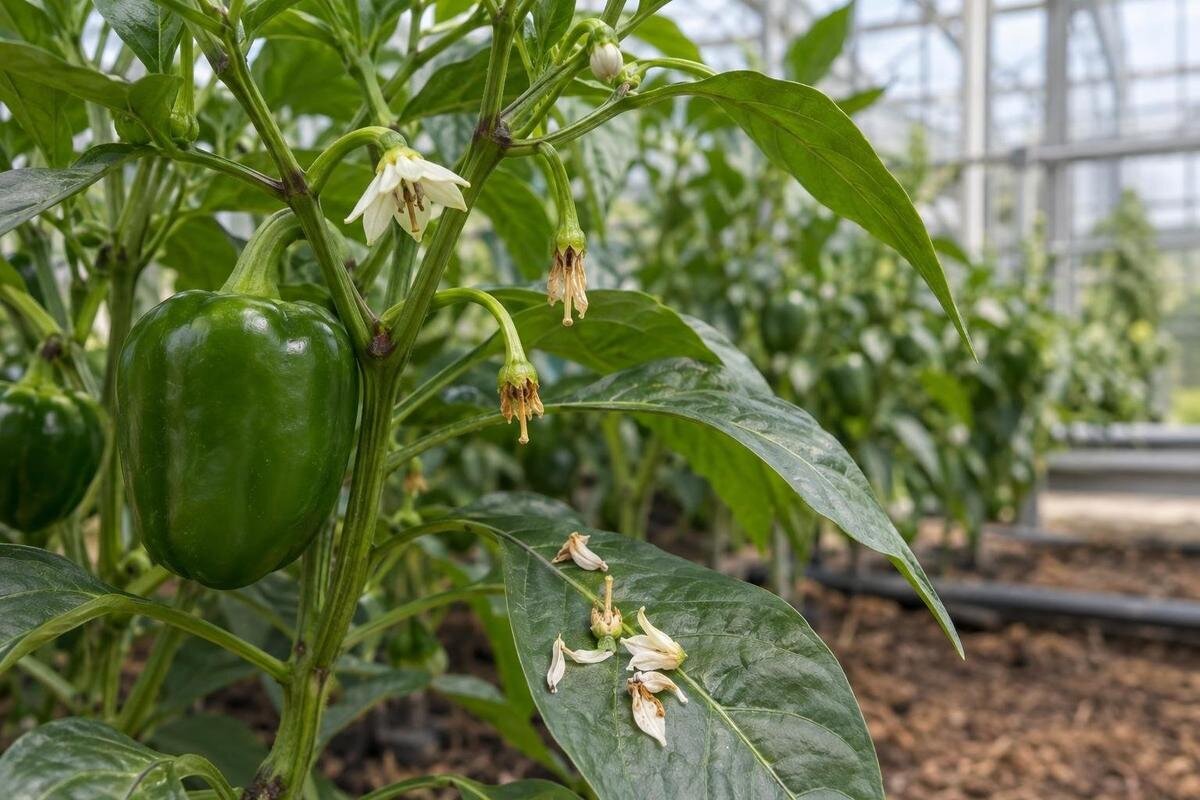
Pepper growing
Pepper flowers falling in a greenhouse can be alarming, especially when no tiny fruit follows. First distinguish petals dropping after fruit has started to form from a whole flower falling before it sets. Heat, cool nights, uneven root moisture, pollination conditions, transplant adjustment and plant growth can all affect fruit set; several may overlap. The most useful clues come from the pattern across several flowers, the plant’s overall condition and measurements taken at crop height. One fallen bloom or photograph alone cannot establish the cause.

Greenhouse planning 1
What counts as flower drop in peppers?
Pepper flowers do not all behave the same way after opening. When a flower has set fruit, its petals usually wither and fall while the green base beneath them, the ovary, stays attached and starts to swell into a tiny pepper. The small green calyx, or cup at the flower’s base, remains around the developing fruit. This is normal development, not a failed crop. Fallen petals on the soil are not enough, by themselves, to show that the plant is stressed. Look where the flower joined its stalk and check whether the green fruit is enlarging over the next few days.
True blossom drop means the flower has come away before a fruit begins to enlarge, sometimes with its short stalk. Check several blooms over a few days rather than relying on one fallen flower. Note whether each was a bud, a newly opened bloom or an older flower, and whether the whole flower or only its petals came off. Look for damage around the calyx and flower stalk, too. If several open flowers disappear and no tiny peppers form, that points to poor fruit set, but does not identify the cause: heat, water stress, pollen problems and the plant’s condition can look much the same. A photograph documents the flower’s appearance, not the temperature or root conditions that led to its loss.
Temperature extremes can interrupt pepper fruit set
Temperature is a major factor because pepper flowers and pollen are sensitive to prolonged conditions outside their workable range. High greenhouse temperatures can interfere with pollen viability and fruit set; cool nights or a sharp day-to-night swing can also disrupt flowering. A brief warm afternoon does not prove that heat is the cause, and no single temperature threshold suits every cultivar and growth stage. Repeated peaks while flowers are opening are more informative than one reading. In an enclosed greenhouse, air can become hotter than outside, and conditions may vary between the canopy and the doorway. Flowers on a sunny side may also experience more heat than a reading elsewhere suggests.
Place a min–max thermometer in the crop zone, shaded from direct sun, and record readings through sunny afternoons and overnight. Compare them with the dates when flowers fell, and note which vents or doors were open. If the pattern points to overheating, use available ventilation or shading in a measured way, then watch new flowers; avoid making several changes at once. If you are comparing a Wall Greenhouse, consider where the crop and thermometer would sit in relation to the wall and openings. The listed range is 3.69 m² to 14.34 m². Use the actual configuration to assess access to ventilation controls; floor area alone cannot tell you how temperatures will vary around the plants.
Greenhouse planning 2
Uneven watering puts flowers under stress
Pepper roots need a reasonably steady supply of moisture. A long dry spell followed by a heavy soaking can stress the plant, while waterlogged growing media can deprive roots of air and reduce their ability to take up water. Either situation may be followed by wilting, stalled growth or flower loss. Check below the dry surface: a pot can look dry on top while remaining wet lower down, and a bed can dry unevenly near its edges or between drippers. Pots may dry faster than beds, so compare plants growing in similar conditions. Notice when leaves droop, whether they recover, and whether nearby plants show the same pattern.
Water according to the root zone, not a fixed calendar or the fact that one bloom has fallen. Keep the medium evenly moist rather than allowing it to swing between very dry and saturated; allow excess water to drain, and adjust for the plant’s container, size and current weather. Record watering dates alongside temperature, because a hot day can increase demand while the surface disguises dry roots. When comparing layouts for Limited Edition Aluminium Greenhouses, mark where you would need to reach each pot, bed or dripper. The listed areas range from 3.77 m² to 28.08 m². Plan access for checking moisture across the planting area, rather than judging all the plants from the nearest pot or bed edge.
Pepper flowers can self-pollinate, but pollen still needs to move
Sweet peppers and chillies have flowers with both male and female parts, so a flower can usually pollinate itself; bees are not essential for every fruit. Pollen still has to be released from the anthers and reach the stigma. Gentle plant movement, air movement and insect visits can help, while unsuitable temperatures or very humid, still conditions may interfere. A lack of bees is therefore not the first conclusion to draw when blossoms fall. Pollination is only one stage: a flower may receive pollen and still abort later if heat, water stress or the plant’s condition becomes unfavourable.
In a still greenhouse, you can test whether fruit set improves by gently vibrating a support or lightly tapping flowering stems when plants are dry; handle them carefully and do not shake hard enough to break them. Mark a few newly opened flowers with a loose label nearby, then check whether a tiny pepper remains after the petals fade. If a small fruit forms but stops enlarging, consider fruit retention as well as pollen movement. When reviewing a T-Model Orangery Greenhouse layout, use the actual plan to decide where plants and supports would go and how you would reach the flowers for these checks. Its listed area of 16.52 m² to 30 m² is a starting point for that layout, not a description of access around mature plants.

Greenhouse planning 3
Transplant shock and plant growth affect early flowering
A pepper plant that has recently been moved, repotted or planted out may shed some flowers while its roots establish and it adjusts to a new light and temperature pattern. This is more plausible when drop begins soon after the change and the plant is otherwise healthy; it is not a rule that every young pepper must lose its first flowers. A plant that is badly wilted, has stopped growing or is losing leaves needs a wider check. Keep conditions as steady as practical after planting, and judge the next flowers rather than repeatedly disturbing the root ball or shifting the plant. Note when the move took place so you can compare it with the timing of flower loss.
Look at the whole plant, not just the number of blooms. A plant already carrying fruit may have limited resources for further growth. Record whether those fruits are enlarging while newer flowers fall, and whether the plant is producing healthy new leaves. This helps distinguish a change in flowering from a broader decline without assuming that every lost bloom signals a feeding problem. Removing leaves or flowers at random can reduce productive leaf area or remove flowers that might set. For planting-capacity comparisons, the Pyramid Greenhouse is listed from 5.53 m² to 18.9 m². Consider that footprint alongside the cultivar’s mature size, planned spacing and access routes; it is not a direct measure of how many pepper plants will fit.
Fertiliser imbalance is possible, but flower loss is not a nutrient test
Fertiliser imbalance is one possibility, not a diagnosis that can be read from dropped flowers. Too much nitrogen can favour leafy growth, and excessive feeding may raise the salt concentration around roots; inadequate nutrition can also weaken growth. These conditions can overlap with water stress, because damaged roots have trouble taking up nutrients. The same flower loss may therefore appear under different problems, while a nutrient issue may also affect leaf colour, growth rate or root-zone measurements. A single yellow leaf, a strong-looking stem or one fallen blossom cannot identify a particular nutrient.
Before feeding more, review the product label and your recent routine: what was applied, how often, and whether the crop is in pots or a bed. A soil or growing-media test, interpreted for that growing system, is more useful than trying several supplements in sequence. Do not add a trace-element product merely because flowers have fallen; excess can cause its own damage. When reviewing a layout for Aluminium Greenhouses with Storage – Limited Edition, note the proposed positions of pots and beds so that feeding records can identify which plants received each treatment. The listed areas range from 5.52 m² to 28.08 m², but the useful detail for investigating a feeding problem is the growing medium and treatment history of the affected plants.
Greenhouse planning 4
Consider light, humidity and ventilation together
Air, light and humidity influence one another in a greenhouse. Stagnant, very humid air may impede pollen release and keep foliage damp; hot, dry air can increase water loss from leaves and the demand on roots. That does not mean simply opening every vent is always the answer: a hot draught may add stress, and the result depends on weather and structure. Observe whether flowers fall in the still interior, near a sun-warmed wall or beside an opening. Check conditions around the canopy and flowers rather than relying only on what you feel at the doorway. A humidity reading can add context, but it does not explain flower loss on its own.
Track direct sun, shade and ventilation over the day. If plants are crowded, leaves can shade flowering branches and air may move poorly through the canopy; if shade is heavy for most of the day, peppers may have too little light to support steady growth. Confirm the heat pattern before adding shade, and make a modest change that you can evaluate. If you are considering the Bloomcabin Prestige Greenhouse, mark proposed plant positions on the plan alongside the actual openings and any nearby sources of shade. The listed range is 3.77 m² to 28.08 m². Compare the space available around mature foliage as well as the overall area, rather than planning only for the size of young plants.
Track several flowers before changing the growing routine
An observation log turns a vague impression into a pattern. For each affected plant, record the date, whether the bloom was a bud or open flower, whether the whole flower fell or only petals, and whether a small fruit followed. Add minimum and maximum temperatures, watering, feeding, ventilation and any sudden change in position or weather. Take close photographs of the flower attachment and of the whole plant from the same angle on later checks. A simple map of rows or benches is useful: flowers near a door, roof edge or wall may experience different conditions from those deeper in the greenhouse. Photos show visible changes but cannot show root moisture or the conditions that preceded them.
Give one likely cause priority and adjust one factor at a time. If readings show recurring heat peaks, improve available ventilation or shading and continue tracking new flowers; if the root zone cycles between dry and wet, stabilise watering before adding fertiliser. Wait for later blooms to show a response, because already aborted flowers will not recover. For a larger layout such as the Spacious Greenhouse, listed from 47 m² to 70 m², plan observation points in different parts of the crop and at different heights. Keep each reading tied to its location in the log. This preserves the differences between areas instead of combining them into an average that may obscure conditions around the affected flowers.

Greenhouse planning 5
Check for pest damage when flower loss is localised
Inspect buds, flower stalks and leaf undersides if loss is concentrated on one plant or one section. Look for damaged or distorted buds, scars, small insects, sticky residue, stippling, webbing or unusual leaf curling. Thrips and other pests can injure flower parts, but these signs require identification; not every mark means an insect is responsible. A hand lens and close photographs can help record what is present. Check the same plant repeatedly, since a fleeting view of one flower is poor evidence and some pests are difficult to see without magnification. Compare new growth with older leaves as well.
Compare localised damage with the wider pattern. Simultaneous flower loss across many plants after a hot spell points more towards an environmental event than a pest on one bloom, but several causes can coexist. Avoid applying a pesticide simply because flowers are dropping; identify the pest or disease first and seek locally appropriate professional guidance if needed. Access for inspection also deserves attention when comparing Aluminium Greenhouses, listed from 3.77 m² to 28.08 m². Check the actual plan and openings, then mark how you would reach plants at the back of beds and examine leaf undersides. Base that assessment on the intended planting arrangement, not just the product name or total area.
When to seek a closer diagnosis
Seek a more specific diagnosis when whole blossoms continue to drop through several flowering rounds, when the plant is declining as well, or when unusual lesions, distorted new growth or visible pests appear. A short period of adjustment after transplanting differs from persistent loss with worsening foliage. If the growing medium stays wet or dries rapidly despite changes, investigate roots and drainage rather than continuing to alter surface watering. These signs do not establish a single disease, but they make a focused assessment more worthwhile than guessing from flower drop alone.
Collect useful evidence before asking an experienced horticulturist or plant-health service: the cultivar if known, whether plants are in pots or a bed, recent feeding and watering, a temperature log, the date of transplanting, and clear photographs of affected flowers, leaves and the whole plant. Include a healthy flower and a fallen one where possible, plus any tiny fruit that has set. Those details let an adviser compare symptoms and conditions. Keep care steady while gathering evidence rather than changing watering, feeding, shade and ventilation all together; a clear record makes it easier to judge what happens next.
Frequently asked questions
Do greenhouse peppers need bees to set fruit?
No. Pepper flowers can usually pollinate themselves, so bees are not essential for each fruit. Pollen still has to move within the flower, however, and conditions such as temperature and humidity can affect that process. In still air, gentle movement may help, but a lack of bees alone does not explain flower drop.
Are fallen pepper petals a sign that fruit set has failed?
Not necessarily. After a flower sets fruit, its petals wither and fall while the green base remains attached and begins to swell. Check the flower stalk for a tiny pepper. If the whole flower has fallen before a fruit forms, that is more consistent with blossom drop, though it does not reveal the cause.
Will watering more stop pepper flowers from falling?
Only if the root zone is too dry, and even then it is better to correct the moisture pattern than simply add more water. Waterlogged roots can also struggle to take up water. Check the medium below its surface and look for a repeated dry-to-saturated cycle before changing how you water.
Can high greenhouse temperatures cause flowers to drop?
Yes. Sustained heat can interfere with pollen and fruit set, while cool nights or large day-to-night swings can also affect flowering. Measure conditions near the plants, including overnight lows, and compare readings with the dates of flower loss. A single warm afternoon is not enough to confirm the cause.
Should I fertilise peppers when their flowers drop?
Not on that sign alone. Excess nitrogen can encourage leafy growth, while other nutrient problems may affect plant health, but flower drop is not a nutrient test. Review recent feeding and, if the problem persists, consider testing the soil or growing medium before adding more fertiliser.
The key distinction is between petals falling as a tiny pepper begins to grow and whole flowers being shed before fruit forms. When true flower drop repeats, compare the pattern with temperature readings, root moisture, pollination conditions and the plant’s overall growth. Make one evidence-based adjustment at a time, then watch the next flowers. That is more reliable than changing water, fertiliser and shade all at once.
