
Internally or Externally Fed Wood Sauna Heater: Which Layout?
Sauna heating
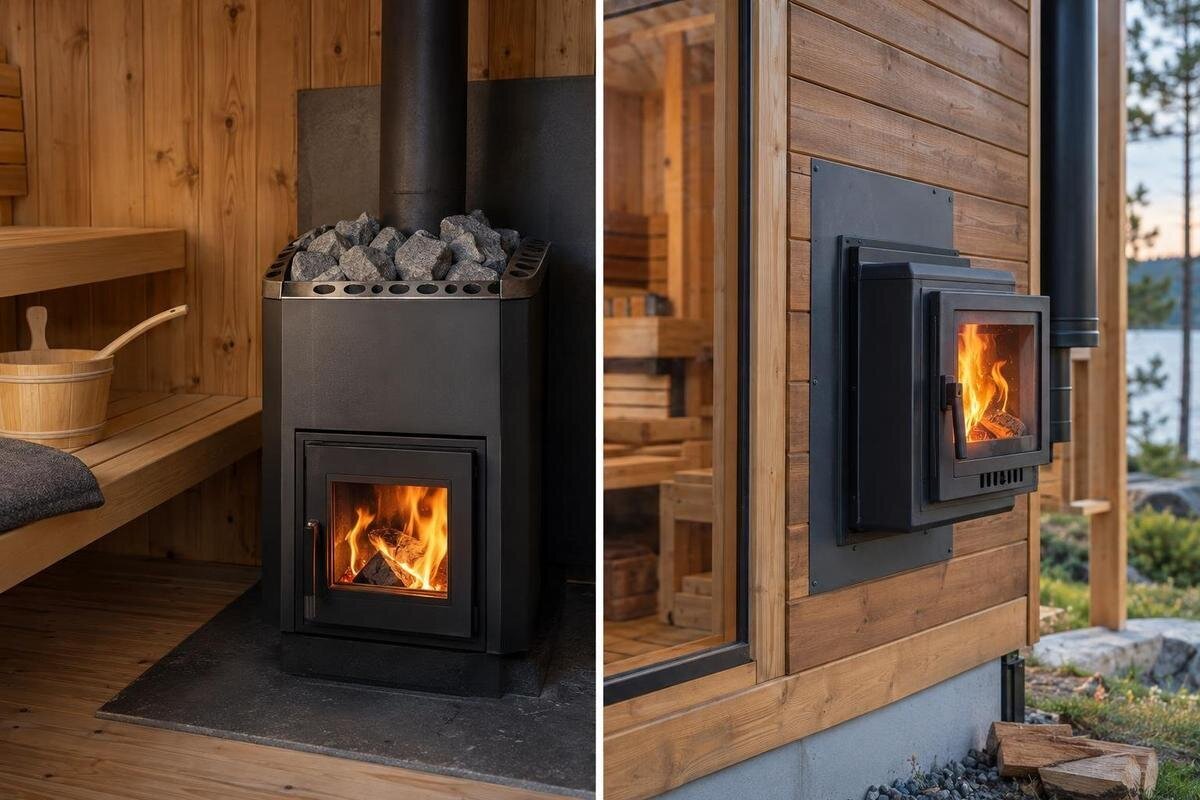
Choosing between an internally and externally fed wood-fired sauna heater is a decision about where you load the firebox, but it affects more than convenience. The route for logs, the space a person needs while tending the fire, and access for cleaning all change with the loading side. An external feed can move fuel handling beyond the hot room; it also depends on an approved wall arrangement and a usable adjoining space. Neither label proves that a particular heater will fit a particular cabin. Compare the exact heater and cabin documents before deciding which layout works for the site and your routine.
What internally and externally fed mean
An internally fed heater has its loading door facing the sauna interior, so logs are put into the firebox from the hot room. With an externally fed design, the loading door is reached from an adjoining room or from outdoors, often through a wall; some or all of the heater body may still sit inside the sauna. “External feed” does not tell you how much of the appliance is outside. Designs and product terminology vary, so use the manufacturer’s drawing to identify the firebox, loading door, heater body and access points. A photograph may show the heater’s appearance, but not how the feed arrangement is constructed or whether the door is intended to face indoors or out.
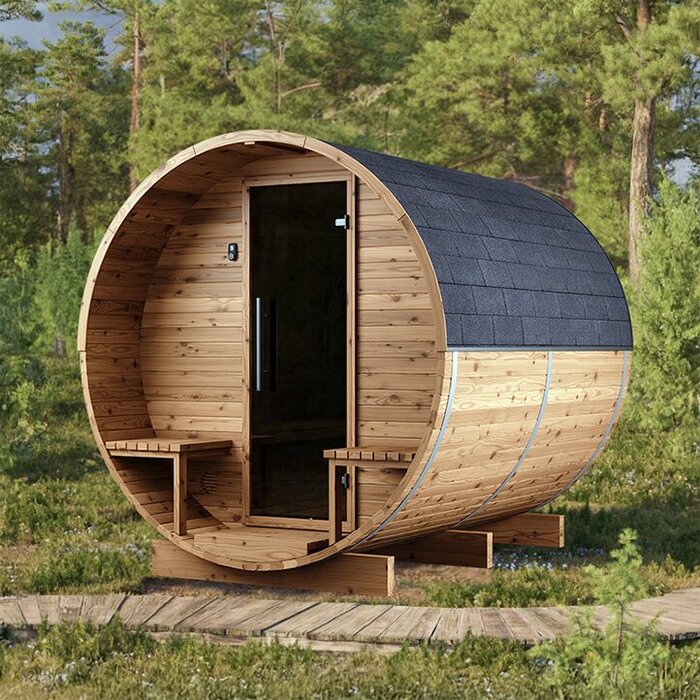
Treat those positions as layout choices, not performance grades. The loading arrangement by itself does not establish a heater’s output, fit, air supply, installation clearances or suitability for a cabin. For example, the S-140 Thermowood Barrel Sauna listing gives an area of 1.93 m²; that figure describes the cabin’s area, not the heater type it can take. Ask the supplier to confirm the exact sauna and heater models, the documented feed configuration and whether the drawing matches the wall and room arrangement you have in mind. If left- or right-hand access is involved, confirm it for the exact version rather than assuming it can be changed.
How internal loading changes the sauna routine
With an internal feed, the person tending the fire carries logs through the sauna entrance and opens the loading door from inside. That avoids a separate loading opening through a wall and keeps the firebox door reachable without going to another room. The trade-off is that refuelling and any initial ash handling take place in the sauna. Bark or small pieces of wood can add to cleaning, while a basket occupies space as it is moved; allow for both in the route. If the entrance has a tight turn or threshold, include that too. Decide where fuel can be kept in line with the heater instructions, rather than treating an empty corner as storage.
An area figure cannot answer whether that routine will fit. The HC-150 Thermowood Barrel Sauna listing states 2.97 m², but one number does not show a suitable standing position, clear route or approved heater location. Mark the chosen unit and seating on the cabin plan, then add the entrance swing and the room needed to carry wood and open the loading door. Include people moving between entrance and seats, not just the person feeding the fire. The manual and installer must determine clearances and any guard; do not treat a convenient-looking gap as a safe clearance or count a heater guard as usable seating space.
What external loading changes
An external feed lets you bring fuel to the loading door from an adjoining room or from outdoors, depending on the model. This can reduce log carrying and loose bark in the hot room, and the person feeding the fire need not stand beside the seating. The benefit depends on the actual route: a nearby, accessible wood store may make it practical, whereas a longer walk around the building may remove much of the convenience. When considering the HC-225 Thermowood Barrel Sauna listing, which gives an area of 4.4 m², establish where the loading door would be positioned in a supported heater configuration. Check doorways and thresholds along the approach, as well as the distance from the wood store.
Plan a clear working area on the loading side, including space for the door to open and for someone to approach without blocking an everyday route. If the door faces another room, check how it relates to other doors and normal movement; if it faces outdoors, consider whether the path to the wood store remains practical in wet or windy weather. The maker’s instructions determine the acceptable external arrangement. If the heater body remains in the sauna, it still occupies floor space and needs its specified clearances. Confirm which operating and cleaning tasks still require entry into the sauna; the feed position does not settle ventilation, flue placement or repair access.
Map the route from the wood store to the firebox
Draw the route from the place where wood is kept to the firebox before fixing the heater position. With internal loading, follow the path through the sauna entrance and around the seating; include the turns needed to carry a basket and the place where someone will stand. With an external feed, map the route to the separate door and show its swing and the approach to it. Mark where a basket can be put down without blocking a door. Also trace the reverse route for ash or parts that need to be removed, because the easiest way to bring in a log may not be the easiest way to carry something out. Consider other people entering or using the adjoining space at the same time.
Use the exact cabin plan and selected heater drawing to map circulation. For the N-210 Thermowood Barrel Sauna listing, which states an area of 4.43 m², obtain the internal dimensions, bench positions and door layout before comparing loading routes. Mark the loading door, heater body, seats, entrance and intended place for setting down fuel, then ask the installer to check the arrangement against the maker’s requirements. A sketch is useful for comparing options, not for determining the required wall opening or clearances. If a route works only by moving a seat or standing in a doorway, resolve that conflict before ordering.
Keep loading access clear of seats and walkways
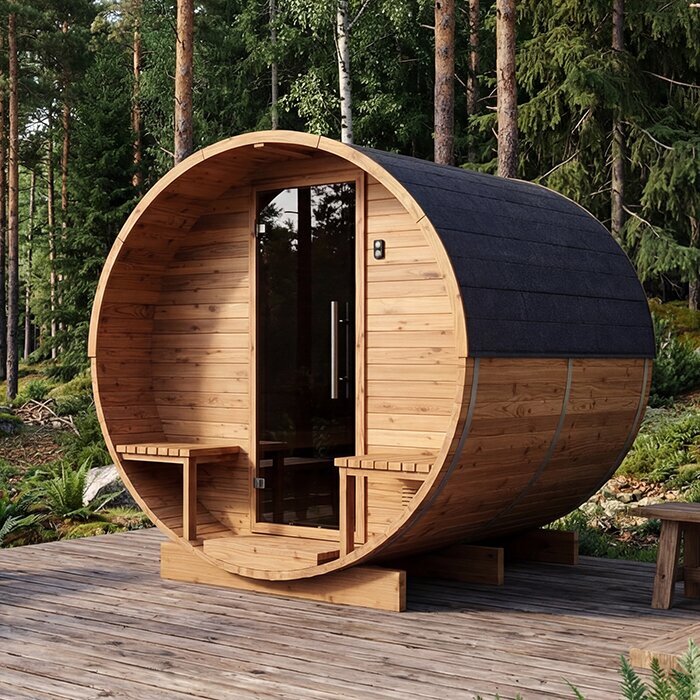
The loading door needs to be reachable without turning a seating area into a work zone. With internal loading, allow for the person opening the door and placing a log, as well as people moving past. A route to the exit should remain clear when someone is tending the fire. Keep seats and loose items outside the heater’s specified clearances, and check whether the manufacturer calls for an approved guard in that configuration. An area that looks adequate on paper may still have no practical standing place or turning space. Include the opening arcs of both the sauna entrance and heater door, and use the actual cabin plan and instructions rather than a general rule of thumb.
An external feed relocates the person tending the fire but does not remove the heater body or its access needs inside. Seating, circulation, protective measures and maintenance access may still affect the interior arrangement. When reviewing the N-250 Thermowood Barrel Sauna listing, with its stated area of 5.27 m², compare the proposed seating plan with the heater’s position and access requirements. Check both sides of the wall: the external loading point can be clear while a bench or passage inside is obstructed. Have the supplier or installer review where a person stands on each side and whether the approach to the loading door conflicts with another doorway.
Ventilation and flue planning remain separate
Feed position and ventilation are separate questions. The loading door’s location does not show how the chosen wood heater obtains combustion air or how the sauna must be ventilated, and a feed-through opening should not be assumed to provide either. Combustion air and room ventilation are related but not interchangeable. The heater manual and sauna design need to be considered together, including the flue route, clearances from combustible parts and any specified air arrangements. These details may affect where an appliance can sit even when the loading door seems convenient. Have a qualified sauna-heater installer or other appropriate professional verify the exact heater and cabin combination. Do not copy ventilation openings or flue routes from a different sauna or heater model.
For a cabin such as the LC-260 Thermowood Barrel Sauna listing, which states 5.12 m², ask for the manufacturer’s installation drawing and confirmation of the feed version. Have an installer check the ventilation and flue arrangements against the intended cabin and site. Moving the loading door does not remove the need to follow the appliance or cabin instructions. A drawing for a similar-looking model may show a different configuration, so make sure the plan covers the combination you intend to order. If it does not, ask the supplier for a supported alternative before settling the heater position.
Loading access is not service access
Refuelling access and service access are not the same thing. Ask how ash is removed, which parts must be inspected or cleaned, and which side a technician needs to reach; the answer depends on the heater. If the manual shows an ash container or removable part, establish the route and clear space needed to handle it rather than assuming the loading door serves every task. Ask how the flue will be inspected and cleaned, where tools can be brought in and whether access remains possible after seats or guards are installed. Make maintenance part of the layout comparison, and confirm who will need to reach the appliance for routine care.
An internal loading door gives access from the hot room, but the work then takes place in that room and can compete with circulation. An external feed may keep routine fuel handling outside, yet maintenance can still require access to the heater from within. For the LCF-300 Thermowood Barrel Sauna listing, which states an area of 6.89 m², compare the proposed bench layout with the selected heater’s service-access requirements. Identify where removed ash, tools or parts will be handled and how they will be carried out. A door reachable for loading may not leave enough room for cleaning, inspection or repair.
Wall construction and through-wall loading
Where the feed door passes through a wall, the opening is part of the heater’s fire-safety installation, not a simple convenience hole. The manufacturer must specify a configuration suitable for that type of wall and feed arrangement, and the sauna construction needs to be checked against it. The position can affect the opening, any required frame or protective components, wall finish and nearby combustible surfaces. Exact distances and methods depend on the model, so do not cut or adapt a wall from a generic sketch or a similar-looking stove. A qualified installer may need to check the actual wall materials and build-up. Have the supplier and installer confirm the complete arrangement before work starts.
An internally fed layout avoids a separate wall opening for loading, but it still has to meet the heater’s clearances and the cabin’s instructions for the flue, floor and surrounding materials. For the HCF-300 Thermowood Barrel Sauna listing, which states an area of 6.89 m², obtain the cabin’s wall details alongside the exact heater documentation. Have a professional review how the proposed heater arrangement fits the cabin construction on site. If an outdoor-facing loading door is proposed, confirm that the configuration is intended for that position. Do not assume a custom opening or alteration will make an undocumented combination suitable.
Which layout fits your site and routine?
An internal feed may suit a plan with no useful adjoining loading area, an approved internally fed heater and a workable route through the sauna entrance. It lets the user tend the fire from within and avoids a separate wall opening for loading. The arrangement is less convenient if carrying logs repeatedly crosses seated users, if the person tending the heater blocks the exit, or if there is no suitable standing space beside the door. Think about who will load the fire, where wood is kept and how the route works during ordinary use, not just when the room is empty. Consider the number of trips that person will need to make.
An external feed may suit a site with accessible adjoining space, a practical route from the wood store and a documented through-wall configuration. It can make loading possible without entering the sauna, but only if the loading door remains reachable and does not become a bottleneck. It may be a poor fit when the wall opening conflicts with seating, the external loading area is awkward to reach, or the exact cabin and heater combination is not approved. Consider how usable the route will be in the weather you encounter, not only on installation day. Neither layout is automatically safer, cleaner or more comfortable; each moves the work to a different place.
What to confirm before ordering
Before ordering, identify the exact heater model and ask whether the selected version is internally or externally fed; do not assume a similar name or another variant has the same door position. Request the manufacturer’s drawing showing the appliance body, loading door, required clearances and wall interface. Confirm which parts or extensions belong to that documented configuration, and whether the cabin maker accepts the proposed arrangement. Ask whether the feed side is fixed or offered as a variant, and confirm that the configuration is available in the local offer you intend to buy. A cabin listing may identify a sauna and its stated area, but does not prove heater compatibility.
Have the proposed layout checked against the actual site: the fuel route, loading-door swing, seating and circulation, ventilation and combustion-air requirements, flue route, service access and any protective measures required around the heater. Ask who will handle routine cleaning and what access that person needs, not only who will carry logs. Keep the final heater instructions and drawing with the purchase details so the installer works from the same specification. If the supplier cannot confirm the exact configuration, choose a documented option rather than relying on an improvised adaptation. Resolve any conflict between the cabin and heater documents before work begins.
Frequently asked questions
Can any wood-fired heater be installed with an external feed?
No. External loading must be a configuration designed for the exact heater, including any required feed extension or wall components. Do not assume that an internally fed model can simply be turned around or fitted through a wall. Check the manufacturer’s drawing and have a qualified installer review the proposed cabin layout.
Does an externally fed heater sit entirely outside the sauna?
Not necessarily. The term usually describes where the loading door is accessed, not the position of the whole appliance. The heater body may remain inside while the firebox door is reached from an adjoining room or from outdoors. Check the manufacturer’s drawing to see the arrangement for the exact model.
Is an external feed always safer and cleaner?
No. It can reduce the amount of wood carried through the sauna, but it adds a loading position and may involve a wall opening that needs to be designed for the heater. Safety and cleaning depend on the installation, clearances, operating instructions and routine care, not on the feed label alone.
Can I choose the feed layout from cabin area alone?
No. An area figure does not show the heater’s feed side, available clearances, seat positions, wall construction, ventilation or service route. Compare the cabin plan with the drawing for the exact heater, then confirm that the proposed combination is supported.
Which layout is easier to maintain?
Neither is automatically easier. Internal loading makes the firebox door accessible from the sauna, while external loading moves that task elsewhere. Ash removal, flue cleaning and repairs may need different access points. Compare the heater’s maintenance instructions and make sure the required routes remain clear in the final layout.
Choose by tracing the real route for the person, fuel and maintenance, then compare it with the drawings for the exact equipment. Internal loading may suit a plan where carrying logs through the sauna is manageable and the heater’s interior access can be kept clear. External loading may be convenient when an adjoining space is genuinely usable and the manufacturer documents the wall arrangement. The better layout is the one that works for your routine without compromising circulation or service access; neither label is a substitute for a confirmed installation plan.
