
Working Out Rainwater Storage for a Greenhouse
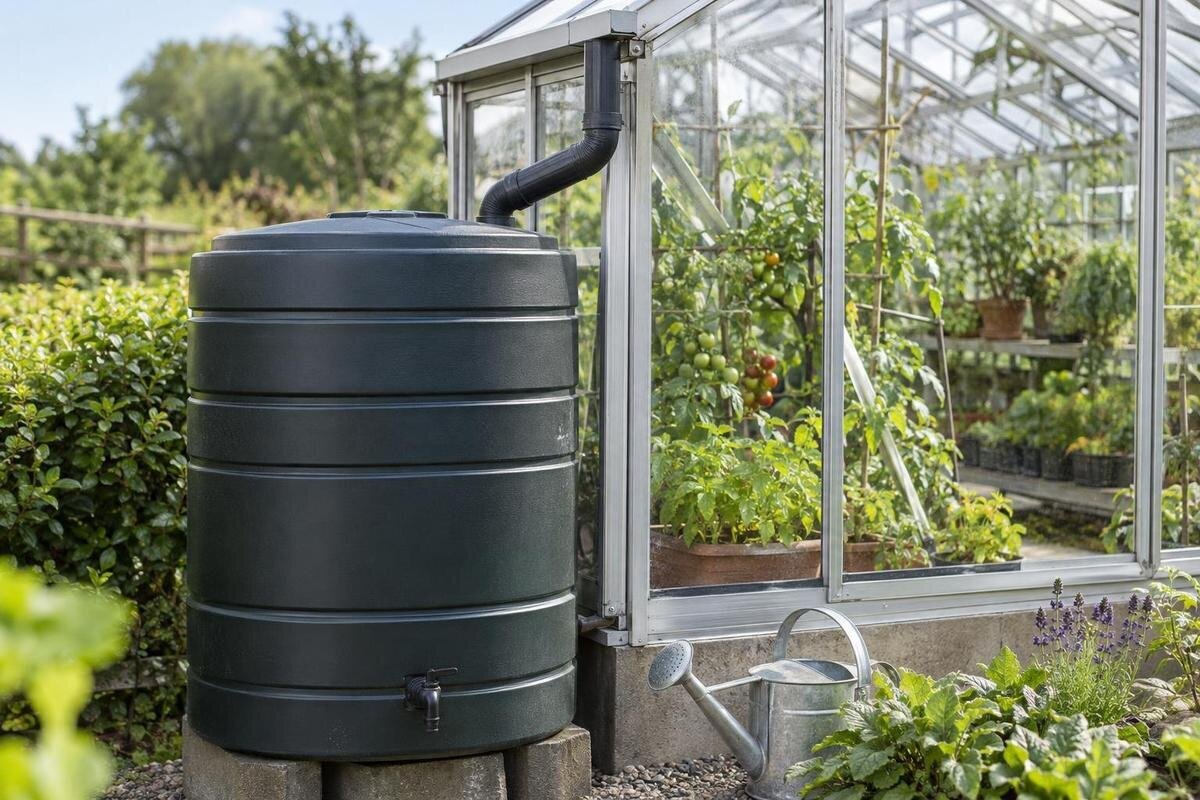
Greenhouse water planning
Rainwater storage for a greenhouse depends on three figures: the roof area that actually drains to the tank, the volume of rain that reaches it, and the water your plants will use before the next useful rainfall. For a greenhouse in Malta, an annual rainfall total alone cannot tell you whether storage will last through a dry spell; timing matters as much as the total. Measure the catchment, work from local rainfall records and your own watering routine, then check usable capacity and overflow separately. The method below turns those inputs into a tank-size range rather than a misleading one-number guess.

Tank-sizing checks 1
Measure the roof area that will feed the tank
The basic conversion is straightforward: 1 millimetre of rain falling on 1 square metre of horizontal catchment equals 1 litre before losses. For a rectangular roof, multiply its horizontal length by width; for a roof with several planes, add their horizontal projections without counting any area twice. With a pitched roof, use the area seen from above, not the larger sloping surface. A greenhouse floor measurement is only a starting clue: overhangs and roof sections may send water to different gutters. The Aluminium Greenhouses listing covers sizes from 3.77 to 28.08 m², but that range is not the catchment area of your chosen variant.
Count only surfaces that drain to the tank. Exclude side panels or any roof section whose water runs elsewhere; do not add a nearby house roof or canopy unless its runoff is intentionally connected and the whole arrangement has been checked. Include an overhang only if its runoff enters the gutter. Sketch the roof, mark each gutter and outlet, and note the measured dimensions in metres. For a complex shape, break the horizontal projection into simple rectangles or triangles and add those areas once. This prevents a common overestimate: treating every square metre of greenhouse as though it contributes equally to one tank.
Use rainfall records for the greenhouse site
Use rainfall data relevant to the plot rather than relying on an annual total for a wider region. A rain gauge placed clear of eaves and obstructions can show what falls at your site; compare it with reliable local records if available. Daily or event totals are more useful for tank planning than annual totals alone because they reveal the gaps between showers and show when heavy rain arrives while a tank may already be full. Look across several years where records allow, rather than letting one unusually wet or dry year set the design. Monthly totals help identify seasonal patterns, but they do not show how rain was spaced within the month. Decide how many rain-free days you want the tank to cover.
Match each rainfall figure to the same catchment area and time period. If a record gives 10 mm in an event and the horizontal roof projection is 6 m², theoretical yield is 60 litres before collection losses. Do not multiply an annual rainfall total by roof area and call the answer tank capacity: that is a possible annual collection total, not the volume available during a dry interval, and surplus can spill before later demand. The T-Model Orangery Greenhouse listing covers variants from 16.52 to 30 m²; identify the exact configuration before assigning a roof area, because a product-family range cannot replace that measurement.
Tank-sizing checks 2
Allow for losses between roof and tank
The roof-to-tank route reduces the theoretical figure. Some water can miss the gutter, splash out, remain in a channel, leak at a joint or be diverted by a first-flush arrangement. Debris or a blocked screen can also interrupt collection. The combined effect depends on the actual roof and fittings, so do not apply a supposedly universal percentage without a reason. Write the calculation as: expected collection in litres = rainfall in millimetres × horizontal catchment in square metres × collection factor. Treat 1.0 as the no-loss ceiling for a simple vertical-rain estimate, not a guarantee; use a lower, clearly stated factor where measured losses or system design justify it.
If possible, estimate the factor from your own system. Record a rain event, its measured depth, the tank volume before and after, and any water used or deliberately diverted in between. Choose an event when the tank has room, or overflow will cap the reading. A product title such as Pyramid Greenhouse identifies a model, but does not establish whether a gutter, outlet or collection accessory is included. Check the actual installation details rather than estimating yield from an image. Clearing gutters can improve reliability, but it does not remove the need to account for losses.
Estimate water use from the plants
Estimate demand from the plants you actually intend to water. List each bed, pot group or growing area, then record the volume delivered during a normal watering using a marked container, a meter or another repeatable measure. If different crops are watered on different days, total the full cycle and convert it to an average per day or week. Keep higher-use periods separate if demand rises as plants grow or conditions change. Avoid a generic litres-per-square-metre rule where you can measure your own routine. Watering habits, container size and crop stage can make two equally sized greenhouses use very different volumes.
Separate the water supplied from the tank from any mains or other backup source, and note water that drains away unused. The tank needs to cover only the use you plan to supply from rain, but the calculation should not quietly count backup water as tank supply. The name Aluminium Greenhouses with Storage – Limited Edition does not establish that a rainwater tank or collection system is included; check what the selected configuration actually provides. Keep pot and bed totals separate if their schedules differ. This makes the demand estimate more realistic and helps identify which part of the watering routine is using the most stored water.

Tank-sizing checks 3
Choose the dry spell the tank should cover
Size the tank to bridge an intended gap between useful rainfall, not to hold a whole year’s theoretical roof yield. Choose a planning interval using local records and your own observations rather than relying on a fixed rule. For a simple conservative test, assume no dependable rain during that period: usable capacity required = tank-supplied daily demand × chosen rain-free days. Add a deliberate reserve if you want extra cover. If you expect rain to refill the tank during the interval, model that separately and do not assume average rainfall will arrive exactly when the stored water is needed.
Decide what you expect the tank to supply. If you plan to water only part of the greenhouse from rainwater, calculate demand for that area; if you expect it to supply every bed and pot, include them all. The Limited Edition Aluminium Greenhouses range offers multiple size options, but greenhouse size alone does not tell you how much water you want available through a dry spell. Write down both assumptions beside your result: the number of days to cover and the litres used per day. Comparing a shorter and a longer interval will show how much extra capacity a larger buffer requires.
Check the calculation with an example
Consider a made-up example to check the arithmetic, not as a Malta rainfall forecast. A roof projection of 3 m by 2 m gives 6 m². A 10 mm shower would produce 60 litres before losses, because 10 × 6 = 60. If a trial of the actual gutter route shows that only 50 litres reach the tank in a comparable event, use 50 litres as the practical yield for that event; do not count all 60 as stored. The Bloomcabin Prestige Greenhouse listing covers variants from 3.77 to 28.08 m², so the example’s 6 m² catchment should not be transferred to a real model without measuring its roof.
If your recorded use is 12 litres a day, seven rain-free days require 84 litres of usable water: 12 × 7. A 50-litre collection would be 34 litres short of that week’s demand if no other water arrives. A tank with 84 litres of usable capacity could cover the stated interval only if it starts full and the demand estimate holds. This separates two questions: how much one shower can collect and how much storage is needed to carry water through a dry spell. Repeat the arithmetic with your measurements. Add a reserve or allowance for unusable volume only where you have identified a reason for it.
Tank-sizing checks 4
Choose usable capacity, not just the tank’s stated volume
Distinguish usable capacity from the volume printed on a tank. Water below the outlet, a settling area or any volume the system cannot draw may not be available to plants. The manufacturer’s usable-volume information is more helpful than a headline figure alone. Add an explicit reserve if you want a buffer for extra days, and state what it covers. The target is working volume that meets calculated demand, not an assumption that every litre in the tank can be withdrawn. A larger tank will not necessarily fill: compare likely collection with demand and capacity over time. The Spacious Greenhouse range is listed from 47 to 70 m²; those size options do not directly specify a tank volume.
Use a basic water balance to test a proposed capacity: starting usable water + rainwater that reaches the tank − irrigation drawn = ending storage, subject to the tank’s usable limit. If the result exceeds that limit, the surplus is overflow; if it falls below zero, there is a shortfall. You would need to reduce use, add another source or accept a shorter period of cover. A weekly spreadsheet is enough for a first comparison, while daily entries show whether storm timing causes spills followed by a dry spell. This helps you judge whether a larger tank would retain water that is currently lost, or whether too little rainwater reaches the tank to meet demand.
Plan a safe route for overflow
Every tank needs a suitable route for water once it is full. Include an overflow outlet and direct surplus away from the greenhouse, walkways and the tank’s base. Do not assume a nominal tank size will handle an intense storm: once storage is full, roof runoff continues. The inlet, gutter and overflow must work together, and a suitably qualified installer should confirm that the arrangement can pass expected flows. If water is routed to a drainage point, soakaway or another destination, check that the receiving place is appropriate for the site and will not create pooling, erosion or nuisance.
Keep the overflow unobstructed and direct it to an endpoint that can be inspected, so a blockage is not hidden. Avoid a loose hose that can slip out of place, and do not cap the overflow to gain a few more litres; doing so transfers risk to the gutter or tank connections. Where the route is not obvious, seek advice from a competent drainage professional and check any local requirements that apply to your property. Plan for a near-full tank when a heavy shower starts. The storage calculation estimates water available to you; it is not a substitute for managing surplus water.

Tank-sizing checks 5
Verify gutters and tank connections for the chosen greenhouse
Before choosing a tank, confirm that the greenhouse can collect water in the way your calculation assumes. Check whether gutters and downpipes are supplied, whether they can be fitted to the selected configuration, where their outlets fall and whether the planned tank inlet can be connected as intended. These details cannot be inferred from a model name or image. The Wall Greenhouse page identifies a lean-to category, but it does not establish that a building’s roof runoff is included or that a particular gutter arrangement is compatible. Ask for the chosen variant’s dimensions and drainage information, and have an installer confirm any connection that is not documented.
Check tank placement, access for cleaning and whether the supporting surface is appropriate for a full vessel. Water storage adds substantial weight, so ask a qualified professional to assess the support if its capacity or base is uncertain. Make sure the tank does not obstruct a path or access to the greenhouse. Keep it covered and protect the inlet as the system maker recommends, while leaving safe access for inspection. This calculation concerns volume for irrigation only; it does not establish that captured water is suitable for drinking or every other use. If you intend a different use, obtain the relevant treatment and safety guidance.
Use real records to refine the estimate
Treat the first season as a measurement exercise. After each useful rain, note rainfall depth, the tank’s starting volume, how much water it collects and whether any overflows; record watering drawn before the next event. If the tank reaches full well before a dry spell, the roof may produce more water than the chosen storage can hold at that time. If it empties sooner than your model predicts, check the demand log, leaks, diversions and actual rainfall at the site before deciding that a larger tank is the answer. Consistent records help show whether the main limitation is roof capture, storage capacity or plant use.
Review the calculation when the planted area or watering routine changes, rather than keeping last year’s number as a permanent answer. Use observed dry gaps to reconsider the planning interval, and update measured use as crops mature or pots are added. Include the overflow route in the review too: a change to a gutter or tank position can alter where excess water goes. The most useful estimate is a transparent calculation that can be corrected using the greenhouse’s own rainfall, storage and watering records, rather than a single figure taken from a catalogue or annual average.
Frequently asked questions
How many litres can a greenhouse roof collect from 1 mm of rain?
One millimetre of rain on 1 m² of horizontal roof area is 1 litre before losses. Multiply rainfall depth by the roof area that drains to the tank, then allow for water that misses the gutter, is diverted or overflows.
Can I use the greenhouse floor area to size the tank?
Use the horizontal projection of the roof that actually feeds the tank, not the floor area as a shortcut. A pitched roof’s sloping surface is not the same measurement. Check the chosen greenhouse’s dimensions and which roof sections drain into its collection route.
What collection factor should I use?
There is no single factor that suits every roof and gutter arrangement. If the system is already in place, compare rainfall with the volume that reaches the tank, accounting for any water used or diverted during the test. If it is not installed yet, label any allowance as an estimate and review it after collecting real data.
Should the tank hold all the water from the biggest storm?
Not necessarily. Size storage around the amount you want available through a chosen dry spell. When the tank is full, further rain needs a suitable overflow route, so storage capacity is not a substitute for planning how surplus water will drain.
How do I know whether my chosen tank is large enough?
Compare its usable capacity with your measured tank-supplied demand over the number of rain-free days you want to cover. After installation, record rain, water collected, watering use and overflow. Those figures show whether the limiting factor is storage, roof collection or demand.
A sensible tank size provides enough usable water to cover a chosen dry spell at measured demand. The roof must also collect enough rainwater to replenish that supply, and surplus water needs a suitable overflow route. Keep the assumptions visible and update them with actual rainfall, collection and watering records. That gives you a practical storage figure for your greenhouse, rather than one based on roof area or annual rainfall alone.
