
Buying a Freestanding Greenhouse: Choose Its Position Before Ordering
Greenhouse buying guide
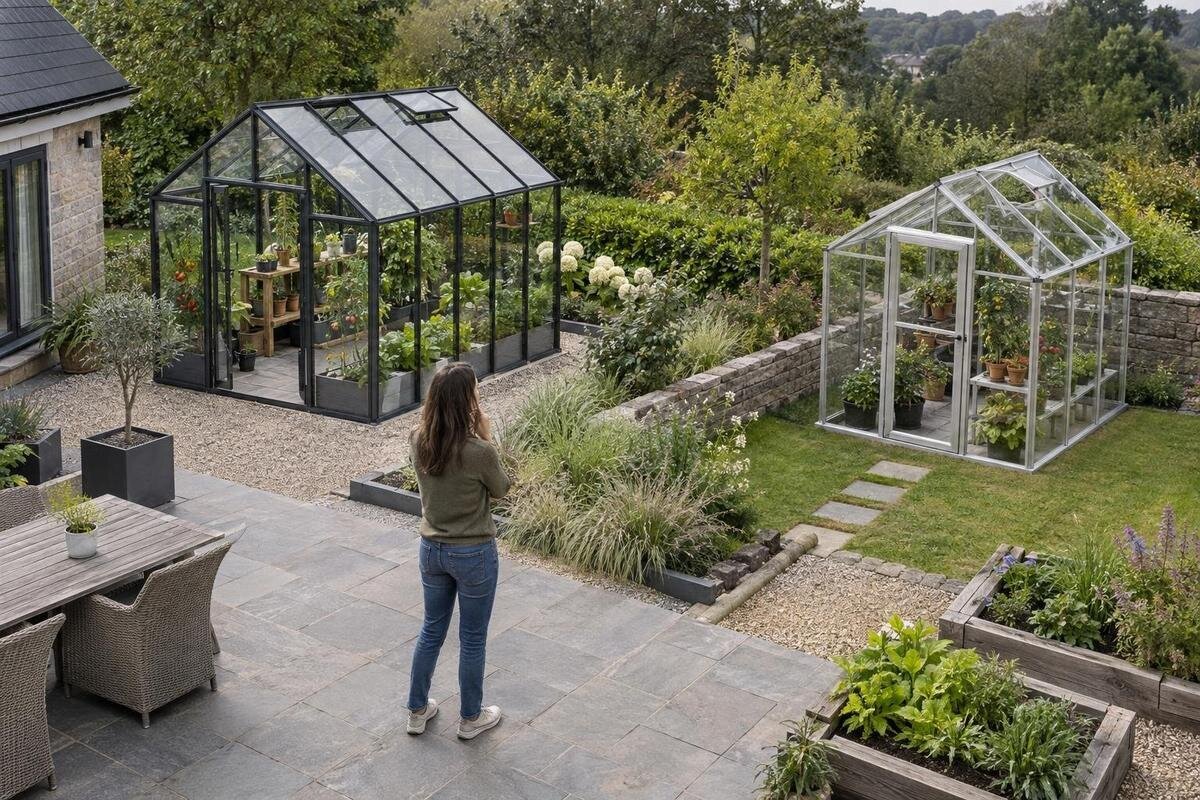
Before you buy a freestanding greenhouse, decide where it could stand and test that spot against the requirements of actual models. A patch that looks sunny on one visit may be shaded in another season; a position with good light can still be exposed to gusts, hold water or be difficult to reach. Marking out a likely footprint and checking the ground, access route and nearby obstacles gives you a practical basis for comparing listings. It also helps you distinguish a genuinely freestanding design from a model intended to sit against a wall or use a particular base.

Before you order 1
Confirm the greenhouse is genuinely freestanding
A freestanding greenhouse needs a position where it can stand as an independent structure, with room for its own footprint and the support arrangement specified for that model. Before comparing dimensions, decide whether the available area is open enough for the type you want, rather than assuming every greenhouse can sit anywhere in the garden. A wall-mounted model has a different relationship with a building, so assess a freestanding design against its own installation requirements. Do not count a fence or house wall as support unless the product instructions explicitly make that arrangement part of the design. A freestanding label does not, by itself, tell you whether the chosen ground or base is suitable. Confirming the type first also helps you allow access around it.
Product labels can make the distinction easy to miss. For example, the T-model wall-mounted greenhouse listing identifies a wall-mounted type; that wording is not evidence that it can stand independently. Check the product category, installation diagram and component list before putting an option on a freestanding shortlist. If a wall or fence is near your preferred position, account for its effect on light, access and working space, but do not treat proximity as proof of compatibility. Use the exact model information rather than a broad category page or a photograph; neither alone establishes what support the design needs.
Check sunlight across the year
Spend time observing the proposed footprint rather than judging sunlight from one visit. Note which parts receive direct sun in the morning, around midday and later on, then repeat the check when the sun's path changes through the year. Winter shadows from houses, fences and trees can reach farther than summer shadows, while deciduous trees may block more light when in leaf. A site that looks bright from the gate may have a shaded strip across one end. Mark the greenhouse's full outline on the ground before recording the light. A simple sketch or note is more reliable than memory, especially when comparing two positions weeks apart.
Match that pattern to what you expect to grow and to the guidance for the chosen greenhouse; no single site suits every garden or growing plan. Note whether the best-lit position conflicts with wind shelter, access or the space needed around the structure. For a candidate such as the Bloomcabin Orangerie listing, use its actual published footprint and layout, if provided, when assessing the sunny patch. Do not infer entrance direction, dimensions or suitability from a model name or photograph. If two positions are close, compare them at the same times on more than one day and revisit when seasonal shade is relevant.
Before you order 2
Assess wind exposure and shelter
Check how the site behaves in wind, including gusts that are not obvious on a calm day. Open corners, exposed ridges and gaps between buildings can funnel moving air; a hedge, fence or building may reduce some exposure but can also create turbulence or shade. Notice how nearby foliage and garden furniture move in breezier weather, and ask household members whether the area is regularly windy. Check more than one direction, because shelter on one side can leave another approach exposed. Think about recurring patterns rather than deciding from a single afternoon, when conditions may not represent the site's usual exposure.
Use the exact model's installation and siting information to judge whether it is appropriate for the exposure you have observed. A product name such as the limited-edition aluminium greenhouse listing does not establish a wind rating, anchoring method or suitability for an exposed garden. Check whether the manufacturer gives requirements for the intended setting, and ask the supplier or a qualified installer if the guidance does not cover your site. Avoid planning improvised supports or attachments; installation should follow the instructions for the selected product and your ground conditions. Resolve any uncertainty about exposure before ordering.
Check drainage and ground condition
Visit the proposed position after rainfall, not only when the surface is dry. Look for puddles, soft patches, muddy runoff and places where water gathers against paving or a fence. Check whether the ground slopes, falls away unevenly or shows signs of settling; a shallow-looking dip can still affect drainage or the base area. Repeat the check after another rainfall if drainage seems inconsistent. If the same low spot remains wet, do not plan around it without checking the cause and a suitable approach to the base. Where the ground condition is unclear, ask a qualified professional to assess it before choosing a position.
Record what the greenhouse would sit on: lawn, bare soil, paving, an existing slab or a mix of surfaces. Note cracks, loose pavers, soft edges and any area where runoff is directed. A surface can look flat without being suitable for the model's foundation, so compare what you see with the actual installation requirements rather than assuming a hard surface is ready. Even a general listing name such as the Aluminium Classic greenhouse listing cannot tell you how your particular ground will behave. Separate site-preparation questions from product claims and get help where the surface needs assessment.
Before you order 3
Match the base to the site
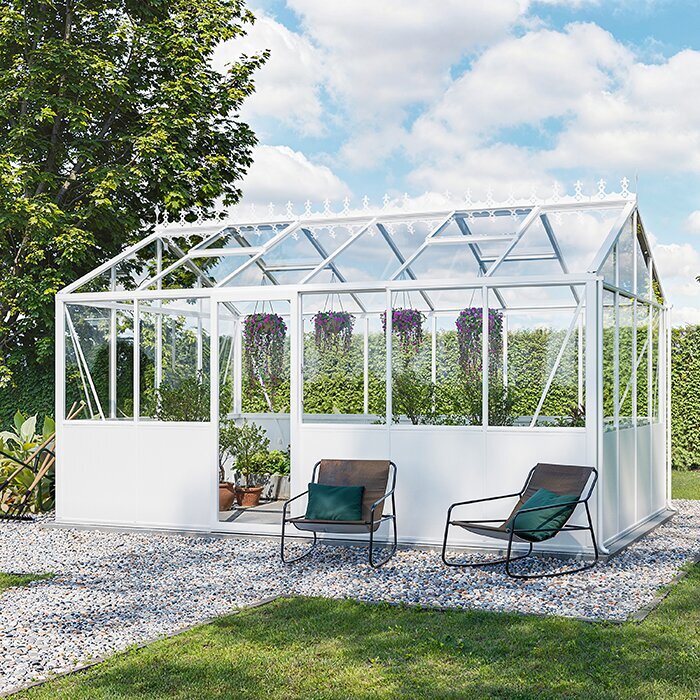
Treat the greenhouse base and the site beneath it as one purchase decision. Find out which foundation or base arrangement the exact model calls for, what parts are included and what must be prepared separately. The wording in the Bloomcabin Prestige greenhouse with metal foundation listing is a prompt to verify those details, not a complete installation plan. A title alone does not explain the installation, anchoring, ground preparation or whether your chosen surface meets the instructions. Read the current product details and assembly guidance before arranging work. If the information is unclear, ask the seller or installer to identify the specific requirements.
Compare those requirements with the actual position, not an idealised level patch. Existing concrete or paving may have joints or a slope; soil and lawn can change with moisture, and different parts of a garden may settle differently. Do not assume that a supplied base removes the need for preparation, or that a base sold separately will compensate for unsuitable ground. Confirm what the seller supplies and what you must arrange for site preparation; similar terms such as base and foundation can refer to different parts of the job. Where foundations, anchoring or ground stability are uncertain, get qualified advice rather than estimating from appearance.
Measure the footprint and working clearance
Measure the model's overall outside dimensions, not only the space you hope to use for plants. Mark its length and width on the ground with a tape, string or temporary markers, then check that the outline fits without cutting through a path or garden bed you need to keep. Include any foundation dimension or projection if the product information gives one. Do not infer size from a model number: the number in the Classic Plus 385 listing is not a measurement unless the product details explicitly say what it means. Use figures for the exact version you intend to order, not measurements remembered from another model.
The footprint is not the whole space requirement. Check the height and roofline, entrance position, door opening, windows or vents that need to open, and any external parts shown in the model drawings. Allow a workable margin for opening, cleaning, repairing and moving around the sides; the distance needed depends on the design and your garden, so do not copy a clearance from another greenhouse. Consider nearby fences, eaves, shrubs and paths where they could obstruct access. A paper plan showing the base and open-door positions can reveal a clash before purchase.
Before you order 4
Plan the delivery and access route
Trace the route from the point where delivery can be received to the greenhouse position. Check the narrowest gate, turns, steps, sloping sections, low branches and soft ground; a clear final site is not useful if components cannot be brought to it. Measure openings and pinch points, but compare them with packaging dimensions only when the supplier or delivery provider confirms those figures. Do not guess from the finished greenhouse dimensions, as a large item may be handled differently once unpacked. If a gate opens into the route or a path is shared with other garden access, include that in your plan before ordering.
Allow for a practical work area as well as the path. Whoever is assembling the greenhouse will need room to set components down and keep walkways clear. Check whether a gate can stay open, whether a wheelbarrow can approach, and where packaging can be kept while work is under way. The narrowest pinch point matters more than the width of the gate alone, particularly where the route turns or changes level. Keep access to doors, taps and existing garden routes in mind after the greenhouse is in place. If the route is tight, ask what delivery and handling details are available before committing.
Account for trees, structures and services
Look up and around the proposed site as well as at the ground. Mature trees can cast changing shade, drop leaves or small branches, and their roots may affect the space available for ground preparation. Eaves, fences and neighbouring structures can reduce daylight or direct rainwater onto the greenhouse area. Note where gutters discharge and whether nearby vegetation may grow into the space you need to keep clear. A site that works today may become less usable if a hedge is likely to thicken or a planned garden feature will block access, so consider changes already expected in your garden.
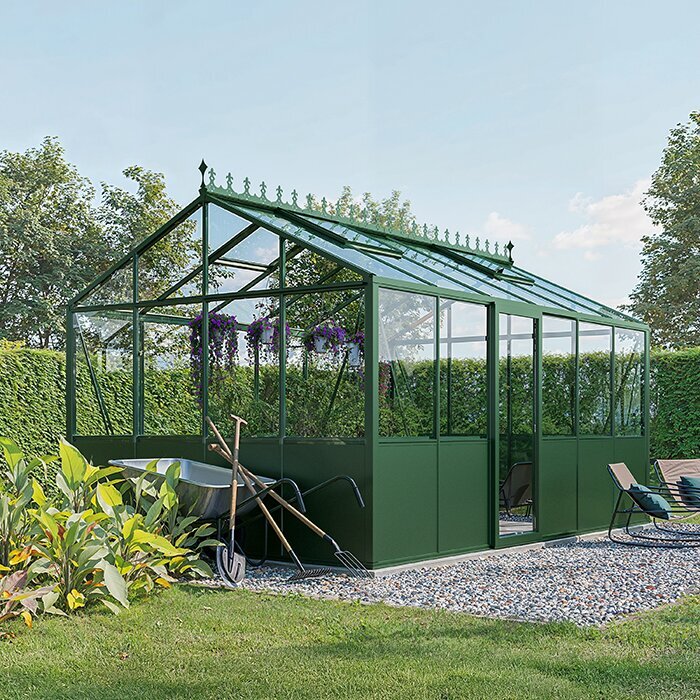
Identify drains, pipes, cables and other services before anyone digs or anchors anything; the surface does not reliably show what lies below. If you have an existing paved or masonry area, do not treat its appearance as proof that it matches a model's base requirements. The wording in the Pyramid greenhouse for a masonry base listing flags a detail to verify, but it does not confirm that your existing surface is ready or that anything is included. Ask for the exact model's requirements and get qualified help if ground work or buried services are uncertain. If the position is close to a boundary or shared access, check any relevant site constraints before ordering.
Before you order 5
Compare the exact product details
Once you have a possible site, compare it with the full details for each exact model, not just a category page or product name. Confirm the outside measurements, height, entrance and opening positions, foundation requirements, included parts, installation instructions and any siting guidance given by the manufacturer. Keep a short note of what is confirmed and what remains unanswered; this makes it easier to compare candidates without mixing up figures. Check that product drawings and written measurements refer to the same version, particularly where a range has several models or configurations. Keep the model name and its details together in your notes.
A listing with a different installation type still needs to be read on its own terms. For example, the Aluminium Wall Greenhouse listing names a wall greenhouse, so do not use it as the basis for a freestanding layout unless the exact product details confirm it is the model you need. Review each page's stated dimensions and siting instructions, and ask the seller to clarify a missing measurement or component. Product images can help you recognise a model, but they cannot confirm dimensions, foundation suitability or whether it fits the conditions at your address.
Decide whether the site is ready for an order
Before ordering, make a simple site record: the proposed position, marked footprint, sunlight notes, wind exposure, ground condition, nearby obstacles and route in from the delivery point. Put the chosen model's confirmed measurements and base requirements beside it. Revisit the site after rain or in different light if those conditions have not yet been checked. This lets you weigh the practical constraints together rather than treating one attractive feature as a complete answer. If an essential detail remains unknown, such as the base arrangement or whether the model suits the site's exposure, hold the decision until you get clear guidance.
Compare the shortlist against that record and decide whether the position is workable, needs preparation or should be ruled out. If work is needed, establish who will assess and complete it before committing; if the footprint conflicts with a gate, tree or path, test another location before changing to a smaller or different model. Keep a second position in mind only if it passes the same checks. That way, the greenhouse you choose is tied to a real place in the garden, not to an assumption that can only be tested after it arrives.
Common questions
How do I check whether a spot gets enough sun?
Observe the marked footprint at several times of day and revisit it as the seasons change. Nearby buildings, fences and deciduous trees can alter the shade. The right amount of light depends on what you plan to grow and the guidance for your chosen greenhouse, so do not base the decision on one bright afternoon.
Does a greenhouse need to be sheltered from wind?
Some shelter can be helpful, but a fence or hedge does not guarantee protection and may create shade or turbulence. Check the exact model's siting guidance against the exposure you have observed. If the position is exposed or the guidance is unclear, ask the supplier or a qualified installer before ordering.
Can I put a freestanding greenhouse on soil?
It depends on the exact model's base and installation requirements and the condition of the ground. Check whether the area is firm, level and drains appropriately, then compare it with the manufacturer's instructions. If the ground is soft, uneven or its condition is uncertain, get qualified advice before preparing the site.
How much space should I leave around it?
There is no single clearance that suits every model. Start with the published overall footprint, then allow for doors and windows to open, access for cleaning and maintenance, and any requirements in the instructions. Mark those areas on the ground and check that walls, fences, paths and plants will not obstruct them.
Should I order before preparing the site?
Choose a position and compare it with the selected model's confirmed dimensions, base requirements, access route and siting guidance first. If preparation is needed, find out what work is involved and who can assess it. Resolve important unknowns before committing rather than hoping the finished greenhouse will fit.
Choosing the position first makes the purchase more grounded: you can rule out sites that fail on light, drainage, access or space, then compare models whose documented requirements match the place. If a key detail about the ground or exposure is unresolved, pause and get it clarified. A product listing is not a substitute for a position that works in your garden.
