
Buying a Greenhouse for Snowy Winters: Questions About Structural Loads
Greenhouse buying guide
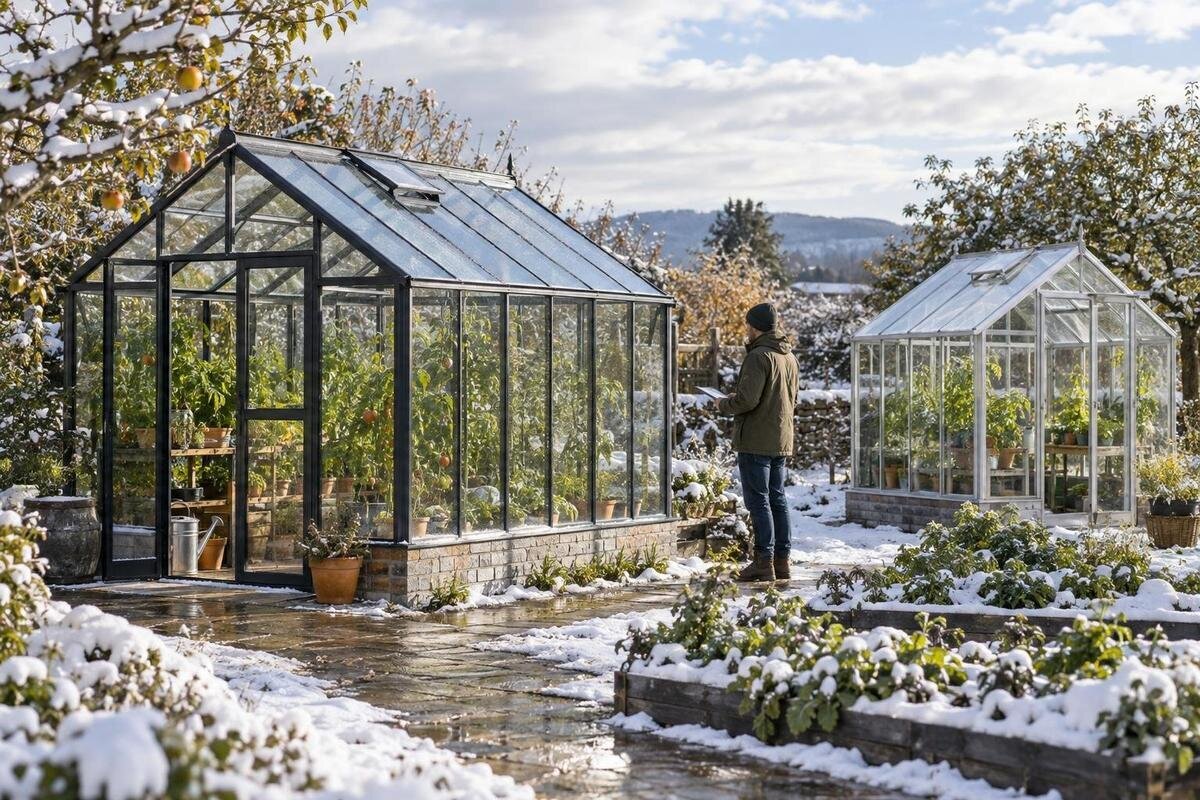
Buying a greenhouse for snowy winters means checking structural capacity alongside layout and appearance. A photograph, roof angle or product name cannot show what snow load the complete structure was designed to carry, nor the conditions assumed by a rating. Before choosing a model, ask whether snow-load specifications are available, what parts of the greenhouse they cover and whether they match your site. If the documentation is incomplete or the site conditions are uncertain, have a suitably qualified structural professional advise what needs to be compared.
Buyer checklist 1
Why snow-load evidence matters when buying
Snow suitability is not a visual judgement. A frame can look substantial and a sloping roof can appear likely to shed snow, but neither observation says what load the complete greenhouse was designed to support. Snow can vary in weight and collect unevenly, and the design may depend on more than the visible frame. Treat a missing snow-load figure as unknown, not as evidence that a greenhouse can handle local winter conditions. Ask early, before choosing a style or placing an order. Words such as robust or all-weather in a general description are not a substitute for a stated load and the conditions it covers. A greenhouse used successfully elsewhere is not proof that your site and setup are comparable.
The decision has two parts: establish the load conditions relevant to your site, then confirm that the exact greenhouse configuration has documented capacity for them. A supplier may identify product documentation; a suitably qualified structural professional can advise which site conditions need to be considered. Use the Prestige greenhouse listing to identify a candidate, not to infer performance from its name or images. If snow exposure is central to your purchase, request written information for the precise model before weighing its appearance, layout or other features. Keep the chosen options and correspondence together so you can check that any later change still matches the same evidence.
What a useful snow-load specification should say
A useful specification should identify the exact product and explain what a stated snow-load value represents, which units are used, and whether it covers the complete greenhouse or one component. Ask whether the figure is a design value, a test result or another measure, and what conditions qualify it. A number without a unit or clear definition is difficult to compare; a maximum also needs its scope and assumptions. A depth forecast is not a load rating, so do not convert between the two yourself. Ask the supplier to explain technical terms in writing. If a figure describes a test, ask what the test does and does not establish for ordinary use.
Make sure the document matches the option you would actually order: the model and variant, roof and glazing configuration, frame parts, and any base or extras that affect the structure. A product family may cover more than one setup, and a specification can be restricted to a particular configuration. The Orangerie greenhouse listing can identify the item in your enquiry; confirm whether its product documentation states the snow-load details you need. Ask the supplier to confirm that any information applies to the item in your quote and the kit to be delivered, including your selected options. Do not transfer a figure from a similar-looking model if the seller cannot link it to your chosen version.
Buyer checklist 2
Does the rating cover the complete greenhouse?
Snow acts on the roof, but the supporting structure carries that load through panels, roof members, connections, the frame and the base to its support. A rating for a roof panel or an individual frame member does not automatically describe the capacity of that complete route. Ask which parts were assessed together and whether the stated value applies to a fully assembled greenhouse in its specified configuration. The answer should make clear whether the capacity of the supports and joints is included. A connection or support omitted from the assessment can determine whether the figure applies to the finished assembly, so do not assume that a collection of strong-looking components amounts to a rated structure.
Ask what elements, if any, are excluded. A rating might name the frame but say little about anchoring, the foundation or the interface between the greenhouse and its base. Those omissions matter when comparing complete purchase options: an included base and a separately prepared support are not interchangeable assumptions. When discussing the Classic Plus 385 listing, use its exact title to identify the candidate and ask for documentation covering the whole assembly. If the supplier provides separate documents, ask how they relate. Component values cannot be combined by a buyer to create a whole-structure rating.
Ask which snow conditions the rating assumes
Ask what snow pattern and weather conditions sit behind the figure. An even covering of dry snow is not the only possibility: wet snow may weigh more at the same depth, while wind can move snow into drifts or piles. Snow slipping from a higher roof or collecting beside a change in roof form can also create a local concentration. These are reasons a simple snowfall-depth estimate is not enough; they are not conditions you should turn into a load calculation yourself. The specification should state which design cases it covers, rather than relying on a broad description such as suitable for snowy areas.
Find out whether the rating assumes an even distribution or includes specified uneven accumulations, and whether nearby roofs or other site features were considered. If a higher roof could shed snow towards the greenhouse, ask whether that situation is covered or needs separate assessment. Have a suitably qualified professional identify the relevant requirements for your location, then ask the supplier to compare the greenhouse documentation with them. Do not assume an unmentioned load case is covered. A clear answer about the assumptions makes it easier to distinguish a general product statement from information that addresses the conditions you expect at the site.

Buyer checklist 3
Roof shape and glazing are not load ratings
Roof shape is useful when comparing layout, but it is not a stand-alone measure of snow strength. A pitched roof may allow some snow to move, yet the amount retained or shed depends on the design and conditions; snow can also collect unevenly. A photograph cannot show how the roof members and joints were assessed. Likewise, a glazing description or visible panel thickness is not proof of a load rating. Ask for evidence that applies to the exact roof profile, panels and supporting frame in the version you plan to buy. Do not treat a steep-looking roof or a material label as a shortcut to structural information.
An attached greenhouse raises another question: what role does the adjoining building play? Snow may slide from a higher roof onto the greenhouse or build up near the junction, while the wall and its attachment form part of the support arrangement. Do not assume a wall-mounted design is sheltered or reinforced for those effects. For the T-model wall-mounted greenhouse listing, ask what supporting wall and adjoining conditions any load information assumes. The wall itself is not automatically part of an assessed assembly. A qualified professional familiar with the site can advise whether those assumptions fit; the listing title cannot answer that question.
Include the base and ground support in the enquiry
Include the base and ground support in the structural enquiry. Loads carried by the frame must ultimately transfer through its base and connections to the supporting surface, so ask which base or foundation arrangement is assumed by the load information. Clarify what is included in the greenhouse purchase and what must be provided separately; a name that mentions a base does not establish its design capacity or suitability for your ground. Ask for the relevant written requirements, but leave the assessment of supporting construction to an appropriately qualified professional rather than relying on a generic diagram or sales description. The support material, connections and ground conditions may sit outside the scope of the greenhouse documentation.
The distinction matters when a listing identifies a particular base type. The pyramid greenhouse for a masonry base is an item to identify, not a structural specification for the masonry, its connections or the ground beneath it. Ask whether the greenhouse rating is conditional on a particular base and whether the documentation addresses how the structure connects to that support. If the frame and base have separate documents, ask a qualified professional to review the complete arrangement rather than matching a base type by name alone. Do not assume that a base is optional unless the load documents explain what support the rated configuration requires.
Buyer checklist 4
Match the product information to your site
Site conditions are the other half of the comparison. A broad label such as snowy climate cannot describe how snow reaches a particular greenhouse: nearby buildings or trees, changes in roof height and the proposed position may affect where snow accumulates or slides. Ask a local building or structural professional to identify the design conditions relevant to the exact location, including any requirements that apply to the project. Snowfall averages, a map or a neighbour’s experience are not a substitute for considering your proposed site. Snow shed from a nearby roof, for example, may need to be considered separately from snowfall across the area.
Once you have that site brief, ask the supplier to confirm whether the published load information and the exact greenhouse configuration address it. The supplier’s product information and a professional’s site advice answer different questions. If the Aluminium Classic greenhouse listing is on your shortlist, use its exact listing name in the request and ask for documents for the configuration you are considering. If the answer is conditional, ask what assumptions must hold at your site. Have the professional explain any technical terms you need to pass on, so the requirements are communicated accurately rather than translated through a guess or an informal comparison.
Get supplier answers in writing
Request the technical sheet or other supporting material and keep it with the quotation. Ask which model or version it covers, what value and units are stated, which conditions are assumed, and what parts are included. If a response uses phrases such as heavy-duty, reinforced or designed for winter, ask what measurable specification those phrases refer to. A verbal assurance or a general product description may help identify a product, but it is not a load statement you can check against the site requirements. A dated or versioned document also helps show which information applied when you made the decision.
Match every answer to what will actually be supplied. Ask whether changes to panels, frame options, base, openings or attachment method would change the rating, and whether a later revision has different documentation. For the Aluminium wall greenhouse listing, use the exact candidate name in your correspondence, then ask what assumptions apply to its support and mounting arrangement; the name alone does not establish them. Before paying, resolve any conflict between a sales description, a technical sheet and the quotation rather than assuming the most favourable wording applies. If a replacement component is proposed later, ask whether it changes the configuration covered by the original information.
Buyer checklist 5
Find out whether snow management is assumed
Some published capacities may rely on snow being removed under stated operating conditions. Ask whether the design assumes a maintenance or snow-clearing routine, what triggers it, and whether the rating changes if snow remains in place. Do not assume that a greenhouse described as snow-rated is intended to carry every accumulation without attention. Any requirement to monitor or clear the structure affects how practical the purchase will be over time, not just how it looks in a comparison. Ask the supplier to point to the relevant operating instructions and clarify the exact conditions, rather than guessing from a general caution.
Think through who could carry out any required work and whether the site allows safe access, especially if the greenhouse sits beside another roof or in a confined area. This is not a guide to clearing snow from a roof; ask a qualified professional or appropriate contractor about safe, site-specific maintenance. Consider whether the required work can realistically be arranged throughout the season. If a rating depends on a task you cannot provide, raise that during selection and compare an option whose documented conditions can be met. That is a practical buying constraint, not a reason to guess at an alternative capacity.
Compare documented options before ordering
Compare written answers side by side rather than relying on a single headline figure. For each candidate, record the exact model and configuration, the snow-load value and units, which parts are included, the snow patterns and other conditions covered, the assumed base and support, and any required maintenance. Add the site requirements confirmed by a qualified professional, then note whether the supplier has addressed each point. Mark items as answered, conditional or unresolved; that prevents different definitions or assumptions from looking directly comparable. A blank or vague answer means the evidence is missing, not that the candidate has no limit or can borrow another model’s rating.
Use the same questions for every listing, including the limited-edition greenhouse listing: identify the exact variant, ask for documentation that applies to it, and compare that with the site brief. Do not infer capacity from a model name, appearance, roof shape or an adjacent product’s specifications. If a supplier cannot answer a structural question that matters to your site, pause the purchase or compare other candidates whose documentation can be assessed. If evidence only partly addresses your requirements, resolve that gap before finalising the decision; a favourable isolated figure should not outweigh an unanswered condition.
Frequently asked questions
What should a greenhouse snow-load specification tell me?
It should identify the greenhouse configuration, explain what the stated load figure means and give its units. Ask which conditions and structural parts are covered, whether the figure is a design value or a test result, and what assumptions apply to the base and support. If anything is unclear, request an explanation in writing.
Does a steep roof make a greenhouse suitable for snow?
No. Roof shape alone does not show how much snow the complete structure can carry or what happens if snow accumulates unevenly. Ask for load information that applies to the exact roof and greenhouse configuration, and compare it with site requirements identified by a qualified professional.
Can I compare a snowfall-depth forecast with a load rating?
Not directly. Depth and structural load are different measures, and snow can vary in weight or accumulate unevenly. Do not convert a forecast into a load figure yourself. Ask a qualified professional to identify the relevant conditions for your site, then check whether the greenhouse documentation covers them.
Should a snow-load rating include the foundation?
Ask what the rating covers and what it assumes about the base, anchoring and supporting ground. A figure for a frame or roof alone may not describe the complete structure. Give the supplier’s information to a qualified professional if you need to assess the proposed base and support for your site.
What if the supplier does not provide a snow-load specification?
Ask whether product-specific documentation is available and what conditions it covers. If you still cannot establish the greenhouse’s rated capacity, treat that as unresolved rather than inferring suitability from its appearance or another model’s information. Compare the site requirements with documented options before deciding.
A sound buying decision rests on evidence that connects the greenhouse configuration to the snow conditions expected at its site. A clear specification, a professional assessment of local requirements and written confirmation of the exact product give you a meaningful basis for comparison. If any link in that chain remains uncertain, treat it as an open question rather than filling the gap with a guess.
