
Buy a Small Greenhouse on Black Friday: Choose a Size You Won’t Outgrow
Black Friday greenhouse buying guide
Black Friday can be a convenient time to compare greenhouse options, but a headline price cannot tell you whether the footprint will suit your garden. If you want to buy a small greenhouse, decide what it needs to hold, measure the space it can occupy and consider how your growing plans may develop. Planning before checkout helps distinguish a useful small model from one that feels cramped as soon as plants fill out. This guide focuses on size and fit; it does not assume a particular offer is available.
Before you order 1
List what you want the greenhouse to do
Start by naming the greenhouse’s main job: raising seedlings, keeping potted plants, growing crops to harvest or sheltering plants you already own. Those uses need different arrangements, so a single plant count can be misleading. Seed trays call for bench space; containers take up floor positions; established plants also need access for watering, picking and routine care. Write down the tasks that genuinely matter instead of trying to fit every possible use into one small structure. This gives you a practical basis for judging a product, beyond the impression created by a photograph. Note which tasks are regular and which are occasional. Also note what must happen inside at the same time, such as potting up seedlings while mature plants are still occupying the benches. A greenhouse that supports one task comfortably may be too restricted when two regular jobs overlap.
Sort your list into essentials and extras, then think about when the greenhouse will be busiest. If you want to raise seedlings for outdoor beds as well as keep mature plants inside, allow for the period when both are there at once. Consider whether pots stay inside all year or move outdoors, and whether you need to keep different groups separate. The useful measure is peak occupancy, not the quietest week. This exercise can also help you rule out a greenhouse that looks roomy but cannot accommodate your main purpose alongside the other plants you intend to keep.
Plan for mature plants, not seed trays
Plan positions around plants at the size you expect them to reach, rather than their size as seedlings. Check plant labels or reliable growing guidance for mature height and spread, and leave room to reach leaves and containers without crushing neighbouring growth. A tight row of young plants may seem to fit on a bench, but the same arrangement can become awkward as they grow. Include the space taken up by pots, trays and any supports you intend to use. A simple sketch with blocks showing mature plant footprints turns a rough plant list into a more realistic space plan. Group plants by the amount of room they will need rather than drawing every small seedling separately. This makes it easier to see whether the plan still works when a few larger pots are brought indoors.
Height matters as well as spread. Think about whether taller plants need room above them and whether their position would make other plants difficult to reach. When comparing a catalogue entry such as Prestige greenhouse with metal foundation, use its stated measurements and written product information rather than the name or photograph to assess the fit. Look for the outside dimensions, internal height and any details about openings that affect your layout. If an important measurement is not clear, ask the retailer before ordering instead of assuming a model will accommodate a particular plant.
Before you order 2
Measure the full site, including access
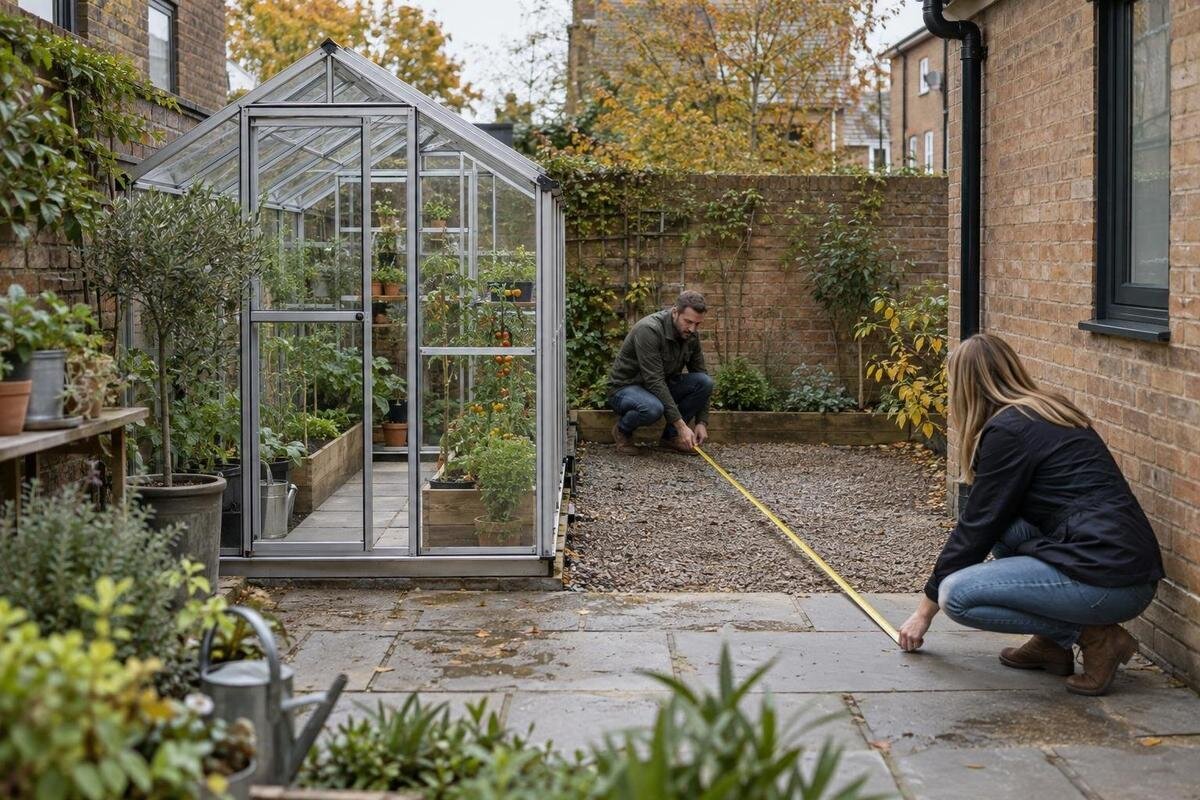
Measure the place where you expect the greenhouse to stand, not just the approximate area visible in a photograph. Mark the available length and width on the ground with string, chalk or another temporary marker, and compare that rectangle with the product’s stated outside dimensions. Check for obstacles such as a fence, shed, tree trunk or garden feature that may restrict the usable area. Measuring the spot at ground level makes it easier to see when a seemingly minor obstruction would interfere with the planned position. Take measurements at more than one point if boundaries are not straight or the surface has an awkward shape. Record them with the proposed entrance position, since turning the greenhouse around can change whether access remains practical.
Include the route to the entrance and the space needed to approach it with pots or tools. A footprint that fits tightly between boundaries may leave little room to get around the structure or carry out routine care. Mark any access space separately from the greenhouse footprint so you do not mistake one for the other. Before judging a listing such as Bloomcabin Orangerie, compare its stated overall dimensions with your ground markings; do not estimate its size from a screen image. If the available product information leaves a measurement uncertain, resolve that question before choosing.
Check usable growing space, not just outside dimensions
A greenhouse’s outside footprint and its usable growing area are different measurements. The structure’s frame, base and openings can affect how much room is available inside, so an external length and width alone may not tell you how many plants will fit. Check whether the product information gives internal dimensions or a plan, and note which measurement each figure describes. Do not rely on a number in a product title as a dimension unless the written specifications explicitly say what it means. Where both kinds of measurement are given, write them in separate columns in your comparison notes. That prevents an outside footprint from being accidentally compared with another model’s internal growing space.
Use the internal measurements to sketch the layout you actually want: plant positions, benches or shelves, and a route for reaching everything. Allow enough room to move a pot or tray without having to shift every other item first. For a catalogue name such as Classic Plus 385, compare the specifications rather than interpreting the number in the name as a particular length or area. If the listing does not provide enough information to check usable space, ask for clarification or leave it off your shortlist until you can make a fair comparison.
Before you order 3
Compare height and reach as well as floor area
Floor space is only part of the fit. Check the greenhouse’s stated height and consider whether it provides room for the plants you plan to grow, including their mature height. The roof profile and lower wall areas can affect where taller plants or shelving can sit, so a single maximum height may not describe the whole interior. If a product plan or measurements show different heights at different points, use those details when deciding where each plant could go. Consider the height of the pot or bench as well as the plant itself, because both raise the growing position. A plant that fits at floor level may not fit in the same location once it is placed on a shelf.
Consider your own access too. You may need to reach the back of a bench, lift a tray or move a pot through the entrance; a layout that uses every corner can make those tasks difficult. Check any stated opening dimensions and clearance requirements rather than assuming they are obvious from a picture. A listing such as T Model wall-mounted greenhouse is still something to assess from its written dimensions and product information; its name does not establish whether its height or access will suit your plants and site.
Draw the bench, pot and walking layout
Before choosing a size, draw the space from above and place the items you expect to use inside it. Include benches, shelves, pots and trays only where you intend to put them, and leave a route that lets you reach plants at the far end. If you plan to move containers in and out, check that the route remains usable when benches are occupied. This quick sketch can expose a layout problem that a total floor-area figure would hide. Draw the largest containers first, as they are least flexible to reposition later. Then add smaller pots and seed trays, rather than assuming they can fill every remaining gap without affecting access.
Use measurements from the product information to make the drawing to scale, even if it is only a rough plan on paper. Mark the entrance and any specified opening clearance, then test whether your intended arrangement leaves room to tend plants. Do not assume accessories are included unless the listing says so, or that a named model has a particular internal layout. For example, pyramid greenhouse for a masonry base is a product name to identify an entry, not a substitute for checking its stated dimensions and the space you can use inside.
Before you order 4
Choose a position that works throughout the day
The available spot affects how useful a given size will be. Watch how nearby buildings, fences and trees cast shade at different times, and consider whether seasonal changes may alter the light reaching the site. The right conditions depend on what you plan to grow, so check the needs of those plants rather than assuming every sunny-looking corner will work equally well. A site plan that looks generous on paper may also be less practical if it blocks an existing route through the garden. Observe the spot at different times on an ordinary day if possible, rather than relying on one brief visit outdoors. Note whether shade reaches the proposed entrance or working side when you would normally be tending plants.
Mark the intended greenhouse position on the ground and view it from the paths and areas you use most. Check whether the entrance can be reached comfortably and whether nearby features leave the space needed for opening and routine care. A catalogue entry such as Aluminium Classic Greenhouse should be judged against its stated footprint and the conditions at your chosen spot, not just its product image. If the position is close to a boundary or another structure, check the relevant product guidance and ask a suitable professional about any site-specific installation questions.
Leave clear routes for opening, tending and upkeep
Allow space for day-to-day use as well as the structure itself. Think about how you will carry in a bag of growing mix, take out a full pot or reach the plants at the back. A narrow gap beside a fence may technically accommodate a greenhouse but still make maintenance difficult. Check what clearance the product information calls for around openings and access points, and include that space in your site plan instead of treating it as spare garden area. Consider where you will temporarily place pots while cleaning, rearranging or repotting plants. Even a modest clear area near the entrance can make a small greenhouse easier to use without making the interior feel overcrowded.
Check how any doors or vents shown or specified are intended to open, and make sure nearby walls, plants or stored items will not obstruct them. The images alone may not show the clearance you need, so use written product information and ask if a detail is missing. Keep the approach to the entrance clear in your layout, especially if benches or large containers could shift over time. When reviewing aluminium wall greenhouse listing, as with any candidate, check the stated dimensions and access details against the actual position rather than relying on the product title.

Before you order 5
Allow for likely changes without buying unused space
Think about how your growing plans may change, but make that forecast specific. You might add another bench, grow a wider mix of plants or keep seedlings inside for longer; each possibility has a different effect on the space required. Compare the layout you need now with one realistic future layout, using the mature plant sizes and access routes in both. Avoid sizing for every imagined project at once, as that can turn a small greenhouse purchase into a footprint that is difficult to place. Base the future plan on changes you can describe, such as a new vegetable bed that will need seedlings or a collection of pots you expect to keep. This keeps spare capacity purposeful rather than speculative.
A little spare capacity can be useful, but it only helps if you have room for it and a reason to use it. Extra floor area may make access easier, while an unnecessarily large footprint can crowd the garden or leave space you do not need. Check whether the exact candidate has the measurements your future plan requires; do not assume a structure can be expanded later unless its product information confirms that. A listing such as limited-edition aluminium greenhouse belongs on a shortlist only after its stated dimensions have been compared with both your current and plausible future layouts.
Use Black Friday to check the shortlist carefully
Treat Black Friday as a chance to compare candidates, not as a reason to skip the size checks. An event label or headline price does not say whether a greenhouse fits your site, and it does not by itself confirm that a particular offer is available. First remove options that fail your footprint, access or growing-space requirements. Then check the current product information for any offer terms that apply, without assuming a discount or saving that has not been stated. Keep the same written plan beside each candidate so the comparison is consistent. Assessing every option against one set of measurements and layout needs is more useful than revising your requirements to suit a product that happens to catch your attention.
Before ordering, review the exact product name and the measurements you used in your plan. If a listing offers different choices, confirm that the selected option is the one whose dimensions you assessed. Compare outside measurements with the marked site, and check the internal area and height against your planned arrangement. Keep a note of any detail you had to confirm so it is clear what you are ordering. This final check helps prevent a seasonal purchase from being based on a model name, image or assumption rather than a size that works.
Frequently asked questions
Is there a standard size for a small greenhouse?
There is no single size that suits every garden or growing plan. Treat “small” as a description, not a measurement: compare the greenhouse’s stated dimensions with your available space, the plants you want to grow and the room needed to tend them.
How can I tell whether a small greenhouse will be big enough?
List the plants you want to keep inside at the same time, allowing for their mature size. Draw where they, any benches and a clear access route would go, then compare the layout with the stated internal dimensions. If a key measurement is missing, ask before ordering.
Should I buy a larger greenhouse just in case?
Only if you have a realistic use for the extra space and a suitable place for it. A larger footprint can make access and site fit harder, while space you will not use may not be worthwhile. Compare a current plan with a plausible future one before deciding.
What should I measure in the garden?
Measure the ground area the greenhouse will occupy, then mark out that footprint where you plan to place it. Include the route to the entrance and any clearance needed to open doors or reach the structure for routine care. Check the product’s stated outside dimensions against your markings.
Does Black Friday mean a greenhouse is discounted?
The event name alone does not confirm that a particular product has a discount or what its terms are. Check the current product information for any offer, and assess the greenhouse’s size separately. A promotion does not change whether its footprint or layout suits your garden.
A small greenhouse is less likely to feel undersized when its site, usable area, mature plants and access are considered together. Make a realistic plan for what you will grow, compare it with the product’s stated measurements and allow only for future uses you genuinely expect. Black Friday does not change those fit requirements: the best choice is the one whose size works for your garden and growing plans.
