
Buying a Greenhouse Online: Measurements and Details to Check Before Paying
GREENHOUSE BUYING GUIDE
Buying a greenhouse online is easier when you can compare listings, but a headline footprint rarely answers every fit question. Before you pay, check what each measurement includes, how much clear growing area remains inside, which frame and glazing details are actually stated, and what the site and delivery arrangements require. Treat a product name or photograph as identification, not a complete specification. Measuring the intended space and recording unanswered details turns a quick comparison into a sound purchase decision, especially when the online page offers several sizes or options.
Check what each listed dimension measures
The first useful check is what each listed dimension actually measures. Record the assembled external length, width and overall height, then note the reference point for each: outer edge, base, eaves or ridge. A summary may show only a headline footprint while a drawing includes more measurements. Confirm whether projecting parts shown, such as a base or roof edge, are counted. This matters when the greenhouse must fit within a measured plot or beside a fence. Keep the unit beside every number, and record assembled dimensions separately from package dimensions: one describes the installed space, the other matters for delivery and access.
Compare like with like across options, and do not treat model numbers as measurements. A number in a product name may be a version or range identifier, not a stated length or area. Check the specification table for the exact selected size and any variant menu before recording a figure. For example, the Classic Plus 385 listing still needs to be compared using its listed length, width and height; its title alone confirms no dimension. Make sure the figures belong to the option in your basket, not a neighbouring size. If a measurement is missing or a drawing has no scale, ask for the assembled external dimensions rather than estimating from a photograph.
Measure the space around the footprint
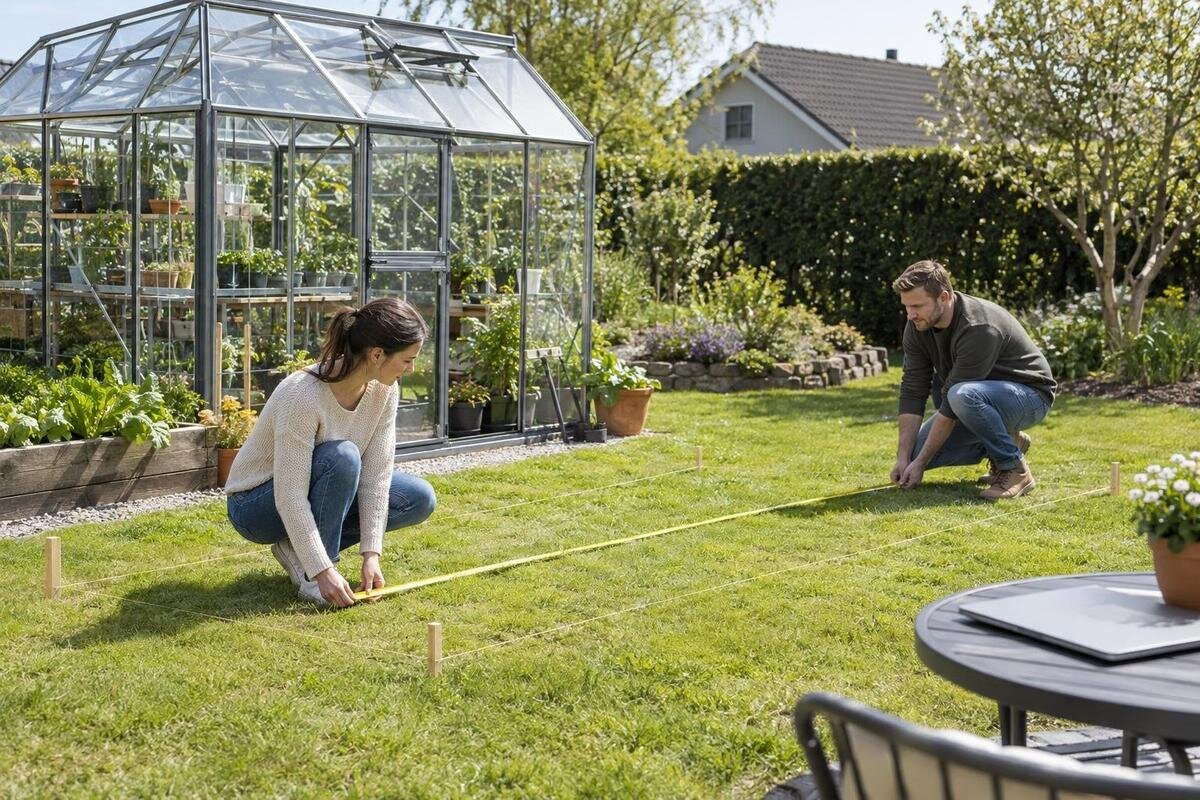
Once you know the maximum assembled footprint, measure the intended position and the working space around it. Check the available width and length at more than one point if boundaries taper, and mark the footprint on the ground with string or temporary markers. Allow for the chosen door arrangement, access during assembly and enough room to reach the areas you expect to maintain. A greenhouse may fit between two boundaries yet leave no clear route past it, or place the entrance against a fence. Record nearby walls, gates, trees and paths instead of treating the garden as an empty rectangle. For an irregular site, use the narrowest usable point rather than averaging measurements.
Think about conditions that a plan view does not show. Note slopes, soft or uneven ground, drainage patterns, shade and exposure, then compare them with the installation and growing requirements stated by the seller. There is no single orientation or foundation assumption that suits every site; do not infer one from a product photograph. If support or siting conditions are unclear, ask the supplier or a qualified installer before choosing a location. For any option, including the Orangerie greenhouse listing, compare the specification with your measured space instead of estimating scale from the image. If light matters to your plans, note when nearby buildings or trees shade the growing area.
Calculate usable growing space inside
Make a small plan of the interior around what you intend to grow and do there. Mark beds, pots, shelves, a potting bench or other equipment at their real footprint, then draw the path needed to reach them. A space that technically accommodates containers may still be awkward if you cannot get between them to water, prune or move pots. Consider whether the plan depends on standing room, working from one side or keeping space free for seasonal changes. The path also uses floor area; a layout with no practical access is not usable just because all the containers fit. This turns the listed area into a workable plan, not an abstract square-metre figure.
Do not equate the outer footprint with clear growing space. Frames, supports, doors and any included fittings can affect the space available at floor level or along the sides. Check for internal measurements and the position of obstructions; if the page only provides external dimensions, ask for usable internal width and length. Compare those figures with your drawn plan and the size of equipment you already own. Also check usable height where you plan to train plants vertically or place shelves, and verify whether shelves or staging shown in an image are included or sold separately. Leave room to turn or carry larger pots if that is part of your routine.
Confirm height, doorway and ventilation details
Overall height is not necessarily the headroom where you will stand. Look for separate ridge and eaves heights and check the measurement reference, particularly if you plan to work under shelves or grow tall plants. For the doorway, compare the clear opening width and height with the largest tray, pot or tool you expect to carry through; the door leaf’s own size does not guarantee the same clear opening. Note whether the door swings out, slides or uses another arrangement, so nearby fences, walls or beds do not obstruct it. Check where the entrance sits and whether its orientation can be changed. The Aluminium Classic greenhouse listing needs these same checks; its name does not state door dimensions.
Ventilation is another item to confirm in the specification, not something to assume from the presence of glazing. Check which vents or windows are provided, where they sit, how they open and whether any opening mechanism is included or optional. Relate their position to the bed and shelf plan: an opening may be difficult to reach if tall shelving sits directly below it. If the listing gives no drawing, ask for one showing doors and vents, along with their clear openings. That information helps you assess everyday access and whether your planned layout remains workable. Consider whether you will be able to reach handles or catches once your chosen shelving is in place.

Read the frame and glazing specifications
Read the frame and glazing as two separate sets of details. For the frame, look for the specified material, finish, joint or connector information and any care requirements. For the glazing, check the material, panel thickness if stated, panel size and how the panels are retained. Confirm whether the frame and glazing are supplied as a complete kit or whether a particular component is an option. Where the wording is broad, ask for the exact component description and make sure it applies to the model and size selected, not just to the product range. If a drawing shows different panel types, check that each is identified. A photograph shows appearance, but does not establish material grade, glazing type or included parts.
Names such as aluminium or glass are not enough to judge maintenance, strength, insulation or suitability for a particular exposure. Look for stated specifications and relevant installation guidance; if a condition at your site matters but the page does not address it, ask for a clear answer instead of extrapolating from a material name. The limited edition aluminium greenhouse listing is identified by its product name, but that alone does not confirm its glazing, frame finish, performance or package contents. Ask how replacement panels or parts are identified if future servicing matters, and whether the instructions address cleaning. Compare the written details for the exact option you intend to order.
Confirm the base and package contents
The base is both a fit question and a package question. Check what surface or support the greenhouse is specified to use, the size of any base required, and whether that component is included or listed separately. A name that mentions a foundation does not by itself tell you what arrives, what fixings are supplied or what site preparation remains. For example, the Prestige greenhouse with metal foundation listing should be read alongside its itemised contents and base instructions; do not treat the title as a complete parts list. Confirm the exact configuration before comparing it with another model. If base dimensions are given separately, include the relevant outer measurement in your site plan.
Look for assembly instructions before ordering, especially where the base and frame connect or where anchoring is specified. Check what preparation, tools or fixings you must provide and what work is excluded from the kit; if those details are missing, ask what is required for the selected option. Do not improvise a foundation design from a photograph or an approximate footprint. If the ground, support, fixing method or site conditions raise technical questions, have a qualified installer assess them. This helps avoid discovering after delivery that the intended location or preparation does not match the stated requirements. Confirm the model-specific instructions rather than applying details from a different greenhouse.
Check the wall and its clearances for an attached model
An attached or wall-mounted design has a different set of measurements from a freestanding structure. Check the required wall width and height, clearance from the wall, and which edges must remain accessible, using the seller’s drawing rather than the product photo. Compare those measurements with windows, doors, downpipes, exterior fittings and any existing roof edge or gutter that could occupy the same area. Also make sure you can reach the greenhouse entrance and carry out routine maintenance without crossing an obstruction. Note wall openings or protrusions that reduce the uninterrupted mounting area. The words wall-mounted do not show how much adjoining space the selected model needs.
Confirm the stated attachment surface and fixing requirements, and whether the model needs a specific base or support at its outer edge. Do not assume every wall is suitable or that a greenhouse will fit simply because the available wall is long enough. If the listing does not explain the interface, ask the seller or a qualified installer to confirm compatibility with your building before ordering; this is a site-specific question, not one to settle by estimating from an image. The T model wall mounted greenhouse orangery listing should be assessed using its own dimensions and installation details, not its title alone. Account for doors, paths or outdoor fixtures beside the wall that could limit access.
Check the delivery route and package details
Check how the greenhouse is delivered, not just the footprint once assembled. Look for the number and dimensions of packages, their weight if given, and whether the product arrives assembled or in components. If that information is not on the page, ask before payment: carton lengths and handling needs can affect whether a vehicle can reach your property and whether the load can pass through a gate, doorway or narrow side path. Walk the route from the likely drop-off point to the planned site, noting turns, steps and any overhead or width restrictions. Delivery access is separate from the greenhouse’s final fit, so measure the route as well as the plot.
Read the delivery wording for the address you will use. Confirm that the seller can deliver there, what unloading or placement is included, and any charges, scheduling or access conditions shown at checkout. Do not assume delivery means the structure will be moved to the garden or assembled on site. For an exact listing such as the aluminium wall greenhouse page, look for package information; the product name and installed footprint do not reveal carton dimensions. If a delivery limitation could make the order impractical, resolve it before paying rather than relying on a general estimate. Check that the address and any access note are entered correctly.
Compare product specifications line by line
Build a comparison using the specification for the exact variant, with the same fields for each greenhouse: external dimensions, internal usable area, height, clear door opening, frame, glazing, base, included components and installation requirements. Mark a field as not stated rather than filling it from a photograph or assuming it matches a similar model. The pyramid greenhouse for masonry base listing is one example of a product page whose base-related wording still needs to be read alongside its measurements and itemised contents. This line-by-line method makes differences and missing details easier to spot than comparing titles or gallery images. It also keeps confirmed facts separate from questions still awaiting an answer.
Check variant selectors and options carefully. A page can present more than one size, finish or accessory, and a feature visible in an image may not form part of the package; verify the selected option and the listed contents. Read the assembly guide and any stated warranty or support terms so you know what the seller says about setup and after-sales help, without assuming a particular service is included. If a specification on the product page conflicts with the basket summary or a written answer, pause and ask for the correct version. Keep the response that identifies the exact model and option with your order records.
Review the exact order before paying
Before you pay, match the basket against your notes rather than relying on memory. Check the exact model and size, quantity, frame and glazing option, base or foundation, and any accessories you intended to order. Make sure the measurements are for that selected version. Recheck the delivery address and the details of any delivery charge, optional work or extra item shown at checkout, then confirm the order total presented to you. If the basket uses an abbreviated name, compare its identifier with the product page or ask the seller to confirm it is the same configuration. Check the chosen options once more before completing payment.
Save the specification, dimension drawing, assembly information, itemised contents and any written clarification before leaving the page. Read the seller’s terms on changes, cancellations, damaged or missing components and returns, so you understand the stated process if something goes wrong; no general product label can replace those terms. Resolve gaps in dimensions, base requirements, glazing or delivery access before you commit. Once the exact greenhouse and package are clear, your decision rests on measured fit and documented details rather than a guess from the listing’s appearance. Keep a record in case the order confirmation uses a shortened description.
Frequently asked questions
Which greenhouse dimensions should I compare?
Compare the assembled external length, width and height with the clear internal area, usable height and door opening. Check what each measurement includes, where it is taken from and whether a base or projecting part affects the footprint. Make sure the figures match the exact size option you intend to order.
How much extra space should I allow around a greenhouse?
There is no single clearance that suits every site. Use the supplier’s installation and access information, then account for the door opening, assembly and the space you need to reach the greenhouse for routine work. Mark the footprint and any access space on the ground before deciding where it will go.
How can I tell whether a base is included?
Check the itemised contents and options for the exact model, and confirm whether a base is supplied, required or listed separately. A product name or image is not a complete parts list. Also check the stated base dimensions, support requirements and which fixings or preparation you need to provide.
What if the frame or glazing details are missing?
Ask the seller for the exact frame material and finish, glazing material and any stated panel thickness, plus confirmation of what is included. If a site condition affects your choice, ask whether the stated specifications address it. Do not infer performance, maintenance needs or suitability from a product name or photograph.
Can a product photo confirm that a greenhouse will fit?
No. Perspective, cropping and the absence of a scale can make an image misleading. Use the listed assembled dimensions and a dimensioned drawing where available, then compare them with your measurements. If a key figure is missing, ask for it rather than estimating from the image.
A suitable greenhouse is one whose verified dimensions, usable layout, frame and glazing details, base requirements and delivery arrangements make sense for your site and growing plans. Checking those details against your own measurements—and resolving gaps before checkout—gives you a firmer basis for paying than choosing from a product title or photograph alone.
