
Aluminium vs Wood Pergola | Which Material Is Better? UK Guide
United Kingdom • Pergola Material Guide • Bloomcabin Journal
Aluminum vs Wood Pergola
Which material is better for durability, maintenance, appearance, weather, cost and modern outdoor living?
A fair comparison
The strongest argument for aluminum begins by admitting what wood does well.
A timber pergola can be a beautiful addition to a garden. Natural grain, warmth and variation are difficult for any metal finish to replicate. Wood is also familiar to carpenters, easy to cut and modify on site, and particularly appropriate for rustic, craftsman, cottage or traditional architecture.
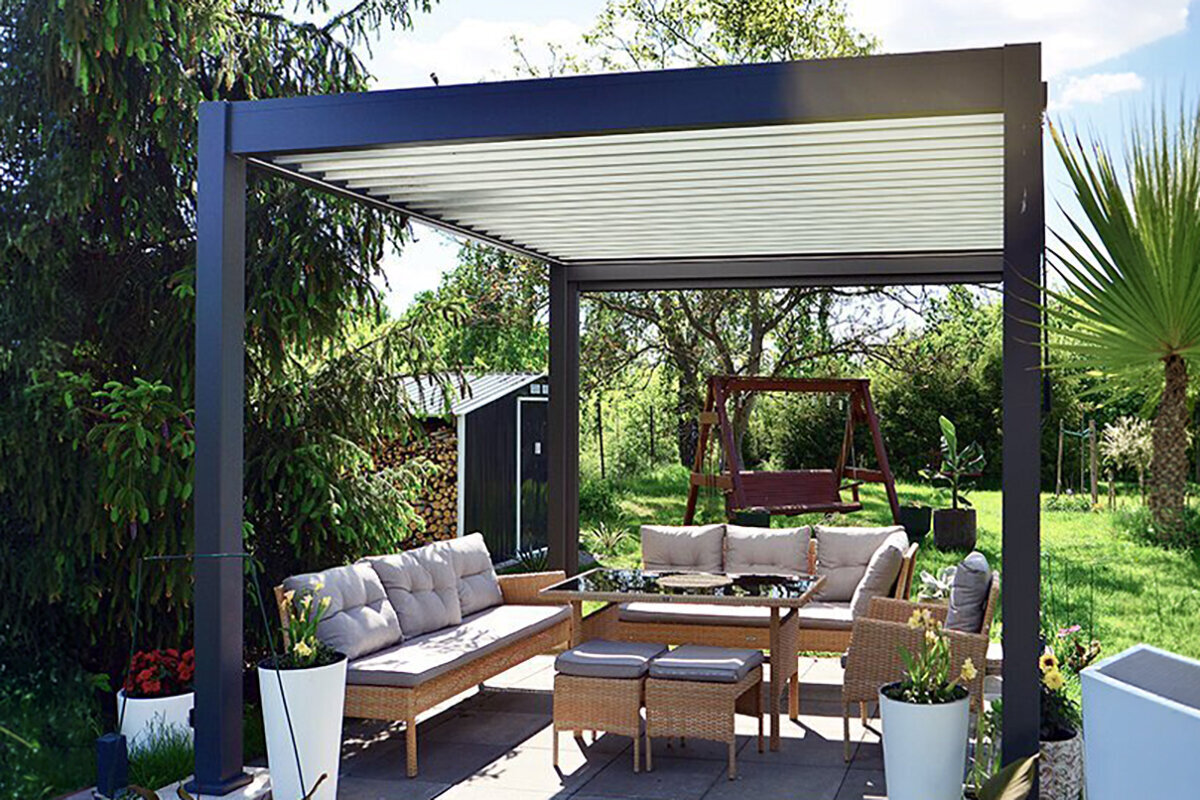
Aluminum solves a different set of problems. It does not absorb atmospheric moisture and swell or shrink in the way wood does. It cannot rot. Termites and wood-decay fungi do not use it as food. Architectural aluminum can be extruded into precise hollow profiles, powder-coated, integrated with drainage channels and designed around moving roof systems.
So the real question is not whether aluminum or wood is universally “better.” It is which material better matches how you want to own and use the pergola for the next decade or more.
If your priority is a finished, engineered outdoor-living structure, start by comparing the Bloomcabin Aluminum Pergola, the Bioclimatic Aluminum Pergola and the Lean-To Pergola.
01 • Side by side
Aluminum vs wood pergola: quick comparison
| Category | Aluminum | Wood | Advantage |
|---|---|---|---|
| Maintenance | Wash, inspect drainage and fixings | May need refinishing, inspection and repairs depending on species/finish | Aluminum |
| Rot & insects | Does not rot; not food for termites | Durability depends on species, treatment, moisture and detailing | Aluminum |
| Moisture movement | No moisture absorption/swelling | Hygroscopic; moisture changes can cause dimensional movement | Aluminum |
| Natural appearance | Precise, architectural finish | Natural grain, texture and warmth | Wood |
| DIY modification | Engineered system; modification should be limited | Easy to cut, drill and reshape on site | Wood |
| Bioclimatic louvers | Highly compatible with precision moving systems | Possible, but less common for sophisticated sealed mechanisms | Aluminum |
| Integrated drainage | Can be engineered inside hollow profiles/posts | Usually relies on separate gutters/drainage details | Aluminum |
| Surface heat in sun | Dark profiles can become hot to touch | Lower thermal conductivity; often feels cooler | Wood |
02 • Durability
Why aluminum has the easier long-term weathering profile
The Aluminum Association identifies durability, corrosion resistance and high strength-to-weight ratio among the reasons aluminum has been used in building and construction for decades. Aluminum also develops a natural oxide layer that protects the underlying metal; architectural coatings such as powder coating or anodizing add another surface system and allow consistent colour.
That does not mean an aluminum pergola is maintenance-free in the literal sense. Coastal salt, dirt, leaves and pollutants should be cleaned, fixings should be inspected and drainage should remain clear. But the material does not need protection from biological rot and does not absorb moisture in the way wood does.
For a pergola permanently exposed to rain, snow, sprinklers, humidity and sun, that difference simplifies ownership and makes the finish less dependent on the homeowner maintaining a protective coating schedule.
03 • Moisture & movement
Wood is hygroscopic. That matters outdoors.
The USDA Forest Products Laboratory describes wood as hygroscopic: it exchanges moisture with the surrounding air, and moisture content responds to relative humidity and temperature. Those changes influence dimensional stability. Correct drying and design can minimize problems, but protective coatings slow moisture movement rather than eliminating it completely.
That is why exterior timber components can shrink, swell, check, twist or move seasonally. A well-built pergola anticipates this with proper species selection, connections, clearances and finishing. It is an engineering property of wood—not evidence that wood is a poor material.
Aluminum has its own movement: it expands and contracts with temperature. Good aluminum systems are designed with that thermal movement in mind. The difference is that aluminum does not absorb atmospheric water and experience the same moisture-driven swelling and shrinkage.
04 • Rot, fungi & insects
This is one of the clearest advantages of aluminum
USDA guidance is very fair on wood: under proper conditions, wood can provide centuries of service. But when moisture, oxygen and suitable temperatures allow wood-degrading organisms to develop, protection becomes necessary. Decay fungi and certain insects can use wood as a food source.
Naturally durable species, preservative-treated lumber, good flashing, water-shedding details and keeping post bases away from persistent moisture can dramatically improve timber durability.
Aluminum does not rot, and termites or decay fungi do not consume it. That removes an entire category of exterior-material risk. The owner still needs to protect the complete pergola system—coatings, fasteners, seals, motors and attachments—but not the aluminum frame from biological decay.
Verdict: aluminum is the clear winner for rot and insect resistance.
05 • Maintenance
Which pergola requires less maintenance?
Aluminum ownership
Clean. Inspect. Keep drainage clear.
Wash off dirt, pollen and salt deposits.
Check fixings and seals.
Keep gutters, downspouts and moving louvers clean.
Wood ownership
Clean. Inspect. Refinish as needed.
Inspect checking, joints and water-trapping details.
Maintain stain, paint or protective finish according to product and exposure.
Repair damaged surface protection before deterioration progresses.
USDA notes that exterior wood finishes are used to protect the surface and maintain appearance; unfinished wood exposed to weather changes colour, roughens and checks over time. Some homeowners love that natural silvering and accept it as part of timber’s character. Others want the pergola to stay visually consistent. For that second group, powder-coated aluminum is easier.
06 • Appearance
Where wood genuinely wins
No powder-coated metal truly becomes natural wood. Timber has real grain, knots, tonal variation, scent and tactile warmth. It ages. It can be carved, stained, painted, sanded or reshaped. In a craftsman bungalow, rustic mountain home or garden where timber is already a dominant material, a wood pergola may simply look more appropriate.
Wood is also more forgiving when the design is intentionally traditional: heavy beams, exposed rafters, decorative brackets and climbing roses can look completely natural on a timber frame.
Aluminum aesthetic
Precise, consistent and architectural.
Choose aluminum when you want slim, crisp geometry, a consistent powder-coated colour and a pergola that looks intentionally contemporary rather than handcrafted.
07 • Engineering
Why modern bioclimatic pergolas naturally favor aluminum
An open timber pergola is mechanically simple: posts, beams and rafters create partial shade. A modern bioclimatic pergola is a different product category. It may have adjustable louvers, motors, hidden drainage, gutters inside perimeter beams, downpipes inside posts, LED channels, screens and sliding-glass tracks.
This is where aluminum’s extrusion capability matters. The Aluminum Association identifies 6xxx-series extrusion alloys as a primary architectural and structural choice, while European Aluminium highlights the ability to extrude complex shapes and finish them in many colours. A beam can therefore do several jobs at once: carry load, receive a louver pivot, conceal wiring and form part of a drainage path.
For true all-weather control
The Bloomcabin Bioclimatic Aluminum Pergola uses an adjustable louvered roof and is designed around integrated outdoor comfort rather than a simple fixed shade frame.
For a simpler freestanding structure, compare the standard Bloomcabin Pergola.
08 • Cost
Which costs more: aluminum or wood?
There is no honest universal answer because “wood pergola” can mean a simple pressure-treated DIY frame or a custom cedar pavilion with detailed carpentry, while “aluminum pergola” can mean a basic fixed-roof frame or a motorized bioclimatic system with adjustable louvers and side glazing. Those are not equivalent products.
Wood can win on entry cost
A straightforward pressure-treated lumber pergola, especially DIY, can be one of the least expensive ways to create overhead structure and partial shade.
Aluminum can win on ownership simplicity
When comparing premium finished products, include refinishing, repairs, maintenance time, drainage systems, roof control and other features—not only the initial frame price.
For actual Bloomcabin sizing and available formats, use the Pergola Size Guide.
09 • Installation & repairability
Wood is easier to improvise with. Aluminum is easier to engineer as a system.
For a carpenter or experienced DIY builder, wood has a real advantage: if a beam needs trimming, a decorative bracket needs adding or a dimension changes on site, timber is comparatively forgiving. Individual damaged pieces can often be cut out and replaced with conventional woodworking tools. That flexibility is one reason traditional pergolas are so commonly built from wood.
An engineered aluminum pergola works differently. Profiles, drainage paths, brackets, roof components and fastener positions are designed to operate together. That reduces the need for improvisation but also means structural members should not be casually cut or drilled without understanding the system. The benefit is precision: when the foundation is correct and components are assembled as designed, dimensions, joints, drainage and roof movement are predetermined rather than solved on site.
10 • Roof function
A pergola material decision is also a roof-function decision
If all you want is an open structure for vines and dappled shade, wood remains very competitive because the roof is mechanically simple. But if you want the pergola to actively manage sun and rain, the comparison changes. Adjustable louvers need consistent geometry, pivots, linkages, gutters and seals that continue to align after thousands of movements and repeated weather cycles.
That is why aluminum dominates the premium bioclimatic category. Extruded profiles can integrate structural cavities, drainage routes and attachment points while maintaining slim visual lines. A louver can rotate for shade, open for ventilation and close to shed rain into concealed gutters. Wood can be part of a sophisticated outdoor room, but it is usually not the moving roof mechanism itself.
If you are deciding between those two usage models rather than simply between materials, compare Bloomcabin’s Bioclimatic vs Standard Pergola guide before choosing the frame.
11 • Heat in the sun
Does an aluminum pergola get hot?
Yes, exposed aluminum—especially a dark powder-coated profile in strong sun—can become hot to touch. Aluminum is an excellent thermal conductor. Wood has much lower thermal conductivity and usually feels more thermally neutral when touched.
That does not automatically mean the space beneath an aluminum pergola is hotter. Comfort underneath is dominated by shade, airflow, roof geometry, solar angle and—in a bioclimatic system—the ability to rotate louvers to block direct sun while maintaining ventilation.
12 • Fire behavior
Aluminum does not make a pergola “fireproof”—but the frame itself is not wood
Wood is a combustible construction material; USDA’s Wood Handbook covers its ignition, charring and fire-retardant treatment. Aluminum behaves differently: the metal does not provide fuel in the way timber does, although high heat can reduce its mechanical strength and the complete pergola may contain coatings, wiring, motors, screens, seals or nearby furnishings that can burn.
So the correct claim is not “an aluminum pergola is fireproof.” It is simply that the aluminum frame itself is not a timber fuel source. In wildfire-prone UK regions, follow local building and defensible-space requirements.
13 • Sustainability
Which material is more sustainable?
This is one category where we would not declare a universal winner without a product-specific lifecycle assessment. Wood is renewable when responsibly sourced and stores biogenic carbon during use. USDA describes wood as a renewable and sustainable resource when forest management, production and end use are considered appropriately.
Aluminum has a different circularity advantage: it is highly recyclable. European Aluminium states that recycling aluminum requires about 5% of the energy needed to produce primary metal, while building applications can retain material value through long service lives and end-of-life recycling.
Our view: compare the actual wood species, forest certification, treatment chemicals, aluminum recycled content, coating system, expected service life and end-of-life route.
14 • UK climate
Aluminium vs wood in the British climate
Wet & changeable weatherFrequent rain, wind-driven moisture and long damp periods make drainage and drying details especially important for timber. Aluminium removes biological rot from the structural frame, although coatings, fixings and drainage still need care.
Coastal exposureSalt carried by wind makes cleaning and coating condition important for aluminium. Timber also needs suitable fasteners, detailing and surface protection. Neither material should be treated as maintenance-free beside the sea.
Summer sun & heatDark aluminium can become hot to touch during strong sunshine, while timber surfaces weather under UV. A louvred bioclimatic roof can be particularly useful in the UK because it can switch quickly between shade, ventilation and rain protection.
Frost, wind & occasional snowMaterial alone does not define structural performance. Span, roof position, anchors, local wind exposure and project-specific loading remain more important than simply choosing aluminium or timber.
15 • The honest split
Who should choose wood—and who should choose aluminum?
Choose wood if…
Natural timber appearance is your highest priority.
You want exposed heavy beams or traditional carpentry.
You plan to build or modify the pergola yourself.
You are happy to maintain the finish and inspect the timber.
You prefer responsibly sourced renewable timber.
Choose aluminum if…
Low maintenance is a priority.
You want clean, modern architectural lines.
You want adjustable louvers or a bioclimatic roof.
Integrated drainage, lighting, glass or screens matter.
You prefer a factory-engineered outdoor-living system.
16 • Our recommendation
Why we prefer aluminum for a premium modern pergola
Bloomcabin sells aluminum pergolas, so our commercial preference is not a secret. But the reason is not that wood is an inferior building material. It is that the modern pergola has evolved from a simple shade frame into an engineered outdoor-living system.
Once you want adjustable roof control, integrated water management, clean hidden fixings, consistent finish, slim architectural profiles and the option to add glass or screens, aluminum becomes the more natural platform. At the same time, it removes the need to manage timber moisture movement, biological decay and periodic refinishing of the structural frame.
For most homeowners purchasing a finished premium pergola rather than building a traditional timber structure themselves, aluminum is the material we would recommend.
Explore the Bioclimatic Aluminum Pergola17 • FAQ
Aluminum vs wood pergola FAQ
Does an aluminum pergola rust?
Aluminum does not rust in the iron-oxide sense. It naturally forms an oxide layer that provides corrosion protection, although salt, chemicals, damaged coatings and incompatible metals can still create corrosion issues that proper design and maintenance should address.
Can a wood pergola last a long time?
Yes. USDA specifically notes that wood can provide very long service under proper conditions. Species, treatment, design, drainage, fasteners, maintenance and exposure determine performance.
Is aluminum better for a bioclimatic pergola?
In our view, yes. Precision extrusions, integrated drainage, moving louvers, motor mounting and accessory channels make aluminum exceptionally well suited to sophisticated roof systems. See the Bioclimatic vs Standard Pergola guide.
Which pergola is easier to customise?
For on-site carpentry changes, wood wins. For factory-engineered options such as louvers, integrated drainage, screens, lighting and glass systems, aluminum wins.
Which is better beside the house?
Either material can work. If you want a clean integrated patio structure with modern detailing, see the Bloomcabin Lean-To Aluminum Pergola and our Lean-To vs Freestanding Pergola guide.
What should I check before buying?
Compare structural design, foundations, drainage, roof system, finish, warranty, local wind/snow requirements and accessory compatibility. Bloomcabin’s Pergola Foundation Guide is a useful companion resource.
Sources & Further Reading
- Wood Protection Association — Preservative Treatments
- Wood Protection Association — Resources for Treated Wood
- Forest Research — Characterisation and Modelling of Moisture Movement in Wood
- European Aluminium — The Material
- European Aluminium — Aluminium in Use
Material performance depends on alloy, timber species, treatment, coating, fasteners, structural design, exposure, installation quality and maintenance. This guide compares typical characteristics for UK pergolas; it does not replace project-specific engineering, planning or local building requirements.
