
Aphids in a Greenhouse Identify, prevent and control the colony before it spreads.
Greenhouse casefile / T39
Aphids in a Greenhouse Identify, prevent and control the colony before it spreads.
The first clue is seldom the insect. It is usually a curl in the youngest leaf, a polished droplet beneath a shoot tip or a pale shell beside a vein. Read the evidence carefully and a small aphid colony can remain exactly that: small.
Good greenhouse management begins with access. Young growth should be reachable, leaf undersides visible and new plants held apart long enough to reveal problems. The ventilated, considered structure of a Classic Aluminium Greenhouse gives serious home gardeners a calm, practical setting for that discipline.
Chapter 01 / The evidence
Read the plant before reaching for a treatment.
No individual symptom proves aphids. Environmental stress and other sap-feeding pests can also produce sticky or distorted foliage. Build the diagnosis from connected evidence: find living insects or fresh cast skins, then relate them to honeydew, sooty mould and damaged young growth.
Live colony
Cast skins
Honeydew
Sooty mould
Distortion
Live colony
Look for small, soft-bodied insects gathered on tender tips, stems, buds and leaf undersides. Adults, young nymphs and occasional winged forms may occur together.
Cast skins
Pale, papery shells are shed skins. They are not active whiteflies, and they should not be mistaken for mildew.
Honeydew
Aphids excrete excess sugary sap as sticky honeydew. It leaves a glossy film on foliage, pots, staging and surfaces beneath the feeding site.
Sooty mould
Black or brown sooty mould can colonise honeydew. This surface growth is secondary; the sap-feeding insects are the underlying problem.
Distortion
Young leaves may pucker, curl, twist or stall. Damage matters particularly on seedlings, herbs, chillies, tomatoes, cucumbers and flowering ornamentals.
Ants provide supporting evidence, not a diagnosis. They collect honeydew and may protect aphids from natural enemies, so their route should lead you to inspect the plants above and nearby.
Chapter 02 / Identification
How to identify aphids at close range.
Under magnification
- Pear-shaped body
- Long legs and antennae
- Cornicles
- Winged or wingless
Pear-shaped body. Most aphids are delicate, soft-bodied insects, often only a few millimetres long. Viewed from above, the rounded abdomen tapers towards a smaller head. A hand lens makes this profile easier to recognise in a crowded colony.
Long legs, antennae and cornicles. Aphids commonly have conspicuous antennae and, on many species, two short tube-like projections near the rear called cornicles. These features help distinguish them from flatter, fixed scale insects found on leaves and stems.
Winged and wingless forms. Both forms are aphids. A winged adult is a disperser, not necessarily a different pest. Finding one is a reason to widen the inspection to neighbouring plants, doors, vents and stock brought in recently.
Inspect the feeding location. Aphids usually concentrate where sap is readily accessible: young leaves, flower stems, buds and soft shoots. Finding the characteristic insect in this setting is more meaningful than relying on colour alone.
Comparison guide / do not confuse the evidence
Whiteflies
Thrips
Soft scale
Helpful larvae
Whiteflies
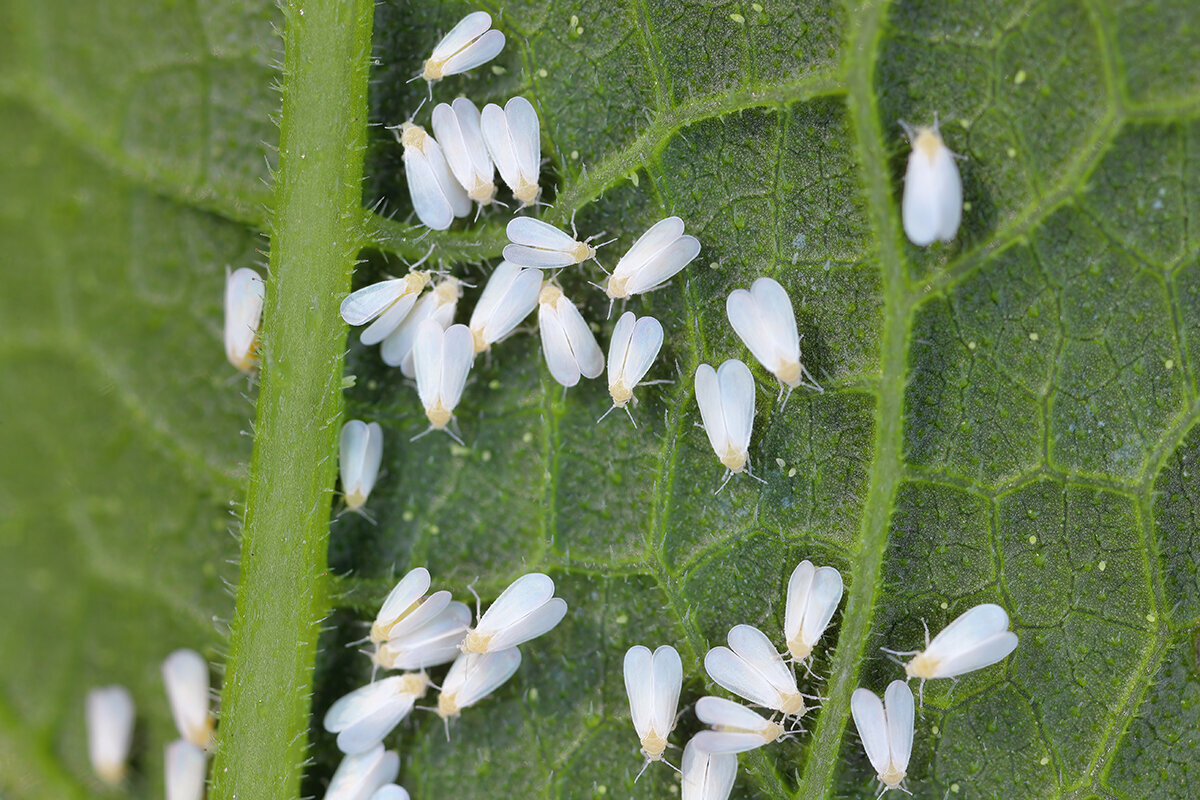
Small white adults tend to flutter up when foliage is disturbed. Their immature stages sit scale-like beneath leaves, unlike a mobile aphid colony.
Thrips
Thrips are slender and mobile. Their feeding more often causes silvery scarring and dark waste specks than sticky honeydew.
Soft scale
Scale insects can produce honeydew, but adult scales appear as raised, largely fixed bumps rather than mobile pear-shaped insects clustered on tender growth.
Helpful larvae
Ladybird, lacewing and hoverfly larvae hunt aphids. Pause before removing an unfamiliar insect moving through a colony; it may already be working in your favour.
Chapter 03 / Acceleration
A colony will not stay small simply because it looks small today.
Warmth, protected foliage and a continuous supply of tender growth allow greenhouse aphids to build rapidly. Their pace depends on species, crop, temperature, light and plant condition, so there is no responsible universal countdown. There is, however, a consistent reason to inspect regularly and act while a colony remains accessible.
01Arrival
02Feeding cluster
03Honeydew
04Dispersal
Aphids may first establish on one newly introduced or overlooked plant. Wingless individuals feed and increase among sheltered leaves and buds, while cast skins and honeydew become more conspicuous as the colony grows. When the colony is crowded, the host deteriorates or conditions change, winged forms may appear and move to fresh plants. Timing remains condition-dependent, which is precisely why a repeatable weekly scouting route matters more than a fixed calendar date.
Winged aphids can also enter through doors and vents, while colonies arrive unnoticed on herbs, plug plants, ornamentals and overwintered specimens. Treat one affected basil pot, chilli plant or pelargonium as a greenhouse-wide scouting trigger. Because some aphids transmit plant viruses, severely distorted or suspicious plants should be kept separate rather than propagated, shared or moved through the house.
Chapter 04 / Scouting map
The greenhouse hotspots most often missed.
Walk the same route on every inspection. Starting at the entrance and finishing with the newest arrivals makes even a compact greenhouse legible: you begin to notice what has changed rather than seeing only the most obvious damage.
- 1
Youngest growth
Inspect folded leaves, soft stems and shoot tips first. Aphids favour vigorous, expanding tissue. - 2
Leaf undersides and midribs
Turn leaves over, especially within crowded foliage where casual observation and direct treatment can both fail. - 3
Incoming plants
New herbs, plug plants, cuttings, gifts and overwintered specimens are common entry points. - 4
Weeds, baskets and edges
Weeds and hanging plants can support colonies beneath bench level, above eye level or beyond easy reach. - 5
Doors and vents
Include these likely entry corridors for winged aphids in every regular visual inspection.
Yellow sticky traps can help reveal winged aphids near entrances and vents, but they are monitoring tools—not a control method or a substitute for examining plants. For a permanent structure designed around clear routes, practical staging and access to crops, consider the Classic Aluminium Greenhouse.
Chapter 05 / The perimeter
Prevent the next colony through exclusion, quarantine and balanced growth.
Screen Reduce entry, retain airflow.
Quarantine Hold new plants separately.
Hygiene Remove weeds and debris.
Growth Avoid excessively soft growth.
Record Note the crop, place and date.
Quarantine need not be elaborate. A separate tray at the end of a bench or another bright, protected holding area is useful if it allows new plants to remain apart for roughly a fortnight where practical. Inspect beneath leaves, around stems, along pot rims and inside tight new growth. If aphids appear, maintain isolation until fresh evidence and active colonies have ceased.
Exclude what you reasonably can without turning the greenhouse into a stagnant box. Suitable screening may reduce entry by winged adults, but openings must still provide the ventilation required by the crop. Roof vents, doors and orderly spacing form part of this balance. Bloomcabin’s Classic Aluminium Greenhouse offers a useful starting point for considering ventilation, glazing, shelving and access as one coherent growing system.
Weeds matter because they can remain unnoticed reservoirs for aphids. Clear them beneath benches, immediately outside the threshold and along the route to the door. Inspect decorative and overwintered plants too: a pelargonium, citrus plant or tender ornamental in a quiet corner may introduce aphids to vegetable seedlings when active growth resumes.
Finally, resist forcing plants with excessive feed. Very lush, tender growth can be especially attractive to aphids. Match feeding to the crop, container and stage of growth; water consistently; provide adequate light; and maintain enough space to inspect new leaves without breaking stems or brushing insects onto neighbouring plants.
Chapter 06 / Control ladder
Start with the least disruptive action that can still reach the colony.
Aphid management is not a contest to find the strongest product. It is a problem of access, coverage and follow-up. Escalate only when the previous step is insufficient for the crop, colony size and practical reach available to you.
01
Isolate and mark the source.
Move a manageable potted plant away from the main bench where this can be done without brushing aphids onto others. Label it with the date, and inspect every touching neighbour. Do not take cuttings, share pots or return it to the crop until follow-up inspections are clear.
02
Remove the densest evidence.
Pinch out or prune badly curled tips, heavily occupied buds and tissue that cannot be inspected properly, provided this will not compromise the plant. Remove prunings from the greenhouse. On sturdy plants, a careful stream of plain water can dislodge exposed aphids; support the foliage, protect flowers and seedlings, and allow leaves to dry with good airflow.
03
Choose biological control with a plan.
Where aphid pressure is recurring or affects several plants, beneficial insects may be more elegant than repeated broad treatment. They must, however, suit the aphid, crop, greenhouse conditions and residues from any products already used.
04
Use an authorised contact treatment when direct coverage is realistic.
Products sold for aphid control often depend on direct contact and thorough coverage. They cannot reliably solve colonies sheltered inside curled leaves or deep flower clusters. Read the current UK label for the precise crop, pest and setting; test only where directed; and avoid treating heat-stressed, drought-stressed or otherwise vulnerable plants.
Field note / Biological control
Useful allies require compatibility, not wishful thinking.
Predatory midges, lacewing larvae, hoverfly larvae, ladybirds and parasitoid wasps can all contribute to aphid suppression. The most suitable greenhouse choice depends on the aphid and crop, the size and age of the colony, current temperature and light, and the environment you can maintain.
Predators consume aphids, while parasitoids develop in them and may leave swollen tan or dark aphid ‘mummies’. Do not remove every unusual-looking aphid without checking it closely: a mummy can be visible evidence that a parasitoid is already active.
Chapter 07 / Direct treatment
Soaps, oils and conventional products: let the UK label set the boundary.
Contact soaps and oils
Contact treatments may be a practical next step in a home greenhouse, but their key limitation is reach: aphids must be contacted as the label describes. Turn leaves and gently open the canopy so sheltered stems and undersides can be covered where permitted. Survivors or newly visible aphids after treatment may indicate that protected folds, curled growth or other pockets were missed.
Plant safety is crop-specific
Even a product commonly sold for aphids can harm a sensitive cultivar or stressed plant. Temperature, strong sunlight, drought stress, tender transplants and interactions with other treatments may matter. Follow all stated conditions, test a small area only when directed, observe the specified interval and never improvise mixtures because individual ingredients seem familiar.
Systemic and conventional options
Some products move through plant tissue or retain longer residual activity, but this creates additional considerations for edible crops, open flowers, pollinators and introduced beneficial insects. A product authorised for ornamental greenhouse plants is not automatically permitted on tomatoes, chillies, herbs, cucumbers or leafy crops. The exact current label determines whether and how it can be used.
UK legal use follows authorisation and label
The Health and Safety Executive states that plant protection products must be authorised or permitted before they can be marketed or used in the UK. Confirm the crop, pest, setting, application method, safety precautions and harvest interval where stated. Do not rely on overseas recommendations, old bottles, retailer summaries or instructions intended for another crop.
Avoid the false certainty of a calendar spray. No universal product, concentration or spray interval is suitable for every UK greenhouse crop and aphid species. Follow the current label exactly, including maximum frequency, crop restrictions, storage and disposal instructions. Never improvise concentrations or mix household substances into homemade insecticides. If you are using biological controls, obtain compatibility guidance before applying any treatment that could harm them.
Chapter 08 / Recovery
Coverage is only half the work. Reinspection closes the case.
A water spray, pruning or contact treatment reduces what can be reached on a particular day. It does not prove that every folded leaf, tight bud or neighbouring plant is clear. Make the recheck part of the original action rather than an afterthought. This inspection rhythm complements—rather than replaces—product labels and biological-control supplier instructions.
| When | Inspect | Record | Decision |
|---|---|---|---|
| Day 0 | Source and neighbours | Live aphids | Isolate |
| Day 2–3 | Fresh growth | New activity | Improve coverage |
| Day 7 | Nearby crop | Trend | Reassess |
| Weekly | Hotspots | Recurring sources | Record |
Day 0
Inspect the source plant, touching neighbours, nearby benches and likely entry points. Record live aphids, cast skins, honeydew, winged forms, removed tissue and the action taken. Clean tools after handling affected plants.
Day 2–3
Return to the youngest leaves, buds and concealed undersides. Distinguish fresh living aphids from old cast skins, and note whether washing, pruning or direct treatment failed to reach folded tissue.
Day 7
Inspect the original plant, the entire bench and nearby hanging plants. Look for new honeydew, fresh distortion, winged aphids, predator activity and parasitoid mummies where biological controls are being used.
Following weeks
Continue a weekly route through recurring hotspots and recent arrivals. A rising count can expose a missed weed, inaccessible crop area or repeatedly introduced host plant.
Clean honeydew after the colony is controlled.
Wipe honeydew from glass, pots, staging and suitable hard surfaces with a damp cloth and plain water where practical. On robust foliage, a gentle rinse may remove sticky residue and improve light capture, but delicate leaves should not be scrubbed. Sooty mould should stop developing once fresh honeydew is no longer deposited. The purpose is to restore plant function and make new evidence visible, not to achieve cosmetic perfection immediately.
Support affected plants with steady, crop-appropriate care rather than corrective overfeeding. Remove only tissue that is dead, badly deformed or obstructing airflow and inspection. Maintain suitable light, consistent watering, sensible spacing and ventilation while the quality of later leaves shows whether the plant is recovering.
UK greenhouse FAQ
Questions that matter once you have found the first colony.
Can I use an aphid spray on greenhouse vegetables?
Only when that exact product is currently authorised and its label permits use on your specific edible crop and in the intended setting. Check application directions, safety precautions and harvest intervals where stated. Never assume that instructions for ornamentals also cover food crops.
Will spraying aphids with water kill them?
A careful jet of plain water can dislodge many exposed aphids from a sturdy plant and is useful for a small colony. It will not reliably reach insects inside curled leaves, buds or dense foliage, so support the plant and inspect it again within a few days.
Are ants causing the aphid problem?
No. Ants are attracted to sugary honeydew and may protect aphids from natural enemies, making control more difficult. Address the aphid colony itself, then reduce ant routes and attractions such as spills, fallen fruit and foliage bridging onto staging.
Why have aphids returned after I treated the plant?
Likely causes include survivors hidden in folded growth, incomplete contact coverage, a nearby untreated host, weeds, incoming stock or winged aphids entering through an opening. Reinspect the immediate area and trace the likely route before reaching automatically for a stronger product.
Will ladybirds solve a heavy aphid infestation?
They may contribute, but a large outbreak can exceed what one predator release will suppress quickly, and adults may disperse. Correct pest identification, initial physical reduction, reputable supplier guidance, suitable conditions and compatibility with earlier pesticide use all influence whether biological control succeeds.
Should I discard an aphid-infested plant?
Not necessarily. A small colony on an accessible, valuable plant can often be isolated and managed. Disposal may be sensible when the infestation is severe, the plant is badly distorted, treatment would spread insects through the greenhouse or virus-like symptoms make retaining and propagating it unwise.
Sources and further reading
Keep authoritative UK guidance close at hand.
More from Bloomcabin: greenhouse layout, planting and care in the UK · greenhouse design options · summer greenhouse care advice
- Royal Horticultural Society —Aphids: identification, damage and management.
- Royal Horticultural Society —Aphid predators and natural control.
- Royal Horticultural Society —Biological control in the garden.
- Royal Horticultural Society —Managing pests and diseases without chemicals.
- Health and Safety Executive —Using pesticides in your garden, home or allotment.
- Health and Safety Executive —Plant protection product databases overview.
- Teagasc —Biological control and organic IPM in protected crops.
The final record
Close the case before the colony writes the next chapter.
Aphids reward attention before force. Confirm the living insects, remove the most accessible source, protect beneficial organisms and make reinspection a fixed greenhouse ritual rather than an optional final step.
Three decisive actions
- Inspect the youngest growth.
- Isolate the source.
- Book the recheck in your growing calendar.
Build that routine around a greenhouse created for calm access, responsive ventilation and lasting cultivation.
Classic Aluminium Greenhouse