
Buying a Pergola for an Outdoor Kitchen
Pergola buying guide
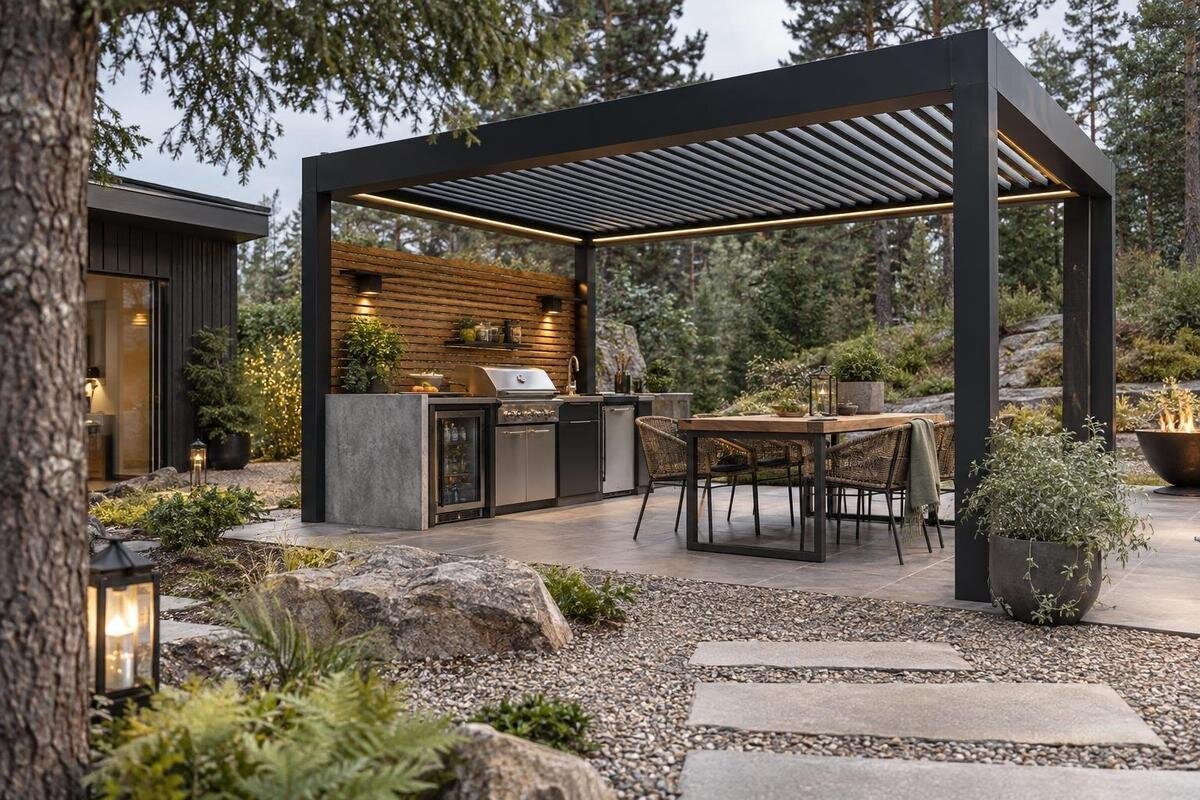
An outdoor kitchen changes what a pergola needs to accommodate: cooking equipment, preparation space, serving routes and somewhere to eat all compete for room. Before comparing styles, sketch those elements in place. Then consider smoke, shade and access, and use the product information to establish whether the pergola you are considering fits the plan.
Before you buy 1
Map the cooking sequence and fixed equipment
List the full cooking sequence, not only the grill, hob or pizza oven. Allow for a preparation surface, somewhere to set ingredients, a place for utensils and trays, and a clear route for carrying food from the house. Note who will use each zone: a single cook needs a different circulation pattern from a space where someone else is serving or helping. If tasks overlap, such as opening an oven while another person prepares food, mark those positions at the same time. Include a sink, bin or refrigerator only if each is genuinely planned, because every fixed unit changes the space required. This turns a general wish for an outdoor kitchen pergola into a layout you can test against a real routine.
Mark the footprint of every fixed item, including appliance doors or lids when open, worktops and any planned storage. Add the chairs, bins or trolley you expect to keep nearby, plus the walking line between the kitchen and dining area. Compare the sketch with the Bloomcabin pergola listing, checking only the dimensions and layout details actually stated on its page. A product photograph cannot show whether the supports land in useful places, so ask for that information if it is missing. The aim is to see whether the whole arrangement, not just the cooking appliance, fits the proposed footprint without blocking the way people use the garden.
Measure usable floor space, not just roof size
Measure from fixed points such as the house wall, the edge of the paving, a step or a drain so the drawing matches the site. Record the width and depth available after accounting for obstacles, including raised beds, drain covers and doors that swing out. Measure an appliance’s body as well as its work surface: lids, doors and serving shelves may take up additional room when open. If you have not chosen the equipment yet, use a provisional outline for planning, then replace it with the confirmed dimensions before making a final pergola decision. A rough estimate can help you compare layouts, but it should not be treated as the finished plan.
Treat the roof outline and the useful ground area as separate measurements. Supports or posts may affect where a counter or table can sit, even if the roof appears to cover the entire arrangement. Check the stated overall dimensions and any support-position drawing, then transfer them to your plan. If you are reviewing the Bloomcabin bioclimatic aluminium pergola listing, see whether the measurements provided are enough to check the layout; ask for clarification if not. Leave room for ordinary movement as well as furniture, and use the appliance maker’s guidance for any required clearances rather than guessing them from the pergola’s footprint.
Before you buy 2
Position the kitchen for access and smoke movement
The pergola’s position affects how easily you can carry food, but also where cooking smoke and odours may travel. Consider the route from the house, nearby doors and opening windows, seating areas and the edges of the garden. Wind can change direction, so observe the space at the times you expect to cook rather than relying on one impression. Think about where ingredients and crockery will be set down and whether the cook can reach the dining area without crossing another person’s work zone. Follow the appliance maker’s guidance on its placement, and get professional advice if the proposed arrangement raises a question about ventilation or safe use.
Check the location against existing paths, steps, taps and any services planned for the kitchen. A shorter route from the house may be convenient, but the layout should not obstruct access to a door or leave equipment difficult to reach. If you are considering the Bloomcabin lean-to pergola listing, use its stated installation information to assess the intended position; do not rely on the product name or image to infer what the site requires. Where a proposed installation involves a wall or nearby services, ask an appropriate professional to assess the details before ordering. The suitability of a particular position depends on the product information and the conditions at your property.
Decide what shade and rain cover you need
Think about the tasks that need shelter. Shade over a worktop may matter at different times of day from shade over the dining table, while rain cover may be a separate priority. Note when the area is likely to be used and how sunlight reaches it; a layout that feels comfortable at lunchtime may be exposed later. A pergola should not be assumed to provide sealed rain cover or protection in every kind of weather. Decide whether you need some shelter over the cooking area, the dining area or both, and compare that expectation with what each product actually states.
Roof design and operation can affect the amount and type of cover, so check the product description and instructions rather than relying on a style name. Ask how the stated roof arrangement behaves in the positions you expect to use, and whether the coverage described includes the area where you will cook and sit. You can include the Bloomcabin pergola page in that comparison, but treat any unstated performance as unknown. Also consider whether the roof position would leave the worktop shaded when needed without making the dining area awkward. The aim is to match stated shelter details to your plan, not to assume that every pergola offers the same protection.
Before you buy 3
Check the pergola against the cooking appliances
Choose the main cooking equipment, or at least narrow down the models, before committing to a pergola. Their dimensions and opening parts affect the layout, while the instructions may specify requirements for positioning, clearances or ventilation. Those details can influence the pergola’s location and the space available for counters and seating. If an appliance is not yet selected, keep its outline provisional and avoid treating a generic grill size as final. Make a note of the manufacturer’s requirements alongside your site plan so you can compare the same arrangement against each pergola you are considering.
Different types of appliance can have different installation and use requirements, so do not assume that one roof arrangement suits them all. Check the appliance maker’s information and the pergola’s own documentation, particularly where heat, ventilation or the position of the cooking equipment is concerned. If you are comparing this Bloomcabin pergola product page, regard it as a product to assess, not evidence of compatibility with a particular appliance. Ask a qualified installer to resolve any question that the published information does not answer. Do not alter an appliance or pergola plan to meet a guessed clearance; establish the requirements before you place an order.
Plan the dining area and serving route
Decide whether people will eat beneath the pergola, beside it or in a separate part of the garden. If the table is included, draw its full footprint and the space needed to pull out chairs, rather than measuring only the tabletop. Include a route for carrying dishes from the cooking area and room for someone to pass when others are seated. A compact arrangement may work for a quick meal but feel crowded when several people are helping or serving. Planning for the way you actually host makes it easier to compare pergola sizes without giving the roof more importance than the usable space beneath it.
Keep the cook’s working area distinct enough that guests are not repeatedly passing through it. That does not require a physical barrier: a change in the position of the table, worktop or entrance route may be enough to create a clearer flow. Compare your planned dining footprint with the product page for a Bloomcabin pergola, using the dimensions and support positions that are actually provided. If the chairs or serving path fall outside the area you hoped to cover, decide whether that matters for how you will use the space. It is better to settle that trade-off on paper than to rely on a photograph to judge how people will move around the finished layout.
Before you buy 4
Compare materials, care and appearance
Look for stated information about the pergola’s materials, finish and care requirements, then consider how those details relate to the kitchen’s location. Cooking can bring grease, food splashes and smoke close to nearby surfaces, so think about which parts will need regular access for cleaning. Ask what cleaning methods the manufacturer recommends rather than assuming that a surface can be treated like an indoor worktop. Also consider exposure to rain, sunlight and garden debris when comparing care information. The aim is not to guess how a material will perform, but to understand the maintenance described for the actual product and whether it suits the way you plan to use the area.
Appearance still matters, particularly if the pergola will sit beside the house or form the main view from indoors. Compare the listed finish and any stated colour options with existing paving, walls and garden furniture. Do not treat a photograph as confirmation of exact colour, surface or material; product information is the better basis for comparison. You can review the Bloomcabin pergola product page alongside other candidates, but check the information provided for the specific item rather than assuming that products with similar names have the same details. A consistent look is useful, but it should not outweigh practical fit, maintenance and the requirements of the cooking equipment.
Check the site and installation requirements
The condition and layout of the site matter as much as the space shown on a plan. Note whether the intended position is paved, uneven or crossed by a drain, and identify any steps or changes in level around it. The product’s installation documents should explain what needs to be considered for that model; do not infer its fixing method or support requirements from a photograph. Ask a qualified installer to assess questions about the base, supports or nearby structures. This is especially important if the planned position is close to a wall or if you are unsure whether the existing surface is appropriate for the proposed installation.
Read the installation information before ordering and check whether it describes any requirements for access, assembly or preparation of the site. If work near existing services is involved, have a suitable professional assess the arrangement rather than planning the work from a picture. For the Bloomcabin option in the catalogue, look for the actual site and installation details supplied for that product, and ask about anything that remains unclear. You may also need to check whether local planning or property requirements apply to your particular site; ask the relevant local authority or a qualified professional rather than assuming that a pergola is exempt. Resolving these points early helps avoid choosing a position that cannot be used as planned.
Before you buy 5
Compare product information on the same basis
A simple comparison table helps separate confirmed details from assumptions. For each pergola, record the stated overall dimensions, support positions, roof arrangement, materials, installation requirements and care information, if supplied. Note whether a detail is missing instead of filling the gap with an estimate. Compare those facts with the same drawing of your kitchen, appliance and dining furniture, so every product is judged against one layout. A larger stated roof area is not automatically the better choice if the supports fall where a worktop needs to go or the usable space does not match the way you will cook.
Check what is included in the order and whether any accessories or options are listed separately; do not assume that items shown in an image come with the pergola. Read the instructions for details that affect your site and the equipment you plan to use. If descriptions use terms you cannot interpret, ask the supplier to explain them in writing before choosing. Keep a record of the exact product and any selected options so you can compare like with like. This makes the decision more reliable than comparing names, promotional photographs or general descriptions without checking what each one actually specifies.
Plan the order around delivery and installation
Before placing an order, consider how the product will reach the garden. Measure gates, side passages and other narrow points on the route, and identify where components could be kept temporarily if they cannot be carried straight to the installation area. Ask the supplier what the order includes, how it is packaged and whether assembly information is available. Check that the person arranging installation has the details for the exact pergola you have selected. Delivery access and assembly arrangements are easy to overlook when attention is focused on the roof, but they can affect when and where the site needs to be prepared.
Revisit the full plan after settling on the appliance, pergola and furniture. Confirm that the product variant and stated dimensions match the drawing, that the planned position remains clear, and that installation questions have been answered. If the cooking equipment needs professional installation, coordinate the plans with the relevant tradesperson before fixing the layout. Ask the supplier about current delivery arrangements rather than assuming a particular timescale, and allow for the sequence of site preparation and assembly when you organise the project. A final check of the whole arrangement can reveal a conflict between a chair, a support or an opening appliance while it is still straightforward to adjust the plan.
Frequently asked questions
Can any pergola go over an outdoor kitchen?
Do not assume that every pergola is suitable for every cooking appliance. Check the pergola’s own installation information and the appliance manufacturer’s guidance on clearances, heat and ventilation. If those documents do not answer a safety or installation question, ask a qualified professional.
Will a pergola keep an outdoor kitchen dry?
Not necessarily. The word pergola alone does not tell you how much rain a particular roof blocks, especially in wind-driven rain. Check the product’s stated roof arrangement and coverage, and decide whether that level of shelter suits the cooking and dining areas.
How large should a pergola be for an outdoor kitchen?
There is no useful size based on the appliance alone. Include worktops, open doors or lids, the route to the house, dining furniture and space to move around. Draw these to scale, then compare the complete layout with the pergola’s stated dimensions and support positions.
Should I choose the pergola or the cooking equipment first?
Plan both together, but identify the equipment and its requirements before you commit to a pergola. Appliance dimensions, opening parts and manufacturer guidance can affect the layout and the structure’s position. If the equipment is not yet chosen, treat its footprint as provisional until you can confirm it.
What should I check before ordering?
Confirm the exact product and dimensions, where its supports sit, what roof details and materials are stated, and what is included. Check the installation information against your site and appliance guidance, then consider access for delivery and assembly. Ask about any detail that remains unclear.
The best fit is not necessarily the pergola with the largest roof. It is the option whose confirmed footprint gives the cook room to work, keeps the serving route practical and leaves space for the dining arrangement, while meeting the requirements of the appliances and site. If those functions do not fit together, revise the layout before ordering rather than trying to make a crowded cooking area work around a choice made on appearance alone.
