
Fungus Gnats in a Greenhouse: Causes, Prevention and Treatment
Greenhouse pest register · adults above, larvae below
Fungus Gnats in a Greenhouse: Causes, Prevention and Treatment
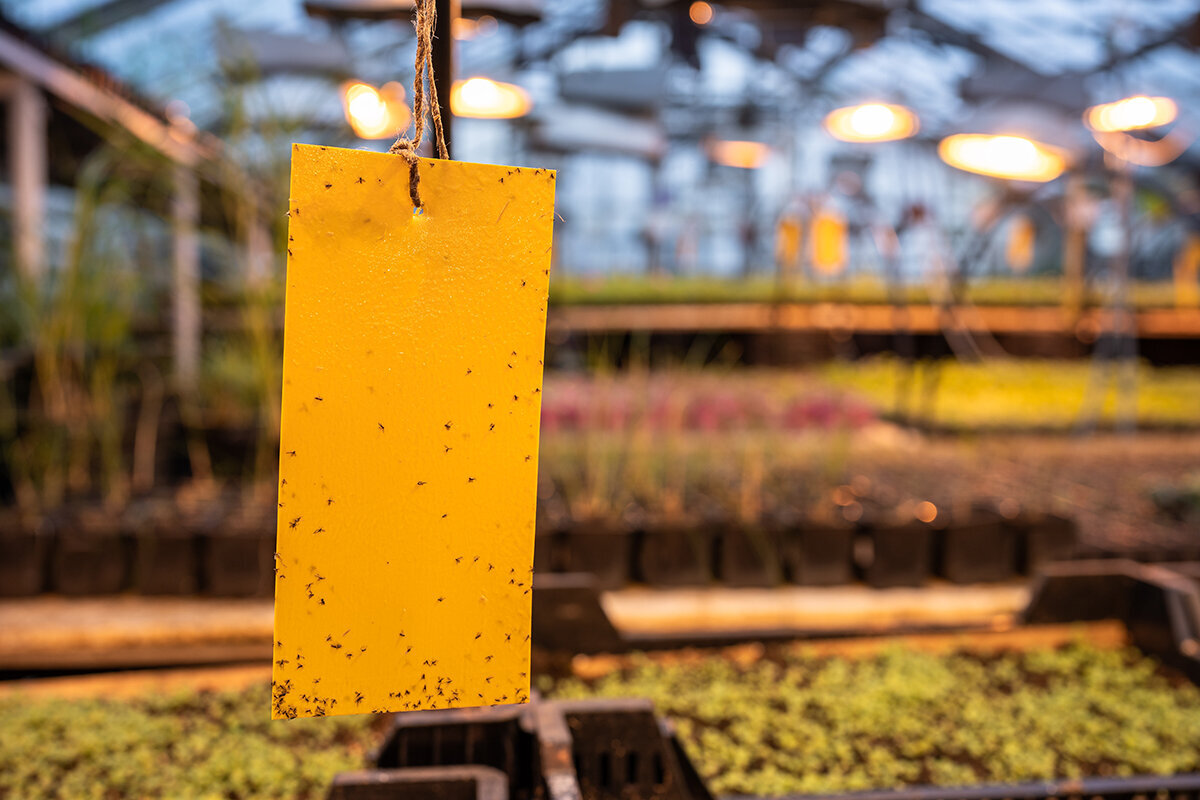
A yellow card scattered with tiny dark flies makes the problem conspicuous. It cannot make the root zone healthy. In most greenhouse outbreaks, trapped adults are the visible record of larvae developing in persistently moist, organic-rich growing media.
That distinction changes the response. Catching flying adults is useful for monitoring and may reduce nuisance pressure, but fungus gnat management is won or lost around moist compost surfaces, algae, decaying residues, vulnerable propagation material and larvae close to the roots. The aim is not to force every pot bone-dry. It is to restore a crop-appropriate wet interval: sufficient water for the plant, with less uninterrupted habitat for sciarid flies.
Read the card as evidence. If weekly catches rise, trace the moisture, sanitation and propagation conditions beneath the crop rather than treating the card as a complete solution.
First 48 hours
Protect the tender work first.
Fungus gnats matter most where a serious gardener has invested the greatest care: fresh sowings, plugs, rooted cuttings, newly potted plants and slow-starting transplants. Established, vigorous plants often tolerate a modest population; fine roots and newly struck cuttings have far less margin. Begin by gathering affected propagation trays in one easy-to-inspect area, rather than spraying or disrupting the entire greenhouse.
01
Pause automatic assumptions.
Check whether timers or habitual watering continued through cool, cloudy days after plant growth slowed. A schedule that suited last week may be excessive this week.
Check whether timers or habitual watering continued through cool, cloudy days after plant growth slowed. A schedule that suited last week may be excessive this week.
02
Remove standing water and algae.
Empty saucers and catch trays, clear puddles beneath staging, and clean green films from floors, pots, labels and irrigation areas.
Empty saucers and catch trays, clear puddles beneath staging, and clean green films from floors, pots, labels and irrigation areas.
03
Quarantine incoming material.
Keep new plugs, plants and damp bags of growing media away from propagation until they have been inspected and monitored with a nearby card.
Keep new plugs, plants and damp bags of growing media away from propagation until they have been inspected and monitored with a nearby card.
Identification before intervention
Not every small dark fly is a fungus gnat.
Adult fungus gnats, commonly called sciarid flies in Britain, are delicate, dark grey-brown, long-legged insects generally3.0to4.0mm long. They are weak flyers, often hovering slowly near pots or running across the compost surface. Long legs and threadlike antennae are useful clues on a well-positioned sticky card, although close inspection is more dependable than colour alone.
The larva is the decisive underground clue: slender, translucent to whitish, legless and equipped with a distinct shiny black head capsule. Look in the moist upper growing medium rather than only deep in the container. Larvae are often easiest to find in wet propagation cells, beneath surface debris or around decaying leaves resting on compost.
Likely fungus gnatDelicate · long-legged
Shore flyStockier · algae-associated
Identification cautionTrace the emergence source
Working ruleConfirm habitat and insect
Likely fungus gnat
Look for weak, erratic flight, long threadlike antennae and a habit of resting or running on the compost surface. Sciarid larvae have a clearly visible dark head and consume fungi, decaying organic material and, under heavy pressure, tender roots or stem bases.
Common lookalike: shore fly
Shore flies also favour algae and excess wetness, but adults are usually stockier than fungus gnats. They can be a nuisance, although their larvae are not normally the root-feeding concern associated with sciarid flies.
Follow the source carefully
Fruit flies tend to gather around fermenting produce, while drain flies are fuzzy and moth-like and remain close to drains. A yellow card alone does not confirm any of these diagnoses. Inspect several specimens and trace the place from which adults are emerging.
What the distinction changes
Algae and retained moisture deserve attention in either case. Root-zone protection and larval controls become much more important when sciarids are confirmed. A card count alone cannot establish that distinction.
The two-storey cycle
One pest, two different working levels.
Fungus gnats develop through egg, larval, pupal and adult stages. Timing varies with temperature, moisture and available food, although development may take roughly three to four weeks under favourable greenhouse conditions. The practical point is simpler: adults are intercepted above the crop, while eggs, larvae and pupae remain associated with moist growing media. An effective programme must interrupt both levels.
Above the crop
monitoring plane
monitoring plane
Adults→
Egg laying→
Cards record→
Adults emerge
In and near
upper media
upper media
Eggs→
Larvae→
Pupae→
Root risk
Above the crop: what cards can show
Weak-flying adults gather around containers, lower foliage and damp compost. Females lay eggs in cracks and crevices near moist growing media where food will be available to larvae. Yellow cards reveal adult activity and changes in pressure over time; they cannot show how many larvae occupy each pot. Newly emerged adults leave pupal sites and restart the visible phase.
In the upper media: where intervention matters
Tiny eggs occur at or near the damp compost surface. Larvae feed where fungi, algae and decaying organic matter are available before pupating in the medium. High larval pressure is most consequential around seedlings, plugs, cuttings and plants whose roots are already stressed.
Why outbreaks start
Moisture is not the enemy. Persistent wetness is.
Protected air + wet upper compost + organic residues + repeated irrigation without a suitable dry-back interval = favourable fungus gnat habitat.
Peat-free and other organic growing media can be excellent for plants. Trouble begins when surfaces remain wet day after day, drainage is restricted, algae establish, leaf debris accumulates or containers sit in runoff. Fungus gnats are not proof that a greenhouse is dirty, badly built or universally affected by root damage. They are, however, a useful signal to inspect the biological conditions created by irrigation, storage, drainage and crop spacing.
Drainage
Water must be able to leave.
Blocked pot holes, compacted compost, tightly nested containers, water-filled saucers and trays acting as reservoirs keep the bench environment wet long after the crop has taken what it needs.
Algae
Green film is a clue.
Algae indicates recurring surface wetness and nutrient-rich runoff. It supports shore flies particularly well and commonly accompanies the same persistently damp conditions that favour sciarid flies.
Organic debris
Remove the soft fuel.
Dead leaves, failed seedlings, spent plugs, old compost and plant fragments retain moisture and support fungal growth. Remove them before they become part of the next generation’s habitat.
Read symptoms carefully
Larvae can stress roots, but diagnosis still requires restraint.
Fungus gnat larvae mainly consume fungi and decaying organic material. In high numbers, however, they may feed on fine roots or tender stem bases. Seedlings, plugs and newly rooted cuttings are the greatest concern because even modest feeding can have an outsized effect on establishment. Feeding and tunnelling may also create openings that leave already stressed roots more vulnerable to soil-borne disease organisms.
Yet yellowing, stalled growth, wilting and poor rooting are not exclusive fungus gnat symptoms. Low light, cold compost, nutrient imbalance, root disease, blocked drainage, underwatering after an overcorrection or poor transplanting can look similar. Ease out a representative weak plant, compare it with a healthy plant of the same crop, and inspect roots and moisture before assigning blame. For a structure that keeps this work accessible, consider the Classic Aluminium Greenhouse.
Healthy zonePale, resilient roots; crop-appropriate moisture.
Food zoneAlgae, debris and failed plug material.
Risk zoneConstantly wet surface; larvae positively identified.
Do not assumeAdult sightings do not prove root feeding.
Useful threshold: Treat confirmed larvae around propagation as a prompt to improve the growing environment immediately. Waiting for dramatic wilt makes recovery harder and narrows the range of gentle, crop-sensitive options available.
Irrigation is the main lever
Design a dry-back rhythm, not a drought ritual.
Advice to let compost dry is useful only when it respects the crop, root volume, weather and growth stage. Basil in a small cell tray, a rooted cutting, a mature citrus plant and a moisture-loving fern do not share one safe interval. The objective is partial drying of the upper medium where the crop permits it, while keeping the active root zone appropriately hydrated. Complete dry-out is neither necessary nor safe for every plant.
Water when requiredPartial surface dry-backRewater before stress
1. Check beneath the surface.
Lift the container and judge its weight, inspect the lowest cells, or feel beneath the upper compost where the pot size permits. A pale surface can conceal a saturated lower root zone; a dark surface may still be appropriate for a moisture-sensitive crop. Use several observations rather than relying on appearance alone.
2. Review volume and frequency.
If a bench remains wet, examine irrigation output, runoff and drainage. Apply enough water to reach active roots, but do not repeatedly top up the surface with small amounts merely because a timer or familiar routine says watering is due.
3. Reset for the weather.
Reduce irrigation through dull, cool spring or autumn spells, particularly when ventilation is limited. In hot, bright weather, crops may need substantially more water without becoming gnat-prone, provided the compost drains and an appropriate surface break develops between applications.
Tomatoes are a useful reminder that crop requirements come first: demand changes markedly as plants enlarge, light levels rise and fruit develops. A practical structure for observing these changes is the Classic Aluminium Greenhouse, where watering can be organised by crop zone. Apply the same principle to every container: water the plant’s root system, not the gnat habitat by habit.
A four-station diagnosis
Triangulate the problem before escalating treatment.
A single monitoring method sees only one part of the greenhouse system. Use yellow cards, larval sampling, root inspection and a simple dated watering record together. This turns an irritating cloud of flies into useful information: where adult pressure is greatest, whether larvae are present, which plants are vulnerable and whether moisture correction is producing a downward trend.
Yellow cards
Adult activityLarval check
Surface larvaeRoot inspection
Crop vulnerabilityWatering record
Habitat patternYellow cards
Place cards low and close to the growing medium, especially around propagation benches. Date them, replace and count them on the same day each week, and compare trends rather than fixating on one isolated catch. Cards reveal adult activity and movement; they do not measure larval density or prove root damage in every pot.
Larval check
Inspect moist upper compost or lay a small fresh potato slice or wedge on the surface as a targeted sample. Check its underside after roughly two days for pale larvae with black heads, then dispose of it. This can reveal active surface larvae, but it does not provide a complete root-health diagnosis.
Root inspection
Select a limited sample of weak seedlings or plugs and compare them with healthy plants of the same crop. Look for pale, firm fine roots, brown or soft tissue, odour, saturation and confirmed larvae before deciding whether sciarids are the principal cause of decline.
Watering record
Note irrigation dates, tray weight, cloudy spells, leaks, algae and card catches. A short weekly record often exposes a relationship that memory misses: for example, rising catches after a prolonged wet interval. The record reveals habitat patterns, although it cannot identify the insect species by itself.
Prioritised treatment pathway
Correct the habitat first, then narrow treatment towards larvae.
The most dependable programme layers compatible measures. Begin with the wet, organic conditions supporting the population. Add biological controls where larvae are confirmed or pressure persists. Consider plant protection products only where the current UK authorisation and product label permit the exact crop and setting. Never assume that overseas advice, or a product intended for ornamentals, is suitable for edible crops or amateur greenhouse use.
1
Drainage, dry storage and sanitation
Clear saucers, reservoirs and puddles; remove algae and decaying plant matter; and discard badly infested old compost where replacement is sensible. Store fresh growing media dry, sealed and off the greenhouse floor. Open blocked drainage holes and review irrigation uniformity. This foundational work helps prevent another wave after monitoring or biological controls have reduced the current population.
Best for:
Every outbreak, crop and season.
Every outbreak, crop and season.
2
Physical management and crop handling
Use yellow cards for detection and to reduce adult nuisance, but never substitute trapping for larval management. Remove senescent leaves from compost surfaces, provide enough spacing for air movement and keep drainage visible. Do not leave propagation cells continuously wet simply because neighbouring mature plants need a larger or more frequent drink.
Best for:
Low to moderate pressure and early intervention.
Low to moderate pressure and early intervention.
3
Biological controls for larvae
Options identified by RHS guidance may include the pathogenic nematode Steinernema feltiae, suitable predatory mites and greenhouse rove beetles. Availability varies, so use only supplier-approved biological controls appropriate to your crop and conditions. These are living control agents, not decorative additions: buy from a reputable supplier, use them promptly and follow instructions precisely for freshness, storage, application timing, growing-medium moisture, temperature and compatibility with other greenhouse treatments.
Best for:
Confirmed larvae, propagation areas and planned programmes.
Confirmed larvae, propagation areas and planned programmes.
4
UK-authorised products, used with precision
Do not assume that a product recommended online in another country is authorised for amateur use in the UK. If considering a plant protection product, check the current HSE authorisation database and use only one labelled for your plant, pest and setting. Follow the label for dose, timing, protective measures, storage and disposal. Never improvise with household chemicals or decant products.
Best for:
Persistent cases after accurate identification.
Persistent cases after accurate identification.
Compatibility check: Beneficial nematodes, mites and beetles require suitable environmental conditions and may not be compatible with every sanitation product, tank mix or residual pesticide. Plan biological releases and any authorised product as one coordinated system. Before combining measures, consult the current product label and the live biological-control supplier, paying close attention to timing, temperature, moisture and compatibility warnings.
Propagation-area reset
Make the next tray less hospitable from day one.
After each crop cycle, remove failed plants, loose compost and organic debris from benches, floor edges and drainage areas. Wash reusable trays and tools, clean algae from splash zones, and ensure staging drains rather than retaining a thin film of water. Begin new propagation with clean containers, fresh growing media stored dry, clearly labelled trays and dated monitoring cards already positioned close to compost level.
Then give each crop its own watering logic. A misted cutting bench has different constraints from a tomato transplant bench, and neither should determine the irrigation of the other. Separate zones where possible, keep enough room to inspect pot rims and drainage holes, and ventilate in a measured way when British weather permits. This is more precise horticulture and a calmer form of pest management.
The clean bench sequence
EmptyRemove debris and old compost.
WashClean trays, tools and surfaces.
DryRepair leaks; clear retained water.
MonitorDate cards before planting.
For a greenhouse intended as both a long-term garden room and a productive workspace, use layout, drainage and ventilation choices to make this routine straightforward. Explore the durable, adaptable Classic Aluminium Greenhouse and plan clear bench access, roof ventilation and a dedicated propagation corner around the gardening work you actually undertake.
Frequently asked questions
Practical answers from the potting bench.
The right response is usually calm observation followed by a coordinated environmental reset, rather than one dramatic product, indiscriminate spraying or a severe drying spell.
Will yellow sticky cards get rid of fungus gnats?
They capture adults, may reduce nuisance numbers and are excellent for showing where activity is concentrated. They do not directly control eggs, larvae or pupae in growing media. Keep using dated cards to measure the trend, while correcting drainage and crop-specific moisture conditions and targeting confirmed larvae where necessary.
How dry should greenhouse compost become?
Only as dry as the crop can safely tolerate. Encourage partial drying of the upper medium where appropriate, but do not subject young cuttings, seedlings, ferns or other moisture-sensitive plants to whole-root-ball drought. Judge the need to water from pot weight, lower-cell moisture, weather, root volume and crop condition rather than using one universal number of days.
Can fungus gnats damage mature plants?
Around mature, healthy plants they are often principally a nuisance, but a large larval population may feed on fine roots. Damage is more consequential in seedlings, plugs, cuttings and already stressed crops with little root mass to spare. Examine roots and confirm larvae before attributing every case of poor growth to sciarid flies.
Are shore flies treated in the same way?
Both are associated with damp greenhouse conditions, so improved drainage, cleaner surfaces and algae control are useful. Shore flies are generally stockier and more closely tied to algae, however, and their larvae are not usually the root-feeding threat associated with sciarids. Accurate identification therefore influences how strongly treatment should focus on the root zone.
When should I use nematodes or other biological controls?
Use them when a larval issue has been confirmed or is strongly evidenced and you can provide the conditions specified by the supplier. Check delivery freshness, storage dates, application method, temperature and compatibility with other treatments. Biological controls perform best as part of an integrated programme in which drainage, sanitation and irrigation are already being corrected.
Sources and further reading
Authoritative references for identification and integrated management.
Product availability and legal directions can change. Before purchasing or applying a pesticide or biological control, consult current UK authorisations, the live product label and supplier instructions. The following references support the identification, monitoring and measured management described above.
More from Bloomcabin: greenhouse layout, planting and care in the UK · water-wise greenhouse gardening guide · Bloomcabin UK greenhouses and conservatories
- Royal Horticultural Society — fungus gnats and sciarid flies
- RHS — biological pest controls
- HSE — pesticide authorisation databases
- HSE — using pesticides at home or in gardens
- UConn Extension — managing fungus gnats and shore flies in greenhouse production
- UMass Amherst — greenhouse integrated pest management and sticky-card monitoring
A repeatable weekly ritual
Reset the wet interval.
A greenhouse with declining fungus gnat pressure is rarely the result of one perfect trap or one forceful treatment. It comes from a short, disciplined inspection repeated before damp compost, algae and organic residues become a permanent habitat.
Inspect moistureCheck the upper compost and lower root zone before the next planned watering.
Empty standing waterInspect saucers, trays, staging and floor edges; remove every lingering wet pocket.
Read the cardsDate catches and compare them with the previous week rather than relying on memory.
Examine vulnerable rootsInspect a representative cutting, plug or seedling when catches rise or growth begins to stall.
