
How Long Does an Aluminium Pergola Last? Key Ownership Factors
Outdoor living guide
How long does an aluminium pergola last? The ownership choices that matter.
An aluminium pergola can remain a valuable part of a garden for many years, but its lifespan is not decided by the frame alone. Site exposure, foundations, moving components, drainage and access to support all influence how confidently it can be enjoyed over time.
When homeowners ask how long does an aluminium pergola last, they are usually looking beyond a headline lifespan. They want to know whether the structure will still look at home beside the house, whether it will operate smoothly through changing seasons, and what ownership will require. The most useful answer is therefore a framework for judging durability, not a single promise measured in years.
Aluminium is widely chosen for its clean architectural appearance and its suitability for outdoor use, yet every pergola is a system. Posts, fixings, guttering, roof elements, screens and controls may age in different ways. A simple roofed structure asks less of its mechanisms than a louvred design, while both depend on careful fitting, sensible use and regular inspection.
For a British garden, exposure deserves particular attention. A sheltered courtyard, a coastal plot and an elevated terrace present very different conditions. By asking focused questions before purchase, then setting aside modest time for routine care, you can choose an aluminium pergola that suits the way you live and make informed decisions about future maintenance and replacement parts.
01 · Start with the system
A lifespan is more than the frame
The aluminium frame is the visible backbone of a pergola, but long-term condition depends on the whole assembly. Coatings need gentle care, connections need to remain secure, and rainwater needs a reliable path away from the structure and its base. A pergola that is proportioned for its setting and fitted to an appropriate substrate begins life with fewer avoidable stresses.
Bioclimatic designs add adjustable roof elements, channels and operating hardware to the ownership picture. These features can make a terrace feel more adaptable across the year, but they should be considered as serviceable parts of a complete system rather than as separate accessories. Choose a layout that leaves room to inspect, clean and operate every element without awkward workarounds.
- Look for clear information separating frame care, roof operation, drainage checks and any electrical equipment requirements.
- Think about access from the outset: ladders, planting and boundary treatments should not obstruct sensible future inspection.
For adaptable overhead shade, explore a bioclimatic aluminium pergola with its roof system considered as part of long-term ownership.
02 · Material and finish
What aluminium needs from you
Aluminium is valued for a crisp, contemporary appearance and does not demand the same treatment routine as timber. That does not mean it should be ignored. Airborne dirt, pollen, bird droppings and garden residues can dull surfaces if left to accumulate, particularly around joints, channels and sheltered corners. A gentle clean using suitable methods helps you notice small changes while they are still straightforward to address.
The site can affect the care schedule. Gardens near busy roads may gather grime more quickly, while coastal or highly exposed locations can justify more frequent washing and closer attention to metal connections. Avoid improvised abrasive tools or harsh cleaners that may compromise the surface. Use the manufacturer’s care advice for the particular finish and test unfamiliar products discreetly first.
- Rinse away loose debris before wiping, paying particular attention to ledges, gutters and post bases.
- Keep climbing plants and irrigation spray from constantly holding moisture or debris against the structure.
If you prefer a straightforward roof format, consider a regular aluminium pergola and build simple seasonal cleaning into your garden routine.
03 · The base matters
Installation sets the starting point
A durable pergola begins below eye level. The supporting surface must be suitable for the proposed structure, with fixings selected for the actual substrate rather than assumed from its appearance. Paving alone is not necessarily a structural answer; the construction beneath, ground conditions and any existing drainage all matter. A professional installer or suitably qualified adviser can assess the proposed location before work begins.
Accurate alignment and secure connections help doors, screens and moving roof elements operate as intended. Installation should also preserve clear routes for rainwater and avoid creating places where water repeatedly sits around the bases. Retain drawings, product instructions and records of the work. They are useful references if you later add accessories, arrange maintenance, sell the property or seek a replacement component.
- Discuss surface build-up, slopes and drainage before choosing the final position or ordering a bespoke size.
- Check that access for installation and later maintenance will not be restricted by walls, trees or neighbouring structures.
Where adjustable overhead elements are central to the brief, a bioclimatic pergola with louvred roof deserves particularly careful installation planning.
04 · Weather and water
Manage the garden around it
British weather brings repeated wetting, leaf fall and sudden changes in temperature, so water management is a practical ownership priority. Keep gutters, outlets and surrounding drainage routes free from leaves and moss. Water that overflows repeatedly may mark nearby finishes, saturate the base or conceal a developing blockage. A brief inspection after heavy weather is often more useful than waiting for the annual garden clear-out.
Trees create welcome shade but can also deposit sap, twigs and leaves on a roof and in its channels. Position furniture and planting so that cleaning access remains realistic. If your pergola sits close to the house, take time to understand how its drainage relates to the existing rainwater system. Do not alter connections or add fixings without checking product guidance and the condition of the building fabric.
- Clear loose leaves before they become compacted in channels, especially during autumn and after strong winds.
- Observe where water travels across the terrace during rain, then address pooling before it affects the surrounding surface.
For terraces seeking a clean, uncomplicated canopy arrangement, view a traditional regular pergola alongside your drainage and planting plan.
05 · Moving components
Complexity needs a care plan
Moving parts are not a drawback; they simply call for a more deliberate approach to care. Louvre blades, pivots, screens, seals, motors and controls should be operated in line with the product instructions and kept free from debris that could impede movement. If operation changes, avoid forcing the mechanism. Inspect first, consult the supplied guidance, and use an appropriate service route where the cause is not obvious.
A useful buying question is not only what a feature does on day one, but how it can be reached, cleaned and supported later. Ask which components are designed to be replaced, what information identifies them, and whether the layout leaves safe access. Consider electrical additions separately: cable routing, controls and any work on connections should be handled in accordance with relevant professional advice.
- Operate adjustable elements periodically rather than leaving them untouched for an entire season.
- Keep the order confirmation, model details, colour reference and installation records together for future identification.
For homeowners wanting adjustable light and ventilation, a bioclimatic pergola with adjustable louvres rewards a clear routine for operation and inspection.
06 · Support over time
Spare parts are part of value
Long-term confidence comes partly from knowing how a product can be supported after installation. Ask the supplier how to identify a roof component, seal, handle, screen part or fixing should it eventually need attention. Product ranges can evolve, so accurate records are more useful than relying on appearance alone. Photograph labels and retain documents in a place that will remain accessible after renovations or a change of owner.
Do not assume every maintenance issue calls for wholesale replacement. Some concerns may relate to cleaning, adjustment, a worn consumable part or a localised drainage obstruction. Equally, do not postpone a persistent issue just because the frame still looks sound. A timely assessment can clarify whether a small repair is appropriate and help protect the rest of the installation from unnecessary strain.
- Before buying, ask what documentation is supplied for ordering compatible parts and arranging technical support.
- Record unusual noises, stiffness, leaks or recurring overflow with dates and photographs before requesting advice.
For a lower-mechanism outdoor room, a regular pergola with fixed roof can make the future parts conversation more straightforward.
07 · Costs without guesswork
Budget for the whole ownership period
The long-term cost of an aluminium pergola is broader than the initial order. Include preparation of the site, installation, optional features, routine cleaning materials, occasional professional help and the possibility of replacement components. These costs will vary with size, configuration, access and location, so a current written quotation is the soundest basis for comparison. Avoid treating a low starting figure as a complete ownership forecast.
Compare proposals on what they include and how clearly responsibilities are described. It is sensible to ask about installation scope, substrate assumptions, electrical work, drainage, aftercare and the process for sourcing parts. If you are weighing features, place their likely maintenance demands alongside their day-to-day usefulness. The most satisfying choice is often the one whose ongoing care fits your household and garden habits.
- Request a clear breakdown of the project scope so exclusions or preparatory work do not emerge unexpectedly.
- Set aside a modest contingency for garden changes, professional checks or component attention over the ownership period.
To compare a more feature-led option, review a bioclimatic aluminium pergola system with questions about access, controls and aftercare prepared.
08 · Protect the decision
Review planning, insurance and change
Planning considerations for a pergola can depend on its dimensions, position, property type and local context. Listed buildings, conservation areas, boundaries and attached structures can introduce further considerations. Check your proposed scheme with the relevant local authority or a qualified planning professional before committing, rather than assuming that a neighbour’s project or an online example applies to your property.
It is also sensible to tell your insurer about significant garden additions and ask how they wish the structure to be recorded. Policy terms, installation standards and cover limits vary, so obtain guidance directly from the insurer rather than relying on general advice. If you later enclose an area, alter drainage, add electrics or attach new elements, revisit the original documents and seek suitable professional input.
- Confirm local planning requirements before finalising location, height, boundary relationship or attachment to the home.
- Ask your insurer focused questions about disclosure, evidence of installation and any future alterations you are considering.
When you want a calm, open garden structure, a classic regular aluminium pergola can be assessed against the specific constraints of your plot.
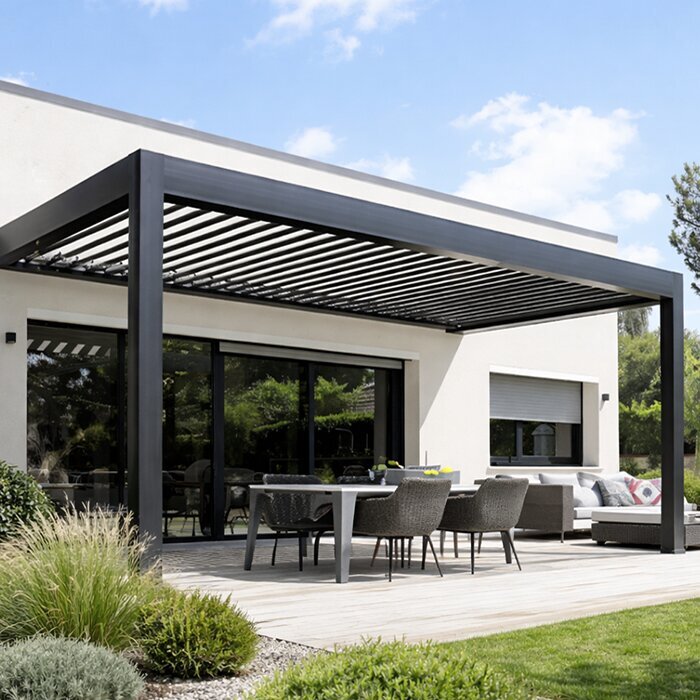
Comparison
Choosing for long-term ownership
There is no universally right pergola format. Use this comparison to relate the design to the amount of mechanism you want, the care you can realistically provide and the way your terrace will be used. Confirm exact features and specifications for the configuration you are considering.
| Ownership consideration | Regular aluminium pergola | Bioclimatic aluminium pergola |
|---|---|---|
| Roof approach | Typically a simpler, fixed-format overhead structure. | Adjustable roof elements create a more changeable setting. |
| Routine attention | Focus on finish, fixings, drainage and roof cleanliness. | Includes those tasks plus clearing and operating moving elements. |
| Future support | Fewer operational components may simplify fault finding. | Keep detailed records for roof, controls and associated components. |
| Best for | Homeowners prioritising a defined, uncomplicated outdoor room. | Homeowners who value adaptable shade and accept added care. |
| Installation discussion | Substrate, anchoring, drainage and access remain essential. | Those fundamentals plus precise alignment and service access matter. |
Plan for a longer ownership story
Make the durability conversation part of selection, not an afterthought once the pergola is installed. These steps help turn a broad lifespan question into decisions suited to your home, plot and preferred level of upkeep.
01
Read the site
Map exposure, drainage, trees, nearby walls and practical cleaning access. Notice where wind-driven rain, fallen leaves and standing water are most likely to affect the proposed position.
02
Choose useful complexity
Decide whether a fixed format meets your needs or whether adjustable roof features will genuinely improve daily use. Match the choice to your willingness to inspect and maintain mechanisms.
03
Confirm the foundation
Have the supporting surface, fixing approach and levels considered before installation. Resolve drainage and access questions early rather than adapting around them after the structure is in place.
04
Ask about support
Request care guidance, product identification information and the process for obtaining compatible parts. Keep quotations, instructions and installation documentation together from the beginning.
05
Create a seasonal routine
Schedule simple checks around leaf fall, spring cleaning and periods of heavy weather. Note any changes in operation or drainage and seek appropriate advice before problems escalate.
Questions to ask before you order
Use this checklist in discussions with suppliers, installers and advisers. It will help you compare proposals on the practical details that shape condition, servicing and future costs.
01. Is the proposed substrate suitable, and what preparation or structural work is assumed within the installation scope?
02. How will rainwater leave the roof, and where will it travel once it reaches the terrace or garden?
03. Which areas need regular cleaning, and can they be reached safely without compromising planting or furniture layouts?
04. What care methods and cleaning products are recommended for this specific aluminium finish and roof arrangement?
05. For moving features, what routine operation, debris removal and inspection does the manufacturer advise?
06. What documents, model details or labels should be retained to identify future replacement components accurately?
07. Who should assess a persistent operational, drainage or fixing concern, and what information will they need?
08. Have local planning considerations and insurer disclosure been checked for this particular property and proposed design?
Frequently asked questions
Does aluminium itself rust?
Aluminium does not rust in the same way as ordinary steel, which is one reason it is popular outdoors. However, its surface finish, fixings, joints and surrounding materials still need sensible care. Dirt, trapped moisture and site conditions can affect appearance and components, so clean and inspect the complete pergola rather than focusing on the frame alone.
How often should an aluminium pergola be cleaned?
The right interval depends on exposure. A sheltered, clear garden may need less attention than a plot beneath trees, beside a busy road or near the coast. Inspect it regularly and clean away visible dirt, leaves and residues before they build up. Always follow the care guidance supplied for your particular finish and roof design.
Are bioclimatic pergolas harder to maintain?
They can require more attention because adjustable roof sections and related mechanisms add moving parts. That does not make them unsuitable for long-term ownership; it means access, cleaning and correct operation should form part of the purchase decision. Ask what routine checks are advised and what support is available if movement becomes uneven or restricted.
Can a pergola be repaired rather than replaced?
It depends on the component, the cause of the issue and the age and configuration of the installation. A drainage blockage, local adjustment or replaceable part may call for a targeted remedy, while more extensive damage needs professional assessment. Keep records and contact the supplier or an appropriate specialist with clear details of the concern.
Will my pergola need planning permission?
That depends on the property and proposal, including location, dimensions, attachment, boundaries and local designations. Do not rely on broad online assumptions or a nearby example. Check the relevant local authority’s guidance and seek professional advice where needed before ordering or starting work, especially for listed buildings or sensitive locations.
Should I notify my home insurer?
It is prudent to ask your insurer how a substantial garden structure should be disclosed and what evidence they require. Cover and conditions vary between policies, and future additions such as electrics or enclosure may be relevant. Obtain an answer specific to your policy, then keep installation records and correspondence with your household documents.
Explore pergola options
Choose for the years after installation
How long an aluminium pergola lasts is shaped by a sequence of sensible decisions: selecting the right format, respecting the site, installing it properly and maintaining all of its components. A clean, well-drained and accessible structure is easier to enjoy and easier to assess when something needs attention.
Approach the purchase as an outdoor-living project with a future, not simply an object for the terrace. Bloomcabin can help you explore regular and bioclimatic options while you consider layout, ownership needs and the questions that matter to your particular garden.
Compare designs with your site, preferred level of maintenance and long-term outdoor routine in mind.
