
How to Grow Kale in a Greenhouse
Bloomcabin field notes / cool season
How to Grow Kale in a Greenhouse
A ruffled winter crop with serious structure: grow kale under glass for crisp leaves, repeated pickings and a greenhouse that remains productive after summer crops have gone quiet.
Crop characterCool-season, cut-and-come-again brassica
Best greenhouse roleAutumn, winter and early-spring leaf harvests
Preferred conditionsCool days, bright light, steady moisture
Essential disciplineProtect the central growing point
The winter-light argument
Kale does not need tropical treatment. It needs a bright, well-ventilated greenhouse that moderates soaking rain and wind while allowing its dense, ruffled canopy to dry properly.
Read the crop, not only the thermometerFirm leaves and an active centre suggest steady growth. Limpness, widespread yellowing, bitterness or wet inner foliage are climate notes worth answering early.
A greenhouse does not remove seasonality; it makes it more manageable. Day length still slows winter growth, and an unheated structure is not automatically frost-free. Shelter nevertheless offers control over conditions kale dislikes: saturated foliage, wind stress, erratic watering and abrupt swings in temperature. In a small house, reserve a bright bed edge for kale and keep the path open so that every crown remains visible. The Classic Aluminium Greenhouse offers roof ventilation and a considered growing space for permanent beds, containers and seed-starting benches.
Kale tolerates cold, but it is not indifferent to stress. The best leaves come from plants growing continuously rather than alternating between cold, sodden roots and sudden greenhouse heat. The purpose is not to force rapid growth in December. It is to create a stable room where each new leaf can unfold cleanly, dry after a humid night and remain worth harvesting for as long as possible.
01 / Choose the silhouette
Choose kale for the room it will occupy.
A cultivar is not merely a decision about flavour. It determines height, leaf density, harvest style and how readily air moves through the bed. Select a form whose mature scale suits both your path and the intended length of its season.
Curly kale
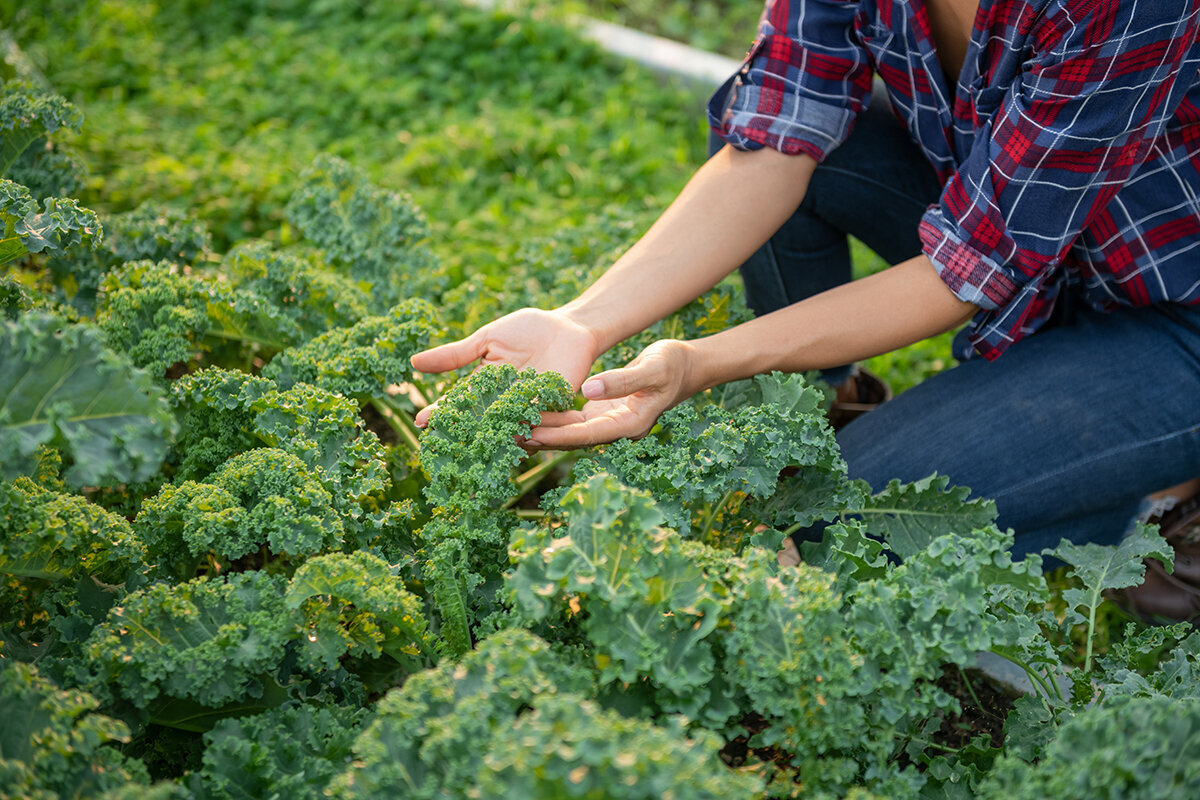
Dense, finely ruffled leaves provide substantial pickings and a familiar winter crop. The folds also retain moisture, so generous spacing, dry foliage and early ventilation are particularly important under glass.
Best forRepeated outer-leaf harvests
Greenhouse noteAllow 30–60 cm for mature plants
Cavolo nero
Long, dark, pebbled leaves create a composed vertical rhythm in a bed. Its comparatively open architecture is straightforward to inspect and convenient to pick one leaf at a time.
Best forNarrow beds and containers
Greenhouse notePick lower leaves before they toughen
Red Russian
Softly lobed blue-green leaves and purple stems bring colour to low-season planting. It is particularly useful for tender baby leaves, although warm spring weather can accelerate its growth.
Best forBaby leaves and succession sowing
Greenhouse noteInspect inner leaves for aphids
Compact types
Shorter selections resolve narrow-bed, low-eave and container constraints. Their contained footprint can give a worthwhile crop without turning the greenhouse path into a damp wall of overlapping foliage.
Best forContainers, benches and narrow plans
Greenhouse noteChoose a genuinely deep, roomy pot
For mature plants, RHS guidance recommends approximately 30–60 cm between plants, depending on the variety and intended size. Closer spacing belongs to baby-leaf production, where around 7.5 cm may be sufficient. In a compact greenhouse, prioritise access over plant count. You should be able to see each plant’s base, direct water towards the roots and pick without brushing repeatedly against wet leaves.
Use deep, fertile soil that drains freely while retaining useful moisture. Good garden loam or a greenhouse border improved with mature compost is ideal. Before refreshing an old bed, clear crop residues and add well-finished organic matter without creating a heavy, compacted root zone. Avoid growing brassicas repeatedly in exhausted soil; RHS advises periodically replacing greenhouse-border soil to limit the accumulation of soil-borne problems. A balanced general fertiliser before planting is more suitable than treating this leafy crop routinely with high-potash tomato feed.
02 / Begin in waves
Sow a braid, not one grand batch.
One large sowing can create a handsome harvest followed by a gap. Several modest batches establish a better greenhouse rhythm: young replacements, plants ready for regular picking and mature crowns that can be cleared when their leaf quality begins to decline.
First thread
Sow carefully
Sow seed about 1 cm deep in modules, small pots or a prepared bed, using fresh seed compost or a fine, evenly moist mix. Garden Organic gives March to May for indoor sowing and notes that germination commonly takes seven to twelve days.
Thin deliberately. Crowded seedlings can supply baby leaves; retain only the strongest, best-spaced plants where full crowns are required.
Second thread
Transplant with purpose
Raise seedlings in modules while another crop still occupies the final bed. Move them once they have a sound root system and several adult leaves, before the roots become congested and growth is checked.
RHS guidance advises planting kale deeper than before, with the lowest leaves at soil level. Firm the soil thoroughly, water at the roots and provide only brief shade if an unexpectedly bright day follows.
Third thread
Repeat in modest batches
Continue small sowings while there is adequate light and sufficient space for the resulting plants. Autumn succession sowing can give an excellent return. During the darkest winter weeks, accept slower growth rather than crowding trays or forcing soft, vulnerable leaves.
Record the date, cultivar and position of each batch. Every greenhouse has its own microclimate, and these observations soon become more useful than a rigid national calendar.
A useful British pattern is to raise spring plants from March to May, then start modest replacement batches for autumn and winter cutting. In northern or exposed gardens, sturdy plants should be established before the shortest days. In milder southern gardens, watch for excessive warmth as spring advances. When fitting kale into a larger annual plan, the ventilation and adaptable growing space of the Classic Aluminium Greenhouse can help preserve transition space rather than filling every bed with one sowing at once.
Keep the seed mix consistently moist but never saturated during germination. Once seedlings emerge, give them maximum available light and gentle air movement so that stems remain short and sturdy. A tray standing in direct spring sunshine can dry unexpectedly even when outdoor air feels cool, so inspect the compost rather than relying on the weather forecast. When moving plants from an indoor propagation area into the brighter, cooler greenhouse, acclimatise them gradually and avoid allowing newly transplanted roots to dry during establishment.
03 / Climate observatory
Cool air, dry crowns, evenly moist roots.
Kale is a cool-season crop, and its leaf quality reflects the steadiness of its environment. Aim for even leaf expansion rather than rapid, soft growth followed by heat, drought or waterlogging stress.
Sowing
Day length
Heat pressure
Harvest
A seasonal braid: sowing, light, warmth and harvest move together.
Read the four tracks together. As daylight declines, growth naturally slows, so reduce expectations rather than adding unnecessary fertiliser or water. As light returns in late winter and spring, begin ventilating earlier because greenhouse heat and flowering pressure can rise faster than the calendar suggests. Several small sowings spread this seasonal transition across plants of different ages, leaving mature leaves available while younger crowns establish for the next round of picking.
Open ruffles
Clear air channels
Crowded ruffles
Trapped leaf moisture
With open spacing, air reaches the soil surface, stems and inner leaves. You can direct irrigation towards the root zone, remove an ageing lower leaf and check whether the crown has dried after a humid night.
In a crowded bed, overlapping foliage retains moisture and turns pest inspection into guesswork. The apparent gain from extra plants is frequently lost through poor access, slower drying and declining leaf quality.
Ventilation is a winter discipline as well as a summer one. In a sealed greenhouse, plants and damp soil release moisture into a limited volume of air, leaving condensation among the ruffles. A measured exchange of fresh air carries this moisture away and supports a healthier atmosphere. Roof vents are especially useful because warm, humid air rises. The roof ventilation available in the Classic Aluminium Greenhouse makes this daily practice part of a clean-lined, year-round growing room rather than a last-minute response to stale air.
Water according to the root zone, not a fixed weekly schedule. Push a finger 4–5 cm below the surface before irrigating; a dry-looking crust does not always mean that deeper compost is dry, especially in cold weather. Containers can dry more quickly than in-ground borders, while kale in dim winter light uses much less water than a plant growing strongly in spring. Water early enough for accidental splashes to dry before evening, and never leave pots standing in water. Remember that rain outside does not irrigate a crop beneath glass.
04 / Crown care
Harvest the perimeter. Protect the future.
The most productive harvesting method is also the gentlest: remove fully formed outer leaves individually and preserve the compact centre where each new round of foliage develops.
Outer leaf ring / active inner ring / protected centre
Outer ring Take the oldest, full-sized leaves first. Bend or cut each stem cleanly close to the main stalk without tearing the crown.
Active inner ring Leave expanding leaves in place; they are both working foliage and the next harvest.
Protected centre Never cut into the compact central growing point. Damage here can interrupt or end the plant’s normal pattern of repeated leaf production.
Unsafe cut Removing the entire crown supplies one large picking, but sacrifices the plant’s valuable cut-and-come-again habit.
Wait until each leaf is large enough to justify the energy invested in it, then take a few leaves from several crowns rather than stripping one plant bare. Begin low on the stem, where the foliage is oldest, and work around the rosette. Clean snips are useful for thick leaf stalks; a controlled bend works when stems are tender. Remove torn stubs and declining leaves so that the plant remains clean and easy to inspect.
The centre is not a leaf to harvest. It is the rest of the season held in reserve.
For baby kale, cut above soil level only when the crop has been deliberately sown densely for one or two quick harvests. For mature plants, picking individual outer leaves is the better technique. It protects the growing point, maintains a handsome upright form and spreads useful harvests across many weeks rather than reducing the crop to a single cutting.
Pick after the foliage has dried, preferably before the greenhouse becomes warm. Cool unwashed leaves promptly and wash them just before use. Older, substantial leaves are well suited to braising, soups and slow cooking after their tougher stalks are removed. Tender young leaves can be used in salads or cooked briefly. Whatever the kitchen plan, modest and frequent harvesting gives the plant enough foliage to continue rebuilding.
05 / Read the distress signals
Correct the condition before treating the symptom.
Kale problems are often cumulative. A crowded canopy, wet foliage and a warm, still afternoon together are more revealing than any one factor alone. Inspect leaf undersides, the protected centre, stems and soil before reaching for feed or a treatment.
Symptom
Holes or chewed leaf margins
Likely cause
Caterpillars, slugs or other brassica pests can reach crops under cover, particularly through open doors and unscreened vents during milder weather.
Correction
Inspect twice weekly, including leaf undersides and the crown. Remove visible pests, clear hiding places and use fine insect mesh where practical without allowing foliage to press against it.
Symptom
Sticky, curled inner leaves
Likely cause
Aphids sheltering deep within the crown, where dense ruffled growth lets a small colony remain unnoticed.
Correction
Part the centre and inspect new growth regularly. Remove the worst leaves and dislodge a light infestation with water away from the greenhouse where practical. Improve spacing so that every crown can be checked.
Symptom
Grey mould or decaying leaves
Likely cause
Persistently wet foliage, overlapping leaves, stale air or infected crop residues allowing decay or disease to develop.
Correction
Remove affected material promptly, clean tools, irrigate at soil level in the morning and increase air exchange. Refresh old border soil rather than repeatedly planting brassicas into an exhausted bed.
Symptom
Tough, bitter or limp leaves
Likely cause
Heat, dry roots, a congested container or a mature plant beginning its seasonal movement towards flowering.
Correction
Vent earlier, restore consistent root moisture and apply a modest balanced feed only if an otherwise healthy, actively growing crop is pale. If the central stem elongates, harvest sound leaves and re-sow.
Good greenhouse hygiene is quiet prevention: clear yellow lower leaves, wash soil from tools and do not leave discarded stems on a bench. Rotate away from other brassicas where space allows, or deliberately refresh long-used border soil. Aphids favour sheltered young growth, so examine the crown during every inspection. For a structure that supports clear access, controlled ventilation and orderly crop care, consider the Classic Aluminium Greenhouse as the foundation of a practical edible growing room.
If a plant-protection product becomes necessary, use only one authorised for the crop and intended situation, and follow its label precisely, including harvest intervals and restrictions applying under glass. For a household crop, early detection, hand removal, sanitation, screening and improved airflow are usually the most useful first responses. Avoid indiscriminate spraying: identify the problem before acting, preserve cleanliness around edible foliage and consult current UK plant-health guidance where a pest or disease cannot be confidently recognised.
06 / Use your latitude
Three British greenhouse realities.
Local weather, glazing, exposure and the greenhouse’s heat retention matter more than one national date. Use these regional notes as a planning lens, then let a maximum-minimum thermometer, root-zone checks and your own records make the final decision.
Northern and inland gardens
Establish sturdy plants before short days and persistent winter damp arrive. In the darkest period, kale may hold its leaves rather than produce them quickly; harvest modestly and expect growth to strengthen as daylight returns. Prioritise good drainage, clean glazing and a tidy interior. Insulating exposed pots can reduce root stress during severe spells, but avoid grouping plants so closely that stagnant humidity becomes the greater threat.
Sheltered southern gardens
Autumn to spring can provide a long kale window, but excess greenhouse warmth is often the central management issue. Vent early on sunny shoulder-season days, keep foliage dry overnight and sow in small waves so that rising spring temperatures do not push every plant towards tough growth or flowering at once.
Coastal and exposed sites
Wind and rapidly changing weather place extra demands on doors and vents. Ensure they can be secured when necessary, then use them whenever conditions permit. Kale benefits from protection against driven rain, but it still needs fresh air; an enclosed damp house is not an improvement on an exposed outdoor bed.
Across the UK, an unheated greenhouse is most useful as a moderated environment rather than a source of tropical warmth. Northern, inland and exposed sites often struggle more with prolonged dampness and limited winter light than with cold alone. Southern sites can overheat surprisingly early in spring, particularly where dark leaves stand near masonry or paving. Coastal gardeners must balance ventilation with secure fittings during sudden weather. In every case, clean glazing, reliable access and a maximum-minimum thermometer make conditions easier to read.
Kale also contributes a strong visual cadence beneath glass: dark, textured crowns in the border, with trays of young leaves ready to replace older plants. When planning a room that can move calmly from winter greens towards spring and summer crops, the proportions and ventilation of the Classic Aluminium Greenhouse help create a composed handover rather than an urgent clearance once tomatoes and other fruiting crops need the space.
07 / Field questions
Greenhouse kale FAQ
Concise answers to the decisions that determine whether kale becomes a brief experiment or a dependable cool-season crop under glass.
Can kale grow in an unheated greenhouse?
Yes. Kale is hardy and well suited to an unheated UK greenhouse through autumn, winter and early spring. The structure moderates wet and windy conditions and makes moisture easier to manage. Growth still slows sharply during short, dark days, so treat the greenhouse as weather protection and season extension rather than a guarantee of uninterrupted midwinter production. Continue ventilating whenever conditions allow.
What temperature is too hot for greenhouse kale?
Kale does not need high temperatures, and leaf quality declines when the greenhouse repeatedly becomes hot. RHS warns that greenhouse damage can occur above roughly 27°C. Vent well before reaching that point, opening roof vents and doors early on bright days. Persistent warmth encourages limp or tougher leaves, bitterness and faster movement towards flowering.
How often should I water kale under glass?
Water according to the condition of the root zone, not a calendar. Check 4–5 cm below the surface: soil should remain evenly moist without becoming waterlogged. Containers require more frequent attention than deep borders, while plants use less moisture during dark winter weather than during bright spring growth. Water thoroughly at soil level rather than applying small daily splashes.
Can I grow kale in greenhouse containers?
Yes. Choose a genuinely generous container with unobstructed drainage and use a fertile, moisture-retentive but free-draining compost. Compact varieties are particularly suitable. Pots dry out and cool down more quickly than deep borders, so inspect them regularly. Once the initial compost nutrients are spent, apply a light balanced feed during active growth rather than relying on high-potash tomato fertiliser.
Why is my kale flowering?
Flowering is influenced by the plant’s age, lengthening days, warmth and stress. Overheating and erratic watering can hasten the change from leaf production. Once the central stem begins stretching upwards, harvest the usable foliage promptly. Starting a fresh batch is usually more productive than trying to return a plant already committed to flowering to its earlier growth pattern.
Should I remove yellow lower leaves?
Yes. Remove yellow, damaged or soil-splashed leaves promptly. An occasional ageing outer leaf is normal, but widespread paling may indicate poor nutrition, waterlogged roots or restricted root space. Clearing declining foliage improves airflow, exposes the stem for inspection and prevents decaying material from sheltering pests. Diagnose the wider condition before automatically adding fertiliser.
Research shelf
Sources &
further reading
These UK gardening, horticultural and crop-health resources informed the practical recommendations in this guide. Always adjust sowing, watering and ventilation to your greenhouse, chosen cultivar and immediate local weather.
More from Bloomcabin: aluminium greenhouse product information · greenhouse setup, layout, planting and care · custom aluminium greenhouse guide
A protected winter growing room
Turn low-season light into leaves you can harvest repeatedly.
A greenhouse gives kale more than shelter. It provides a place to read the weather closely, maintain an even root zone, dry textured foliage and keep the kitchen supplied while much of the outdoor garden is resting.
Classic Aluminium Greenhouse