
How to Grow Orchids in a Greenhouse
Bloomcabin UK / greenhouse growing notes
How to Grow Orchids in a Greenhouse
A good orchid house is not a tropical fog machine. It is a composed place where filtered light, clean water, open media and moving air let roots become wet, then airy again.
The epiphyte principle
Arrange a successful orchid collection around what happens between waterings—not around the colour of its flowers.
Many familiar greenhouse orchids are epiphytes: plants that anchor themselves on branches or rocks rather than growing in ordinary soil. Their roots catch rain and organic debris, retain moisture briefly and then breathe in circulating air. A glazed house allows those conditions to be composed deliberately through bright but moderated light, atmospheric moisture without stagnation, open media and gentle differences between day and night.
The greenhouse also intensifies mistakes. A compact building can become hot surprisingly quickly, closely spaced pots may remain damp after watering, and one new plant can introduce pests to an accommodating environment. The objective is not to reproduce a jungle at every moment. It is to establish stable, observable conditions in which compatible orchids experience an appropriate rhythm of wetness, drainage, growth, drying and seasonal rest.
Begin with the label. Genus, hybrid name, provenance and the grower’s culture notes are more useful than a generic instruction to water weekly. Bench position, pot size, medium, root mass, season, active growth and British weather all alter the drying rate. A collection becomes easier as it becomes more legible: plants with compatible needs sit together, while leaves, labels and roots remain readily accessible.
For a first dedicated orchid house, choose robust, clearly labelled hybrids before building around demanding species. An adaptable structure with clear access, useful staging and controlled ventilation—such as the Bloomcabin Classic Aluminium Greenhouse—offers a more dependable foundation than a large but undifferentiated assortment.
A useful distinctionEpiphyte describes where a plant grows, not a parasite; it uses a branch, rock or mount for support.Terrestrial orchids grow in ground-like media and commonly follow a different moisture pattern. Always use guidance for the particular species or named hybrid in front of you.
01 / Choose an achievable climate
Select orchids by habitat, habit and experience.
Temperature categories are planning tools, not guarantees. Species and hybrids within a genus may differ considerably, so let the plant label and reputable specialist guidance take precedence over broad rules.
Warm
Protected winter warmthIntermediate
Moderated days and nightsCool
Summer heat reliefWarm-growing choices
Warm growers suit a greenhouse where winter nights remain reliably mild and cold glazing cannot chill their foliage. Many Phalaenopsis hybrids, warm-growing dendrobiums and some vandaceous hybrids fit this direction, although their light needs differ. Kew places moth orchids at a minimum around 15°C. Even a warm house requires ventilation: trapped heat and humidity create disease risk, not a convincing tropical climate.
Intermediate-growing choices
This is often the most practical starting point for a mixed UK greenhouse collection. Many cattleya hybrids, Oncidium-alliance orchids,Brassia hybrids and adaptable intergenerics respond well to a bright, moderated climate with gentle night cooling and the ability to vent accumulated heat. This middle category also leaves room to create brighter, shadier, faster-drying and more sheltered positions without rebuilding the entire collection.
Cool-growing choices
Cymbidium hybrids and selected cool-tolerant orchids can suit a bright, frost-free greenhouse. RHS guidance places cymbidiums at approximately 10–24°C, with good light and protection from strong summer sun. More exacting cloud-forest orchids demand genuinely fresh, humid and continuously moving air. Do not buy a cool grower for its flowers if your greenhouse remains hot at bench level in July.
A practical UK rule: establish a dependable intermediate or warm zone first. Add demanding cool growers only after recording summer maxima and winter minima at plant level. A thermometer by the roof can tell a very different story from one positioned beside the leaves.
02 / Light is a position, not a setting
Use glazing, staging and shade to compose useful light.
Greenhouse sectionSeasonal sunlight
HighFiltered bright light
BenchModerated exposure
LowerProtected shade
Air routeLow intake to roof vent
A seasonal shading study
Measure first. Shade second. Reassess often.
In Britain, the same greenhouse may feel dim during a grey winter week and become intensely bright on a clear March morning. Observe the movement of sunlight over several days and place a min–max thermometer at leaf height. Bleached patches, hot foliage and red stress colouring may indicate excessive exposure; deep, soft green growth with reluctant flowering can suggest insufficient light. Diagnose these signals alongside temperature, watering and the requirements of the individual orchid.
The upper zone is generally brighter and warmer, making it suitable for carefully acclimatised plants that need more light and faster drying. Mid-bench positions often become the working centre of an intermediate collection. Lower, protected shelves can benefit shade-tolerant orchids, provided they are not dark, congested corners. Every level still needs circulating air, clear drainage and enough access for routine inspection.
Install adjustable shading before a heatwave or sustained spell of strong sun, then reassess it as conditions change. Heavy year-round shade can replace scorched leaves with weak growth and poor flowering. Removable screening is more refined, particularly when paired with clean glazing, working vents and open staging. The adaptable design of Bloomcabin’s Classic Aluminium Greenhouse shows how glazing, shade, access and ventilation can operate as one considered growing system.
Acclimatise every new orchid gradually. A plant raised beneath artificial light or in a shaded nursery should not be placed beneath the brightest glazing on its first clear spring weekend. Move it in stages, inspect the leaves over several days and remember that cold, cloudless weather can still produce unexpectedly high leaf temperatures beside glass.
03 / The root laboratory
Water thoroughly. Then let oxygen return.
For most epiphytic orchids, the decisive skill is learning each plant’s drying behaviour rather than enforcing a calendar.
Read the wet–dry cycle.
Healthy exposed roots often appear silver-green or pale when dry and become greener after watering as the velamen wets. This visual signal is useful, but it is not universal. Roots hidden by opaque pots or old medium, terrestrial orchids and different genera will not all present in the same way. Read colour alongside firmness, active root tips, pot weight, the smell and texture of the medium, current weather and the plant’s stage of growth.
Velamen cycle
Dry
Water
Absorb
Drain
Re-aerate
Water in the morning whenever practical, allowing foliage, crowns and greenhouse surfaces time to dry before the coolest part of the night. Wet the root ball evenly with tepid water until it flows freely from the base; a superficial splash leaves dry pockets and can concentrate fertiliser residues. Do not leave pots standing in drainage water. A small mounted orchid may need frequent attention during bright summer weather, while a large bark-filled pot dries much more slowly. Both rhythms can be correct.
Water quality and humidity are separate questions.
Rainwater is valuable to many orchid growers because it is usually low in dissolved minerals, but collection and storage must remain clean. Hard mains water can leave mineral deposits in bark and around roots, particularly when combined with regular feeding. If your supply is hard, consider clean rainwater or appropriately filtered water. Periodically flushing the medium with plain, lower-mineral water can limit salt accumulation, while pot drainage must remain free at all times.
Humidity supports an orchid but cannot replace water at its roots. Many orchids appreciate moderately humid greenhouse air, yet the balance matters more than a target number. Humidity without movement encourages prolonged leaf wetness and disease; an excessive fan stream can dehydrate plants or create a cold draught. Aim for gentle, continuous circulation that barely stirs foliage, disrupts damp pockets and helps the collection dry predictably after watering.
Roof vents, lower-level ventilation, sensible door management and small circulation fans provide a coordinated answer to heat, condensation and stale air. For a structure that can be organised around these functions, consider Bloomcabin’s Classic Aluminium Greenhouse and its provision for a carefully planned Classic Aluminium Greenhouse as part of one integrated orchid environment.
04 / Media is architecture
Choose a container that suits the roots and greenhouse.
Orchid medium is not ordinary potting soil. It is a temporary architecture providing moisture, air-filled spaces, anchorage and practical access to the roots.
Pot
Basket
Mount
Pot
A pot provides stability and a measured reserve of moisture, making it flexible for many hybrids. Transparent pots assist observation, while slotted designs can increase gas exchange. Select only enough space for near-term growth. Match bark grade and retention to root thickness, greenhouse conditions and your watering habits rather than choosing a container solely for appearance.
Basket
A basket provides rapid drainage, abundant oxygen and space for roots to travel. It can suit vigorous orchids that resent enclosed roots, but it requires dependable humidity and a grower able to keep pace with faster drying, especially in summer or near vents. A basket is not inherently superior; it simply establishes a more exposed wet–dry rhythm.
Mount
A cork or wood mount gives the closest visual echo of an epiphytic habit. Mounted orchids can thrive, but exposed roots dry very quickly. Reserve this method for plants whose biology suits it and for a greenhouse routine that can provide reliable watering, atmospheric moisture and airflow. Mounting is not a shortcut for an orchid needing moisture-retentive roots.
Coarse bark frequently works well in a humid greenhouse because it preserves open air spaces and drains freely. Fine, aged or compacted media retain more water and may remain wet for too long, while small-rooted plants or orchids in warm, fast-drying positions may need greater moisture retention. There is no virtue in choosing the coarsest mix available. The correct medium supports the roots while producing a suitable, observable interval before the next watering.
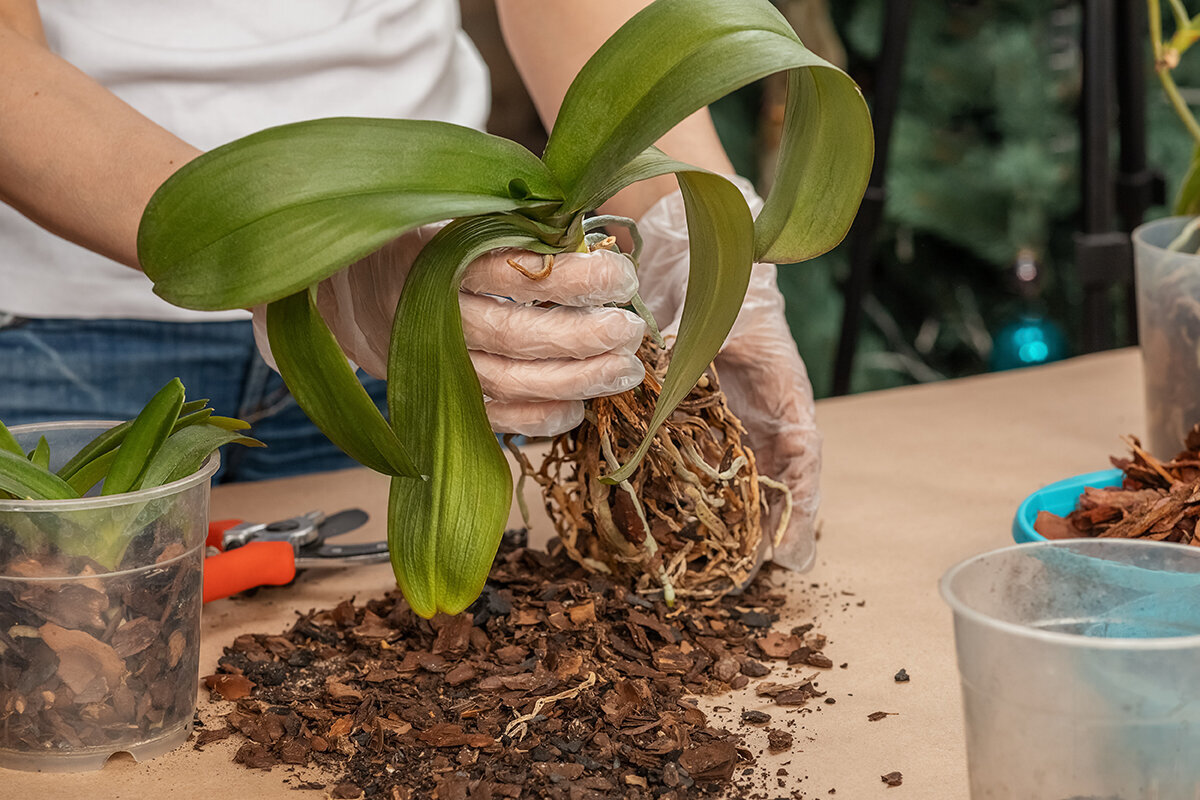
Repot when bark decomposes, drainage slows, salts accumulate, roots fail or the plant has outgrown its container—not merely because a date has arrived. Where the plant’s cycle allows, work as new roots begin so fresh growth can establish into the new medium. Use clean tools, remove only roots that are clearly dead, hollow or rotten, secure the plant against movement and avoid overpotting. Unused wet medium around a small root system can remain saturated.
05 / Growth makes the calendar
Feed and repot in response to active growth.
Orchids use water and nutrients differently while extending roots, producing leaves, swelling pseudobulbs, resting or preparing to flower.
Roots
Leaves
Pseudobulbs
Spikes
Rest
Fresh root tips indicate active growth, when a compatible plant can establish after repotting and use modest feeding effectively.
Monopodial orchids such as many Phalaenopsis extend from one crown. Prevent standing water lingering there in cool conditions.
Many sympodial orchids store water and energy in thickened stems. Older pseudobulbs can continue supporting developing growth.
Flower spikes arise from different places according to the orchid: between leaves, from nodes, canes or maturing new growth.
Some orchids expect a cooler, drier or lower-feed interval. A seasonal pause is not automatically evidence of a deficiency.
Fertiliser: modest, consistent, flushed.
Use an orchid fertiliser or suitable balanced product, following its label and accounting for your water quality and medium. Feed when the plant is actively making roots, leaves or pseudobulbs, then reduce or pause if its documented rest period requires this. Kew’s principle of feeding only during active growth is more dependable than forcing fertiliser into a resting plant in low winter light. Alternate with plain water and flush periodically to limit accumulated salts.
Reblooming: correct the environment first.
Reblooming is generally an outcome of healthy growth rather than a separate trick. Start with accurate identification, suitable light and a functioning root system; then consider maturity, feeding, seasonal rest and differences between day and night temperatures. RHS notes that cymbidium flower stems form with good light and a distinct temperature drop from day to night. Do not apply that regime to a warm-growing moth orchid, or cut, chill and starve a plant using advice intended for another group.
06 / The quarantine threshold
A beautiful collection deserves a disciplined threshold.
Warm, moist greenhouse conditions can accelerate pests and disease. Let every new orchid complete a calm intake routine before joining the main benches.
New-plant intake
- Keep the newcomer apart from established plants for a meaningful monitoring period, ideally in a separate space or clearly isolated area.
- Inspect leaf joints, undersides, sheaths, flower spikes, crowns, roots and pot rims for scale insects, mealybugs, aphids, thrips, mites, slugs and suspicious damage.
- Remove dropped flowers and packaging, clean the outer pot and bench, sanitise tools and prevent drainage from reaching established orchids.
- Water separately and monitor repeatedly, including after warmer days reveal activity. Record the label, purchase date, symptoms and any treatment rather than trusting memory.
Symptom triage
- Soft, dark roots or sour medium: review drainage, decomposition and watering frequency; remove decay with clean tools and isolate if deterioration is advancing.
- Sunken or spreading lesions: improve sanitation and airflow, isolate the plant and seek a sound diagnosis before applying any treatment indiscriminately.
- Sticky residue or cottony clusters: inspect nearby plants closely for sap-feeding insects and act promptly.
- Wrinkled leaves: do not assume simple thirst. Root loss, excessive heat, mineral damage or failing medium may prevent water uptake.
Avoid routine chemical treatment ‘just in case’. Correct identification, physical removal where appropriate, cultural correction and a product approved for the plant and setting are safer than spraying an enclosed greenhouse without a plan. Follow the product label exactly and continue inspections rather than assuming one application has resolved the problem. Seek qualified horticultural advice when symptoms are persistent, unusual or difficult to identify.
07 / Build a collection with composure
Group by climate—not by flower colour.
A bench is easier to water, shade and monitor when neighbouring orchids share a compatible environmental rhythm.
Place thirstier or lower-light plants where you naturally inspect them and where the air still moves. Give brighter, quicker-drying orchids the upper or more exposed positions they genuinely need. Group mounts together so their frequent watering does not dictate the routine for every bark-filled pot. Retain a clear, separate area for new arrivals, recovery plants and work in progress.
Think vertically. Hanging plants can use the warmer, brighter upper volume, while lower staging provides moderation. Protect access at every level: each plant should be reachable, labels should remain legible and roots should be inspectable without dismantling the bench. Good spacing is not wasted space. It allows air to circulate and problems to be noticed before they spread through the room.
A Classic Aluminium Greenhouse can become a filtered-light orchid room rather than an undifferentiated garden structure. Keep the central path clear, establish one warm or intermediate bench first, and introduce adjustable shade, air circulation and staging as the plants reveal what they need. For a manufacturer-led architectural starting point, the Classic Aluminium Greenhouse offers useful perspective on proportion, access and an adaptable interior for a British garden.
High lightHanging growers
Middle benchCore hybrids
Lower zoneProtected shade
ThresholdQuarantine
Treat this arrangement as a starting composition, not a fixed prescription. The greenhouse’s measured light, airflow, temperatures and drying patterns should ultimately determine where each group lives.
Frequently asked questions
The details growers ask after their first season.
What temperature should a greenhouse be for orchids?
There is no universal temperature for orchids. As a broad planning guide, warm-growing plants such as many Phalaenopsis hybrids commonly need a winter minimum around 15°C, while intermediate plants tolerate cooler nights and cool growers need credible summer relief. Cymbidiums may enjoy approximately 10–24°C. The named plant’s requirements override any broad category. Record daytime maxima and overnight minima at plant level before expanding the collection.
Do orchids need high humidity in a greenhouse?
Many orchids appreciate greater atmospheric moisture than a typical heated room, but a percentage alone is not the goal. Humidity without air movement can leave foliage wet and encourage disease, while excessive fan force may dehydrate plants. Prioritise gentle circulation, free drainage, appropriately watered roots and leaves that dry within a reasonable period, especially during cool, dull British weather.
How often should greenhouse orchids be watered?
Water when the medium has reached the level of dryness appropriate to that orchid, rather than following a weekly timetable. Pot size, bark grade, root mass, light, heat, humidity, air movement and season all affect the interval. Thoroughly wet the root ball, allow it to drain and observe how quickly air returns. Mounted plants and large potted orchids cannot share one schedule.
Can I use tap water for orchids?
Often, but local water chemistry matters. Hard or alkaline mains water can leave mineral deposits in bark and complicate fertiliser management. Cleanly collected rainwater or suitably filtered, lower-mineral water may be helpful, particularly in hard-water areas. Never allow pots to stand in collected water, and flush the medium periodically with plain water if you feed regularly.
Why are my orchid leaves wrinkled when the pot is wet?
Wrinkling indicates a water-balance problem, not necessarily a need for more irrigation. Roots damaged by rot, compacted medium, mineral accumulation, excessive heat or pests may be unable to absorb moisture from a wet pot. Inspect root firmness, the smell and condition of the medium, drainage and greenhouse temperature before adding more water.
Can cool-growing orchids live in a typical UK greenhouse?
Only if the greenhouse can maintain their preferred conditions throughout the year. Some cymbidiums suit a bright, frost-free house, provided they receive good light, reduced winter watering and protection from excessive summer sun. More demanding cloud-forest orchids may struggle when a glasshouse overheats. A fan alone cannot make a hot July bench cool; effective shading, ventilation and a suitable local climate are also important.
Research folio
Sources &
further reading
Culture requirements vary by genus, species and hybrid. These authoritative resources informed the habitat-led greenhouse principles in this guide. Consult current specialist guidance for the exact named orchid you grow, particularly where a seasonal rest or precise temperature preference applies.
More from Bloomcabin: greenhouse curtains, shading and cooling · greenhouse set-up and care guide · Explore considered greenhouse growing
- Royal Horticultural Society — How to grow Phalaenopsis
- Royal Horticultural Society — How to grow cymbidium orchids
- Royal Horticultural Society — Indoor orchid plant types
- Royal Botanic Gardens, Kew — Caring for your orchids
- Royal Botanic Gardens, Kew — Expert orchid care tips
- American Orchid Society — Greenhouse orchid care
