
Whiteflies in a Greenhouse: How to Get Rid of Them
Greenhouse health / Integrated pest management
Whiteflies in a Greenhouse: How to Get Rid of Them
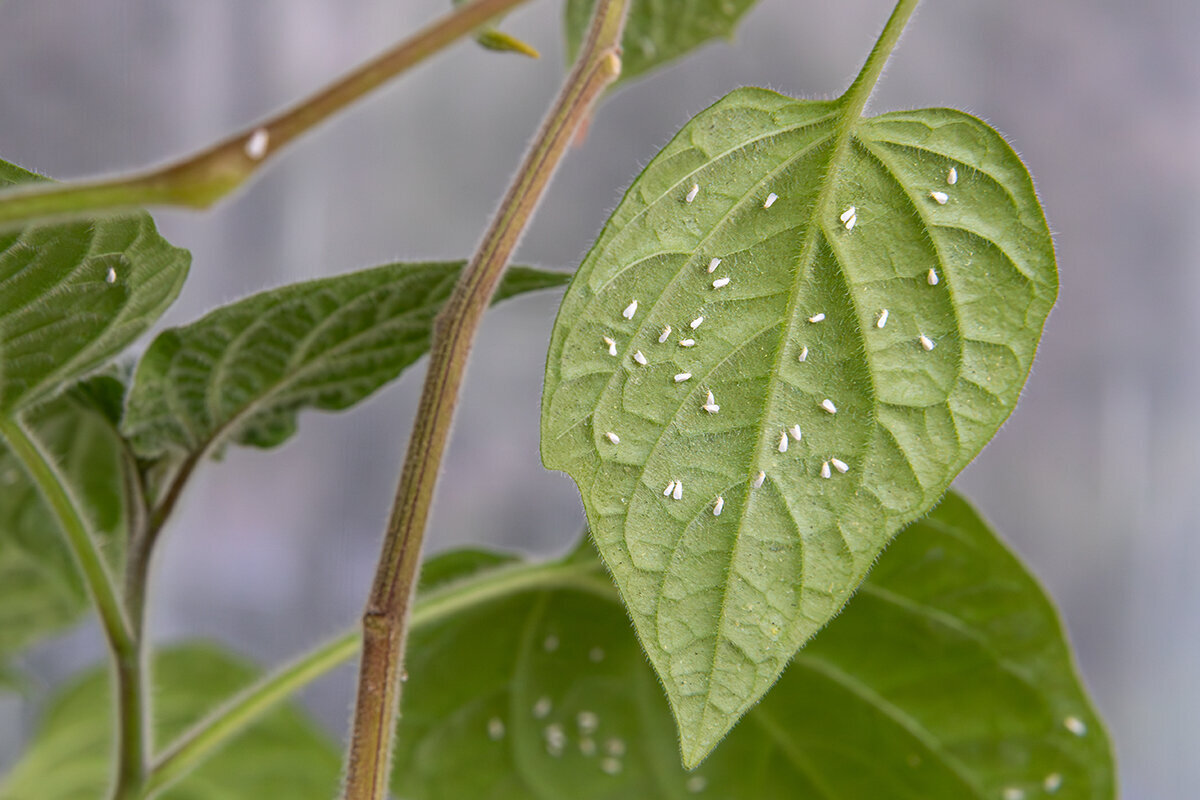
The white cloud is only the visible disturbance. The infestation continues beneath the leaf, where eggs, crawlers and attached immature stages form the next generation.
01 / The visible disturbance
Why the white cloud is only part of the infestation
Brush a tomato, pelargonium, cucumber or tender ornamental in a warm greenhouse and a small pale cloud rises from the foliage. It is an unmistakable warning, but adults are only the airborne part of a whitefly population. Eggs, briefly mobile crawlers and later attached immature stages remain beneath the leaves. Those quieter stages explain why an apparently successful adult knock-down may be followed by another flutter days or weeks later.
Glasshouse whiteflies feed by taking sap from foliage. Heavy feeding can weaken growth, while their honeydew produces a conspicuous sticky shine on leaves, fruit, pots and staging. Black sooty mould may then develop on this sugary residue, reducing the clean, useful leaf area available to the plant. The tobacco whitefly,Bemisia tabaci, requires particular attention because UK plant-health guidance distinguishes it from the ubiquitous glasshouse whitefly. Seek expert identification where a nursery-supplied or unusual infestation causes concern.
A well-organised greenhouse gives you an advantage: it is a defined environment that can be inspected, cleaned, ventilated and managed deliberately. In a permanent structure such as the Classic Aluminium Greenhouse, make scouting part of watering, pruning and ventilation rather than an emergency task reserved for obvious plant damage.
02 / Identification before intervention
Read the underside constellation
A hand lens turns a vague pest problem into a stage-by-stage inspection. Exact appearance and development speed vary with species, crop, temperature and greenhouse conditions, but the underlying inspection logic remains dependable.
Start with several plants and several leaves rather than examining whichever leaf is easiest to reach. Look beside secondary veins, across tender growth and on mature leaves sheltered beneath a dense canopy. Whitefly populations are seldom distributed evenly: one crowded plant may be acting as a nursery while its neighbour carries only adults or newly laid eggs.
Eggs
Near veins; singly or in circles.
Crawler
Briefly mobile after hatching.
Attached immatures
Flat, pale and fixed beneath leaves.
Adult
White-winged and disturbed from foliage.
One leaf can reveal several stages. Use this sequence to orient your inspection, then confirm what is present across representative plants.
Use the map as a prompt, not a diagnosis by itself. Eggs are tiny and may be greyish-white. The newly hatched crawler moves only briefly before choosing a feeding site. Later immature stages resemble flat, pale scales because they remain attached beneath the leaf. Adults are easy to notice, but they represent only the mobile portion of the population.
Look for evidence as well as insects: fresh honeydew, black sooty mould, reduced vigour and increasing numbers of attached immatures. Glasshouse whitefly adults are small, white-winged sap feeders that settle rapidly after disturbance. The field distinction from Bemisia can be difficult because adults and early stages may look similar. Later immature stages can provide stronger diagnostic evidence, but specialist advice may still be necessary. If valuable stock is involved, symptoms are unusual or the infestation arrived with nursery plants, consult an appropriate UK plant-health or biological-control specialist before committing to a species-specific programme.
03 / Do not treat the wrong visitor
Whiteflies versus other small greenhouse flyers
Whitefly
When disturbed: a small, pale flutter rises from foliage.
Where to confirm: leaf undersides, where eggs and flattened immature stages remain attached.
Common clue: sticky honeydew followed by black sooty mould.
Fungus gnat
Dark, mosquito-like adults are usually associated with wet compost, algae and the pot surface. They do not produce fixed, pale scale-like stages beneath leaves.
Thrips
Look for slender insects, silvery feeding scars, specks of frass and distorted young growth rather than honeydew and a powdery white cloud.
Winged aphid
Search for pear-shaped aphids, shed skins and curled new growth on shoots or stems. Aphid colonies may also produce honeydew.
Identification changes management. A yellow sticky card may catch several groups of flying insects, but it does not make them the same pest. Only direct examination of foliage can reveal whitefly eggs and settled immature stages. Do not assume that a measure selected for fungus gnats, thrips or aphids will control whiteflies safely or effectively.
04 / Make observation repeatable
Walk the same route in the same order
Randomly noticing insects is better than not looking, but it cannot reliably show whether a population is spreading, concentrating or declining. Establish a short scouting route through likely introduction points and sheltered areas: doors and vents, recently purchased plants, dense crop groups, upper growth, lower leaves, then weeds and debris beneath staging. Carry a hand lens and keep a notebook or phone record simple enough to maintain every week.
1
Entrance
Door, vents and new arrivals.
2
Hot spots
Plants releasing visible adults.
3
Upper canopy
Tender leaves and fresh eggs.
4
Lower canopy
Mature leaves; attached immatures.
5
Floor line
Weeds, pots and debris.
For a compact collection, inspect a meaningful sample of every crop type instead of repeatedly checking the plant nearest the door. In a larger greenhouse, divide the growing area into clear crop blocks and inspect the same number of plants in each. Record the date, crop, location, adult activity, immature stages, honeydew and any intervention or beneficial release. Consistency is more useful than inventing a universal action threshold.
Give particular attention to plants that are lush, sheltered or difficult to reach. Whiteflies can build quietly in a back corner or beneath crowded foliage. Mark several hot-spot plants discreetly so that they become reference points during the next inspection. A clean reference plant is useful too: it helps you distinguish an expanding population from old feeding damage or sooty mould that remains visible after pressure has fallen.
05 / Controlled yellow-card fieldwork
Yellow sticky cards are monitors, not cures
Read the signal
TrendAdults are counted; hidden stages remain.
One method, every visit
- Number every card.
- Keep it in one zone.
- Count the same marked area.
- Record date and result.
Adult whiteflies are attracted to yellow sticky cards. Used consistently, cards can reveal arrivals, relative adult activity and whether the flying population is rising or easing after an intervention. They cannot demonstrate that eggs, crawlers or attached immature stages have disappeared from foliage. Treat each card as one instrument within an inspection programme, not as a stand-alone method of eradication.
Place cards in consistent zones, close to susceptible plants and at a repeatable height in relation to the canopy, without letting adhesive touch foliage. Count the whole card or the same marked section each time; changing the counting area destroys the comparison. Replace a card when condensation, dust, debris or captured insects obscure it, then compare the replacement only with earlier cards from that exact location.
In a private greenhouse, one card near the entrance and another in each distinct crop area can give a clearer account than a single card hung at random. Pair every count with underside inspections. A lower adult count is encouraging, but fresh eggs, crawlers or numerous live immatures mean the infestation has not been resolved. Remember that sticky sheets may also catch non-target organisms, including parasitoid wasps, so position them carefully around biological-control releases.
06 / Timing is hidden architecture
Why one intervention rarely reaches every whitefly
Greenhouse whiteflies do not pass through their life stages in a neat, synchronised wave. Adults may be laying eggs while older immatures remain attached and another group begins to emerge. Warm, protected conditions accelerate development and allow generations to overlap. For ordinary glasshouse whitefly, development may take several months at 10°C but around three weeks at 21°C, illustrating how strongly warmth changes the pace.
The practical response is not to apply products more aggressively. Build follow-up into the first decision: reduce the reservoir, inspect the stages that remain, use compatible biological or contact measures where appropriate, and return to the same representative plants before another generation gains momentum. Let current evidence determine the next step.
Overlapping population waves
Adults continue laying eggs.
Crawlers settle and begin feeding.
Attached stages persist; adults emerge.
The overlapping waves are a field reminder that several stages are usually present during one visit. Follow-up belongs in the plan from the beginning. Any repeat treatment interval must come from the current UK product label, crop restrictions and relevant professional guidance—not from a generic online timetable.
07 / Reduce the reservoir
Isolate, remove selectively and limit easy entry
Quarantine introductions
Keep new purchases apart before they join valuable crops. Turn several leaves and inspect carefully; eggs and nymphs may need time to develop before they become recognisable.
Remove severe leaves
Where a colony is localised, remove only heavily occupied leaves the plant can spare. Place material directly in a sealed bag before carrying it through the greenhouse.
Eliminate bridge hosts
Weeds, volunteer seedlings, tired ornamentals and abandoned plants can retain whiteflies between crops. Clear floor edges, beneath benches and around stored pots.
Removal should be selective, not punitive. Stripping too much foliage weakens a plant and creates an additional stress problem. Prioritise older leaves carrying dense concentrations of eggs, immatures or honeydew, or remove an expendable plant acting as a major source of adults. On tomatoes, retain clean, productive canopy rather than defoliating indiscriminately. Seal removed material securely; do not shake it over compost or leave it beneath staging.
Exclusion works best before establishment. Fine insect screening at vents and other openings may reduce adult entry, but it must be balanced against the airflow and temperature control required by the crop, especially in summer. Close doors promptly, keep suspect plants away from the entrance and avoid creating a cluttered holding area where new purchases wait uninspected. Thoughtful Classic Aluminium Greenhouse supports clear access, effective ventilation and practical work zones for routine plant care.
Clean glazing and orderly staging are not merely cosmetic. They make honeydew easier to see, improve access to leaf undersides and allow monitoring cards to remain in repeatable positions. Clear paths also let you isolate a suspect pot without carrying it through dense foliage. When planning a serious growing space, consider Classic Aluminium Greenhouse with inspection, circulation and seasonal cleaning in mind.
08 / Ecological control, started early
Beneficial insects work through timing, not magic
Parasitoids and predators
For glasshouse whitefly, the parasitoid Encarsia formosa is a well-established biological-control option. It develops at the expense of whitefly immature stages and is most useful when introduced before plants are heavily affected. Incompatible pesticide residues may undermine a release. An infestation involving Bemisia tabaci requires expert identification and a control strategy suited to that species rather than an assumed universal beneficial. Ask a reputable UK biological-control supplier to match the organism to the identified whitefly, crop, greenhouse temperature and infestation level.
Predators may contribute as well. Predatory mites, including Amblyseius andersonii where available and appropriate, may feed on whitefly eggs. Their role is not interchangeable with that of a parasitoid. Ask which organism suits the pest, crop, population density, environmental range and recent product history rather than requesting a universal ‘best’ beneficial insect.
Inspect for evidence of parasitism before removing every darkened immature. Glasshouse whitefly nymphs parasitised by Encarsia formosa turn black, providing useful visible evidence that the biological programme is operating. A hand lens and reliable identification guidance help prevent the accidental removal of the control organisms you have introduced.
Biological control is a management programme, not a decorative release. It depends on scouting, correct identification, suitable conditions and patience while the natural enemy builds its effect. It also depends on access: a layout that lets you inspect leaf undersides, move between crop groups and distribute releases accurately is more useful than an attractive but unreachable thicket. These practical requirements can be considered when exploring Classic Aluminium Greenhouse.
09 / Match the tool to the stage
Control is a sequence of gates, not one product
Sanitation
Removes occupied foliage and reservoirs.
Sticky cards
Tracks flying adult activity.
Biologicals
Build sustained suppression over time.
Contact measures
Require direct underside coverage.
Sanitation and removal can take out entire groups of eggs and attached stages when severely occupied leaves, host weeds, debris or expendable plants are removed and securely discarded. They cannot reach insects that remain elsewhere in the crop.Sticky cards detect and track flying adults but cannot count every immature stage beneath leaves.Parasitoids and predators can provide sustained suppression when introduced early and protected from harmful residues, but they require correct matching, suitable conditions and time to work.Contact measures suppress exposed adults or immatures only where the applied material actually reaches them.
Contact coverage is literal
Where a suitable soap, oil or other contact product is chosen, coverage matters more than enthusiasm. Whitefly stages are concentrated beneath leaves, so a mist settling on the upper canopy will miss much of the population. Work methodically through lower and inner foliage while following the label. If directed, test a small area first: tender leaves, stressed plants and hot, bright conditions may increase the risk of damage.
For edible crops, confirm that the product is currently authorised for the intended UK setting and crop, then follow every label direction. This includes the application method, rate, maximum number of treatments, harvest restrictions, safety precautions and warnings concerning beneficial organisms. Do not improvise mixtures or assume that a household detergent is equivalent to an authorised insecticidal soap or other plant protection product.
10 / Chemical decisions are conditional
Use UK-authorised products carefully and keep a record
There is no responsible universal spray schedule for a British home greenhouse. Product authorisation, crop listing, plant condition, whitefly species and the presence of biological controls all affect the decision. Check the current HSE garden database and read the label before buying and using any plant protection product. The crop and intended setting must be covered, and all restrictions, intervals and safety instructions must be followed exactly.
When a plant protection product is justified, avoid repeated reliance on one mode of action simply by changing brand names. Resistance is an important reason to integrate hygiene, monitoring and biological measures rather than treating chemistry as the complete programme. This is especially relevant when dealing with some Bemisia populations. Keep a complete application history so later decisions are informed and any proposed beneficial release can be checked for compatibility with residues already present.
Seek appropriate professional or supplier advice for persistent outbreaks, uncertain identification, unusual symptoms or nursery-scale concerns. A strong integrated programme uses an authorised treatment as one carefully positioned tool, never as a replacement for inspection, sanitation, accurate coverage and stage-aware follow-up. Do not use a professional product simply because it appears stronger or buy foreign products without confirming their UK status.
11 / The proof follows the first response
Judge recovery by new evidence, not one quiet afternoon
Selective removal, a contact treatment or a beneficial release may make the greenhouse look calmer immediately. That is welcome, but it is not the finish line. Recovery becomes credible when the same scouting route shows fewer adults on comparable sticky cards, fewer new egg groups and crawlers, fewer live attached immatures and less fresh honeydew on new leaves. Older black sooty mould and previous feeding damage will not disappear at once, so distinguish historic staining from newly accumulating sticky deposits.
A
First revisit
Return to marked hot-spot plants and turn several leaves. Record the stages still present, then remove newly severe foliage where the plant can spare it.
B
Compare the trend
Compare every numbered card with its own earlier count and pair the result with direct leaf observations. A lower adult count is encouraging, but it is not conclusive by itself.
C
Rebalance
If fresh immatures continue accumulating, reassess identification, coverage, sanitation, beneficial compatibility and possible reinfestation through plants, weeds, doors or vents.
Continue the routine after pressure falls. A resilient greenhouse is not necessarily one that never receives an insect; it is one where a small arrival is recognised before it develops into a canopy-wide population. Clear paths, sensible spacing, a regular place for the hand lens and records, effective ventilation and access to both sides of staging convert good intentions into a durable growing habit.
FAQ / UK greenhouse gardeners
Whitefly questions, answered plainly
Will yellow sticky cards get rid of whiteflies in my greenhouse?
No. Yellow cards catch and reveal some mobile adults, making them useful for locating activity and monitoring direction. They do not reliably reach eggs or attached immature stages beneath leaves, and may also catch beneficial insects. Use them as one measured part of a wider programme based on inspection, hygiene and suitable controls.
Should I discard every plant carrying whiteflies?
Not necessarily. Isolate the plant, inspect several leaves and identify the stages involved. Selectively remove heavily occupied foliage if the plant can tolerate it. Discarding a severely infested, expendable plant may be sensible when it is acting as a substantial source of adults, but stripping valuable plants indiscriminately can create further stress.
Why do whiteflies return after I treat them?
Several stages were probably present at once. A measure that suppresses exposed adults may not affect eggs or settled immatures equally, while poor underside coverage leaves targets untouched. Adults may also arrive from retained weeds, overlooked host plants, new purchases or openings. Reinspect before deciding whether the original action failed.
Can I release beneficials after treating whiteflies?
Possibly, but compatibility depends on the exact product, active ingredient, application date, residues, crop and beneficial species. Keep full records and consult a reputable UK biological-control supplier before release. Broad-spectrum or persistent products may disrupt a programme, so never assume that enough time has passed without checking.
Are whiteflies a problem on tomatoes, cucumbers and ornamentals?
Yes. Glasshouse whitefly commonly affects greenhouse hosts including tomatoes, cucumbers, pelargoniums and tender ornamentals. Feeding can weaken growth, while honeydew soils leaves and fruit and supports sooty mould. For edible crops, use only measures and currently authorised products appropriate to that crop, observing every harvest and safety instruction on the label.
How often should I inspect for whiteflies?
Set aside one regular inspection session each week during active growth, with extra checks after introducing plants, noticing rising card counts or making a significant control change. The most useful interval is one you can repeat consistently enough to reveal a trend. Product treatment intervals, however, must always come from the specific label rather than a generic schedule.
Sources & further reading
Build your programme on current UK guidance
Whitefly identification, biological-control suitability and authorised products require current information. These Royal Horticultural Society, HSE and Defra resources support the practical, stage-based approach described here.
More from Bloomcabin: aluminium greenhouse cleaning routine · greenhouse layout, planting and care · aluminium greenhouse FAQ
- Royal Horticultural Society — Glasshouse whitefly identification and control
- Royal Horticultural Society — Biological control in the garden
- Royal Horticultural Society — Biological control in the home garden
- Health and Safety Executive — Using pesticides in gardens, homes and allotments
- Health and Safety Executive — Pesticide databases overview
- Defra Plant Health Portal — Bemisia tabaci plant pest factsheet
- RHS guidance on glasshouse whitefly identification and control
- RHS guidance on biological control in the garden
