
Buying a Greenhouse in Stages: Essentials and Later Upgrades

GREENHOUSE BUYING GUIDE
Buying a greenhouse in stages can make the first purchase more manageable, but the initial structure still needs to be complete for the use you have in mind. The footprint, access, ventilation and site-support requirements can be difficult or costly to change later; some accessories may be added after you have used the space. That only works when the model supports them and they remain available. This guide separates essential purchase decisions from upgrades that may sensibly wait, so you can compare candidates without treating a future add-on as a substitute for a suitable greenhouse.
01
Define the greenhouse’s first-season purpose
Begin with a written description of the greenhouse’s first-season job. Starting seedlings, growing vegetables, sheltering potted plants and providing a potting area are different priorities; one layout may not suit them equally well. List which plants or tasks will share the space, when you expect to use it and whether you need room to pot, water or move containers. Consider what needs to happen at the same time, not only the total number of plants. Include who will use the greenhouse and how supplies will be brought in. This turns “more growing space” into a brief you can apply to every candidate instead of comparing models by appearance alone.
Separate essentials from aspirations. If your first-year plan depends on particular access, ventilation or growing conditions, treat those as purchase requirements, not future upgrades. Put less critical preferences—extra storage or a different work surface, for example—on a second list and ask whether each can be added without changing the structure. Think about realistic near-future needs, but don’t pay for a feature just because it might be useful someday. A T-model orangery greenhouse listing can be compared with other types, but its name does not establish usable area, layout or suitability; compare its documented details with your written brief. If a deferred item would require a built-in opening or a structural change, move it back to the first-stage list.
Check the site and usable footprint
Study the proposed location before settling on a footprint. Observe how buildings and trees affect daylight at different times, consider wind exposure and water drainage, and note delivery access and any services you may need. A place that looks open in one season can be shaded when leaves are out, so don’t base a long-term decision on one brief look. There is no site plan that suits every property or growing goal. If placement, drainage, anchoring or utility access raises technical questions, ask the manufacturer or a qualified local professional rather than assuming the ground is suitable. Check applicable local requirements with the municipality where relevant.
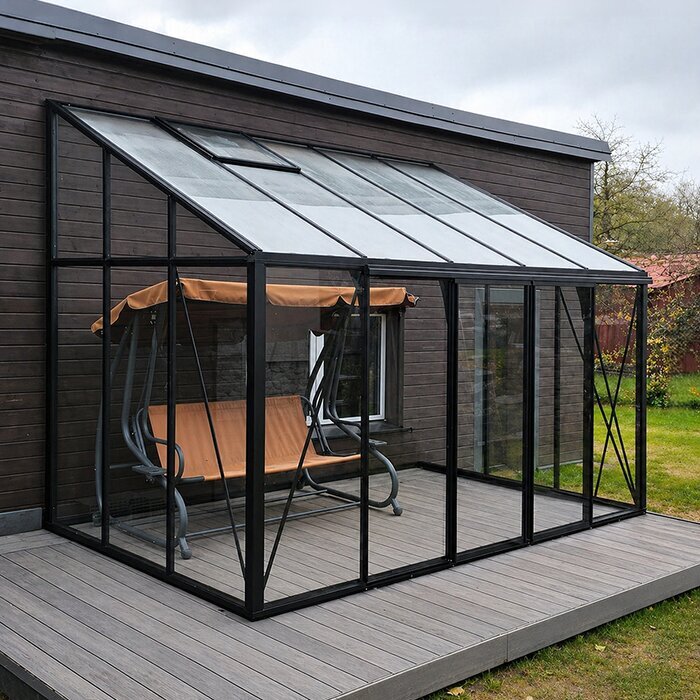
Compare the model’s exact outside dimensions with the clear area around it: the route to the door, room for the door to open, walking space and the area needed for planned benches. Check any available plan for the interior and access, not just the footprint. If a lean-to format interests you, add a lean-to greenhouse listing to your shortlist, then verify from that model’s details how it is intended to relate to a building and what clearances or support it requires. A wall, fence or existing patio does not automatically make the site suitable. Check that the space will remain usable once plants, containers and equipment are in place.
02
Confirm the enclosure and structure before ordering
Treat the enclosure and frame as first-stage choices because they define the greenhouse you are buying. Compare the stated glazing or covering type, frame details, door arrangement, included openings and replacement-component information. If you have preferences based on appearance, upkeep or the plants you intend to grow, rely on documented details rather than assuming similarly named models share the same construction. Check the exact configuration in the order, including what is included and what is optional. Review warranty terms and exclusions, and ask how parts are identified if a replacement is needed. Find out which components, if any, can be changed without altering the structure.
A limited-edition aluminum greenhouse listing is a model to examine, not a full specification. Read its product details for the components actually stated, then compare those points with alternatives. Don’t infer the covering, panel dimensions, fittings or replacement options from a title or photographs. If a future change to the frame or glazing matters, ask whether that exact model supports it and whether compatible parts can be sourced separately. Get the answer before purchase; a later modification may not be possible or may require a different model. Apply the same standard to any feature you expect to add after the initial order.
Make ventilation part of the initial plan
Consider ventilation when choosing the greenhouse, rather than assuming it can be sorted out after delivery. Check which openings the chosen configuration includes, where they are, how they operate and whether any controls are separate. Think about the plants and routine in your written brief, then confirm that the product details address those needs. A general description or photograph may not identify the parts supplied. If the opening method, placement or a particular control matters to you, ask for the model-specific answer before ordering. This is especially important if your plan depends on a feature that is part of the frame or covering.
Some additions—such as automatic vent controls, a fan, shade, watering equipment or a heat source—may be considered later, but first check compatibility and the conditions in which they can be used. They are not substitutes for understanding the greenhouse’s own design and supplied openings. If your plan depends on using the structure through colder weather, ask the manufacturer what the specific model and accessories are intended to support at your site. Don’t treat a future heater as proof that the greenhouse suits that use. Have any fixed electrical or heating work planned with a qualified professional.
03
Plan the interior for access and work
Plan how you will move through the greenhouse before choosing benches or shelves. Decide whether plants will be grown in beds, containers or a mix, where you need standing and kneeling room, and where tools and pots can sit without blocking the route. Check door access, the clear space needed to carry containers, headroom and whether windows or controls will remain reachable after fittings are added. A bench that fits on paper can still make watering or carrying trays awkward if it narrows the working area. If you intend to pot plants inside, allow for that task rather than using every available space for growing.
Keep items you can buy later separate from the space that must exist now. Shelves, a potting surface or storage may fit only if the layout leaves room and the relevant floor or frame can support them; don’t assume the walls accept any fixing. A Bloomcabin Oasis Pyramid greenhouse listing can be assessed against the same plan, but neither its title nor an image confirms interior capacity or usable bench area. Compare dimensions and drawings where supplied, and ask whether pictured accessories are included or permitted. This helps you judge a listing against your working layout rather than an imagined arrangement.
Verify base and site-support requirements
Make the base and support conditions part of the first-stage decision. Check what the manufacturer requires for the particular model, what surface it can be placed on, whether a base or anchoring components are included or optional, and what preparation remains your responsibility. The right answer depends on both the structure and the site; a familiar patio or patch of level ground is not automatically suitable. Compare the documented requirements with the actual location before paying. If you need an assessment of the ground, support or anchoring, ask a qualified professional rather than relying on a general rule of thumb.
Use product labels as a prompt for questions, not as a complete site plan. With a Prestige greenhouse with metal base listing, verify precisely what the base wording means for the selected configuration, which parts are supplied and what surface or fixing requirements still apply. Then check the manufacturer’s guidance for local exposure. Snow and wind exposure, drainage and freeze-thaw conditions vary from site to site; don’t infer a rating from a category name or guess at structural requirements. Ask the manufacturer or a qualified local professional for guidance on the specific model and location.
04
Separate compatible upgrades from structural needs
Make a list of additions you might want later, then sort each item by what it depends on. Movable shelving, extra storage, shade or watering equipment may be optional for your initial setup. An item that needs a particular opening, attachment point, power connection or change to the frame may require a decision before purchase. Reserve floor space and maintain access for any later additions you have planned, but don’t assume the greenhouse will accept them. The useful question is not simply whether an accessory exists; it is whether it fits the exact model and configuration you intend to order.
For each deferred item, ask the manufacturer about compatibility, any required parts and whether the accessory can be ordered separately later. A Bloomcabin Orangerie listing can be reviewed using those same questions; the model name alone does not establish which options fit or what is included. Keep the answer with your product notes, especially if different configurations or revisions are available. Later availability is not guaranteed, so don’t defer a feature that is essential to your planned use unless you have confirmed a suitable way to provide it.
Compare the cost of each purchase stage
Budget for a working setup, not just the greenhouse’s listed price. Separate the structure, required base or site preparation, delivery, assembly if part of your purchase, essential options and any professional help into distinct lines. Include only costs confirmed in the product details or your quote. Keep first-stage essentials apart from optional accessories planned for later, and allow room in your budget for site work that has not yet been assessed. This makes it easier to compare candidates on the same scope rather than mistaking a smaller initial order for a lower total cost.
Set a separate allowance for future upgrades, but don’t rely on a predicted price or assume an accessory will remain available. For each deferred item, note the compatible model, the question still unanswered and what would prompt you to buy it. A Classic Plus 385 listing can be reviewed using the same scope table as any other candidate; its name alone does not tell you what is included, what is required or the total setup cost. Compare current written details and quotes, not hypothetical package bundles.
05
Check the order details before paying
Before submitting an order, confirm the exact model and configuration, selected options, quantities and included or excluded parts. Make sure the documented dimensions, access features, ventilation and base arrangements match your notes. Check what the quote covers for delivery or other services, if those are part of the purchase, and record any separate work you will need to arrange. If an essential accessory is intended for a later stage, confirm its compatibility before paying for the greenhouse. A clear record helps prevent a difference between the model you compared and the configuration shown on the order.
A T-model greenhouse with wall base listing is a reminder that a product label is not a site plan. Ask what the words “wall base” describe for that exact configuration, which parts are supplied and what site or fixing requirements remain. Don’t assume the wording settles how the model should relate to a wall or other support. Use the manufacturer’s model-specific documentation, and keep written answers about any essential options with the order. Apply the same check to deferred accessories so that later plans are based on confirmed compatibility, not an assumption.
When does a staged purchase make sense?
A simple two-column list can help: put purchase essentials in one column and possible later additions in the other. Essentials are the decisions that determine the structure, site fit and first-season function, or that would be difficult to change later. Additions belong in the second column only if the greenhouse can accommodate them without an unconfirmed structural change and you do not need them at the outset. For each item, note what product information supports the decision. If you cannot verify a feature that your growing plan depends on, it remains an open purchase question, not a safe assumption.
Before committing, consider whether the greenhouse would still serve your first-season plan if every deferred accessory were unavailable. If the answer is yes, and the model’s site and setup requirements are clear, staging may suit your budget and plans. If the answer is no, rework the shortlist or order scope rather than counting on an unverified upgrade. Once you have used the space, you can decide whether the optional additions would genuinely improve your routine. That way, later purchases respond to experience while the initial greenhouse remains suited to its intended purpose.
Frequently asked questions
What should I include in the first greenhouse purchase?
Include everything the greenhouse needs to meet your intended first-season use: a suitable footprint, the required access and ventilation, and a base or support arrangement that meets the model’s requirements for your site. If a feature depends on the structure itself, don’t assume you can add it later.
Which greenhouse upgrades can wait?
There is no universal list. Freestanding shelves, extra storage or a work surface may be candidates if they fit the layout and don’t depend on parts that need to be built into the greenhouse. Confirm compatibility and later availability for your exact model before leaving anything out of the initial order.
Can I add ventilation or automatic vent controls later?
Possibly, but it depends on the greenhouse and the parts supplied. Check which openings are included and ask the manufacturer whether the exact model accepts the controls you have in mind. Don’t assume you can add or alter an opening after purchase.
Can I plan to expand the greenhouse later?
Only if the manufacturer confirms that the specific model is designed for the planned expansion and explains what it requires. A product name or photograph does not establish that sections can be added. If future expansion is uncertain, choose a footprint that meets your realistic needs now.
How do I compare the cost of buying in stages?
Compare the confirmed cost and scope of the initial order, including required site work and essential options, then list each deferred item separately. Ask about compatibility and availability rather than relying on estimated future prices. Compare candidates on the same basis so a smaller initial order doesn’t hide missing essentials.
A staged greenhouse purchase is not simply a smaller first bill. It is a sequence in which the initial order meets the site’s requirements and your intended growing plan, while compatible extras can wait until you know what you need. Settle the difficult-to-change choices up front, confirm what each configuration includes and keep the answers with your order. That leaves room to refine the interior after you have used it without depending on an unverified upgrade to make the greenhouse suitable.
