
Buying a Small Greenhouse on Black Friday: Choose a Size You Won't Outgrow
Small greenhouse buying guide
Buying a small greenhouse on Black Friday gives you a moment to compare choices, but the date—and any offer that may be displayed—cannot tell you which size belongs in your garden. A greenhouse can fit the patch you have today yet leave too little room for the containers, working space or additional growing you expect later. The opposite mistake is choosing a larger footprint for an uncertain plan and giving up a path or garden area you use now. Begin with a measured site and a realistic list of what you want to grow and do inside; then compare exact product dimensions and layouts. This guide focuses on choosing a size you can keep using as your plans develop, without assuming a Black Friday promotion is available or right for you.

Sizing checklist 1
Define what “small” means for you
“Small” is relative to the garden and the job. For one household, it may mean room for a few seed trays and pots; for another, it may need to accommodate larger containers or several kinds of plants at once. A product described as compact does not tell you how much usable space is inside, and an outside footprint alone cannot show whether every plant will be easy to reach. Define “small” by the activities you want the greenhouse to support, not by a label or photograph. The same footprint can feel generous for starting plants and tight for someone planning to work among mature containers or shelves. Compare the capacity you want with the room your garden can spare.
Separate firm plans from possibilities before looking at models. Write down the plants or growing tasks you genuinely expect to take on, how often you will use the greenhouse and whether you want to spend time working inside. Note whether benches, shelving or storage are part of your intended setup, rather than assuming the whole floor will be available for plants. Keep occasional ideas apart from plans likely to become routine. Buying for every hypothetical interest can take up garden space unnecessarily, while sizing for only a few pots may leave no room for a change you already expect. Your definition of small should cover both the way you will use it now and a plausible next step.
Count plants, containers and tasks
Inventory the items you expect to grow in the greenhouse. Count trays, pots, grow bags and other containers, and note their approximate width and depth. Record the largest container you expect to keep in place, as well as the maximum number of items that will be inside together. Do not add every plant you grow over a year as if all of them need room at once. If you move plants outdoors or clear space after starting seedlings, include that rotation only if it reflects your usual routine. A rough plan with actual quantities is more useful than a list of crop names: it shows whether you need space for many small containers, a few larger ones or a mix.
List the work that happens around those plants, too. Transplanting, pruning, harvesting and moving trays all take room, even if you do not spend long inside. Decide whether you want to enter the greenhouse, reach in from the doorway, or use both approaches. Make space for carrying a pot or tray without having to shift every other container first. Include tools or supplies only if you intend to keep them there, since storage can reduce the area available for growing. This gives you a practical estimate of the busiest arrangement, rather than a maximum plant count that leaves no room to tend anything.
Sizing checklist 2
Measure the footprint and usable space
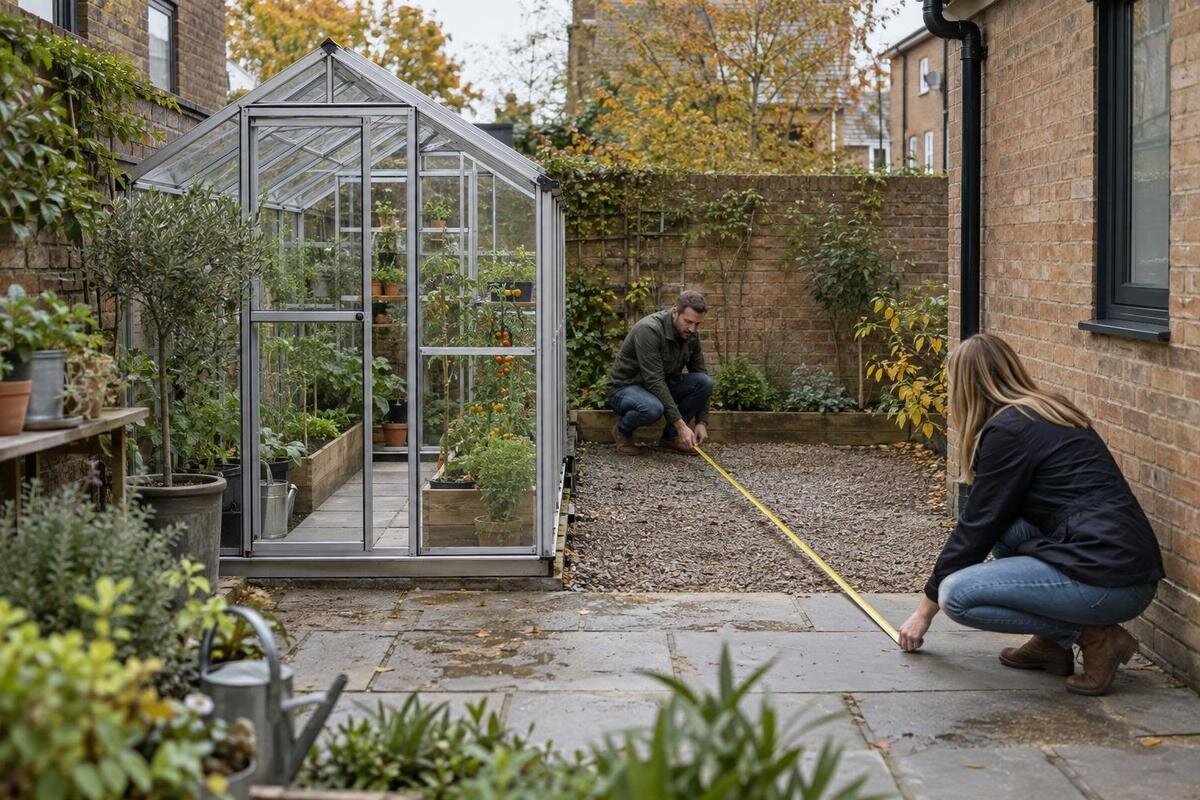
Measure the intended site at ground level, using the narrowest usable width and the full length rather than estimating from the open patch. Note fixed edges such as a fence, wall, raised bed, tree trunk or path, as well as gates and turns on the route to the site. Mark the outline with tape or string and walk around it. This can reveal whether the greenhouse would interrupt access to nearby beds or take up a route you use regularly. If the area is irregular, measure it at more than one point; a measurement from its widest part can make a footprint look as though it fits when it does not.
Compare the site with the measurements for each exact model. The outside footprint, any stated internal floor dimensions, wall height, highest point and door opening answer different questions; look for whichever details are available rather than treating one number as the whole plan. If a measurement is not clearly described, ask what it refers to before comparing it with another model. When you open the aluminum lean-to greenhouse page, look for the actual dimensions rather than trying to infer fit from the product name. A product drawing, if supplied, can help you judge proportions in a way a styled photograph cannot.
Leave room for access and everyday work
A greenhouse footprint can fit on paper and still be awkward to use. On your site outline, mark the entrance and the path of any door as shown in the product information. Leave room to approach the entrance, stand there, turn with a tray and reach plants without stepping on a bed or pushing containers aside. Test the route at home by walking it with a tray or box of similar size. That will not tell you the greenhouse’s dimensions, but it can show whether the space you plan to leave for access is practical for your usual tasks.
Account for anything that will take up room inside, including benches, shelves and stored tools. These can narrow a passage or reduce floor space even though the exterior dimensions stay the same. Decide whether your layout needs a clear central route, space to work along one side, or an open area for containers. Do not count a surface as useful growing space unless you can still reach and tend what is placed on it. For a candidate such as the T-model greenhouse orangery wall-base listing, use the exact model’s plan and doorway details, if provided, to assess the layout rather than relying on its name.

Sizing checklist 3
Check how the location affects the fit
The chosen patch is part of the size decision. Check how much open ground is genuinely available after accounting for existing paths, beds, nearby structures and tree canopies. Notice where shade falls at times when you usually tend the garden, and how that may change through the growing season. Match the location to the needs of the plants you intend to grow instead of assuming that a spot that is sunny at one time will suit every plan. Consider how you will carry containers or water to the greenhouse, too; a convenient route can make a modest growing area easier to use.
Check that the location can be used as the product’s installation guidance requires, and consider whether gates or tight corners make it difficult to reach. Leave access to garden beds and household routes you still need to use. A candidate such as the limited-edition aluminum greenhouse listing must fit the specific area you measured; its title does not show whether the footprint or route works for your garden. If ground conditions, a nearby structure or site-specific fixing questions affect placement, follow the product guidance and ask a qualified professional instead of guessing.
Allow for one realistic future change
A greenhouse that suits today’s list may feel tight if you already expect to start more seedlings, grow a wider variety of plants or keep additional containers inside at once. Choose one likely change and draw the space it would need on your plan. For example, allow for an extra tray or a larger container only if that reflects a real intention. Keeping the allowance specific prevents “just in case” from turning into an oversized footprint that crowds the garden today. It also gives you a reason for choosing more room that you can weigh against the space you would give up.
Think about when the extra capacity would be needed. If trays need room only before a regular clear-out, the peak number of items may be lower than the yearly total. If you expect plants to remain inside together, plan for that overlap. Compare the added space with your measured site and working layout, not just a model’s name. A shape-labelled option such as the T-shaped orangery greenhouse listing still needs to be assessed using its own stated dimensions and layout; the shape itself does not tell you how much usable capacity it provides.
Sizing checklist 4
Compare the full outline, not one dimension
Two greenhouses with similar headline widths may use their floor areas differently because their outlines and entrances differ. Compare the full length and width, then mark the door, corners and intended containers on a rough plan. Consider what you can reach from the entrance and whether the layout leaves a useful route for tending plants. Where walls slope, a floor measurement may not tell you how much room is available at shelf or plant height. Use any drawing or measurements provided to understand the space you can use, rather than treating a single footprint figure as a complete picture.
Apply the same test to every shape. The Bloomcabin Oasis Pyramid Greenhouse listing should be assessed using its own product information, not assumptions about capacity based on its name. Look for the outline and stated measurements; if the usable floor area or entrance details are unclear, ask for clarification or leave it off the shortlist. Images can help you recognize a product’s appearance, but they do not establish its footprint or internal room. The useful comparison is between the space you have marked out and the layout described for the exact option.
Assess any Black Friday offer after the size check
Black Friday may be a time to compare greenhouse listings or offers, but the date alone does not establish that a discount is available or that a particular size suits your garden. If more than one offer is displayed, check whether each applies to the same model, dimensions and configuration before comparing the headline amounts. A lower price attached to a smaller or differently configured greenhouse is not a like-for-like comparison. Note the exact size beside each candidate, and consider whether it passes your site and layout checks before weighing any price information.
Make a shortlist based on footprint, access and likely interior layout before focusing on promotions. If an offer appears on a candidate such as the Bloomcabin Prestige Greenhouse with Metal Base listing, confirm that the selected option is the one whose size you evaluated and read the terms shown for that item. Do not let a prominent price or a sense of urgency turn a marginal fit into a good purchase. If no offer applies to a size that works for you, the measured fit remains the better basis for deciding whether to buy or keep comparing.

Sizing checklist 5
Verify the exact option before ordering
Review the product information for the exact option you intend to order. Confirm the published outside dimensions and any internal plan, what is included in the stated configuration, and the assembly and site requirements. Look for delivery, return and warranty information as it is currently presented; do not assume that the terms for one model or seller apply to another. If an important measurement, inclusion or requirement is missing or ambiguous, get clarification before paying. A product title and main image cannot fill in details that matter to your size decision.
Think through the route from the delivery point to the chosen site, including gate openings, turns, steps and a place where components could be set down. Do not infer package dimensions or the assembly method from the greenhouse footprint; ask the seller or installer if access may be tight. The Bloomcabin Orangerie listing should be assessed from its own details, just like any other candidate. If a surface, existing structure or other site condition raises questions about assembly or fixing, use the product guidance and consult a qualified professional.
Select the best fit from your shortlist
Put the remaining candidates side by side with columns for outside footprint, internal dimensions or plan, entrance clearance, the items you need to fit, one likely expansion and any site constraints. Mark whether each option fits the measured patch, leaves a workable route and supports your planned layout. The Classic Plus 385 listing can be recorded as one candidate, but the model name is not a size measurement. Base each comparison on information for the exact option, rather than carrying an assumption over from another product.
Remove any greenhouse that fails a non-negotiable requirement, even if its label sounds compact or an offer seems attractive. Among the options that remain, choose the smallest footprint that accommodates your current routine and the specific extra capacity you have a good reason to expect. If none balances those needs, revise the layout or consider another location before ordering. Stretching the site plan or relying on a vague future intention will not create usable room. This rule keeps the decision tied to what your garden and growing plans can support.
Frequently asked questions
How much space do I need in a small greenhouse?
There is no single useful size for every garden. Count the plants and containers you expect to have inside at the same time, then add room for the tasks you will do there and one realistic future change. Compare that plan with both the greenhouse’s footprint and its usable layout.
Should I buy a larger greenhouse for future plans?
Only if the extra capacity supports a likely plan and the larger footprint still fits your garden comfortably. Choose a specific addition you expect to make, such as keeping more containers inside at once. A bigger model bought for vague possibilities can crowd out paths and garden space you use now.
Can I assume a greenhouse is discounted on Black Friday?
No. The date itself does not confirm an offer or a particular saving. If a promotion is displayed, check which model, size and configuration it applies to, along with its stated terms. Make sure the greenhouse fits your measurements before weighing the price.
Are exterior dimensions enough to compare greenhouses?
They tell you about the outside footprint, but not necessarily the usable floor area, interior layout, height or access. Compare the measurements and drawings provided for each exact option, and clarify what a dimension refers to if that is not clear. A product name or photograph cannot replace those details.
What if only a narrow area is available?
Measure the full length and width of the usable area, then check the entrance, door clearance and route to it. A narrow footprint is not automatically a good fit if it blocks a path or leaves too little room to work. Compare layouts rather than assuming a particular greenhouse shape will solve the problem.
A greenhouse you will not outgrow is not automatically the largest one you can place in the garden. It is the option whose measured footprint leaves essential routes usable, whose layout supports the plants and tasks you identified, and whose spare capacity covers a realistic next change. Use Black Friday to compare exact models and any terms actually shown, but let measured fit decide which options deserve consideration. That keeps a seasonal purchase grounded in a practical growing plan rather than a size label or an uncertain promise of future use.
