
Buying a Wood-Burning Sauna: Heater, Flue & Site Planning
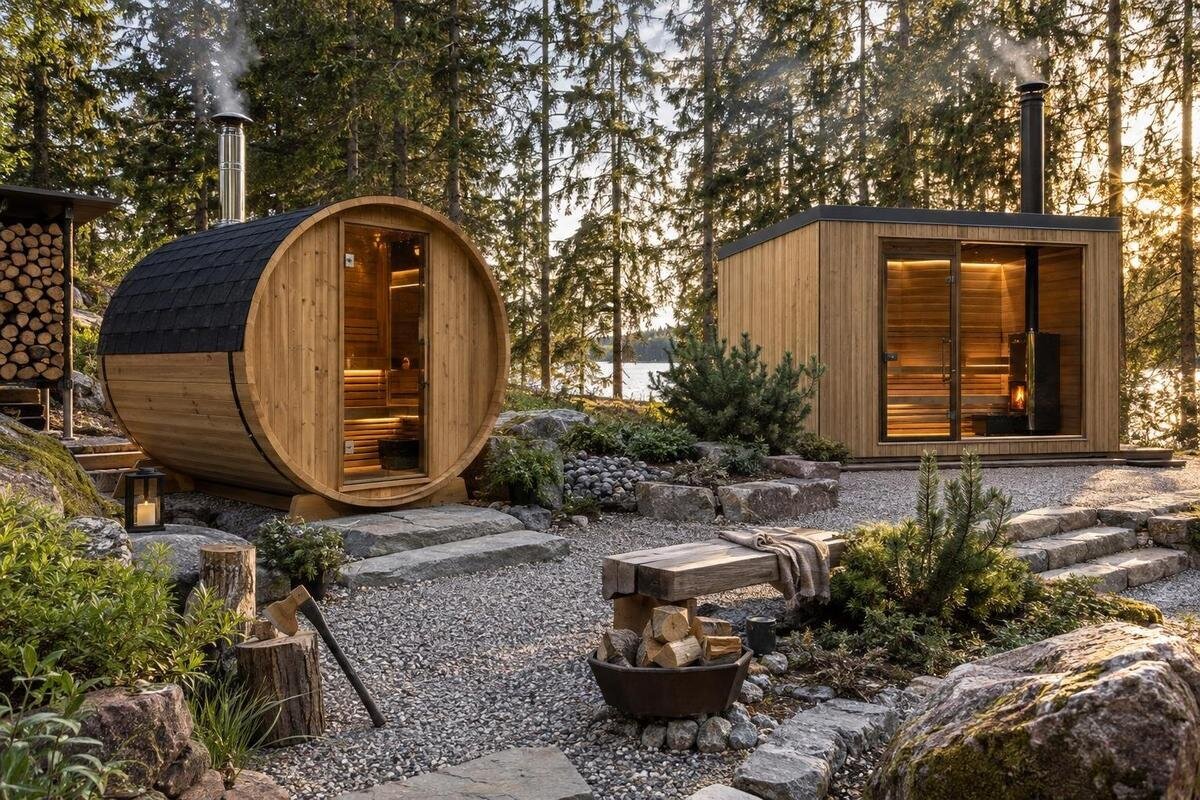
Wood-burning sauna buying guide
Buying a wood-burning sauna means choosing a cabin, heater and chimney route that work together at your property. The stove’s permitted room range, firebox access, flue layout, delivery route and site conditions all affect the order. A cabin that fits the yard on paper may still be difficult to install if there is no workable route for the specified chimney or for future servicing. Before committing, compare the documents for the exact combination and have the proposed installation reviewed by qualified professionals. This guide focuses on decisions to settle before ordering; it does not assume that any named sauna includes a wood stove.
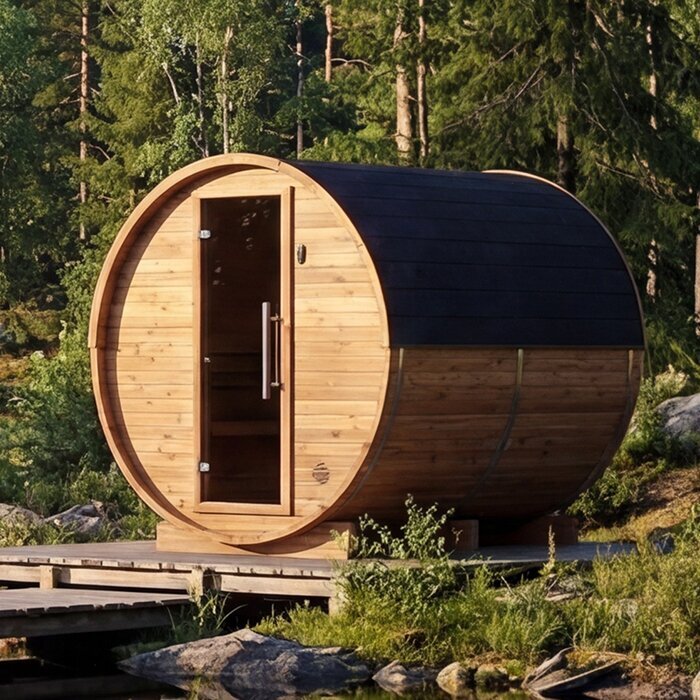
Consider the routine of owning a wood-burning sauna
Start with the routine you want from the sauna, because a wood-burning heater adds recurring tasks to the purchase. Someone must obtain fuel, keep it in the condition required by the stove maker, carry it to the firebox, tend the fire, and deal with ash and scheduled heater and chimney care. The exact requirements belong to the equipment manuals, but the time and storage needs are real parts of ownership. Consider how often you expect to use the sauna, whether preparation is welcome or a nuisance, who will manage the fire, and whether a practical fuel-storage spot is available without blocking the entrance or service access. This clarifies what kind of setup fits your routine before you compare cabin listings.
Consider the setting as well as the routine. Smoke, firebox access and the eventual chimney route can affect windows, outdoor seating, neighbouring spaces, and how people move between the house and sauna. If storing fuel or carrying it across a long, awkward path would make frequent use less appealing, mark that issue now rather than after delivery. Decide how many people normally need the cabin at once, whether they need a clear changing or waiting area nearby, and whether someone using the stove can move about without crossing the main traffic route. The answers give you a practical brief; they do not replace the stove maker’s capacity data or a site review.
Match the heater to the cabin’s stated room range
Use the stove manufacturer’s stated room-volume range as the first filter, then have the seller or installer confirm the match for the exact cabin. A model code or outside length is not a sizing method. Ask for internal dimensions and the stated room volume, along with any enclosure details the stove maker uses to assess suitability. Glass area, insulation and wall construction may affect a manufacturer’s sizing method, but the adjustment is model-specific; do not add a guessed allowance or calculate the required heater yourself. If the maker calls for adjustments, ask which assumptions apply to the offered cabin configuration and who has confirmed them. A clear written match is more useful than an occupant count or a broad label such as small, medium or large.
Compare the cabin and heater as a pair, not as independent purchases. Ask for the exact stove model, recommended room range, any stated conditions or adjustments, and written confirmation that it is intended for the selected cabin configuration. If you are reviewing the Thermowood Barrel Sauna S 140 listing, treat the name as an identifier only: it does not establish usable room volume or whether a wood stove is included or confirmed as compatible. Request the documents for the precise version being ordered, including any options that change the cabin layout. A seller’s general statement that a heater fits is a reason to ask for its supporting manufacturer information, not a substitute for it.
Compare firebox access and stove features
Wood-burning heaters can differ in firebox arrangement, and that affects how the cabin is used. Some are loaded from inside the sauna; others are designed for feeding from an adjoining space. Confirm the exact stove’s arrangement rather than assuming a photograph or a cabin shape reveals it. Consider whether a loading door can be reached without crossing the main path, whether a feed-through design needs space on the other side of the wall, and how the stove location relates to the entry, benches and circulation. Ask for a plan drawing that identifies the heater and loading side. The manufacturer’s layout and installation documents should guide any final review, including whether the proposed arrangement leaves practical access for the people using the cabin.
Compare documented stove characteristics that affect the buying fit: recommended room range, firebox size and permitted fuel, stone capacity, door position, physical dimensions, servicing access and any optional features you actually want. A single advertised figure cannot settle the match: stone capacity alone does not prove a stove suits the cabin, and a large firebox is not a guarantee of a particular warm-up time. For a page such as the HC150 Thermowood Barrel Sauna listing, request a layout showing the firebox arrangement and a written heater pairing; do not infer either from the model name. Use official specifications for comparisons, and ask which stones or other components are supplied rather than assuming they are included.
Plan the chimney route with the heater
Treat chimney planning as part of the heater choice. Ask for the exact chimney or flue system specified for the selected stove and a component list that covers the route from the heater connection to the outlet. A connector and a complete chimney installation are not necessarily the same scope, so have the quote identify what is supplied and what must be sourced separately. The proposed route can involve a wall or roof penetration, support, separation from other materials and weatherproofing; do not design those details from a picture or generic online diagram. A qualified installer should review the complete arrangement against the appliance documents and applicable local requirements before the order is final. Ask as well how the specified maintenance and cleaning access will be preserved.
Ask for a flue plan for the actual site, not only a display layout. The route influences where the sauna can sit, which part of the building envelope is affected, and whether future inspection and cleaning are accessible. If the proposed cabin would sit under another structure, attach to a building or be near overhead obstructions, confirm that the exact cabin and chimney arrangement are suitable for that location; never assume a garden sauna is roof-rated. For the Thermowood Barrel Sauna HC 225 listing, as with any cabin option, obtain model-specific chimney information and have a qualified installer assess the route at your property. If no workable route is confirmed, settle that before choosing the final cabin position.
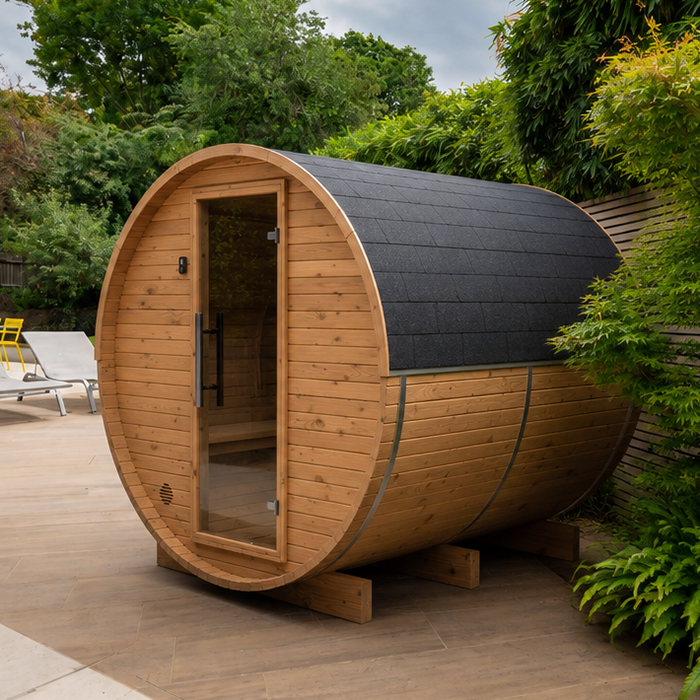
Measure the site and confirm support requirements
Map more than the cabin’s outside footprint. Use the manufacturer’s drawing to allow for the entrance, steps if required, door operation, movement around the sauna, and access to the stove and chimney for service. Any clearances specified for the heater and flue are separate from the cabin’s nominal size. Model numbers and catalogue photographs do not show the usable installation zone. Ask for the outside and interior dimensions, door orientation and installation plan for the exact version you are considering, then place those measurements on a site sketch. Include the route for carrying fuel and the space needed to approach the firebox; this can reveal conflicts with fences, paths, planted areas or existing structures before delivery is arranged.
Confirm the support and surface requirements with the sauna supplier and, where needed, a qualified builder or installer familiar with the site. Ground slope, drainage, surface condition and exposure are property-specific; do not assume that a particular deck, patio or base will suit every cabin. Ask what the manufacturer requires and who will assess the planned support rather than choosing a foundation from a photo or a neighbour’s installation. If the sauna will be outdoors, verify that the specific product is intended for the proposed exposure and ask how site drainage is to be addressed. If the Thermowood Barrel Sauna N 210 listing is on your comparison list, its model label alone does not provide a footprint or support specification.
Check clearances, weather and neighbouring spaces
Review the proposed location against the exact heater and chimney documentation. Ask the installer to assess the specified separation from walls, fences, decks, stored materials and overhead features, as well as nearby windows and air openings. Do not copy a clearance from a different stove: requirements can depend on the appliance and chimney system. Check with the relevant local building or fire officials about what applies to your property; this is a question to settle before purchase, not an assumption based on a neighbour’s setup. Keep neighbouring outdoor areas in mind too, especially where smoke or firebox access could affect how those spaces are used.
Seasonal use can change whether a site is practical. If snow or ice is relevant at your property, consider where it may collect, whether the entrance and firewood route can be kept accessible, and whether servicing remains possible. Discuss wind and smoke direction with the installer rather than relying on a simple compass rule; nearby windows and outdoor seating may matter. A product page cannot substitute for this assessment: if the Thermowood Barrel Sauna N 250 listing is among the options you are comparing, request its installation layout and review it against the same on-site constraints. This keeps the cabin choice separate from unsupported assumptions about chimney placement.
Plan delivery, assembly and service access
Delivery can decide whether a suitable product is practical to order. Ask the supplier for packaged dimensions, package count, shipping weight, the expected unloading method and any access needs; do not use assembled dimensions to judge whether a crate can pass through a gate or around a turn. Measure the entire route from the delivery vehicle’s stopping point to the planned site, including narrow passages, steps and overhead restrictions. Consider where packages could be staged without obstructing the work area, and whether access changes in winter. Clarify whether unloading and movement to the installation area are included in the quote, and who provides any equipment or labour that is not. These details help prevent a delivery problem after the site has been prepared.
Ask how assembly and installation are divided between the cabin supplier, stove seller and installer. Confirm whether the order arrives assembled or in components, who is responsible for fitting the cabin and heater, and whether the installer needs clear access to both the sauna and proposed chimney route. Plan for future service too: the stove and chimney need to remain accessible for the maintenance and cleaning specified by their makers. If you are assessing the LC 260 Thermowood Barrel Sauna listing, request its package and assembly information rather than inferring transport needs from the model code or product images. Keep delivery, assembly and future service access on the same site plan.
Confirm what the package includes
Get the supply scope itemized before comparing packages. Ask whether the quote includes the cabin only or also a specific wood stove, the exact stove model, chimney components, connector parts, stones and any accessories identified by the manufacturer for that setup. Clarify which parts, if any, must be ordered separately and whether cabin assembly, stove installation, chimney work, site preparation and delivery are included. Items such as hearth protection, shields or flashing should be discussed where the selected design calls for them; do not presume a generic kit is appropriate. A photograph of a complete sauna does not establish what arrives with the order, and a heater shown nearby does not by itself confirm it is part of the package.
Request a single list of supplied items and a separate list of exclusions, then compare them against the cabin and heater documents. The names of two items in the same catalogue do not prove they are offered as a compatible package, and a cabin model does not identify which stove or flue parts, if any, are supplied. For the HCF 300 Thermowood Barrel Sauna listing, check the written scope in the same way: confirm whether a heater is an option, which configuration is quoted, and what remains for you or an installer to arrange. Resolve unclear wording before paying, so a cabin-only figure is not mistaken for a complete installed setup.
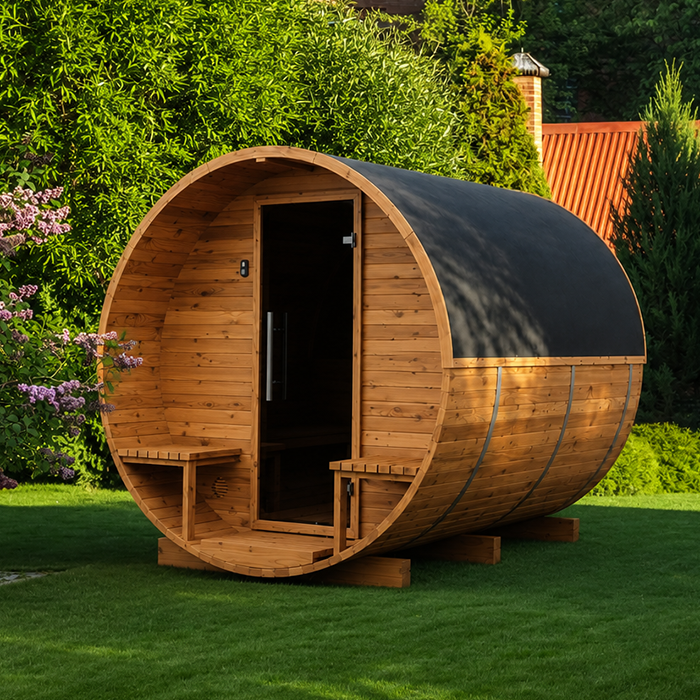
Compare the total project cost and schedule
Compare the whole project rather than a single cabin or heater amount. Ask for separate figures for the sauna, heater, compatible chimney system, site preparation, delivery, assembly, professional review and installation, plus any related work the installer identifies. Include ongoing costs such as fuel and routine maintenance in your own comparison, without assuming a particular consumption rate. If a change to the chimney route or support plan could add work, ask how that change would affect the estimate. A written breakdown lets you compare packages on equal scope; the lowest cabin-only amount may not represent the setup you actually need.
Schedule planning matters too. Ask the supplier and installer for current order and work estimates, what must be completed before delivery, and which decisions could delay the installation; do not rely on a generic seasonal promise. Check payment, change, cancellation and delivery-damage terms, and ask where warranty responsibility sits across the cabin, heater and chimney components. If local approvals or insurance questions may affect the plan, confirm them with the relevant authority or insurer before placing an order. For the Thermowood Barrel Sauna LCF 300 listing, as for any product page, the model name alone cannot tell you the package cost or lead time; request a dated, itemized quote for the configuration you intend to buy.
Get the configuration in writing before ordering
Gather one written set of documents for the exact configuration before placing an order: cabin identity and dimensions, heater make and model, its recommended room range, manufacturer-confirmed cabin compatibility, the specified chimney components and the proposed site route. Add the package inclusion and exclusion list, delivery and assembly requirements, access measurements, and any site or approval checks that remain open. Make sure the heater and flue instructions refer to the same models named on the quote. If different suppliers are involved, have the relevant professionals review their parts together instead of assuming that separate confirmations are consistent.
Proceed only when the cabin, stove, flue plan and property can be described without guesswork. If the room range is unclear, the chimney system is not identified, or no one can confirm the site arrangement, pause while the supplier or qualified installer answers that specific point in writing. Do not resolve a mismatch by adapting the stove or chimney yourself. The documents also make it easier to compare a revised package or another cabin fairly, because you can see whether the difference changes compatibility, installation work, delivery or the total project cost.
Frequently asked questions
How do I choose the right size wood-burning stove?
Start with the stove manufacturer’s stated room-volume range, then have the seller or a qualified installer confirm the match for the exact sauna. Ask how the maker accounts for the cabin’s layout and any glass or construction details. Do not size a heater from exterior dimensions or a model number.
Does a wood-burning sauna include the chimney?
Do not assume it does. Package scope varies, so ask for an itemized list that names the stove, chimney components and any parts that must be purchased separately. Confirm who is responsible for checking that the specified components suit the exact heater and proposed route.
How can I tell whether the chimney route will work at my property?
Have a qualified installer review the exact heater, chimney system and proposed location before ordering. Share the site plan and ask for the route and required components in writing. A generic drawing or another property’s installation cannot establish that the same arrangement suits your site.
Can a wood-burning sauna go under a roof or beside another structure?
Do not assume it can. Ask the cabin and heater suppliers to confirm that the exact arrangement is suitable for the proposed location, then have a qualified installer assess the chimney route and site. A garden sauna’s appearance or product name does not show that it is roof-rated.
What should I measure before placing an order?
Check the planned installation area, entrance and service access, plus the route from the delivery vehicle to the site. Ask for the exact cabin and package dimensions, including shipping dimensions where available. Also have the required support conditions and clearances confirmed for the specific setup.
Buying a wood-burning sauna is a coordination decision: the cabin must suit the stove, the flue must fit both the appliance and the property, and the delivery and installation scope must match the quote. When those details are documented before ordering, you can compare options on what will actually be supplied and installed—not on a model code, photograph or unverified assumption. The best fit is the configuration that works at your site and matches the ownership routine you are prepared to maintain.
