
Wood-Fired Sauna Heater: Internal or External Feed?
Wood-fired sauna heater guide
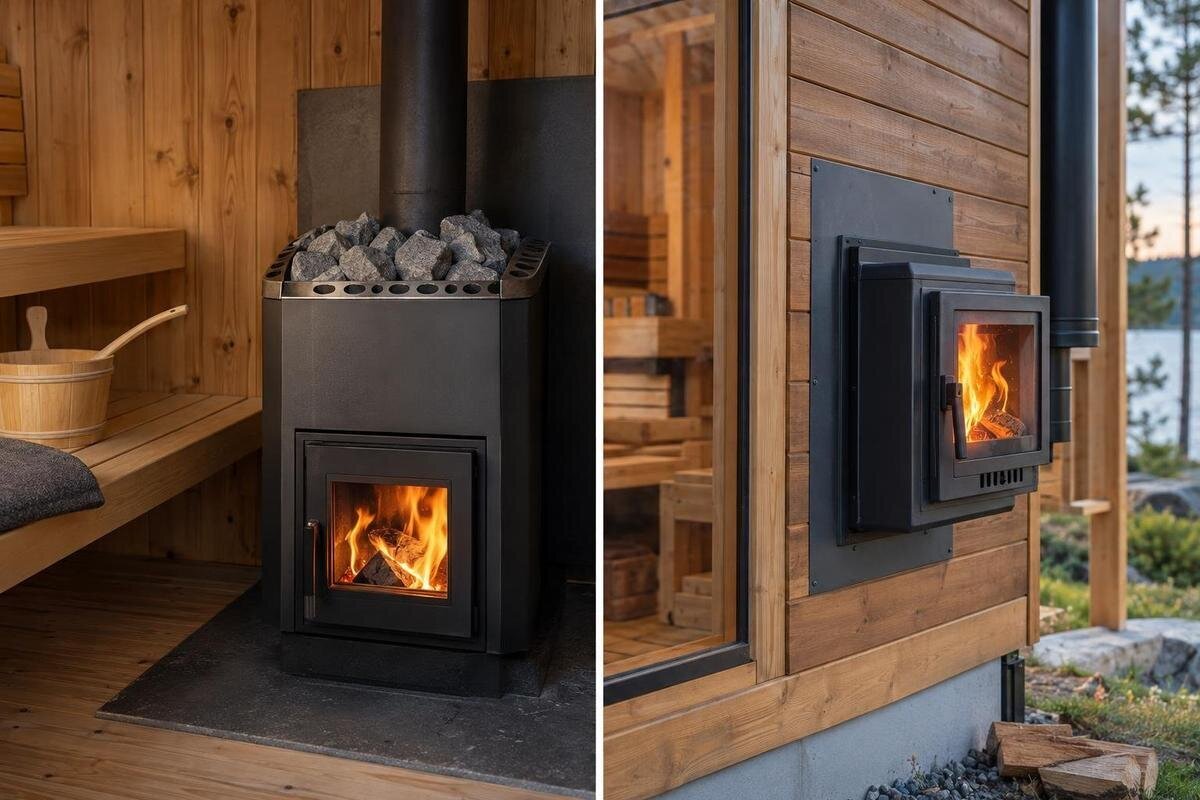
Choosing a wood-fired sauna heater involves more than locating the appliance. The feed layout determines where fuel is loaded, where the person tending the fire stands, and which routes are needed for carrying logs, removing ash and accessing service points. An internal feed opens to the sauna; an external feed is loaded from an adjoining space or outdoors through a configuration designed for that heater. Neither arrangement is automatically better. The useful comparison is whether the cabin plan, installation requirements and normal tending routine work together.
What internal and external feed mean
Internal and external describe where the loading door is accessed relative to the hot room, not necessarily where the entire heater sits. An internally fed heater is loaded from inside the hot room. An externally fed model is loaded from the other side of a wall, such as an adjoining changing area or an outdoor location if that exact heater is designed for it. The heater body may still be in the sauna. The label does not tell you which feed extension is permitted, whether it is included, or how the connection through the wall must be handled; those details belong to the specific model’s drawings and manual. The person tending the fire also needs a place to stand, not just enough room to reach the door.
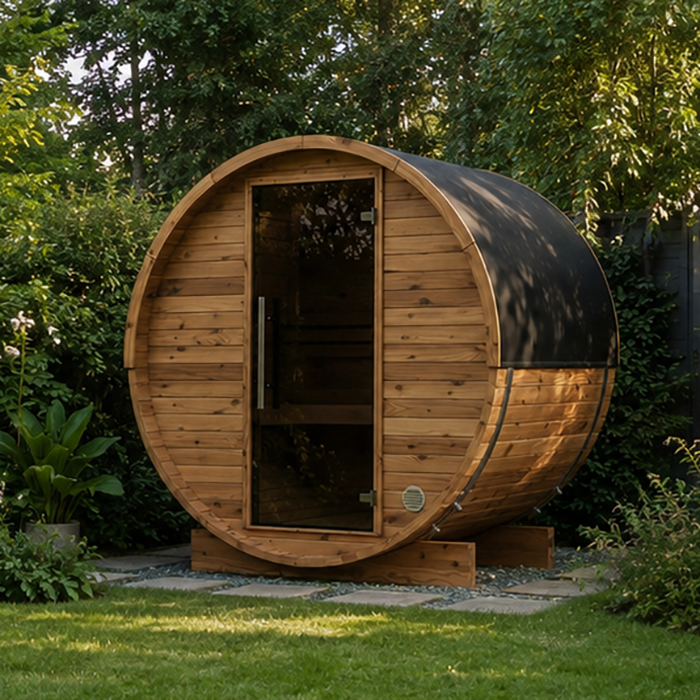
Keep loading access separate from the heater’s position, chimney route and air requirements: choosing one does not settle the others. The listing for HCF-300 Thermowood Barrel Sauna states a floor area of 6.89 m², but that figure cannot show the usable wall section, bench placement, door direction or a compatible feed configuration. Compare the cabin’s dimensioned plan with the exact heater manual and drawings. A sauna product listing identifies a cabin; it is not proof that a particular wood heater or feed option is included or fits. Mark the approach to the loading door on whichever side it will face, then check whether that route crosses a bench, entrance or other work area.
Internal feed: loading from the hot room
Internal feeding suits a layout where tending from the hot room is acceptable and there is no practical reason to reach the fire from elsewhere. The operator brings wood through the sauna entrance and opens the loading door from inside. This can avoid setting aside an adjoining loading position or planning an external feed passage. It keeps the task close to the people using the sauna, which may be convenient when someone is already checking on the heater. Still, assign a place for any wood basket and tools that stays out of walkways and the clearances specified for the model. Internal access is not automatically the most space-efficient choice; it puts the working position inside the room.
The trade-off is that every fuel trip passes through the hot room, and the attendant needs room to approach the heater while its door is open. During shared use, a person, basket or tool can interrupt the route between the entrance and benches; loose bark or debris may also collect along that route. Think about whether the operator can work without asking other users to move and where the next load will wait. When reviewing the plan for the LCF-300 Thermowood Barrel Sauna, listed at 6.89 m², focus on the route from the entrance to the loading position. Look at where someone carrying wood would turn, set down the basket and approach the firebox, as well as how other users would enter and leave.
External feed: loading from the other side
External feeding moves the loading door to an adjoining area or an approved outdoor-side location. External is relative to the hot room: the loading side might be another indoor space, not an exposed yard. This layout can keep routine log carrying and fire tending out of the sauna, so an operator does not need to cross the hot room each time the fire needs attention. It may also put the loading position closer to a dry wood store, if the building plan allows. The benefit is about the route and point of access, not eliminating tending; someone still needs to handle fuel and operate the heater as instructed.
The arrangement needs usable space on the feed side: a route for logs, a standing position and access to the model’s door as it opens. If that side is outdoors, consider the path in the weather your site experiences and where fuel can wait without blocking access. For the S-140 Thermowood Barrel Sauna, listed at 1.93 m², establish whether a separate feed is supported before comparing possible loading locations. Check the cabin and heater drawings together to identify where the loading door would face and how someone would approach it. A changing area, utility space and yard create different access conditions, even though each is outside the hot room. The useful question is whether that particular space works for tending, rather than whether it simply lies beyond the sauna wall.
How each layout changes fuel handling
Trace wood from storage to the firebox instead of comparing only where loading happens. With an internal feed, the route enters the hot room; with an external feed, it ends in an adjoining room or outdoors. Decide where logs and kindling arrive from, whether they must cross a narrow doorway or wet change area, and where a supply can wait without narrowing a walkway or entering the heater’s specified clearance zone. A short route on a drawing may still be awkward if the basket and open loading door compete for the same space. Consider who will carry the wood and what else they need to bring with them.
Fuel handling continues after the fire is tended. The chosen heater’s manual determines how it is operated and what ash or other residue needs attention; an external door does not prove every cleaning task can be done from outside. Include the route for any tools or waste container, and ask whether routine care needs access from the sauna side. When considering the HC-150 Thermowood Barrel Sauna, listed at 2.97 m², identify where fuel and tools would wait between tending visits. Keep those locations separate from the space needed to carry them to and from the heater. If the loading side is shared with another doorway or changing area, compare the fuel-handling route with everyday traffic rather than allocating the same space to both tasks.
Circulation around the heater and benches
Map people’s movement as well as heater placement. On the sauna side, trace the ordinary path from the entrance to the benches and the path taken by anyone tending the fire. Consider the loading door’s position when open and whether another person can pass the attendant without squeezing past the heater or crossing the main route. An external feed can remove that fuel trip from the hot room, but it adds an open door and an operator on the other side, where a changing-room entrance or corridor may already be busy. Assess both sides of the wall, not just the space occupied by the heater itself.
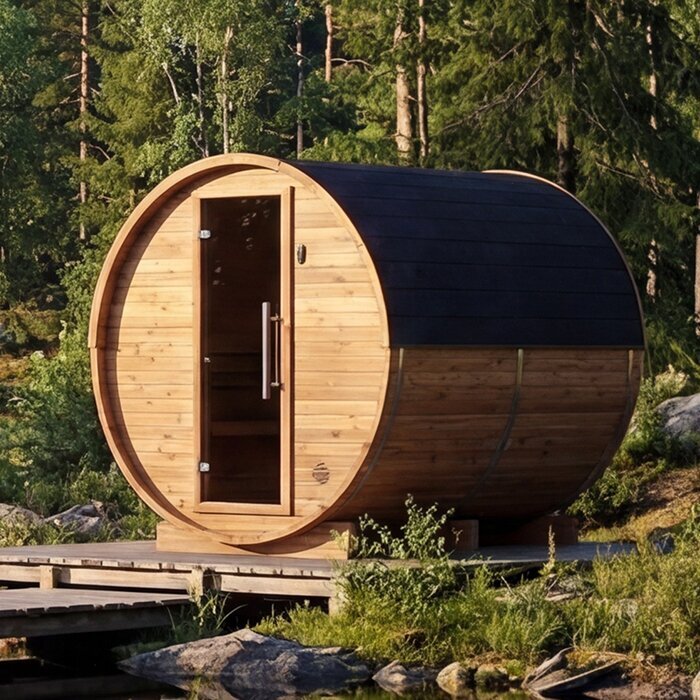
Floor area is only one input; the shape and position of the entrance, benches, heater and loading door define circulation. For the HC-225 Thermowood Barrel Sauna, listed at 4.4 m², use a dimensioned plan to examine these positions together. Mark the attendant’s position at the proposed loading door, including when it is open, and trace the route another user would take to reach the benches. For an external-feed option, repeat that exercise in the adjoining space. Compare the proposed working positions and routes with the manufacturer’s required clearances. Do not treat a required heater clearance as spare standing or storage space. This separates the room’s overall size from the space people can actually use while the heater is being tended.
Wall openings, heater clearances and fit
An external-feed arrangement requires a heater designed for that use and an approved interface through the cabin wall. Its details can depend on heater orientation, a specified feed assembly, wall thickness and material, and the required separation from combustible surfaces. Do not assume a feed extension can be adapted to a wall just because it appears to reach. Internal feed still has manufacturer clearances and access requirements; avoiding a wall-through loading door does not remove installation requirements around the heater. If a wall is curved or otherwise unusual, have its fit assessed against the exact drawings rather than improvising.
Before choosing either format, request drawings that show the cabin structure, heater body, loading door, floor and planned flue together. A qualified sauna-heater installer should confirm that the exact components and wall arrangement are suitable as a system and identify what must remain clear. The N-210 Thermowood Barrel Sauna listing states 4.43 m²; assessing a wall opening requires its construction details and dimensions, not just that floor-area figure. Have the proposed opening position considered alongside the heater orientation and loading access. Confirm applicable local requirements with the professionals responsible for the work, and do not cut or modify the cabin based on a generic diagram. Use the selected heater’s own instructions rather than borrowing clearances from a similar-looking model.
Ventilation and chimney planning remain separate
Loading-door position and room air are related planning topics, but one does not specify the other. A wood-burning heater’s combustion-air arrangement and the sauna’s ventilation need to be planned for the selected model and cabin using its instructions. External feed does not automatically mean the firebox draws air from outdoors or from the adjoining room; internal feed does not tell you where vents belong. Do not relocate, add or omit an air opening based on the feed label alone. Have the model-specific requirements reviewed as part of the cabin layout rather than treating the door location as an answer to an airflow question.
Chimney location is a separate consideration: the approved route and any penetrations have to fit the cabin and heater drawings and be assessed by a qualified installer. Changing the feed side does not prove that a different chimney route is allowed. Nor does loading externally guarantee a smoke-free sauna; smoke behaviour depends on the actual appliance, installation and operation. If you are considering the N-250 Thermowood Barrel Sauna, listed at 5.27 m², include the proposed heater, chimney and air arrangements in the layout review. Identify which details concern the firebox loading position and which concern air supply or the flue. Keeping those questions separate avoids treating an external loading door as a complete answer to how the heater and sauna will operate.
Cleaning and service access
Maintenance access can differ from loading access. An external feed makes the firebox door reachable from the adjoining side, but it does not prove that the heater body, stones, flue connections or other service points can be reached there. An internally fed model may put normal tending inside the sauna while maintenance still involves another access point, depending on the design. Use the exact manual to list routine cleaning and inspection tasks, then note which side of the wall each task requires. Do not let fixed benches or stored supplies block an access point specified by the manufacturer.
Think beyond the first use: can someone carry out the prescribed cleaning and reach each service point without moving built-in benches or supplies? Ask the installer how a service visit will approach the heater and what needs to stay unobstructed. For the LC-260 Thermowood Barrel Sauna, listed at 5.12 m², review maintenance access alongside the proposed bench and heater positions. Distinguish a route that lets someone reach the loading door from one that gives access to the heater body or flue connections. Mark the required service points on the same plan as the loading position, using the model drawing and maintenance instructions. That makes it easier to see whether either feed layout leaves a task awkward or inaccessible before the cabin arrangement is finalized.
Choosing by site and routine
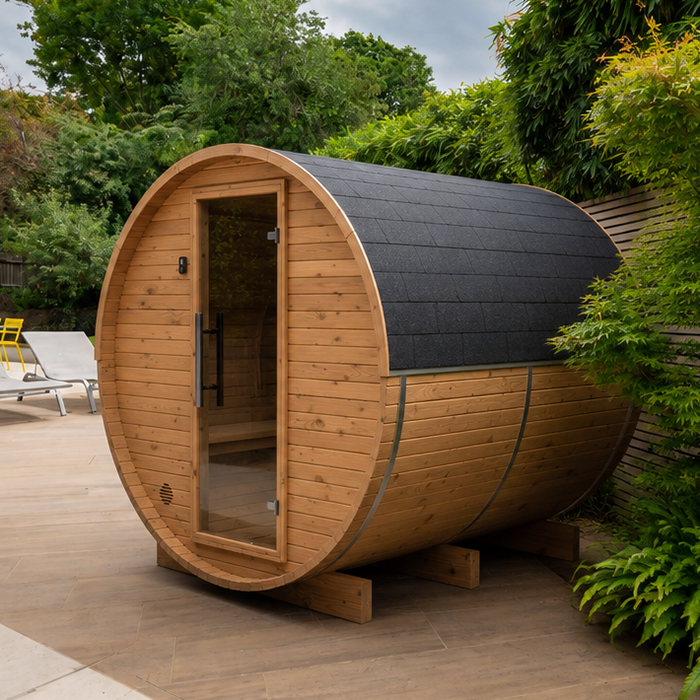
Internal feed may be more workable when the route to the heater is clear, carrying wood through the sauna is acceptable, and there is no useful adjoining place to load from. External feed can suit a household that wants the fire-tending position outside the hot room, provided the specific heater and cabin support it and there is room on that side. If the loading door would open into a busy passage, exposed yard or cramped change area, the separation from the sauna may not outweigh the extra access demands. Neither rule applies to every cabin; the actual layout and intended use matter.
Picture a normal tending visit: someone brings wood from storage, opens the firebox, handles tools, returns to the sauna and later follows the manual for any cleaning. Who performs each task? Will other users pass through the same doorway? If the feed side is outdoors, is the approach practical in the conditions the property experiences? Consider privacy, fuel storage and maintenance access too. If an adjoining room is both the loading area and the main route for changing, account for congestion when the sauna is in use. Comparing the whole routine is more reliable than choosing by preference for a door on one side of the wall.
What to confirm before you order
Identify the exact heater model and feed configuration, then request the manufacturer’s dimensioned drawings and manual. Confirm which side the loading door faces, which feed components are approved or required, whether those parts are included in the offered configuration, and how the cabin wall and heater clearances relate. Review the entrance, benches, heater, loading access, air requirements and chimney on the same plan. Ask for the operator’s position to be considered on both sides of the wall, not just an outline of the heater. A product title or floor-area figure cannot answer these questions.
Have a qualified installer review the actual cabin and site before any opening or flue work is planned. Ask for confirmation that the selected model, feed option and wall arrangement can be used together and what requirements apply locally. With the seller, verify the configuration, availability and included feed components so the order matches the layout that was reviewed. Establish who will maintain the heater and which access points must remain clear. Resolve unclear dimensions or compatibility before purchase rather than selecting a layout first and trying to adapt the building afterward. If a component or wall detail is not shown in the documents, get an answer for the exact model rather than assuming it matches another heater.
Frequently asked questions
Does an external-feed heater sit outside the sauna?
Not necessarily. External feed describes where the firebox is loaded relative to the hot room. The heater body may remain in the sauna while a feed section designed for that model extends through the wall into an adjoining space. Check the manufacturer’s drawing for the exact arrangement; the label does not mean the heater is rated to sit outdoors.
Can I choose a feed layout by the sauna’s floor area alone?
No. Floor area does not show the positions of the door, benches, heater or suitable wall sections. It also does not establish the clearances or access a particular model requires. Compare a dimensioned cabin plan with the heater’s drawings and manual.
Will external loading keep smoke and wood debris out of the sauna?
It can reduce the need to carry logs through the hot room, but it does not guarantee a smoke-free sauna or remove every cleanup task from the room. The heater’s design and instructions determine what tending and cleaning involve.
Does internal feed heat a sauna faster?
Feed location alone does not establish heat-up time. That depends on the specific heater and its installation and cabin conditions. Compare performance only using manufacturer information for the exact compatible setup, not by assuming one feed arrangement is faster.
Can I convert any wood-fired heater to external feed?
No. Use an external-feed configuration only if the manufacturer supports it for the exact heater model and cabin arrangement. Do not extend a firebox or alter a wall based on a generic diagram; have the manufacturer’s instructions and the proposed layout reviewed by a qualified installer.
Internal feed keeps loading in the hot room; external feed moves it to a suitable space on the other side of the wall. The practical trade-off is where wood travels, where the attendant stands and whether the cabin can accommodate the heater’s approved configuration. Compare both routines on the cabin and heater drawings, including circulation and service access, before settling on a layout.
