
Replacing an Outdoor Sauna: Can the Base and Connections Be Reused?
Outdoor sauna replacement
An old garden sauna may have sat on its base for years and its heater may have worked reliably, but neither fact proves that a replacement will fit the same support layout or use the same electrical supply. Assess the base, electrical service and any other connections separately against the exact new model. Reuse is possible only when the drawings, condition and appropriate professional checks support it.

Get the replacement model’s current drawings
Identify the exact sauna model and configuration before measuring the old installation. Use the Sauna HC-225 model page to identify a candidate, then obtain its current assembly manual and dimensioned drawings from the manufacturer or seller. A category name, product photo or general description cannot establish the support points, clearances or service locations for a specific unit. Keep the heater and any included or optional equipment in scope, because the cabin and its services may be specified separately. Confirm that the documents match the version and package you intend to order, not a similar-looking sauna. Ask for missing pages instead of filling gaps by assumption.
Make a comparison sheet from the drawing rather than relying on memory: overall footprint, base contact or support lines, required orientation, door position, service entry points and any stated clearance or surface conditions. Measure the existing installation using the same reference points, including elevations and the edges of the prepared area. Mark which details are measured, which come from a drawing, and which remain hidden under the old cabin. Record the drawing version and ask the supplier or manufacturer to clarify an unclear interface before ordering. Never scale dimensions from a photograph or assume a similar-looking sauna uses the same base. Use consistent units and flag any difference you cannot reconcile.
Compare the base’s support layout with the new sauna
Compare more than overall length and width. For a candidate such as the Sauna N-210 listing, obtain drawings that show the support arrangement. The new sauna’s load-transfer points, rails, bearers or other supports need to land on a base arranged to receive them; a similar outside footprint can conceal a different support pattern. Check dimensions and elevation at the locations identified, and note any portion that would overhang or sit unsupported. Compare any anchoring or fastening points if the manufacturer specifies them. If the support arrangement is unclear, ask the manufacturer or supplier for written clarification rather than interpreting a product photograph. This is a check of the documented interface, not just visual similarity.
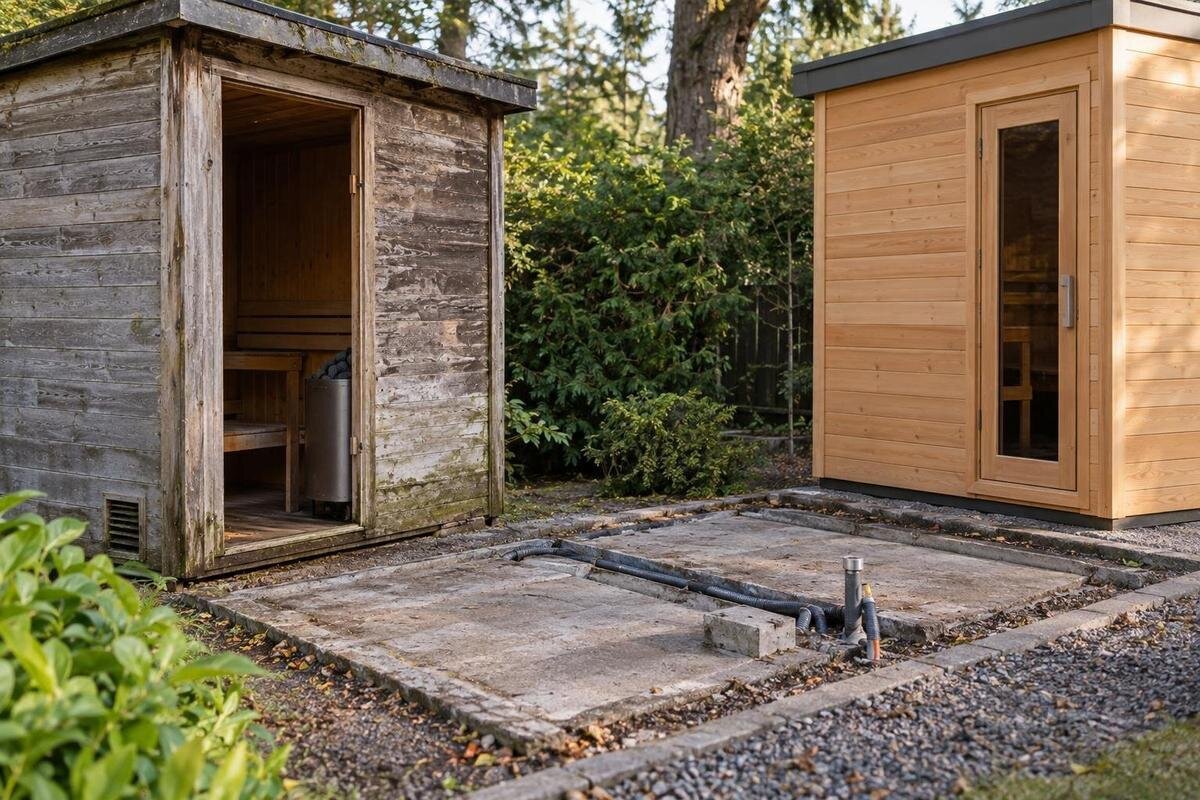
Record what the old sauna rests on: a slab, concrete pads, pavers, timber framing, compacted material or another construction, if known. These examples are not interchangeable specifications; the relevant question is whether the replacement instructions can be met on that support type and whether it remains stable. Note repairs, added shims or extensions that may have changed the original arrangement. A qualified contractor or other appropriate site professional can assess the base and explain whether work is needed. Avoid making mismatched supports line up with loose packing or an improvised bridge. Any adjustment can change height, level, drainage or access, so review it before placing the new cabin. A different support layout may use areas of the base that the old sauna did not.
Inspect the base’s condition
Look for visible cracking, broken edges, loose joints, movement, uneven settlement, standing water, soft or decayed timber, and corrosion where metal supports are exposed. Treat these as observations to record, not a diagnosis: a surface can look sound while important support is concealed, and a mark alone does not prove failure. If you are considering the model on the Sauna N-250 product page, compare the base’s condition and level with that model’s installation requirements. Ask a qualified contractor or other appropriate site professional to assess uncertain or damaged areas. Include the surrounding ground in the review, not only the visible top.
Inspection may be more informative once the old cabin has been removed, because hidden areas and supports become visible. Coordinate removal only after electrical and other service routes have been identified and made safe by the appropriate people. When the base is exposed, photograph and measure defects, and note whether repairs would change its top elevation or support layout. A surface patch can cover damage without resolving movement or deterioration below. Ask the professional to distinguish what can remain, what needs repair and whether the finished base should be checked again against the replacement drawing. Keep the findings with the project records, including any areas that could not be examined.
Review water movement around the base
Water management can affect the base long after a visual check. Note where rain and snowmelt collect, whether water sits beside or under the prepared area, and whether runoff from nearby roofs, paths or sloped ground reaches it. Look for staining, washout, soft ground or recurring ice; these clues may warrant a drainage or grading review, but they do not tell you how to alter the site. When considering a replacement from the Sauna LC-260 listing, use its drawings to compare the proposed footprint and orientation with the old installation. A change may affect where water falls. If possible, observe the area after wet weather rather than judging it only when dry. Ask a site contractor to review persistent pooling or erosion.
Keep the cabin’s requirements separate from optional site services. A setup may include nearby water, a shower, lighting or a drain, but those choices depend on the selected design and configuration; an old hose, drain or buried line is not automatically needed or suitable. Identify each visible or known route, what it served and whether it crosses the replacement’s footprint or support area. If landscaping or excavation will change, have the relevant professionals confirm the route and condition beforehand. If a line does not appear on available plans, treat its location as unknown rather than assuming none exists. Do not cut, cap or relocate an unidentified service on guesswork.
Have the existing electrical supply assessed
Treat any existing electrical supply as a separate assessment, not as part of the base decision. If a circuit served the old heater, that tells you only that the former setup operated; it does not confirm compatibility with a different heater or control system. The circuit, protective devices, wiring condition, grounding, route and installation history may all matter to an electrician’s review, but you should not infer suitability from a breaker label or the sauna’s exterior. If you are considering the cabin on the Sauna HCF-300 model page, establish the intended equipment package before requesting the electrical assessment. Give the electrician the exact make and model of the replacement heater if it is electric, along with its current installation information. Note if the old heater was changed during the sauna’s life.
Arrange the review before the new sauna is ordered or the existing supply is altered. Share what is known about the original heater and any previous electrical work, and have an appropriately qualified electrician assess the installation against the exact replacement equipment and applicable local requirements. If labels, records or the route are missing, say so rather than filling the gaps with assumptions; the electrician can decide what further inspection is needed. Do not remove covers, test live wiring or make changes yourself to prepare for the review. Ask for the result in writing, including whether the supply can be retained, what work is required and when it must be completed.
Confirm the heater and control package
Verify the heater as part of the exact purchased configuration. When reviewing the Sauna LCF-300 listing, check whether a heater is included or supplied separately, its model, which controls are part of the package and what the manufacturer says must work together. A sauna cabin’s product name or general family does not establish the heater model, electrical requirements, control arrangement or connection method. Obtain documentation for the exact heater rather than carrying over assumptions from the old one. If a listing is unclear about inclusions, confirm the package with the seller in writing before treating an item as part of the order.
If you intend to keep the old heater, ask the sauna manufacturer whether that exact heater is suitable for the replacement cabin. For an electric setup, have an electrician separately confirm that the supply and controls match the proposed configuration. Check the manuals for any sensors, wiring requirements or equipment-specific clearances. Some equipment is specified as a system, so changing one component can affect how another is installed. Include accessories such as lights or remote controls only if they are part of the intended setup and their manuals call for a service connection. Keep the manuals together and note model or revision differences; physical fit or a familiar connector is not proof of compatibility.
Check site access and service routes
Recheck the surroundings even when the replacement is going in the same place. Compare the manufacturer’s positioning and clearance information with fences, walls, trees, overhangs, paths and the planned door approach. Confirm there is space to assemble or place the cabin as the instructions require, and that the entry remains accessible from the planned path. If the Sauna S-140 product page is on your shortlist, use its model-specific documents and on-site measurements to assess the proposed location rather than assuming a match based on shape. Note any landscaping or structures added since the original sauna was installed, along with seasonal access issues that could affect the route.
Map the cabin, heater controls and any service entry against the base and known utility routes. A buried conduit, cable path, drain or hose can conflict with support points, excavation or access, even if it served the previous installation. Use reliable records where available and have the relevant professional confirm uncertain routes before digging, drilling or moving equipment. Delivery and assembly access matter too: gates, steps, soft ground and overhead obstructions can affect the proposed method. Mark the planned route on a simple site sketch so the installer and other professionals can review the same information. Do not assume the old handling plan still applies because the site is familiar.
Decide separately which parts can be reused
Make a separate reuse decision for each item: the base, electrical supply, heater and controls, conduit or service route, and any water or drainage connection. Record each as suitable to retain, suitable only after a defined repair or modification, unsuitable, or not yet verified. An unresolved item is a hold point, not approval. Keep the selected replacement model identified on the comparison sheet, using the Sauna HC-150 listing if that is your candidate, so decisions remain tied to the correct configuration. This item-by-item approach prevents a sound base from being treated as proof that old wiring is sound—or an electrician’s approval of a circuit from being treated as approval of the base.
Include investigation and repair in the replacement plan, not just the purchase and removal. If support work, electrical changes or service rerouting is needed, agree on responsibility and timing, and arrange any follow-up assessment before installation. Unknowns that remain after a visual walk-through should be assigned to the appropriate professional rather than left for assembly day. This does not mean every old component must be replaced; it makes each reuse decision traceable. If an item cannot be verified in time, adjust the schedule or choose a configuration whose documented requirements can be met instead of forcing old conditions to fit.
Prepare a clear handoff for the professionals
Prepare a compact handoff for the people assessing the project. Include the old sauna and heater make and model if known, the replacement model and configuration, current manuals or drawings, measurements of the existing base, and close photos of visible damage. Add notes about repairs, movement, water or electrical issues and identify anything hidden or uncertain, such as a buried route or inaccessible section. Include the source of each measurement where possible. Do not guess a specification because the old unit is no longer labelled; mark it unknown. A clear package helps the installer, contractor and electrician review the same proposed replacement rather than working from different assumptions.
Ask each professional to answer questions within their scope. The site professional should assess whether the support and surrounding ground meet the replacement documents and explain any repairs needed; the electrician should separately review the supply and heater connection. Ask who will confirm shared details, such as a service route crossing the base area, and whether any repair needs a second inspection. Keep the answers with the drawing version and selected equipment. If advice depends on a condition—for example, a support being solid or a circuit matching the specified equipment—record how that condition will be confirmed before reuse. Resolve conflicting assumptions before work begins.
Coordinate removal, repairs and installation
Plan the work around what must be exposed, assessed or repaired before the new sauna can be placed. Coordinate removal of the old cabin with the people handling its connections, and establish who will inspect the newly exposed base. Agree on the order of any support repairs, electrical changes and service rerouting before committing to installation dates. One trade may need access before another covers a route, and repairs may change dimensions or position. Include any required follow-up assessment in the schedule, with a named person responsible for confirming that the work is ready for installation. Leave time to respond if an inspection finds a mismatch.
Set a clear limit on what can proceed while an item remains unresolved. If the manufacturer’s support layout is unclear, the base’s condition cannot be assessed, or the heater and existing supply cannot be matched from available information, do not treat that item as reusable. Record the missing information, who will resolve it and which work depends on the answer. A replacement in the same garden is not necessarily the same installation: the chosen model, support points, controls, buried services and surrounding site may differ. The aim is to have the agreed repairs and compatibility decisions settled before the new sauna is placed, rather than discovering during assembly that the old arrangement cannot be retained.
Frequently asked questions
If the replacement has the same footprint, can I reuse the old base?
Not on footprint alone. Compare the documented support points, base type, orientation and level, then have the base’s condition assessed. Reuse is worth considering only when the actual arrangement and condition meet the replacement manufacturer’s requirements; similar outside dimensions do not confirm a match.
Can I reuse the old electrical connection?
Possibly, but the old sauna’s successful operation does not confirm compatibility with the replacement equipment. If the new setup uses electric heating or other electrical components, give an appropriately qualified electrician the exact equipment documents and ask them to assess the supply and wiring before you rely on it.
Can the old heater go into a replacement sauna?
Only after the sauna manufacturer confirms that the exact heater is suitable for the replacement cabin. If it is electric, have an electrician separately check the supply and controls against the proposed setup. Physical fit or a connection that worked before does not establish compatibility.
Should I remove the old sauna before the base is inspected?
Coordinate removal with the installer and electrician. An initial review can use the available drawings and visible conditions, but some parts of the base may need to be examined once exposed. Identify service routes first and arrange safe handling of connections with the appropriate people.
What information should I prepare for a site review?
Gather the old sauna and heater model numbers if known, the exact replacement model, its current drawings and manuals, measurements and photos of the base, and notes about repairs or movement. Include records of electrical work and clearly mark details that remain unknown.
An existing base or service connection may still be useful, but age and previous operation are not compatibility checks. Base reuse depends on its actual support layout and condition matching the replacement documents; electrical reuse depends on the exact new equipment and a qualified assessment. Decide about each item separately, record any repairs and leave unknowns open until they are resolved. This makes it clear which parts of the old installation can remain and which work must be completed before the replacement arrives.
