
Sauna Display Checklist: What to Test, Measure and Ask
SAUNA BUYING GUIDE
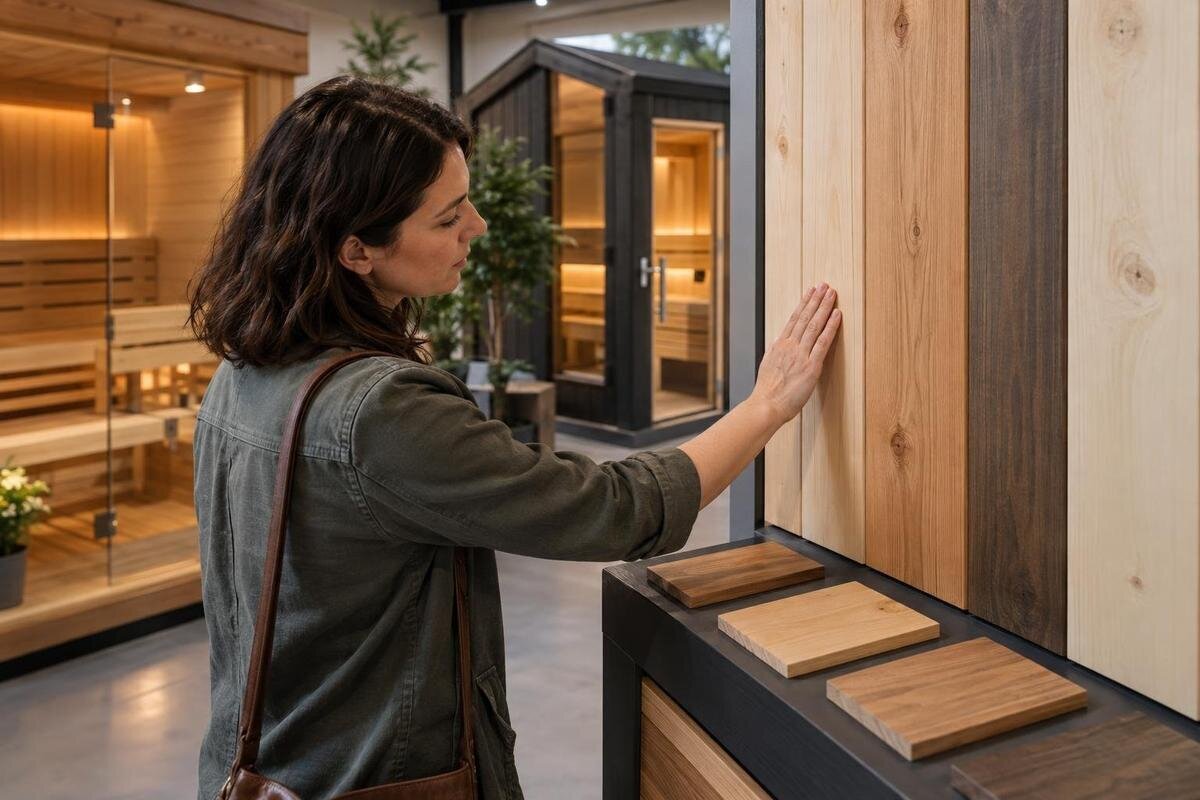
A sauna display can answer questions that photos and drawings leave open: whether the entrance feels awkward, how the benches fit your household, and what the surfaces look like up close. It can also give a misleading impression if the unit is a different model or includes options you may not order. Treat the visit as a practical test, then verify measurements and configuration against documents for the exact product. Before going, ask whether a display is available, where it can be seen, and which model is assembled; an online listing alone does not establish that a local showroom exists.
01
Confirm what is actually on display
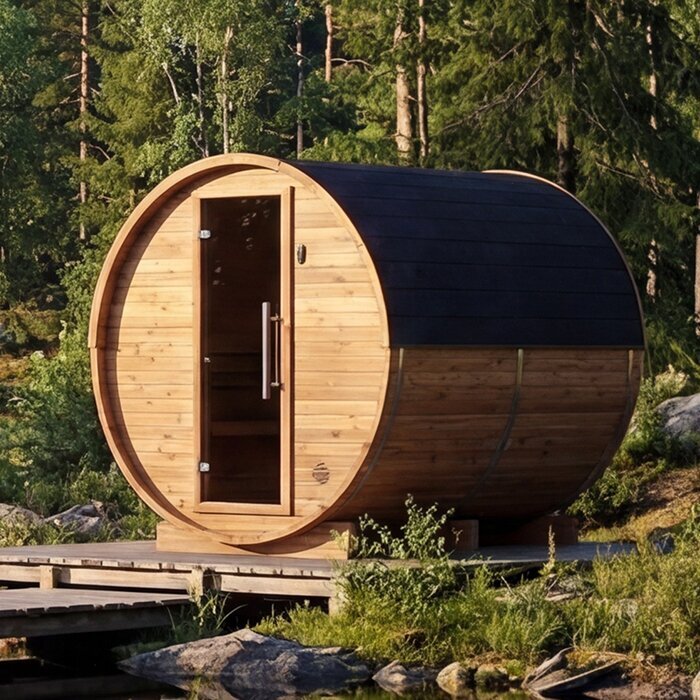
Before setting out, establish the basics with the seller or manufacturer: where the unit is displayed, whether visits are by appointment, whether entry is permitted, and whether measuring, opening the door or taking photos is allowed. Ask for the exact model code and configuration, including visible options, before you travel. Confirm whether you will see a complete sauna, a partial display or only a sample; those are different kinds of evidence. If the model you want is not present, ask what the displayed unit shares with it and what it does not. Check who can answer technical questions, as well as the visit hours. An online listing alone does not establish that a local showroom is available.
Make a short list of questions you cannot answer from the listing, then decide what you want to assess physically: entry, sitting, sightlines, reach or surface appearance. Bring anyone whose height, mobility or comfort requirements should shape the decision, along with a tape measure, notebook and simple site sketch. Put candidate names beside their exact codes; for example, record the HCF-300 Thermowood Barrel Sauna by name rather than writing only “barrel sauna.” That keeps each photo, measurement and question tied to the product you meant. Note which tests were allowed and which were not; an untested door or seat should not quietly become an assumed pass.
Measure the site, route and display dimensions
Before the visit, measure the proposed location and the route to it. Note the narrowest gate, path, doorway or turn, any steps and overhead obstacles, plus fixed items that could limit where the sauna sits. Mark known utility points on a sketch, but do not treat a rough sketch as installation guidance. Record actual measurements instead of estimating from a photo, and add a note when a dimension is uncertain. Ask the supplier which delivery and handling dimensions need consideration, because the route for bringing a unit in may differ from its final footprint. Have site and support requirements confirmed from the manufacturer’s documents or by an appropriate professional.
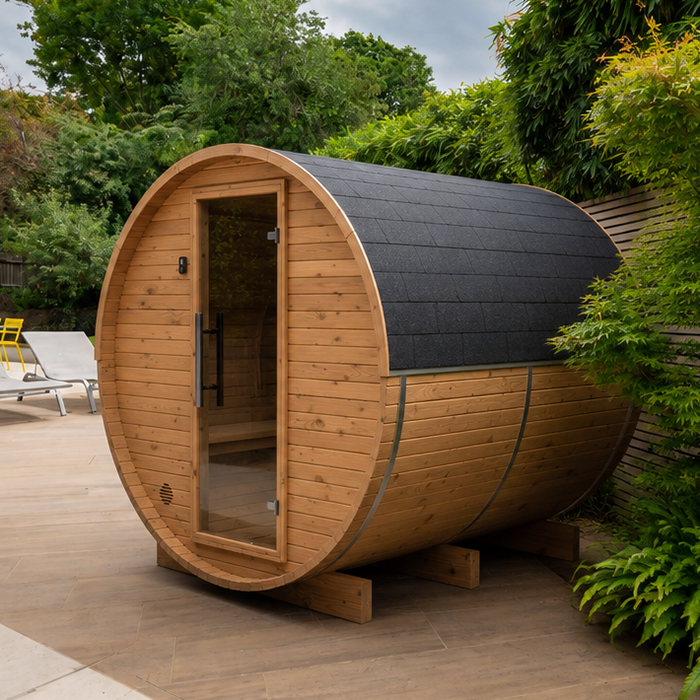
At the display, ask whether you may measure the widest, longest and highest points, and note where each measurement begins and ends. Record projections that affect the overall envelope, and note the door’s position open and closed if that changes the space needed. Request a dimensioned plan and elevations for the same model and configuration. For the LCF-300 Thermowood Barrel Sauna, for example, use the model code to request that drawing rather than assuming the product name gives you a footprint. Keep your measurements and the drawing’s units together; a floor-area label and exterior length and width describe different things.
02
Test the seating with the people who will use it
Sit in each seat that may be part of the configuration, if the operator permits it. Try the position you would actually use: notice where your feet rest, how your knees and shoulders fit, and whether you can shift position without striking a wall or another person. Test more than one place, including a seat near the entrance, and consider what happens when household members sit at the same time. Comfort is individual, so do not take a salesperson’s capacity description—or an impression of an empty room—as a substitute for your own test. A quick sit tells you about one body and one posture, not every user.
Measure bench length, depth and height, plus the clear space between seating levels where relevant. Ask which benches, backrests and footrests are included, and whether the display shows an optional arrangement. If there is more than one level, try the route between them without rushing; do not assume an upper seat is practical just because it looks reachable. When considering the S-140 bench layout, compare the drawing for your intended configuration with the seats you tried. Note who tried each position, where their feet rested and what felt cramped or easy to reach. Those details make a more useful comparison than a single label such as “comfortable.”
Try the entrance and door in realistic conditions
Ask permission to operate the door, then open and close it slowly several times. Notice whether you can reach the handle naturally from both sides, whether the latch needs a particular movement, and whether the door is awkward to manage while stepping through. Check the threshold and any change in floor level. If you expect to use the sauna with other people, consider whether someone at the entrance would block the path for a person already inside. Do not force a sticking door or test hardware the operator has asked you not to use; make a note and request an explanation.
Measure the clear opening, not just the overall door or exterior dimensions, and record the swing direction and the space taken up when open. Think about walls, railings, furniture and the route to the door at your own site; an open display area can make access look easier than it will be at home. For a candidate such as the HC-150 sauna, request a drawing showing the entry and door movement in your proposed configuration. Compare it with your site sketch, keeping the opening width separate from the space needed for the door swing. Also note whether the threshold, handle or step warrants a separate accessibility check.
03
Inspect the wood, surfaces and visible joints
Look at the surfaces that will be touched and seen: bench edges, backrests, wall boards, trim, fasteners and visible joints. Notice splinters, rough patches, gaps, chipped coating, uneven colour or marks, but treat a display as a sample rather than a guarantee of the finish on a future unit. Wood naturally varies, and wear on a display can reflect handling; neither an attractive sample nor a blemish tells you the full production standard. Ask before running a hand over a surface, and note anything you want the seller to explain rather than diagnosing its cause.
Ask for the specified material and finish for each surface separately, including benches and backrests, and ask how those surfaces are meant to be cared for. A name such as HC-225 Thermowood Barrel Sauna is an identifier, not a complete material schedule; “Thermowood” in a product name does not by itself establish the material or finish of every interior contact surface. Request written care instructions and clarify whether a finish is factory-applied or needs maintenance later. Compare the documents with what you saw, and mark unanswered points rather than assuming similar-looking boards have identical material or treatment.
Check the layout, windows, lighting and controls
Take time to inspect the layout beyond the benches. Look at where windows, lights, vents, the heater and controls are in relation to seats and the entrance. Consider privacy and sightlines from the space where the sauna will be placed, and whether a window or fitting changes the wall area you expected to use. A display may include accessories or options, so ask which details belong to the configuration and which are selected extras. Do not assume an item is included just because it is installed in the display; ask the person showing it to identify each feature.
Try any user-facing control only with permission. Check whether its labels are legible, whether its function is clear, and whether you can reach it from the position where you expect to use it. Ask where the operating instructions are supplied and which options change the layout. When reviewing the N-210 configuration, record which displayed fittings are included, optional or still unconfirmed. Keep those notes beside your observations about reach, sightlines and privacy so you can see whether the version offered retains the features that mattered during the visit. Identify any feature you did not test rather than treating its presence in a photograph as confirmation that it meets your needs.
04
Ask for heater documentation and site requirements
Ask which heater is specified for the exact sauna and configuration, whether it is included in the quoted package, and which controls or accessories are paired with it. Request the heater manufacturer’s documentation before treating the displayed arrangement as evidence of what can be installed at your site. A display can show placement and appearance, but it cannot establish that your home’s electrical service meets the requirements. Have a qualified electrician review the relevant documents and your proposed installation; do not use the visit to make electrical assumptions or rely on a verbal estimate as a substitute for that review.
Ask for the sauna and heater manuals, the manufacturer’s electrical requirements, any stated clearances, and the required control arrangement for the specific build. Leave wiring choices, circuit suitability and installation details to the qualified professional and the manufacturer’s instructions; this is not an installation guide. For a question about the N-250 Thermowood Barrel Sauna, give the exact model code and ask which heater document applies to that model and configuration. Keep the response with your other product paperwork. If the exact heater has not been selected, ask which decision remains open and when its requirements can be confirmed, rather than assuming a later option will fit the same plan.
Collect drawings and written specifications
Request the paperwork that turns a visual check into a planning basis: a dimensioned plan, elevations and relevant sections; the overall footprint and height; door-opening information; bench placement; and the stated location of included equipment. Ask for assembly or installation instructions and site-preparation details from the manufacturer, not a sketch of a different model. The drawing should identify the model and configuration, show units, and make clear whether it includes options seen on the display. If the supplier cannot provide an item, note what is missing and who will confirm it. A brochure image may help you recognize a product, but it is not a substitute for a dimensioned document.
Also request an inclusions list, the relevant manuals, material and finish information, and care instructions. Ask whether the drawings are current for the version being offered and how to identify a later revision; record the document title and date, if shown. Keep the LC-260 product details with the corresponding paperwork, making sure the model and configuration match throughout. Label each file clearly so you can distinguish a current drawing from an earlier version or a general brochure. Keep related documents together rather than relying on separate emails or verbal answers, and record which document addresses each question left open during the visit.
05
Compare the display with the configuration you would buy
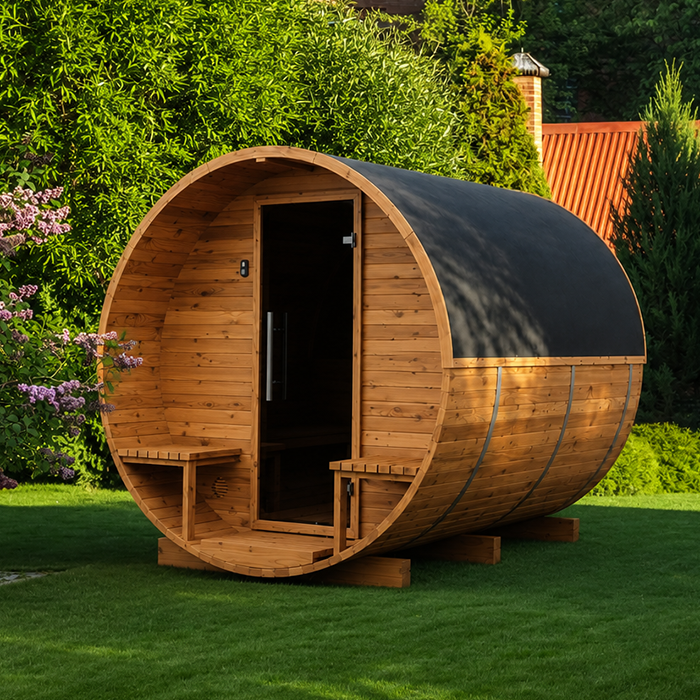
A display can help you assess a sauna, but you still need to separate what you saw from what you would receive. Compare the model code, bench arrangement, windows, controls, finishes, heater and accessories with the product description and written inclusions. Mark each item as included, optional, changed or still unknown. Ask whether the displayed unit has been modified or configured specifically for display; do not assume every visible component is part of the offered configuration. If a detail cannot be confirmed on the spot, make it a written question and identify the component clearly. This keeps your observations about the sample separate from the seller’s description of what is included.
After the visit, check that the same model code appears on the drawing, manuals, inclusions list and quote. If the documents use different names or codes, ask the seller to explain the relationship in writing before relying on their dimensions or requirements. Read the stated scope of any assembly, delivery or accessories carefully; do not infer those services from the way the display is set up. Keep photographs as visual notes, and caption each with the date and view. Your record should distinguish a measurement, an answer supplied by the seller and an unresolved assumption, so a later comparison remains fair.
Turn the visit into a clear decision record
Finish with a compact comparison sheet for every option: site fit, route, door access, seated comfort, finish and care, included equipment, documents received, and questions still open. Use pass or fail for clear constraints, such as a door swing that conflicts with a fixed obstacle at your site; use notes for preferences such as a backrest position or view. If your measurement differs from the drawing, flag the discrepancy for clarification rather than treating it as a definite failure. A score can organize a shortlist, but it cannot resolve an unanswered clearance or electrical question. Keep measurements in their original units and note the source beside each one.
For each unanswered question, record who will respond and which part of the comparison depends on that answer. If you inspected a different model, identify the observations that still need confirmation for your intended configuration. Separate what you tested in person from what the manufacturer documented, and retain any professional review needed for site or electrical requirements with the relevant notes. When an answer arrives, update the affected entry rather than replacing the whole record with a general impression. This lets you see whether an option meets your practical needs, which preferences distinguish it from the others, and what remains open before you choose.
Frequently asked questions
Can I use the display sauna’s measurements for planning?
Use them as a cross-check, not as the only basis for planning. Ask for a dimensioned drawing that identifies the exact model and configuration, and confirm what each measurement includes. The display may differ from the version you would order, and an overall length or area figure does not show the door swing, projections, delivery route or usable interior space.
What should I try inside the sauna?
With permission, sit in the positions you expect to use, try entering and turning, and check whether you can reach the door and any user controls. Bring household members whose height or access needs matter. Do not operate a heater or enter a heated unit unless the display operator explicitly permits it.
Should I measure the sauna or my site?
Measure both. Before the visit, record the intended location and the narrowest points on the route to it. At the display, measure the unit only with permission and note where each measurement begins and ends. Then compare your notes with a drawing for the exact model and configuration.
What if the exact model is not on display?
Ask which model is displayed and how its configuration differs from the one you are considering. Request drawings and manuals for your intended model, and treat the display as a general reference rather than proof of another model’s dimensions, hardware or inclusions.
Which documents should I request?
Ask for a dimensioned drawing, the relevant assembly or installation instructions, an inclusions list, and material and care information. If a heater is involved, request its manufacturer’s documentation for review by a qualified electrician. Check that the documents identify the model and configuration you are considering.
A useful display visit leaves you with more than an impression: it gives you observations tied to a model code, measurements you can compare with drawings, and clear answers about what is included. If those details do not line up, keep the decision open until you know which configuration the documents describe.
