
Sauna Kit vs Fully Assembled Sauna: What to Choose
Sauna buying guide
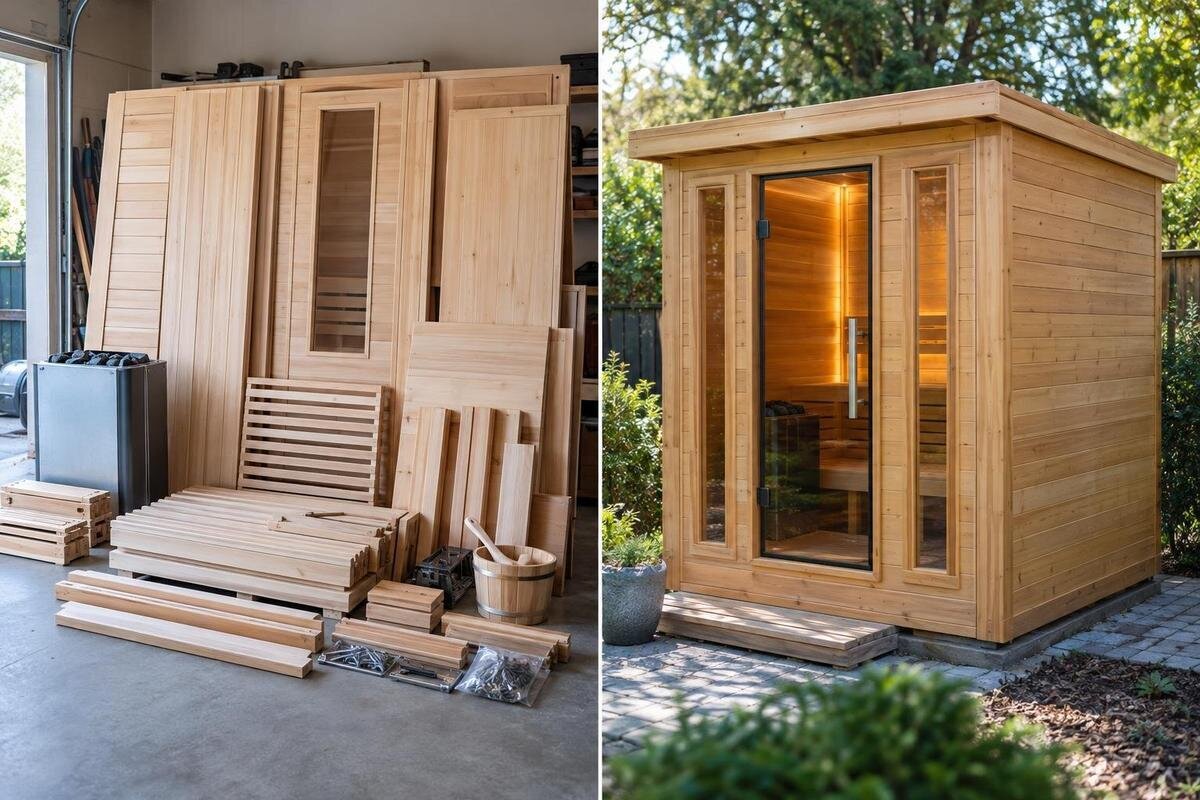
Choosing between a sauna kit and a fully assembled sauna is partly a labour decision, but it is also a delivery and access decision. A kit may move more of the work to your property; an assembled unit may reduce on-site construction while creating a larger handling challenge. Neither label tells you exactly what arrives, who unloads it or what remains to be done. Compare the exact order configuration, route from the delivery vehicle to the prepared site, assembly responsibilities and any lifting plan. This guide sets out the questions to resolve before ordering, without assuming every sauna is offered in both delivery formats.
01
What “kit” and “fully assembled” mean
“Kit” and “fully assembled” are not precise enough to tell you what will arrive. A kit might contain individual components, larger sections or a mix; how much is pre-built can vary. “Fully assembled” might refer to the main enclosure while some supplied items travel separately. The seller’s wording could also describe the state at dispatch rather than the final position at your property. Ask for the exact configuration for the model and options you intend to order, and have the answer confirmed in writing. It should describe what is assembled before shipment, what arrives separately and the state of the sauna when it arrives.
Request an itemized inclusions list and the assembly instructions for that configuration. Check which parts, fasteners, tools, equipment and controls, if applicable, are included, supplied separately or outside the order. Do not assume the package includes a heater or every item shown in product photography. Ask whether any work is assigned to a separate supplier, installer or qualified trade, and where that responsibility begins. When comparing formats, keep the options and equipment choices the same; otherwise, a difference in the bundle could be mistaken for a difference in delivery format.
How a kit changes the work on site
With a kit, more of the build sequence usually moves to you or an installer. Read the manual for the exact model instead of judging the work by its finished appearance. Note the assembly stages, tools, help and site conditions specified in the instructions, and ask about anything they do not cover. Compare those requirements with the time and assistance you can realistically arrange. Allow for receiving and sorting parts as well as the build itself: unpacking, checking labels and keeping components organized all take space and attention. If instructions are not available before purchase, ask what documents you can review and who can answer questions during assembly.
More pieces do not necessarily mean smaller or lighter deliveries. A kit can still contain long or bulky components, or arrive on a pallet that will not pass through a gate. Request the outside dimensions and weights for every package or pallet, the number of handling units and the point where the delivery service leaves them. If you are considering the LC-260 barrel sauna, confirm its dispatch configuration and shipment details with the seller. Compare the package list with the assembly sequence so you can plan where to sort components and keep them accessible. Also check where packages can be stored if assembly will not begin on arrival day.
02
What to expect from an assembled delivery
A fully assembled delivery can reduce construction at the destination, but it does not remove the work between the delivery vehicle and the final site. A completed or partly assembled enclosure may take up more transport space than components packed for a kit; your exact order determines which. Ask how the sauna will be transported, whether any parts are detached, what the crew unloads and where the service ends. Confirm whether the crew will place it on the prepared base or leave it at the driveway or another agreed drop point. Do not treat “fully assembled” as a promise of in-place installation or a ready-to-use handover.
Get a list of the remaining tasks, such as unpacking, attaching supplied items, positioning the unit, installing equipment or making connections. That list should come from the current instructions for the configuration you are ordering. Where electrical work is involved, have a qualified electrician confirm the scope; assembly and electrical work may be separate responsibilities. If the HCF-300 model is under consideration, ask which tasks are completed before dispatch and which must be done after placement. Use that distinction to coordinate the delivery with any installer or lifting provider, including who needs to be present and when their work can begin.
Measure the entire delivery route
Measure the route the load will actually travel, from the place the delivery vehicle can stop to the sauna’s final position. Record the clear width and height at gates and doors, the path width, turning room at corners, steps, changes in level and low branches, eaves or other obstructions. Measure the narrowest point with gates fully open, including handles, posts and thresholds. A straight-line distance on a site plan does not tell you whether a large item can pass a doorway or turn. Consider snowbanks, parked vehicles, bins and seasonal yard items that may narrow the route when delivery takes place.
Use the dimensions of the arriving load—not only the sauna’s finished footprint or floor area. For a kit, request the largest package measurements and individual weights; for an assembled delivery, request the transport and handling dimensions, including detached parts and protective packing. Ask the seller or carrier to review your measurements rather than guessing from a photograph. If the LCF-300 sauna is on your shortlist, request shipment data for the configuration you would order and draw a simple route sketch. Label the narrow points, turns and intended drop point so the carrier can assess the same route you measured. Keep the sketch and shipment details with the quote.
03
Prepare the site for the chosen format
Both delivery formats need a site plan that matches the actual installation instructions. Ask for the selected model’s current drawing and requirements for its supporting surface, clearances and any drainage or service access that applies. Do not choose a base because it suited another sauna or because the cabin looks similar; requirements belong to the specific design and installation guide. If the instructions leave a structural or surface question unresolved, ask the manufacturer or a qualified local contractor to assess it before delivery. This matters particularly when a kit will be assembled on site, as the work area may need to remain accessible during the build.
Sequence site work with delivery. If a fence, path or landscaping is still being built, decide whether it must be completed before the load arrives or could restrict access later. Identify where packages can be set down, whether there is a protected staging area if work is delayed and how the load will reach the prepared spot. A preassembled unit may need clear positioning space; a kit may need room to sort parts, but the exact sequence depends on the instructions. For the S-140 barrel sauna, obtain the current site requirements before settling the base or service layout. Share them with whoever prepares the site so that preparation and delivery follow the same plan.
Agree on who handles assembly and remaining work
Write down who is responsible for each step: unloading, moving packages across the property, assembly, supplying tools and consumables, dealing with damaged parts and removing packaging. A retailer’s delivery service, a sauna installer and a general contractor may have different scopes. “Assembly available” is not enough detail; ask whether it covers the complete build for your configuration, what it excludes, whether the installer brings the tools and whether you need to be present. If you plan to assemble the kit yourself, check that you can follow the model-specific instructions and arrange the required help and time. Do not count on the delivery team to build or position the sauna unless that work is included in writing.
Separate structural assembly from equipment work. If the package includes powered equipment, verify the actual inclusions and instructions, then ask a qualified electrician what electrical work is needed for the chosen setup. Do not assume that the person assembling the structure is also responsible for those connections. If you hire a contractor, share the manuals and confirm who handles questions, substitutions and work outside the agreed scope. When discussing an HC-150 sauna order, ask the seller and installer to distinguish supplied parts from the tools and labour you must arrange. Record any gaps between their services so that an unassigned task does not hold up the installation.
04
Assessing the need for lifting equipment
Lifting equipment may need to be considered when the measured route or handling plan cannot accommodate the load using the agreed delivery method. A bulky assembled unit or an awkward package could prompt that question, but the kit or assembled label cannot answer it. Shape, weight, handling instructions, distance, surface and obstacles all matter. Request verified transport dimensions, weights and manufacturer handling guidance for the exact shipment, then ask the seller and a suitable delivery or lifting provider to assess the method. Do not estimate a lift from product photographs, select machinery using a general rule or assume a particular crew size.
The equipment itself needs access. Ask whether the proposed vehicle can reach a suitable setup area, where it can operate, whether the provider accepts the landing area and approach, and whether branches, roofs or other overhead obstructions affect the plan. Have the provider assess the site rather than trying to calculate loads yourself. Confirm who books the equipment and crew, what information they need and whether the delivery service coordinates with them. If the HC-225 model is on your list, request handling data for its actual shipment before deciding whether special equipment is needed. Give that information to the provider together with your route measurements and proposed landing point.
Compare delivery scope in writing
Compare delivery offers by scope, not by the word “delivery.” Ask where responsibility begins and ends: at the property line, curb, driveway or prepared site? Does the service include unloading, moving the load to its final position, assembly, packaging removal or a return visit? Which access conditions and site preparation does the quote assume? Ask how a blocked route or unsuitable access is handled, and whether a lifting provider must be arranged separately. Put the answers in writing so you know which work you still need to organize; do not assume a particular service is included or available.
Set those answers beside the inclusions list and installation manual for a like-for-like comparison. A format that reduces building can still call for site labour, special handling or a different delivery arrangement; a kit can still require careful unloading. Record exclusions, responsibility for each task, a contact for delivery-day questions and the carrier’s process for reporting transport damage. For an N-210 barrel sauna order, make sure the written quote identifies both the chosen configuration and the agreed delivery service. Check that any separately arranged assembly or lifting work begins where that service ends, with no uncertainty about who moves the load between those stages.
05
Make a plan for delivery day
Decide who will receive the load and keep the agreed route and landing area clear. Before arrival, confirm that the prepared site matches the manufacturer’s instructions and arrange any people or professionals named in your plan. Keep the order confirmation, package schedule, measurements and assembly manual accessible to whoever is on site. If a kit will not be assembled immediately, confirm where it may be stored and how to protect it, following the seller’s directions. For an assembled unit, check that the agreed destination and movement path remain clear. Recheck after construction, weather or other changes rather than relying on measurements made weeks earlier.
At handoff, follow the carrier’s process for noting visible damage, missing packages or a shipment that differs from the paperwork. Match the delivered package count against the order documents and find out whom to contact before assembly continues. Ask what photos or records the seller needs and what to do if a component appears damaged; do not assume the driver can authorize repairs or substitutions. If you order the N-250 sauna, use the shipping list for your chosen configuration when checking the delivery. Keep any discrepancy notes with the order paperwork so the seller can identify the affected package or component without having to reconstruct the handoff later.
Choose based on the work you can manage
A kit may suit you if the documented work fits your schedule, the components can be staged and you can assemble them or arrange an installer. It could be practical for a route that can take the packages but not a larger completed unit, provided the package measurements and unloading plan are confirmed. Consider an assembled format when reducing on-site building matters and the exact unit can be moved to its final position. That choice can shift the main challenge from assembly to access and placement. Neither format is automatically easier; compare the total work from unloading through handover.
Make a simple comparison for each available configuration: dispatch condition; package or unit measurements and weights; unloading point; access and lifting plan; site preparation; assembly and remaining equipment work; tools, labour and packaging disposal; and written responsibility for each task. Confirm that the format is actually available for the model and configuration you want rather than assuming both options are offered. Mark unanswered points and get confirmation from the seller or relevant professional. If the route, site or labour plan still depends on an assumption, resolve it before choosing.
Frequently asked questions
Does a sauna kit always arrive in small boxes?
No. “Kit” describes a delivery or assembly format, not a guaranteed parcel size. It may include bulky components or arrive on a pallet. Ask for the number, outside dimensions and weights of every handling unit, as well as the unloading point, for the exact configuration you plan to order.
Does fully assembled mean the sauna is ready to use when it arrives?
Not necessarily. “Assembled” may refer to the main enclosure only; placement, detached components, equipment installation, connections or other finishing work may remain. Ask for a written list of what is complete on arrival and what is still required. Have a qualified trade confirm any specialist work.
Which format is better for a narrow yard?
Compare the actual packages or transport dimensions for each available format along the whole route, including gates, turns, overhead obstructions and the final landing area. A kit is not automatically easier if a component is bulky, and an assembled unit is not automatically impossible to move. Ask the seller or carrier to review your measurements.
Who is responsible for assembling a sauna kit?
That depends on the order and any separately arranged installation service. Get the responsibilities in writing, including who unloads and assembles the sauna, supplies tools and handles missing or damaged parts. If equipment requires specialist work, confirm who is responsible for it with the appropriate qualified professional.
Do I need a crane or other lifting equipment?
The kit or assembled label alone cannot answer that. Request the exact shipment dimensions, weights and handling instructions, then have the delivery or lifting provider assess the route, setup area and landing point. Confirm who supplies any equipment and crew; do not arrange a lift based on a product photo.
Once you know how the sauna will arrive, where the delivery ends and who handles each remaining task, the format choice becomes practical rather than guesswork. A kit shifts more work into assembly and staging; a fully assembled delivery shifts attention to access and placement. Choose the arrangement that fits the route, site and people you can actually provide, and settle unanswered delivery details before the order is finalized.
