
Scratched Greenhouse Powder Coating: Assessing Repair Options
Greenhouse repair
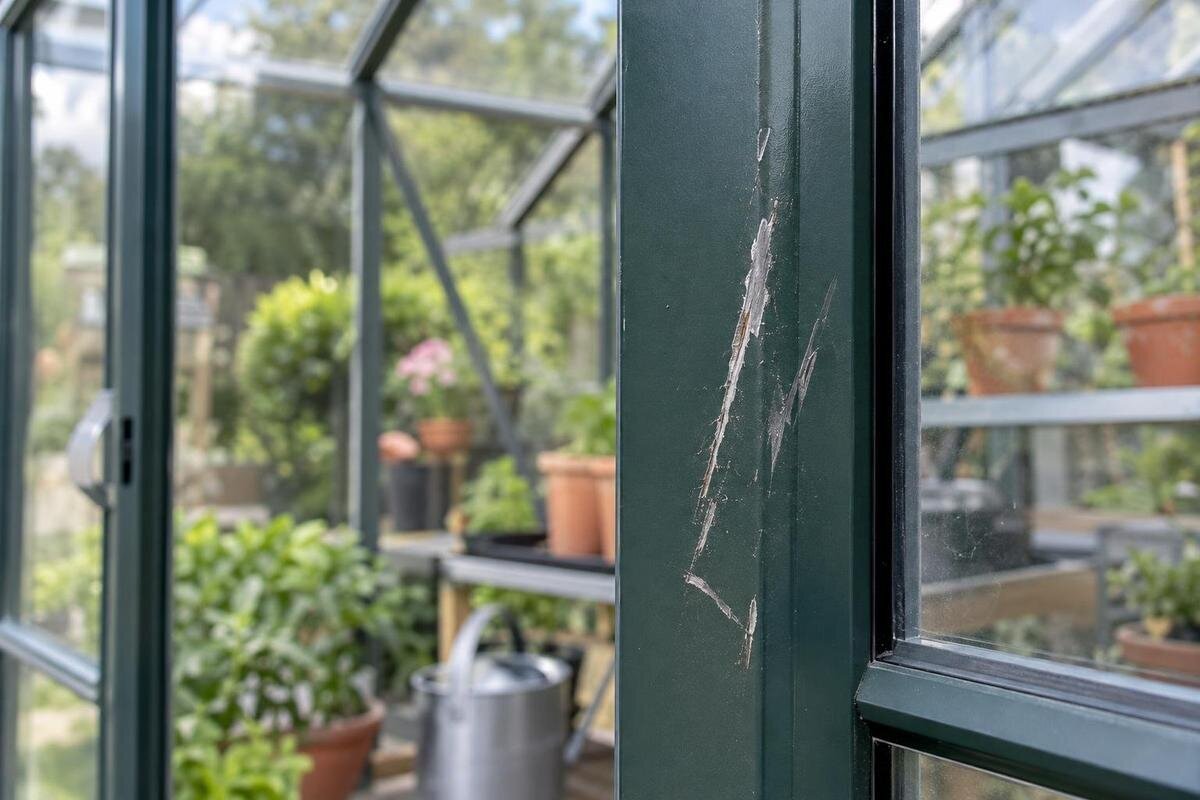
A scratch on a powder-coated greenhouse frame may be a mark sitting on the surface, or a break through the finish. Those call for different responses. Before reaching for paint or an abrasive cleaner, check what the mark looks like after gentle cleaning, where it sits, and what the maker's documentation says about your exact model and colour. A small scuff may need no repair; a coating breach or changing damage deserves a more careful assessment.

What powder coating means for a greenhouse frame
Powder coating is a coloured finish applied over a metal frame; it is a surface layer, not the aluminium itself. A line on that finish might be dirt or material rubbed onto it, a scuff in the top surface, or a cut through the coating to the metal. These can look similar when the frame is wet or catching greenhouse reflections. Even the colour of the mark is not decisive: a grey streak could be a transfer, while a bright line could be exposed metal or reflected light. Compare it only after a gentle clean, and do not scrape at an edge to find out what lies beneath. That can enlarge a small defect without identifying the right repair. At this stage, the aim is to see whether the finish appears continuous, not to diagnose the whole frame from one close-up.
The coating is intended to protect the frame as well as give it colour, but a mark's appearance alone cannot tell you whether a component is sound. An intact surface with one faint scuff may need no treatment. Chipping, flaking or a patch where the finish is missing calls for advice about that coating. A scratch by itself does not prove structural damage, and a straight-looking frame does not confirm that a joint or fitting is sound. Record any concerns about movement, alignment, operation or glazing retention separately from the coating damage. Those issues need an installer to assess the assembly rather than advise on paint alone.
Scuff or scratch: what to look for
Begin with a gentle clean using only a method permitted by the care instructions. If a mark fades, wipes away or changes shape, it may be a surface deposit or material transferred onto the finish rather than coating loss. You may notice some of that material on the cloth. A scuff can look like a lighter or glossier patch because it changes how light reflects, while a cut may remain as a narrow line. Neither colour nor shine alone tells you whether the coating has been broken. Avoid rubbing harder to make the line disappear: pressure can alter a finish, and repeated wiping cannot tell you how deep a scratch goes.
After the area is dry, look for a chipped edge, lifted coating, a small bare-looking patch, bubbling, pitting or a change spreading beyond the original mark. These are reasons to ask for model-specific guidance, not a reliable home test of the metal beneath. Do not probe with a fingernail, knife or pick, and do not sand a tiny spot to expose more surface. If glare obscures the line, view it from a different angle in daylight. Check whether several marks share a path or height; a group may point to repeated contact and affect how you prevent recurrence. When you cannot tell whether the coating is intact, photograph it and describe the uncertainty instead of treating a guess as a diagnosis.
Clean the mark without abrading the finish
Use the greenhouse's care manual before choosing a cleaner. If its guidance allows, wash the area with clean water and a soft cloth, using a mild, non-abrasive detergent only if specified; use light pressure and rinse or dry as directed. Avoid scouring pads, abrasive powders, polishing compounds, wire brushes, blades and unapproved solvents. They can dull, abrade or soften the finish, and a cleaner that works on glass may not be suitable for a coated frame. If paperwork is missing, a Classic greenhouse listing can help you recognise the family name, but it is not a cleaning instruction. Confirm the exact model before choosing a product, and use a fresh part of the cloth so collected grit is not dragged across another area.
Clean only a place you can reach comfortably without leaning on glazing, climbing onto the frame or forcing a door, vent or panel out of position. If the scratch is high up, behind a panel or close to an area that seems loose, ask an installer to inspect it. Let the surface dry as the manual directs, then view it in even daylight. A wet frame, strong reflection or cleaner residue can disguise the edge of a scratch. If the mark remains, stop at inspection; do not escalate to a stronger chemical or abrasive just because the first gentle clean did not remove it.
Location can help explain how the mark happened
Look at where the mark sits and what could have contacted it. A line beside a frequently used doorway, vent, shelf, pot, hose or garden tool may point to repeated rubbing; a single impact may leave a different shape. Note whether it follows the length of one frame member, appears at a corner or joint, or sits next to a glazing edge. Consider whether it appeared during gardening, cleaning or other work around the greenhouse. Do not move a panel or undo a fitting to investigate. Remove a harmless source of rubbing only if it can be moved without stressing the frame, and record the likely cause as a possibility, not a certainty.
A cosmetic mark on an open, accessible face is different from damage beside a connection or a place that holds glazing. If the paperwork identifies a Lean-to Greenhouse, for example, describe the actual member and its position rather than assuming the family name tells someone which part is affected. Give landmarks such as the door side, roof rail, wall-side edge or corner. A mark that returns after cleaning may have an ongoing contact source; one near a joint, with movement or distortion, needs a professional view before any coating is applied. The frame's design alone does not establish whether a particular mark is harmless.

Record the model and colour details
Before requesting advice, find the exact model wording on the original order, invoice, assembly manual or product label if one is present. Note any configuration, item reference or serial identifier supplied with the greenhouse, plus the documented colour or finish code. A Bloomcabin Prestige Greenhouse page can help cross-check a family name, but a current listing does not establish the finish on an older or differently configured frame. Do not infer the coating colour from an online photograph, a nearby part or a broad description such as green or charcoal. If a code is missing, say so and ask the manufacturer or seller how to identify it; a purchase date, if known, may also help them locate the relevant documentation.
Make a simple record while the area is clean and dry: one photo showing the scratch in relation to the whole greenhouse, then one closer view with enough surrounding frame to show its position. Use natural, even light; a flash can make a reflection resemble exposed metal. A ruler held beside, not over, the mark can convey scale if the manufacturer asks for it. Include when you first noticed the damage, whether it has changed, and any cleaning product already used. Leave the image unaltered so the surface colour and edges are not misleading; do not remove glazing or trim to get a clearer photograph.
Follow the maker's approved touch-up procedure
Touch-up is an option only when the manufacturer or supplier identifies a compatible method for that model and finish. Ask for the approved product and colour reference, the surface it is intended for, and the preparation and application instructions. Check whether the method is meant for a cut through the coating or only a superficial mark. The guidance may also specify an applicator, drying or curing conditions, or limits on the size or location of a repair; follow the actual instructions rather than filling gaps from general paint advice. If your documents call it a Spacious Greenhouse, include that exact wording in the enquiry, but do not use the product name alone to select a coating.
Do not substitute a generic aerosol, automotive paint, marker pen, nail polish or leftover household paint on the assumption that a similar colour will adhere. Compatibility, sheen and preparation matter, and an unapproved solvent, primer, abrasive or masking method may make the defect worse. Sanding, scraping, drilling or removing frame parts should not be improvised as preparation. If the maker's procedure calls for any of these steps, confirm that it applies to your exact frame and that it can be carried out safely; otherwise ask an installer. If service or warranty cover may be relevant, check the applicable terms before altering the finish.
How closely will a touch-up match the finish?
Colour matching is more than finding a tin with a similar name. The documented colour reference, gloss level and surface texture matter, while weathering, dirt and lighting can make the existing frame look different from a new repair. A family title such as Limited Edition Aluminium Greenhouses is not a paint code. Send the reference and clear photographs to the manufacturer or supplier, and ask whether the proposed touch-up is intended for a small visible spot or a wider area. Do not order by appearance alone when an exact finish reference may be available; ask whether a photograph is enough for identification or whether they need another detail.
Even the correct approved product may leave a visible outline because a local repair and the surrounding finish reflect light differently or have weathered differently. That does not automatically mean the repair has failed; ask the maker what result to expect and what signs would require follow-up. Resist widening a small spot to blend it into a rail, or coating a whole member for uniformity, unless the written method specifically says to do so. On a highly visible face, knowing the likely appearance in advance helps you decide whether touch-up is worthwhile or whether leaving a harmless mark is preferable.
When the mark needs a professional assessment
Ask the manufacturer or supplier, or a qualified greenhouse installer, if coating is flaking, bubbling or missing in several places; if a bare-looking area is growing; if there is pitting or unexplained staining; or if damage sits beside a joint or glazing support. A single exposed-looking mark does not tell you the full condition, but it is a sensible reason to ask what assessment is appropriate. Give the exact model name, including wording such as T-Model Orangery Greenhouse if that is what your documents show, and provide the location and photographs rather than asking for a colour match alone. Mention any other change you have noticed, such as a door or vent no longer sitting as it did.
Get an installer to review the frame if a member appears bent, displaced or loose, if a door or vent has changed alignment, or if glazing seems insecure. Those are not cosmetic touch-up questions. Do not straighten, drill, tighten unfamiliar connections or remove glazing to reach the mark; changes can affect the assembly, and glass work can be hazardous. Ask the installer whether the issue is limited to the finish, whether a specified part needs assessment, and whether further inspection is recommended. If there appears to be an immediate risk from a loose panel or unstable component, keep people clear of the area until it has been assessed.

Choose between leaving it, touching it up and replacing a part
Leaving a sound, intact finish alone is often the least complicated option for a minor scuff. For a confirmed coating breach, use only the approved touch-up route; if a frame member, joint or fitted part is damaged, ask whether a specific replacement component is required. A Pyramid Greenhouse listing can help confirm a family name, but a whole-greenhouse page cannot identify a compatible spare part. Use the manual's part diagram or an exact spare-part identifier and have the supplier confirm the match; similar-looking sections are not enough to establish compatibility. If no part identifier is available, ask how the supplier can confirm the correct item before ordering.
Do not treat one scratch as a reason to replace a greenhouse. A broader replacement or upgrade enquiry becomes relevant only when an assessment finds multiple damaged or unavailable components, or when an approved repair is not suitable for the condition. Compare the scope of the problem first: how many areas are affected, whether the frame remains in its intended position, and what the maker or installer says can be supplied. Do not adapt a part, cut a section or add a fixing to avoid sourcing the correct component. If the evidence points only to a cosmetic mark, keep the decision equally small.
Prevent repeat scratches and keep repair details
Preventing repeat marks starts with removing the source of rubbing and following the manufacturer's care instructions. Keep metal tools, potting equipment and hard-edged containers from scraping against the frame; lift rather than drag items past it, and take care when pruning or moving equipment through doors. If your records use the name Limited Edition Aluminium Greenhouses with Storage, keep that wording with the manual and finish information so future repair enquiries can identify the right product family. The listing title helps with identification only; use the manual for care and repair details. When equipment needs to sit near the frame, check that it cannot shift into repeated contact.
During routine care, look over accessible frame areas for new chips, repeated contact marks or a change near a connection, without probing the finish. Use only approved cleaning materials, rinse or dry as directed, and do not apply polish, wax or protective coating unless the maker recommends it. After garden work, put tools away before they can rub on the frame, and rearrange loose items rather than adding improvised bumpers or attachments. If a repair is carried out, keep its date, the product and colour reference, and the instructions used with your greenhouse records. Retain the original photos so you can describe any later change without relying on memory.
Frequently asked questions
How can I tell a scuff from a scratch in the coating?
Clean the area gently using a method allowed by the care instructions, then inspect it when dry. A mark that fades or wipes away may be surface residue; a cut or chip that remains may have broken the coating. Colour alone is not conclusive, so ask the manufacturer if you are unsure.
Can I use any paint for a small touch-up?
No. Use touch-up paint only if the manufacturer or supplier confirms that the product, colour and method suit your exact model and finish. Generic paint may differ in adhesion, sheen or compatibility, and improvised preparation can make the damage worse.
Does exposed-looking metal mean the greenhouse needs replacing?
Not necessarily. A small coating defect does not by itself establish that a frame is structurally damaged or needs replacing. Photograph it and ask the manufacturer or a qualified installer what assessment or approved repair is appropriate, particularly if the area is spreading or near a joint.
How do I find a matching colour?
Look for the model name and any documented colour or finish reference in the order paperwork, product label or manual. Give those details to the manufacturer or supplier. A product-family name or online photograph is not a dependable colour code.
Can I touch up the frame without removing the glazing?
Only follow a touch-up method that applies to your exact frame and can be carried out safely in its current assembly. Do not remove glazing or dismantle frame parts to reach a scratch. If the approved method requires access you cannot manage safely, ask an installer.
The safest repair decision follows what you can establish: clean gently, check whether the coating is intact, and record the model and finish details. A faint scuff may be best left alone; a coating breach or changing damage calls for advice matched to the greenhouse. That keeps a cosmetic mark from turning into an avoidable mismatch or an improvised repair.
