
Choosing Rainwater Tank Capacity for a Greenhouse
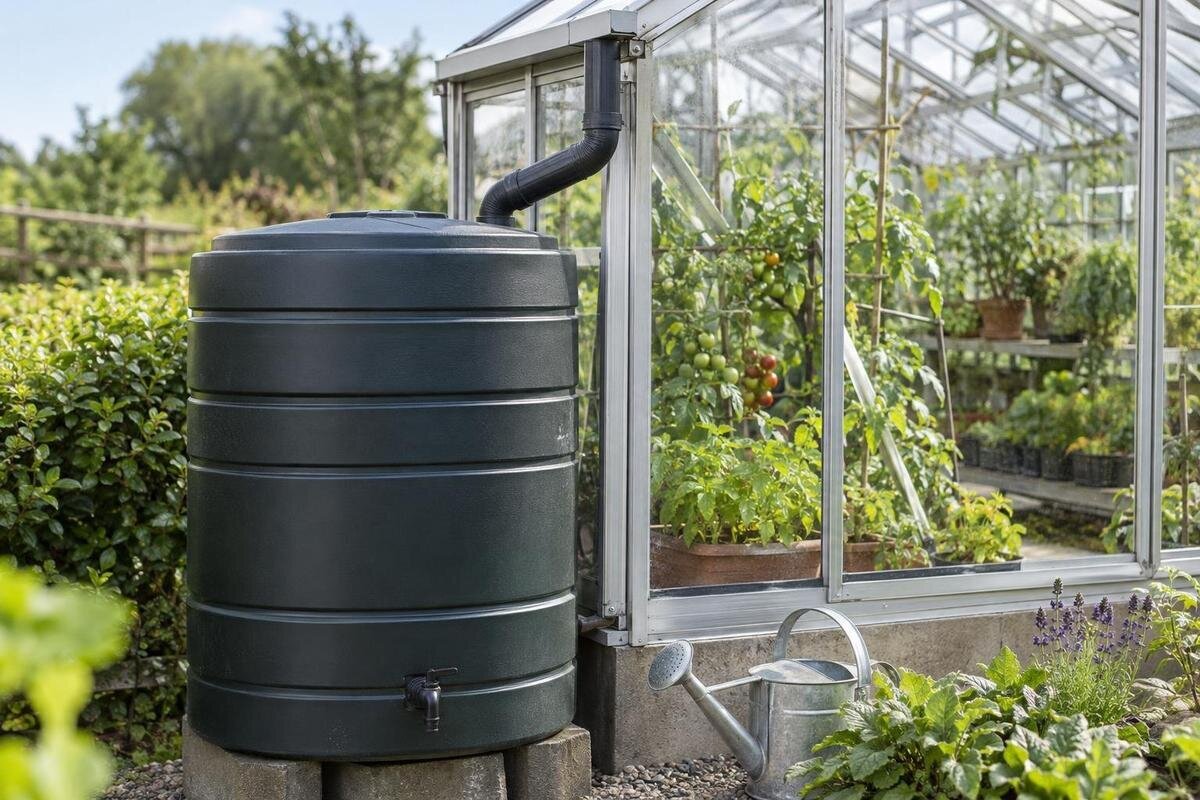
Greenhouse rainwater planning
Tank capacity for a greenhouse depends on two linked figures: how much rain the roof can deliver, and how much water the plants use between useful refills. A greenhouse’s listed area is only a starting clue. Local rainfall, collection losses, seasonal demand and the length of dry spells determine how much storage will actually help.

Before choosing a tank 1
Measure greenhouse watering demand
There are two constraints, not one: the connected roof must collect enough water over time, and the tank must hold enough to bridge the interval when rain is not useful. A large tank cannot make a small catchment produce more; a generous roof does not stop an undersized tank overflowing during a downpour. Decide what the tank is meant to cover, such as all greenhouse watering or a defined part of a dry spell. That turns a capacity target into a practical question. Keep litres stored at one moment separate from litres harvested across a month or year.
Work out greenhouse demand from water actually used, rather than applying a per-plant rule. For a representative week, record the volume poured into beds and containers, or measure the change in a dedicated supply container. Note the season and planting stage; a week between crops will not describe a mature crop in a high-demand period. Keep any tap-water top-up separate from rainwater drawn so the log shows both total demand and the share met from the tank. Record daily amounts as well as the weekly total: dividing the total by seven gives an average, but retaining the individual entries lets you see how much use varied. Note any water taken for jobs outside the greenhouse so it does not become part of the crop-watering estimate. For scale, the Spacious Greenhouse is listed across 47–70 m², but that area range is not a harvest estimate or a tank-capacity recommendation. Measure the selected roof’s connected catchment separately.
Measure the roof area that drains into the tank
Use the horizontal plan projection of roof sections that actually feed the collection system, not the sloping roof surface. Rainfall depth is measured across a horizontal plane; measuring a pitched panel along its slope makes it appear larger without increasing the rain falling over its footprint. For a rectangular roof plan, length multiplied by width gives a first estimate. Split an irregular plan into simple shapes and add the connected parts. Leave out surfaces whose runoff misses the gutter, drains elsewhere or has not been verified as part of the system.
Trace the water path from each roof section to the gutter, downpipe and tank inlet. If only one side of the greenhouse is connected, count only that side. Do not automatically use a greenhouse’s listed area as its roof catchment: overhangs, roof shape and the route to the tank all matter. When comparing Limited Edition Aluminium Greenhouses, use dimensions for the specific size being considered and confirm which roof sections can be collected. Sketch the roof from above and label each connected section with its dimensions. Keep a separate subtotal for any section whose connection is still undecided, rather than including it in the main estimate. This gives you two clearly labelled figures to compare and makes it easier to update the calculation if the collection arrangement changes.
Before choosing a tank 2
Estimate collection from local rainfall
For a first estimate, multiply rainfall in millimetres by connected horizontal catchment area in square metres. One millimetre of rain on one square metre is one litre before losses, so 20 mm on a connected 10 m² roof gives a theoretical 200 litres. To estimate water that reaches the tank, multiply that figure by a collection fraction between zero and one. The fraction represents water lost through bypass, splashing, diversion or other features of the actual system; it is not a fixed specification for all greenhouses.
Use rainfall records from a nearby reliable station or keep an on-site rain gauge, and look at months or individual events rather than an annual total alone. If collection losses are not measured, compare a cautious estimate with a more favourable one instead of presenting a precise figure as certain. For example, a provisional fraction of 0.8 would turn the 200-litre illustration into 160 litres, but that is an arithmetic assumption, not a performance claim. With a Lean-to Greenhouse, do not count runoff from an adjoining roof unless its collection route is actually confirmed.
Use a monthly water balance
A simple monthly ledger shows whether the tank is likely to fill, empty or overflow. For each month, record opening usable storage, estimated rainwater collected and greenhouse watering demand. Add collection to the opening amount and subtract demand. If the result exceeds the tank’s usable capacity, the excess is overflow; if demand exceeds the available water, record a shortfall and set the balance to zero. Keep diverted or bypassed water out of the harvest figure rather than hiding it in the demand total. As an arithmetic example, 60 litres in storage plus 90 litres collected, less 110 litres used, leaves 40 litres to carry into the following month. Enter that closing amount as the next month’s opening balance, rather than assuming the tank starts full again. Use the same opening balance when comparing different tank capacities so that the comparison reflects storage size rather than different starting conditions.
Monthly totals are a screening tool, not a guarantee: they do not show whether rain fell before or after the plants needed watering, or whether a storm filled the tank before later rain overflowed. If the result is close to your target, use daily rainfall and draw-off records for the driest period. When comparing sizes such as the T-Model Orangery Greenhouse, enter the catchment for each specific option in the same ledger. A model’s listed area range is not a rainfall forecast and cannot show how much water will be available in a particular month.

Before choosing a tank 3
Set capacity around a realistic dry spell
Choose the interval you want the tank to cover, then multiply peak-period daily demand by the number of days in that interval. If measured use is 8 litres a day and the planning interval is 14 days, the basic target is 112 litres of usable water. Those figures are an example, not a watering recommendation. Look at local rainfall records to identify a dry interval that matters to your garden, and do not treat a light shower as a dependable refill if it produces little water at the inlet.
Add any reserve you want as a separate amount, so it is clear what the reserve is for and how it changes the target. Then check the tank’s stated usable capacity, not only its nominal volume: some designs do not make every litre accessible for drawing off. If you cannot find a usable-capacity figure, ask the tank supplier how much water can be drawn from the intended outlet. A tank that meets the calculation only when filled to its absolute maximum may not provide the cover you expect in ordinary use.
Check whether the roof can meet the overall demand
Compare expected collection and watering demand across the same period. If the roof can deliver less water over a year than the greenhouse uses, increasing tank capacity cannot remove that overall shortfall. You would need to reconsider the amount of water collected, the demand you intend rainwater to cover, or a separate source of supply. Any additional roof area should be counted only if it can be connected to the same tank through a suitable, confirmed collection route.
A yearly total can still be misleading when most rain arrives outside the months of greatest use. Rain collected in one season may fill the tank and overflow, while a later dry spell leaves little in storage. Check the month-by-month balance before assuming that a positive annual total means the greenhouse can be supplied throughout the year. For a Pyramid Greenhouse, use the measured catchment for the specific size in that balance. Separate two questions in your notes: whether enough water is collected overall, and whether enough can be retained until it is needed. If the annual collection is insufficient, extra storage alone cannot close the gap. If collection exceeds demand but the ledger still shows dry-season shortfalls, compare larger usable capacities in the same ledger to see how much difference storage makes.
Before choosing a tank 4
Account for changes in planting and water use
Greenhouse watering demand can change as plants grow, crops change or weather shifts. A quiet week early in the season may be a poor guide to demand when plants are larger and the weather is warm and dry. Keep a simple record through more than one growing period where possible, and use the higher-demand months when deciding how many days of storage you want. If the planting plan is new, calculate more than one demand scenario and revisit the estimate once actual use is known. Label each estimate with the planting it represents, such as the current layout or a proposed increase in containers. Keep the dry-spell length unchanged when comparing these demand estimates, then vary the interval separately. This makes it clear whether a higher capacity target comes from more watering each day or from wanting the supply to last longer.
Keep greenhouse storage space separate from rainwater capacity when drawing up your buying list. A listing such as Limited Edition Aluminium Greenhouses with Storage does not, by its title alone, specify how many litres a separate rainwater tank can hold. Record nominal and usable tank capacity from the tank’s own details, alongside its external dimensions. Those figures answer different questions: usable litres determine the planned water supply, while dimensions help you assess the space required. Compare candidate tanks against the same demand target and separately stated reserve, rather than changing the target to suit each available size. Note whether each option meets the target, falls short or provides additional storage. You can then consider its position and maintenance access without confusing a convenient fit with enough water for the intended dry spell.
Plan the tank location and overflow route
Check that the proposed location can accommodate the tank, access for maintenance and a clear route for its inlet and overflow. A filled tank can be very heavy, so follow the tank maker’s siting instructions and seek advice from a qualified professional if you are unsure about ground or base support. The Bloomcabin Prestige Greenhouse with Metal Foundation is a greenhouse listing; its foundation detail cannot establish whether the ground or base is suitable for a separate tank.
Plan where excess water will go before choosing a larger capacity. When a tank is full, further collection needs an overflow route that will not cause ponding, erosion or water around the greenhouse entrance or building bases. Do not assume the overflow will simply disappear into nearby ground, or that the tank’s capacity alone determines a suitable route. Follow the tank and drainage-system instructions, and ask a qualified installer about the route if the site is difficult or water could affect access or structures.

Before choosing a tank 5
Verify the collection path and its losses
The calculation is useful only if rain can travel from the roof to the tank. Check whether the chosen greenhouse has gutters and downpipes, whether they are included, and how the outlet can connect to the tank. Do not infer those details from a product name or appearance. For Aluminium Greenhouses, confirm the arrangement for the exact model with its current product information or supplier. If the connection is not confirmed, leave that roof area out of the estimate until it is.
Gutters and inlets also affect how much water is retained. Debris, bypass during a downpour and any first-flush diversion can reduce the volume reaching the tank. If you add a screen or diversion device, account for the water it excludes and keep the device accessible for cleaning. After the system is in use, observe what reaches the tank during rain and compare that with your estimate. Regular checks can reveal a blocked gutter or a changed route before you rely on an optimistic collection figure.
Work through a sample calculation
Suppose the measured connected roof area is 12 m² and a local rain event brings 20 mm. The theoretical collection is 20 × 12, or 240 litres before losses. If, purely for illustration, you use a provisional collection fraction of 0.8, the estimate becomes 192 litres. If measured greenhouse demand is 8 litres a day and the chosen dry-spell interval is 14 days, the basic storage target is 112 litres of usable water, before any separate reserve. These inputs are examples, not a recommended tank size or a prediction for a particular site.
Now test less favourable inputs. With 10 mm of rain and the same provisional fraction, the estimated collection is 96 litres, below the 112-litre dry-spell target. If the interval lasts 21 days at the same demand, the target rises to 168 litres. Also compare storage limits using the original 192-litre collection estimate. Assuming an empty tank and no water drawn during that event, a tank with 120 litres of usable capacity would retain 120 litres and overflow by 72 litres. One with 200 litres of usable capacity would retain the estimated 192 litres, not automatically fill to 200 litres. The smaller option would cover the basic 112-litre target with 8 litres remaining, but not the 168-litre target. These comparisons show what extra capacity could retain from that event and whether the stored amount meets the chosen interval. They do not guarantee that rain will arrive in time. Use measured demand, local rainfall and the tank’s usable capacity together, then revise the estimate as you observe the collection system.
Frequently asked questions
How much rainwater does 1 mm of rain produce on a greenhouse roof?
One millimetre of rain falling on 1 m² gives a theoretical 1 litre before collection losses. Multiply rainfall in millimetres by the connected horizontal roof area in square metres, then allow for water that misses the tank or is diverted.
Should I use the greenhouse floor area or the sloping roof area?
Use the horizontal plan area of the roof sections that actually drain into the collection system. The floor-area figure may be a useful starting clue, but it is not proof of catchment size or gutter connection. Measuring along a sloping roof overstates the area relevant to rainfall depth.
Can I choose a tank from annual rainfall alone?
No. Annual rainfall does not show when rain falls, how much reaches the tank, or whether storage lasts through a dry spell. Compare monthly or daily rainfall with watering demand, and pay particular attention to the months when demand is high and useful rain is limited.
How much tank capacity covers a two-week dry spell?
Multiply your measured daily greenhouse water use by 14, then add any separate reserve you want. For example, 8 litres a day for 14 days is 112 litres of usable water before adding a reserve. Check that the tank’s usable capacity, rather than just its nominal volume, meets the target.
Where should rainwater tank overflow go?
Plan a route that can carry excess water away from the greenhouse entrance and building bases without causing ponding or erosion. Follow the tank and drainage-system instructions, and ask a qualified installer if the route or ground conditions are uncertain.
A useful tank size comes from matching connected roof yield with the amount of water you want to keep available through dry spells. Keep the calculation grounded in measured catchment, local rainfall, realistic losses and usable capacity. Annual rainfall alone cannot show how much water will be waiting when greenhouse plants need it, and a planned overflow route is part of the storage system, not an afterthought.
