
Heated Propagator or Heated Greenhouse for Seeds?
Seed raising and propagation
Seed raising under cover can mean two very different arrangements: a heated propagator for a few trays, or a heater intended to warm an entire greenhouse. The sensible choice depends on how many seeds need warmth at once, how long they need it, and where seedlings will grow after they emerge. A warm sowing medium is not the same as a warm, suitable growing space. Comparing the heated area, equipment and care after germination helps you avoid warming more space than the crop needs—or running out of room as seedlings develop.

The size of the heated area matters
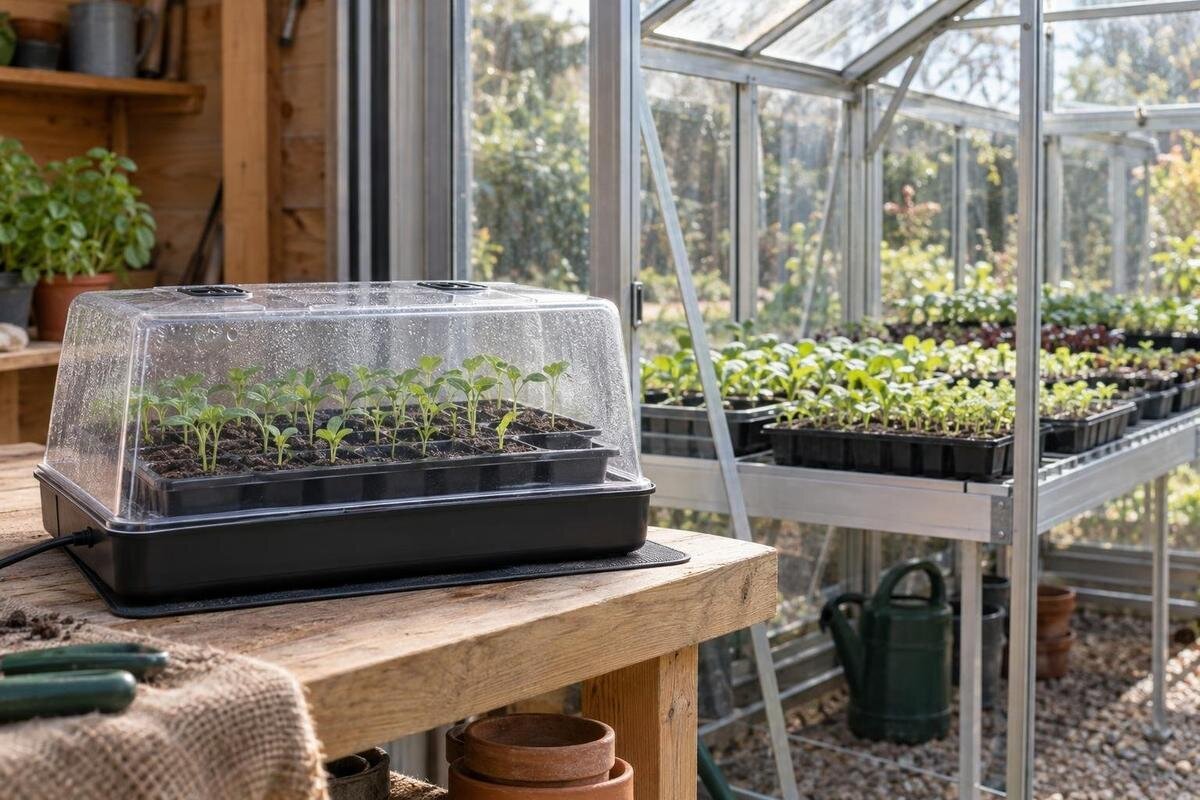
A heated propagator directs warmth to a compact growing area, often through a heated base under a cover, although designs vary. Check what the unit warms—the growing medium, the air beneath the lid, or both—and whether temperature control is included. A greenhouse heater has a different job: it is intended to manage conditions across a much larger volume. Heating the air does not guarantee that the seed-raising mix in every tray is at the right temperature, just as warming one tray does not protect seedlings on an unheated bench. Describing equipment as heated does not tell you what conditions it provides at seed level.
The useful comparison is the area you need to keep within crop-appropriate conditions. If warmth is needed only for a few germination trays, heating every bench and aisle may be unnecessary; if trays and young plants will occupy the greenhouse for longer, whole-space heating may have a role. The Aluminium Greenhouses range is listed from 3.77 m² to 28.08 m², a useful reminder that greenhouse sizes vary widely. That area figure alone does not establish heater capacity, heat retention or running cost. A whole-space system also has to respond to heat lost through the structure, so area is only one part of the comparison.
Count the trays that need warmth at the same time
Count how many trays need warmth concurrently, not how many packets you plan to sow across the season. If you sow in waves, the first batch may still be in the warm zone when the next is due; if seedlings can move to a suitable space for growing on, the propagator may be reused sooner. Note each tray’s outside size, how crops can share conditions and how long they are likely to occupy the heated area. This peak load gives a more realistic answer to whether one propagator is enough. Include room for labels, watering and access, rather than assuming every part of the heated surface can be covered with trays.
Compare that capacity with the space available in the greenhouse or propagation area. A greenhouse’s published area is not the same as usable bench surface: doors, paths and working space affect where trays can go, and shelves may not offer the same light or conditions as a bench. The Lean-to Greenhouse range is listed from 3.69 m² to 14.34 m², which can help you screen for overall size but does not state tray capacity. Check the internal layout and actual bench dimensions before relying on a greenhouse to hold all your sowings. Leave enough room to water and handle plants without shifting trays each time.
Follow crop-specific germination guidance
Use the seed packet or a reliable crop-specific guide for germination conditions, including any pre-sowing treatment, covering depth and temperature range. Requirements differ, and the warmth that helps a seed germinate may not be right for its continued growth. A propagator with a single control setting cannot automatically suit every crop at once. Group seeds with similar needs, or keep them in separate controlled zones, rather than choosing one high setting as a shortcut for all your trays. If instructions are unclear, confirm the crop’s requirements with a trustworthy horticultural source before applying sustained heat.
Temperature is only one part of successful germination. Seeds also need suitable moisture, air around them and the right sowing conditions for their crop; heat cannot make up for a mix that is too wet or for seed sown contrary to its guidance. Keep the seed-raising mix evenly moist rather than saturated, and check it instead of relying on condensation as a measure of moisture in the tray. Follow instructions about whether seeds should be covered or exposed to light. A lid can help retain humidity, but the conditions under it may change as the tray warms, so check the mix and ventilate where the propagator’s instructions allow.
Equipment for a heated propagator
A setup might use a self-contained heated propagator or a compatible heat mat and tray. Check the usable heated area against the trays you plan to use, and find out whether a thermostat is included or whether the unit needs a separate control. The manufacturer’s instructions should explain what types of tray are suitable and where to position any sensor. An appropriate thermometer around the seed trays can help you see whether conditions match the setting; the dial or display alone does not show what is happening in every part of the mix.
Check whether the cover has adjustable ventilation and whether the trays sit flat, rather than assuming every propagator has the same features. Follow the instructions for keeping the unit clean between sowings, particularly if water or mix collects in its base. Use equipment intended for the environment in which it will operate, including a greenhouse if that is where you plan to use it. Do not improvise electrical connections or use equipment contrary to its instructions. If fixed wiring or the suitability of a supply is in question, ask a qualified electrician rather than trying to resolve it yourself.

Heating an entire greenhouse takes more planning
A heater intended for a whole greenhouse has to manage a larger space and the heat that escapes through the structure, openings and ventilation. Conditions can change between a sunny period and a cool night, so the air may not stay at one temperature simply because a heater is present. A sensor near the heater may not reflect what is happening around seed trays. Monitor conditions where the plants are and follow the heater maker’s guidance on control and sensor placement. Heating also does not remove the need to manage ventilation when the greenhouse warms up.
Use the greenhouse’s actual specifications and the conditions you intend to maintain when discussing heater capacity with a supplier or qualified professional. The Limited Edition Aluminium Greenhouses range is listed from 3.77 m² to 28.08 m²; that area range indicates scale, not heating performance or energy use. Check relevant details such as the structure’s dimensions, openings and ventilation rather than assuming that area alone is enough to choose a heater. If you are comparing greenhouse structures as well as heaters, keep those questions separate: a greenhouse listing does not establish what heating equipment is included or whether it will maintain a particular temperature.
A heated propagation area inside the greenhouse
A heated propagator or suitable heated bench inside a greenhouse can separate the warm seed zone from the rest of the structure. That may make sense when only a limited number of trays need warmth, while the greenhouse is used for other plants that do not need the same conditions. It reduces the area you are trying to warm, but does not guarantee a particular energy saving: actual use depends on the equipment, controls and conditions around it. The air outside the heated zone can still fluctuate, so do not assume that a warm tray protects every seedling elsewhere.
This arrangement can also help you keep batches with different needs apart, provided you have room to move seedlings as they develop. Plan which trays will stay in the heated area and which can move into the surrounding greenhouse, then keep access clear for watering and monitoring both groups. The T-Model Orangery Greenhouse range covers 16.52 m² to 30 m². When considering that overall space, distinguish the compact area you intend to heat from the space where other plants will grow. The published area does not describe the bench layout or heating requirements, so it cannot tell you how these two growing areas would fit together.
Change the setup after germination
When seedlings appear, do not assume that the germination arrangement should stay unchanged. Their needs depend on the crop, and the conditions that helped seeds start may not support strong continued growth. Light matters: a warm, dim spot can leave seedlings weak or stretched, so check whether the position provides enough suitable light. Some crops will still need warmth after emergence, while others may need a different growing environment. Use crop-specific guidance rather than switching off heat or keeping every tray at the same setting by default.
As seedlings emerge, monitor moisture and airflow and adjust or remove a propagator cover as the equipment and crop guidance allow. Moving trays into a greenhouse may give you room to spread them out, but assess their new position for light and temperature rather than treating the move as a simple space-saving measure. The Pyramid Greenhouse range is listed from 5.53 m² to 18.9 m². Its overall area is a starting point for comparing space, not a measure of the bench area suitable for seedlings. Keep checking conditions around the plants after the move, especially if only the propagation area is heated.
Plan for potting on and later space
A tray that fits in a propagator at sowing can become a group of larger pots that needs more room after seedlings develop. Before choosing a heating arrangement, consider where you will pot plants on, how you will move them and whether the next stage needs the same warmth. A propagator solves a specific space-and-heat problem at seed stage; it does not provide a bench for every later stage. If you want to raise batches continuously, plan for the overlap between new sowings and seedlings that are still occupying growing space.
When comparing greenhouse area, distinguish space for plants from areas intended for other uses. The Limited Edition Aluminium Greenhouses with Storage range is listed from 5.52 m² to 28.08 m². The name identifies a storage feature, but the area range alone does not tell you how the internal layout divides growing and storage space. Check the product details and dimensions before estimating usable bench area. Also allow for access to trays and room to work; a growing space filled edge to edge can be difficult to manage, even if its stated area appears sufficient.

Running costs and temperature controls
Running costs depend on more than the type of heater. Relevant factors include the equipment’s specifications, how long it operates, the conditions you aim to maintain, your energy tariff and the heat lost from the greenhouse. A propagator warms a smaller area, while whole-greenhouse heating has to manage a larger space; that difference does not produce a reliable cost estimate on its own. Avoid relying on a general claim about typical use. Ask the equipment supplier for an estimate that reflects your intended setup and the conditions in which it will operate.
Compare controls as well as the heat source. Check whether the unit has a thermostat, how it is meant to be monitored and whether the instructions describe appropriate sensor placement. A thermometer that records changing conditions can help you notice differences between day and night, but it does not replace the heater’s instructions or a suitable control system. For the Bloomcabin Prestige Greenhouse range, which spans 3.77 m² to 28.08 m², compare the planned heating equipment and controls separately from the structure’s size. Confirm how the equipment will be controlled in your chosen setup, and get qualified advice where electrical work or heater sizing is involved.
Choose by sowing schedule and local conditions
A heated propagator is usually the simpler option when you have a few trays and need warmth mainly for germination. Consider whole-greenhouse heating when you expect to use a larger space for many overlapping batches or for seedlings beyond the germination stage, and can monitor the conditions there. If neither description fits neatly, a localised heated zone inside a greenhouse may meet the need without warming the entire structure. In every case, compare the busiest part of your sowing schedule, not just the first tray you plan to sow.
Use the conditions at your own site and the growing guidance for the crops you want to raise; a calendar date alone cannot tell you what the greenhouse will be like. At the larger end of the size comparison, the Spacious Greenhouse range covers 47 m² to 70 m². Consider how much of that space your sowing schedule would actually require, both during germination and while seedlings grow on. A large overall area does not mean that every part needs the same warmth. Match the heating plan to the areas you intend to use, rather than choosing whole-space heating simply because there is more room available.
Frequently asked questions
Is a heated propagator enough for most home seed raising?
It can be, if you are raising a manageable batch and need warmth mainly for germination. Check the crops’ requirements and how many trays need heat at the same time. You will also need somewhere suitable for seedlings to grow after they leave the propagator.
Do all seeds need bottom heat?
No. Germination requirements vary by crop, and some seeds may not need added heat. Follow the seed packet or a reliable crop-specific guide rather than choosing one setting for every tray. Heat does not replace suitable moisture, sowing depth or light.
Should I switch off the propagator as soon as seedlings appear?
Not automatically. The right conditions after germination depend on the crop, and a seedling may still need warmth. Check its growing guidance, then consider light, ventilation and moisture as well as temperature. A cover or setting that suited germination may not suit continued growth.
Can I use a propagator inside an unheated greenhouse?
Yes, if the equipment is intended for the conditions where you will use it and you follow its instructions. A propagator warms a limited area; it does not make the surrounding greenhouse reliably warm. Monitor conditions around the trays, especially as the greenhouse temperature changes.
How can I compare the running costs of the two options?
There is no reliable cost figure from greenhouse area alone. Consider the heater’s specifications, how long it will operate, your energy tariff and the greenhouse’s heat loss. For a realistic estimate, use information about your planned setup and ask the equipment supplier or a qualified professional.
Choose the heat source for the stage and space you need to manage. A propagator suits a defined batch of seeds; whole-greenhouse heating is a broader commitment that needs suitable controls and ongoing monitoring. If seedlings will move on quickly, a localised heated area may be enough, provided you have a suitable place for their next stage. The most useful comparison is the peak number of trays, their crop-specific requirements and the conditions available after germination.
