
Combining a Glass Roof with Polycarbonate Greenhouse Sides
Greenhouse glazing guide
Yes, a greenhouse can be designed with a glass roof and polycarbonate sides, but the combination needs to be part of the manufacturer's specification for the exact model. It is not safe to assume that panels can be swapped between openings just because both materials are sold for greenhouse glazing. Roof and wall panels meet different frame sections and may need different support, seals and retaining parts. Before comparing options, ask for a drawing or written specification that labels the material used in every panel position, including any gables, doors or vents.

Before you order 1
Can a greenhouse have a glass roof and polycarbonate sides?
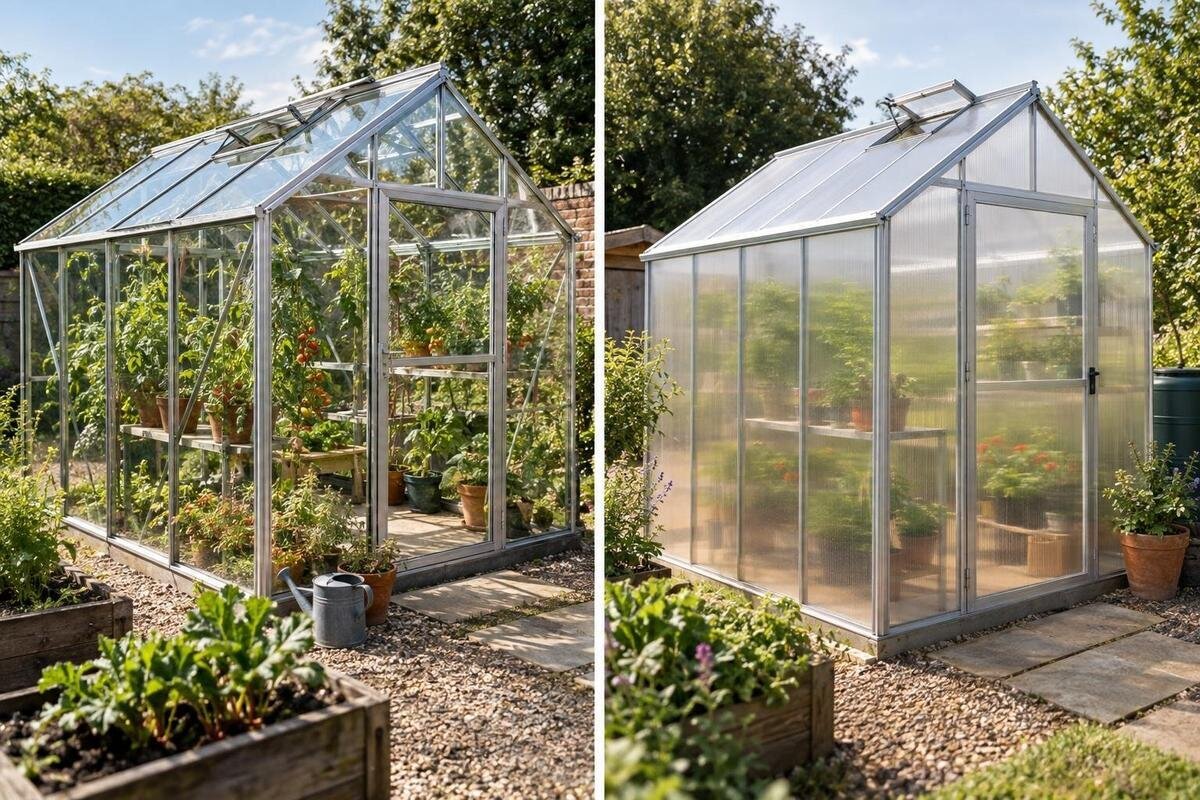
A manufacturer-designed greenhouse can use one glazing material over the roof and another in the walls. It is a configuration choice, not a universal add-on: the manufacturer needs to offer that layout for the exact model and size. The useful question is not whether glass and polycarbonate can exist in one structure in principle, but whether the particular panels, frame members and junctions have been designed to work together. A product listing that offers both materials separately does not confirm that the mix is available in the positions you want, or that every opening is covered by the same specification.
That distinction can be missed when you see a photograph, a sketch or a greenhouse assembled with different materials. An image rarely shows panel thickness, edge support, retaining systems or design limitations. Ask for a drawing that marks the roof and each wall panel, including doors and vents if their glazing differs, and have the supplier confirm it in writing for your selected model and size. Also clarify what 'sides' means: long walls, end walls and gable sections may be specified separately. If the reply only says both materials are available, ask again; that describes two material choices, not an approved configuration.
Why panels are not interchangeable
Panels that look similar are not necessarily interchangeable. Glass and polycarbonate can differ in thickness, edge detail, stiffness and weight, and their movement with temperature may not be the same. Glazing bars, rebates, gaskets, clips and retainers are selected around the specified panel; a substitute may not sit properly or be held as intended. Fit is only one part of the issue: joints also help manage weather and transfer loads into the frame. Relevant dimensions include how much of the panel edge is held, not just the visible opening. A close visual match, or a sheet cut to opening size, is not proof that a panel is compatible.
For a model in the Limited Edition Aluminium Greenhouses with Storage range, the compatibility question concerns the complete glazing assembly, not just the sheets. Ask whether the proposed roof and wall panels use the same retaining parts or require different components, and whether those components are included. The panel schedule and parts list should let you match each panel type to its intended opening. Measurements alone cannot establish that match, and a generic cut-to-size service cannot confirm compatibility with the frame. If the manufacturer offers the mixed configuration, use its specified combination of panel thickness, edge support, retainers and seals rather than assembling a selection of apparently matching parts.
Before you order 2
How roof and wall panels connect to the frame
Roof and wall openings have different requirements, so the places where they meet deserve particular attention. Roof panels sit at an angle and meet the ridge, eaves and roof bars, where the design must also accommodate water run-off. Wall panels sit within vertical frames and meet corners, doors or vents. A mixed system has to accommodate these junctions without leaving gaps, collecting water or relying on a seal intended for another panel. The change in orientation also means a wall sheet is not automatically suitable overhead. Support and clearance details vary by design, so generic advice about finding the right clips cannot replace the manufacturer's assembly detail.
Ask whether the mixed layout changes any frame sections, glazing bars, seals, vent panels or assembly parts, and whether all those items are included in the quoted configuration. Have the drawing identify the roof-to-wall junction and any opening elements, rather than relying on a simple front elevation. A cross-section can show details that are hard to read in a general product image. Keep the answer tied to the model name and chosen size; reassurance about a similar greenhouse is not a specification for yours. For instance, put Bloomcabin Prestige Greenhouse on the request, then ask which drawing or option reference covers your proposed glazing, if one is available.
How glazing affects light and visibility
Glass and polycarbonate can look different once installed, but their material names alone do not tell you how much light a particular greenhouse will transmit. Glass may be offered with different finishes, while polycarbonate options can vary in colour, structure and surface treatment. Those details can affect clarity, diffusion and light transmission. If you grow plants with particular light requirements, compare published information for the actual roof and wall products instead of relying on a general claim about either material. Check whether any figures describe the panel itself or the complete glazing assembly, and ask for the specification when the information is not clear.
Separate your viewing preferences from your plants' light requirements. You might want a clear view overhead, visibility through the walls, or a less direct view into the greenhouse from outside; these are different priorities. For an option in the Spacious Greenhouse range, compare the proposed roof and wall finishes separately, using information for the actual panels. A clear example of one material and a tinted or diffusing version of another do not make a like-for-like comparison. Then consider the whole layout: side panels, surrounding shade, orientation, ventilation and plant position also play a part in growing conditions. Choosing the roof material alone does not settle how the greenhouse will work for your plants.

Before you order 3
Site exposure and glazing suitability
Wind and rain are part of the specification question, not something to check only after choosing a look. A roof panel is exposed differently from a vertical side panel, and the frame has to support the specified materials at roof edges, corners and openings. Wind pressure, uplift and wind-driven rain can affect how a system is designed; no universal combination can be assumed to suit every site. A panel arrangement that is suitable in one location does not establish suitability elsewhere. Ask what site conditions the manufacturer considers for the model and what information it needs. Do not add or substitute parts yourself to address a weather concern.
Describe the proposed site in practical terms: whether it is sheltered or exposed, on a ridge or in an open paddock, near the coast, or affected by nearby buildings and trees. Give this information when enquiring about a model in the Aluminium Greenhouses range, so the discussion concerns your location as well as your preferred glazing. These observations provide context; they do not amount to a technical assessment or establish suitability. Where exposure is unusual or structural performance needs further assessment, ask a qualified local professional to review the manufacturer's information for the proposed configuration. Keep the site assessment separate from the visual comparison: a catalogue image can show appearance, but cannot assess exposure.
Plan for cleaning and replacement panels
Maintenance is easier to plan when you know exactly what each panel is. Ask how the specified glass and polycarbonate should be cleaned, which products or tools to avoid, and whether a sheet has a particular orientation or protective face. Abrasive cleaning can mark some surfaces, so follow the instructions for the actual panel rather than a generic greenhouse-care tip. Also find out how the manufacturer identifies replacement panels: opening width and height may not describe thickness, edge shape or fixing details. A replacement that looks similar may still need different retaining parts. Keep the original panel schedule and model information where you can find them later.
For an option in the Lean-to Greenhouse range, make sure the records distinguish any panels beside the adjoining wall from the roof and other wall panels. A mixed design has at least two panel specifications to keep track of, even when it is supplied as one greenhouse. Ask whether replacement components can be ordered individually and which identifiers are needed to match a part; neither availability nor compatibility should be assumed. Keep the drawing, panel references and care instructions together, so a future enquiry can identify the original component rather than describe it only by appearance. If a replacement in another material is proposed, refer it to the manufacturer before accepting the substitution.
Before you order 4
Compare the full glazing specification
A useful comparison names each material precisely. For glass, ask for the type, thickness, finish and any safety information that applies to the offered pane. For polycarbonate, ask whether the sheet is solid or multiwall, its thickness, colour or tint, surface treatment and whether its orientation matters. 'Glass roof, polycarbonate sides' is only a starting point; it does not describe panel construction or allow you to compare light, visibility, impact behaviour or upkeep. Request datasheets or a manufacturer's specification for the exact components. The same broad material name can cover different products, so avoid comparing different greenhouses as though glazing were the only variable.
Compare the supporting structure, vents, doors, bar layout and panel coverage alongside the glazing. If Limited Edition Aluminium Greenhouses are on your shortlist, record the exact version and size against the alternative you are considering. Use the drawings to distinguish a change in panel material from a change in frame layout or an optional component. Check whether both proposals cover the same openings and include the same parts; otherwise, an apparent glazing difference may reflect a different configuration altogether. Keep these differences visible in your comparison rather than reducing each option to a material name. Any agreed variation should also appear in the quote, so a feature shown on one version is not assumed to carry over to another.
What to ask the manufacturer
To get a reliable answer, send the supplier the model name and size you are considering, describe the split you want—glass roof and polycarbonate walls—and ask if the manufacturer supplies it as an approved configuration. Request a drawing or panel schedule that identifies materials by position, along with specifications for each panel and the frame parts, seals and retainers used. If the design changes roof vents, doors or wall openings, these should appear on the same drawing. Where drawings have a date or revision number, note it so the quote and the information you receive refer to the same layout.
Ask who confirms the design and whether the assembly instructions cover that exact combination. If it requires parts from more than one kit or an on-site substitution, pause and get manufacturer approval before buying. Use a specific listing, such as T-Model Orangery Greenhouse, to identify the family in your request, not as proof that the mix is available. Keep the final specification with the order and check that later clarifications have not changed panel positions, materials or included parts. If no one can give a definitive answer, do not treat a general assurance as approval.

Before you order 5
When a single glazing material may be a better fit
If the manufacturer does not offer a mixed option, compare complete single-material configurations rather than trying to create a hybrid. All-glass and all-polycarbonate greenhouses can differ in appearance, light transmission, thermal behaviour, handling and maintenance, but the outcome depends on the exact panels and frame system. Decide which factors matter most for your plants, viewing preferences, site and routine, then compare the relevant specifications and drawings. One material throughout may simplify your panel list; it is not automatically the better choice or a guarantee of easier upkeep. Evaluate the actual panel types rather than relying on a broad material label.
Compare single-material alternatives at the same size and layout where possible, with equivalent vents, doors and accessories. When considering a model in the Pyramid Greenhouse range alongside another design, note any layout differences before drawing conclusions about the glazing. A different frame or arrangement of openings can make the comparison less direct. Ask whether changing the material within a shortlisted model also changes its frame, opening positions or replacement parts. If the mixed appearance is essential to your choice, establish whether it is available before spending time comparing other features. If it is only a preference, weigh it against the complete single-material options rather than planning a panel substitution after purchase.
Match the quote to the approved drawing
Before accepting a quote, read it alongside the model-specific drawing. Check that the roof material, side material, panel positions, glass type and polycarbonate specification all match what you requested, and that the frame, glazing bars, seals and retainers correspond to that layout. A line that says only 'glass and polycarbonate' may leave too much open to interpretation. The description should also make clear whether vents, doors and other glazed openings follow the same material split or have separate specifications. If there is no panel schedule, ask for one before treating the configuration as settled.
Compare itemised quotes for the same size, layout and inclusions, so the cost reflects the complete approved system rather than the sheets alone. Ask whether any special frame parts or assembly requirements are included, and keep the manufacturer's instructions, care information and replacement identifiers with your paperwork. If a proposed substitution appears after ordering, pause until the manufacturer confirms it in writing. That final check matters because the combination you pay for should be the same combination the frame and glazing system were designed to hold.
Frequently asked questions
Can I order a glass roof with polycarbonate sides?
Yes, if the manufacturer offers and approves that combination for the exact greenhouse model and size. Ask for a drawing that shows the material in each panel position, along with the specification for the panels and their frame components.
Can I swap polycarbonate panels into an all-glass greenhouse?
Not unless the manufacturer confirms the substitution for your particular model. Panel thickness, edge support, seals and retaining parts all affect fit. Use only a replacement or configuration the manufacturer has approved.
Will mixed glazing make the greenhouse warmer or brighter?
There is no general result you can rely on from the material names alone. Light and heat conditions depend on the exact panels, their area and position, shading, orientation and ventilation. Compare the specifications for the actual products.
Is polycarbonate always safer for the sides?
No material is automatically the right choice for every site or use. Breakage and impact behaviour vary by product, and glass and polymer sheets have different care and replacement considerations. Ask for the details of the panels being offered.
What should the supplier confirm in writing?
Get the model and size, a panel-by-panel drawing, the type of glass and polycarbonate, and details of the frame, seals and retainers. Also confirm that the assembly instructions cover the combination and ask how to identify matching replacement panels.
Glass roofing with polycarbonate sides is an option only when the manufacturer treats it as one designed system. Compare the exact panel specifications and layout, not just a material combination in a photo or sales description. If the option is confirmed for your chosen model and site, use that documented configuration. If it is not, choose a greenhouse and glazing arrangement the manufacturer can specify rather than adapting one yourself.
