
Electric or Fuel-Burning Greenhouse Heating: What Should You Compare?
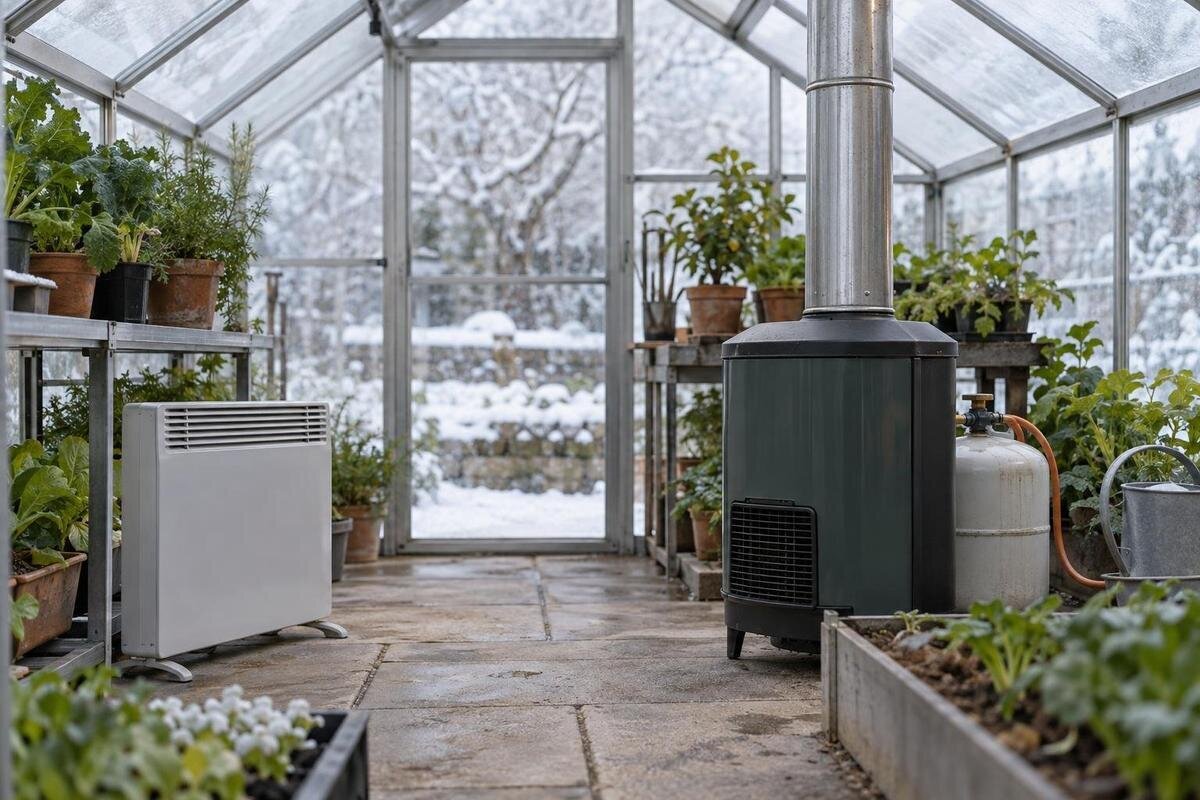
Greenhouse heating
Choosing greenhouse heat by fuel label alone misses the main difference: what an appliance releases into the growing space, what ventilation it needs, and what the site can safely support. A purely electric heater has no combustion at the point of use; a fuel-burning unit may discharge water vapour and exhaust gases inside or outside, depending on its design. That affects humidity, air exchange and installation, not just how heat is made. Compare actual heater models against your greenhouse layout, intended use and available power or fuel. This guide focuses on those practical differences rather than a running-cost estimate or heater-sizing calculation.

Buyer checklist 1
The greenhouse and its heating needs
Write down what the heater must protect or support, how often it will run and which part of the greenhouse matters. Overwintering a few pots at one end is a different job from heating a whole growing area, even though both may be called greenhouse heating. This is not a temperature prescription: the plants and use pattern determine the target. Compare electric and fuel-burning options against the same target, location and operating pattern; otherwise their controls and requirements cannot be judged on equal terms. Note any periods when the greenhouse is unattended and check that the specific model’s documented use covers the routine you expect.
Describe the enclosure as well as its floor area: glazing, height, gaps, door openings, site exposure, and partitions or benches that affect air movement. These details influence heat loss and how warmth reaches plants, so two structures with the same floor area may present different heating conditions. The Classic Aluminium Greenhouses range is listed from 3.77 m² to 28.08 m². Throughout this comparison, the catalogue areas describe size options, not insulation, leakage, ventilation capacity or heater demand. Use drawings and verified construction information for the selected greenhouse to record the conditions each heater must suit. Ask the supplier about missing details rather than treating floor area as a performance figure.
How combustion affects greenhouse moisture
Fuel-burning heaters need a closer look at where their combustion products go. If a direct-fired or unflued unit discharges into the greenhouse, combustion adds water vapour and carbon dioxide to the air; the amounts and any other by-products depend on the fuel and appliance. That extra moisture sits alongside water from irrigation, wet growing media and plant transpiration, and may contribute to condensation on cooler glazing or foliage. A flued or indirect model, when installed and operating as specified, routes exhaust outdoors. Its combustion products are not intended to enter the growing space, but you should verify the arrangement for the particular model.
A purely electric heater does not add moisture from fuel combustion, but it does not remove existing water either. Heating air can lower a relative-humidity reading without taking water out of the greenhouse; if surfaces cool, condensation may still form. A fan can spread warmth but is not, by itself, moisture extraction. When considering the Lean-to Greenhouse range, listed from 3.69 m² to 14.34 m², include plant numbers, watering and wet surfaces in your moisture assessment. Track temperature and relative humidity together to understand the pattern, noting when watering or ventilation changes the readings. This helps separate the effect of warming the air from the effect of exchanging damp air.
Buyer checklist 2
Where heater emissions go
Fuel type does not tell you which emissions enter the greenhouse. The key details are whether a unit is direct-fired or unflued, flued, or indirect, and where its exhaust goes. Combustion produces carbon dioxide and water; incomplete combustion can also produce carbon monoxide, a dangerous gas. Other emissions depend on the fuel and appliance. A steady-looking flame or lack of noticeable smell is not a safety check. A flue changes the exhaust route only when the complete system is installed and operating as designed, and it does not remove the need for the specified maintenance and ventilation.
Read the heater’s manual and technical sheet for its stated application, permitted fuel, combustion arrangement, exhaust path, air supply and maintenance requirements. If the manufacturer does not say that a model is suitable for an enclosed greenhouse, do not infer suitability from a patio, camping or portable label, or from its headline heat output. Ask the supplier or a qualified installer to explain terms such as unflued, flued, direct-fired and indirect-fired. For a structure in the Limited Edition Aluminium Greenhouses range, listed from 3.77 m² to 28.08 m², assess the proposed exhaust route against the selected layout. Keep emissions inside the greenhouse separate from the wider environmental comparison: electricity can also have upstream emissions, depending on how it is generated.
Ventilation is not a substitute for a flue
Ventilation has more than one job. Air exchange can help manage plant moisture and heat, while combustion equipment may need a specified air supply and a designed exhaust route. Those functions are related but not interchangeable: a roof vent or open door is not automatically an approved flue, and a flue does not replace the ventilation needed by plants. Closing greenhouse vents to conserve warmth can conflict with an appliance’s combustion-air instructions. Follow the heater manual and greenhouse guidance together; the number of visible vents is not a reliable substitute for documented airflow.
Compare the required airflow, whether combustion air is taken from the greenhouse or supplied separately, and whether exhaust must leave through a specified flue. For the T-Model Orangery Greenhouse range, listed from 16.52 m² to 30 m², obtain the ventilation details for the selected structure rather than using its floor area as a measure of airflow. Identify which openings serve the growing space and how the proposed heater receives combustion air. Have a qualified installer assess these arrangements together, including any conflict between keeping the greenhouse warm and maintaining the required air supply. If the manufacturer’s instructions cannot be followed with the proposed layout, the heater is not a suitable fit for that site.

Buyer checklist 3
Electric heaters in a damp growing space
Electric heat avoids the need to route combustion exhaust, but electrical equipment still needs to suit the conditions where it will operate. Greenhouses can have condensation, splashes, wet floors and high humidity, so check the exact heater’s instructions for its intended environment, mounting method, clearances and limits on moisture or dust. A generic ‘outdoor’ description or an IP rating alone does not prove that a unit is suitable for an enclosed greenhouse. Also compare heat distribution: fan-assisted and radiant electric heaters do not warm a space in the same way, which can affect placement and temperature sensing.
Check the heater’s supply requirements and electrical input against the circuit that will serve it. A nearby power point does not show that the circuit has capacity, that its protection is suitable or that the proposed cable route is appropriate for a damp area. Ask a qualified electrician to assess the supply, controls, protection and installation, especially for fixed wiring or work near water; do not improvise with unsuitable leads or connections. If you are considering the Pyramid Greenhouse range, listed from 5.53 m² to 18.9 m², mark watering areas, access routes and the proposed heater position on the selected layout. Use that plan alongside the heater documentation when discussing the installation with the electrician.
Installation requirements for fuel-burning heaters
Fuel-burning covers appliances with very different installation requirements. Gas, liquid-fuel and solid-fuel heaters may differ in their fuel supply, ignition, air supply, exhaust, clearances and servicing needs. Establish whether a particular model is designed for direct use in the greenhouse or requires a flue or separate combustion space; do not treat portable equipment made for an open or outdoor setting as suitable for an enclosed growing area. Follow the manufacturer’s stated clearances from glazing, shelving and combustible materials, and make sure there is access for maintenance. These conditions cannot safely be guessed from the fuel name.
Plan the whole installation: where fuel is supplied and stored, where exhaust terminates, how required air reaches the burner, and who will install, commission and service it. The Limited Edition Aluminium Greenhouses with Storage range is described as having storage and is listed from 5.52 m² to 28.08 m². Do not assume that this storage area is suitable for cylinders or liquid fuel; fuel storage needs its own assessment. Check the heater and fuel-supplier instructions, along with any requirements that apply to the site, and seek advice from a qualified professional for that appliance. Allow access for the specified maintenance: a neglected burner or damaged exhaust arrangement can undermine the safety assumptions behind the heater’s documentation.
Buyer checklist 4
Thermostats and heat distribution
A thermostat reports conditions at its sensor, not throughout the greenhouse. A sensor warmed directly by the heater can switch it off while more distant benches remain cool; one in a draught may call for heat for longer than expected. Follow the manufacturer’s placement guidance and check whether a separate thermostat is compatible with that specific appliance. Compare how the control handles the intended operating range and what happens after a power interruption. More settings do not automatically mean more accurate control, and the heater’s own safety devices must remain compatible with the control system.
Heat distribution also depends on greenhouse shape, obstructions and air movement, so one reading does not prove that all plants experience similar conditions. If uniformity matters, compare readings in more than one representative growing position and note whether doors, benches or partitions alter airflow. When planning a layout within the Prestige Greenhouse range, listed from 3.77 m² to 28.08 m², distinguish the thermostat’s proposed position from the places where you want to monitor plant conditions. Use the selected structure’s plan and each manufacturer’s instructions to identify a suitable sensor location. Confirm the arrangement with an installer if the appliance is fixed or fuel-burning, including whether the proposed control is compatible with it.
Power cuts and fuel supply
Reliability depends on what the heater needs beyond fuel. An electric heater normally needs a live electrical supply, while a fuel-burning model may still rely on electricity or batteries for ignition, a fan, a pump or its controls. Some appliances may continue without an electrical supply, but only if they are designed and documented to do so. Check the stated behaviour during an interruption, including whether the unit shuts down safely and how the manufacturer says to restart it. Do not assume that a gas flame makes the heater independent of power.
Consider the complete supply chain: whether fuel can be obtained and stored as specified, whether power is dependable at the proposed site, and whether servicing remains practical through the season. For a project using the Spacious Greenhouse range, listed from 47 m² to 70 m², identify which heater functions depend on electricity before comparing backup options. Base that comparison on the actual appliance’s requirements, not the greenhouse’s floor area or the fuel label. If backup matters, check compatibility and have the arrangement assessed by an appropriate electrical or heating professional. Include the manufacturer’s shutdown and restart procedure in your operating plan rather than relying on improvised connections or an assumed automatic restart.

Buyer checklist 5
Compare the heater specifications side by side
Use current manufacturer documents rather than a shop headline. For each electric option, record its heater type, stated electrical input and heat output, control method, environmental suitability, installation clearances and supply requirements. For each fuel-burning model, record the exact fuel, whether combustion is direct, flued or indirect, where exhaust goes, the ventilation and combustion-air requirements, and the maintenance schedule. Look for an explicit statement about the intended use. If details such as exhaust destination, moisture release or permitted location are missing, mark them as unknown and ask the manufacturer or seller to clarify in writing.
Compare the options under the same assumptions about the greenhouse, target and operating hours, but keep heater sizing and running-cost calculations separate from this choice. A heat-output figure alone cannot establish suitability, and the stated electrical or fuel input is not necessarily the same as usable heat delivered to the space. Note which requirements are the installer’s responsibility and which routine checks the operator must carry out. Broad claims such as ‘greenhouse-safe’, ‘clean-burning’ or ‘low-moisture’ need supporting details about the test conditions and exhaust arrangement. Clear documentation makes the real differences easier to judge.
Matching the heating system to the site
Electric heating can make it easier to avoid combustion products inside the greenhouse, provided the exact unit suits the damp setting and the electrical supply is adequate. Fuel-burning heat should be compared as a complete system, including combustion arrangement, ventilation, exhaust, fuel and professional installation. A flued model is not equivalent to an unflued one, and an electric heater’s lack of combustion does not make it automatically safe or effective. Let the documented model and the site determine the choice rather than treating either fuel category as universally best.
Before buying, make a site plan that marks growing areas, access, ventilation openings, available power or fuel, and the intended heater and control positions. Check it against the heater manual and the selected greenhouse’s verified drawings. Ask a suitably qualified electrician or heating installer to resolve electrical, flue, clearance or combustion-air questions. If the instructions cannot be followed without blocking ventilation, improvising a cable route or changing an exhaust arrangement, revise the layout or compare another model. The useful comparison ends with a system you can operate as its manufacturer specifies.
Frequently asked questions
Does an electric greenhouse heater reduce humidity?
Not by itself. A heater does not add moisture from fuel combustion, but warming the air can lower the relative-humidity reading without removing water. Moisture still needs to be managed separately; ventilation can help exchange damp air when conditions allow.
Do all fuel-burning heaters release exhaust into the greenhouse?
No. Direct-fired or unflued models may discharge combustion products into the growing space, while flued or indirect models are designed to route exhaust outside. Check the exact heater’s manual and installation details rather than relying on the fuel name.
Can I use a patio or camping heater inside a greenhouse?
Do not assume it is suitable. Use it there only if the manufacturer explicitly permits that setting and its ventilation, exhaust, clearance and installation requirements can be met. A high heat-output figure does not establish safe use in an enclosed space.
Can an open greenhouse vent replace a heater flue?
No. Greenhouse ventilation and a specified flue or exhaust system have different purposes. Follow the heater’s instructions for combustion air and exhaust, and separately check what ventilation the greenhouse and plants need.
Will a fuel-burning heater keep working in a power cut?
It depends on the model. Some fuel-burning heaters rely on electricity or batteries for ignition, a fan or controls. Check the manufacturer’s stated behaviour during an outage; do not assume the fuel source guarantees operation.
At the point of use, the key distinction is clear: electric heating avoids combustion products in the greenhouse, while fuel-burning equipment requires a definite answer about exhaust and combustion moisture. That alone does not settle the choice. The greenhouse’s damp conditions, ventilation, supply, controls and installation all matter. Compare the manufacturer’s instructions for the actual heater with the selected enclosure, and get professional clarification before committing if any of those details remain unclear.
