
How to Track Down Parts for a Discontinued Greenhouse
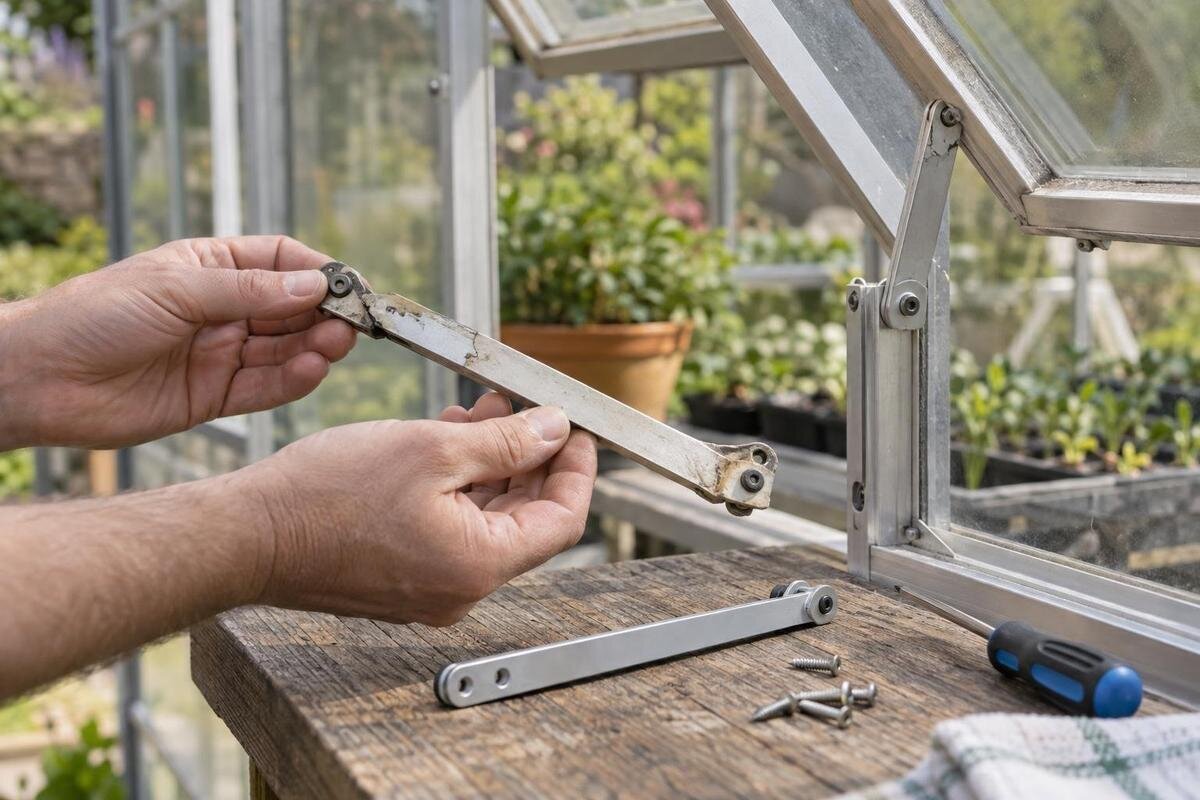
Greenhouse repair and replacement parts
Finding a replacement part for a discontinued greenhouse is mainly an identification job. A length of extrusion, clip or seal can look familiar yet differ in its cross-section, fixing method or model revision. Before ordering, gather evidence that ties the part to the exact greenhouse: maker and model, component location, clear photographs, measurements and original records. This guide explains how to build that evidence, what to ask the manufacturer or installer, and when a whole-model enquiry is more appropriate than trying to adapt an uncertain part.

Confirm the greenhouse’s identity
Begin by identifying the greenhouse, rather than the individual component. Record the manufacturer, retailer or importer separately, then copy the model name exactly as it appears on an invoice, manual, assembly label or order email. Add the approximate purchase or installation year, documented overall size, roof shape, door and vent arrangement, and any serial or batch label you can read safely. Note which details come from paperwork and which are your observations. Include later changes such as a replacement door, altered glazing or an extension; they may explain why an original parts drawing does not appear to match. Mark remembered dates and names as estimates rather than confirmed identifiers.
Search old emails, invoices, assembly paperwork and installation notes before opening any frame covers; do not dismantle anything to reach a label. Copy punctuation, hyphens and suffixes, and photograph the label to avoid transcription errors. Similar words can identify different ranges or revisions. A listing for an Aluminium Classic Greenhouse identifies a named product, not proof that an older greenhouse described as Classic is the same model. Keep alternative names in a separate note, and treat an unmatched version as unconfirmed until a manufacturer record or installer links it to the correct parts information.
Photograph the whole structure and the affected part
Take a wide view from safe standing positions, then one view of each side and end; add an inside view only if access is safe. Include the roof shape, base, entrance, door and vent positions, and enough surrounding frame to recognise the greenhouse. A view taken straight on to a wall or roof slope makes joints easier to compare than an oblique view. Do not climb on the structure, lean a ladder against it or shift glazing to improve the shot. If a section is unstable or glass is damaged, stay clear and arrange an installer assessment instead of moving it for photography. Note the date and which side or end each file shows.
For the affected part, take a close photograph in place and several from different angles, including its junction with neighbouring pieces, the fixing point and any visible damage. Put a ruler beside it in the same plane only if this can be done without touching a sharp or unstable part; leave enough frame in the picture to show where the component sits. Photograph labels or stamped codes in focus and without glare, and keep the original files rather than sending only compressed screenshots. Label any catalogue images you include as comparison images. For example, a picture from the Pyramid Greenhouse page should be kept separate from photographs of your greenhouse so the supplier knows which images show the structure being repaired.
Map the component to its exact position
Describe what the part does and where it sits before trying to name it. Related-looking items may include roof or side glazing bars, ridge or eaves sections, corner posts, base rails, door tracks, hinges, handles, vent parts, clips, seals, connectors and fasteners. If you are unsure of the correct term, use a plain description, such as the narrow channel beside the door opening, and pair it with a marked photograph. Do not call every strip a glazing bar or every small fitting a clip; the manufacturer’s terminology can be checked later. Give each missing or damaged item a separate label if there is more than one.
Make a simple sketch of the greenhouse and mark each component on it. Choose a fixed viewpoint, such as standing outside facing the main entrance, and state that convention whenever you use left or right. Add the roof slope, section or bay number if you can identify it, and whether the part is inside or outside the frame. This helps prevent a mirror-image mistake when someone reads a photograph from the opposite side. A model name such as T-Model Orangery Greenhouse belongs in the greenhouse identity field; it does not tell a supplier which bar, rail or fitting is missing. Record the quantity and whether the parts came from one location or several.
Record the profile and connection details
For a frame component, the cross-section may be more useful for identification than its length. A bar can have grooves, lips, channels or shaped ends that determine how it meets glazing, a seal or another section; similar outside dimensions do not make two pieces interchangeable. If a matching sample is already safely detached, photograph its end square-on beside a ruler, showing the full outline and marking which side faced outward or upward. If it remains fitted, photograph any accessible end without loosening or removing it. Do not cut out a sample or dismantle a structural joint to expose the profile. If the detail cannot be seen safely, an installer can assess it.
Record visible connection details too: the number and position of holes, slots, notches, channels and fasteners, along with any angled or shaped end. A supplier may need a profile drawing or part code rather than a description such as aluminium strip. Note whether a seal or retaining strip sits in the channel, and photograph an undamaged matching section only as a comparison, clearly stating that it is not the failed part. Do not widen holes, drill new fixing points, bend a profile or trim a piece to make it seem to fit. Keep any current product reference, such as the Prestige Greenhouse, separate from the record of the old frame. State whether you are enquiring about an original spare part or a complete replacement greenhouse.

Take measurements that help identify a match
Use millimetres for measurements and say exactly what you measured. For a safely accessible part, note its overall length, width and depth, where each measurement begins and ends, and whether it came from an intact or damaged sample. Repeat a measurement if the edges are unclear, and record an approximate value as approximate rather than adding false precision. If the part is still fitted, distinguish a measurement of the component from one taken across the opening around it. An opening can help describe the location, but it does not establish the part’s original dimensions or identify the profile.
For a fitting, record the distance between hole centres, the number of holes and the direction it faces; for a rail, include the end shape and any visible slots. State the quantity required and whether the measurements are from one piece or several. Do not use dimensions from a whole-greenhouse listing to infer the size of an old component. If you are also comparing a complete replacement, such as the Lean-to Greenhouse, record its overall dimensions separately from your component measurements. This keeps the two enquiries distinct. For glazing, an opening measurement is only preliminary information; use the original specification or ask a glazier or greenhouse installer to confirm the replacement pane.
Identify glazing and seals separately
A missing panel, a retaining strip and a glazing seal are different enquiries, even when they sit beside one another. Record the panel’s position and material only if you know it from the paperwork or an existing label; do not guess whether a pane is glass or plastic from a photograph. Note any visible markings without touching the panel, and look in the manual or parts list for a glazing code. A panel’s visible opening is not enough to establish its specification or cut size, so have the manufacturer, a glazier or a greenhouse installer confirm the exact requirement.
For a seal or retaining strip, photograph its shape and the channel it sits in, and check whether a safely accessible loose sample is available. Age, compression or damage can change how an old seal looks, so colour or general shape alone may not identify a match. Do not remove broken glazing or reach around sharp edges to obtain a sample. If the original panel or seal cannot be identified, ask about the approved options before fitting anything. If you also request details of the Limited Edition Aluminium Greenhouses with Storage, make that a separate enquiry and ask for its glazing information directly. Keep those details separate from the specification for the old greenhouse’s replacement panel.
Search manuals and manufacturer records
Look for the assembly manual, original order confirmation, invoice, packing list, spare-parts sheet, technical drawing and any service emails. An exploded diagram can help connect a part number to its position, while a drawing may show a profile that is hard to photograph in place. Check the document title, revision or date as well as the model name, and keep the page that contains the relevant part code. A manual for a similar-looking greenhouse may be useful for comparison, but it is not confirmation that the parts list applies to your model or version.
If you bought the greenhouse second-hand, ask the previous owner for paperwork, but keep their recollection separate from documented identifiers. If the original seller, importer or manufacturer can be found, ask whether archived manuals or parts information exist for the exact model and approximate year. A catalogue page such as Limited Edition Aluminium Greenhouses can help you copy a product name accurately, but it is not a historical manual or spare-parts list. Save the correspondence and note who supplied any identification so the next enquiry can build on evidence rather than start again.
Ask about availability and approved alternatives
When you contact the manufacturer or supplier, ask them to identify the part against the exact greenhouse model and version, not merely against a photograph or approximate measurement. Confirm the correct spare-part number, the quantity required and whether it is compatible with your particular structure. Ask whether the whole greenhouse or just that component has been discontinued, whether a documented successor exists, and whether related fixings or seals are also required. If there is a drawing, parts diagram or installation note for the identified item, request it so you can check that the reply matches the component you have described.
If the exact item is no longer supported, ask whether the manufacturer recognises an approved alternative. Do not treat a similar-looking generic part, a forum suggestion or an improvised change as an approved substitute. Where the component affects the frame or glazing, ask a qualified installer to review the proposed course before it is fitted. If the discussion turns to replacing the whole greenhouse, the Spacious Greenhouse page is a separate product reference; it does not show whether a new model suits your site or existing base. Keep that assessment distinct from the original part enquiry.

Decide whether the issue needs an installer’s review
A parts search is more straightforward when the affected item can be identified from an exact part number and the surrounding structure does not raise further questions. If several components are missing, a frame section is visibly distorted, or damage extends beyond the part you first noticed, do not assume that replacing one item resolves the problem. Record what you can see and ask the manufacturer or a qualified installer to assess the assembly. Do not try to determine structural capacity yourself or alter a frame to accommodate a replacement part.
A whole-greenhouse replacement enquiry is different from a request for one spare part. Compare the requirements for the complete structure separately, including its overall dimensions, door and vent layout, glazing requirements, access and the existing base interface. Obtain the relevant product documentation and professional review rather than assuming a model name or photograph proves a fit. If the issue is limited to a confirmed component, keep the enquiry focused on that identifier; if the wider structure needs review, state that clearly so the response addresses the right problem.
Send a clear enquiry and keep the reply
Put the useful facts in one message: manufacturer and retailer if known, exact model wording, approximate year, serial or batch details, part location, plain-language description, quantity, measurements, visible codes and any changes made to the greenhouse. Attach the overview, close-up and location sketch, and include the relevant page from a manual or drawing. State which details are confirmed and which are estimates. If you are asking about more than one component, label each in the message and in the photographs so the reply can refer to them unambiguously.
Ask for a specific answer: the manufacturer’s part identifier, compatibility with your model and version, whether an approved successor exists, and any documentation or installer review required before fitting. If the reply is unclear, follow up with the unanswered point rather than ordering on the basis of a broad resemblance. Keep the response, part number and date with the original greenhouse records. Do not discard a safely detached old fitting until identification is complete, but do not handle broken glass or remove a fitted structural component just to supply a sample.
Frequently asked questions
What if I cannot find a label or model number?
Search invoices, order emails, manuals and handover documents, then record what you can observe: the greenhouse’s layout, approximate age, component location and profile. Send clear overview and close-up photographs to the manufacturer, supplier or an installer. Keep any suggested model identification marked as unconfirmed until it is matched to a record.
Can I use a part that looks the same?
Not on appearance alone. Similar parts can differ in their cross-section, fixing points or intended model revision. Ask the manufacturer or supplier to confirm the exact part identifier and compatibility with your greenhouse. If that cannot be confirmed, ask a qualified installer to review the proposed alternative rather than adapting it yourself.
Which photographs are most useful?
Take clear views of the whole greenhouse, each side and end, then close-ups showing the part in place, its connection and any visible code. Include a ruler for scale only where it is safe to do so. Label the viewpoint and keep the original image files. Do not move damaged glazing or unstable parts to get a better shot.
Can I measure the opening to order replacement glazing?
An opening measurement alone does not confirm the size or specification of a replacement pane. Check the original documentation or ask the manufacturer, a glazier or a greenhouse installer to identify the correct panel. Do not handle broken glass or remove glazing to measure it.
What if the manufacturer no longer exists?
Look for the original retailer, importer, installer or archived manufacturer documents, and search for a manual or exact spare-part identifier. An installer may be able to review the structure and the proposed part. If no match can be confirmed, keep a complete replacement enquiry separate from any attempt to modify the existing frame.
A useful parts enquiry connects the greenhouse’s exact identity to a specific component, its position, profile, measurements and original records. When any of those details remain uncertain, say so and seek confirmation rather than treating resemblance as proof. That evidence makes it easier to distinguish a genuine replacement part from a separate decision about repairing or replacing the whole greenhouse.
