
Glass Greenhouse or Polytunnel: Plan Your Growing Space
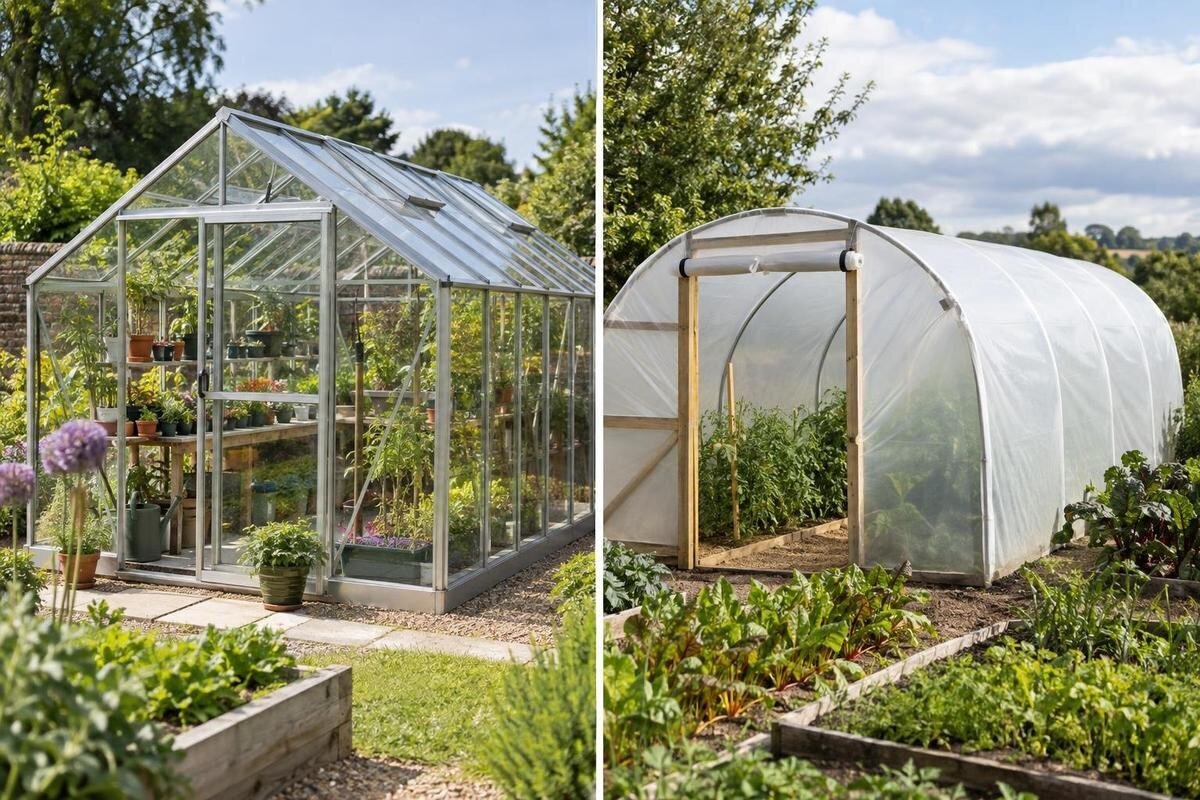
Greenhouse comparison
Choosing between a glass greenhouse and a polytunnel depends on what you need the structure to do. Compare how long you intend to keep it in place, how you will manage light and airflow, the usable growing space, and the routine upkeep or cover replacement involved. In a New Zealand garden, the actual site and the exact specification matter more than a broad label.

Match the structure to the way you grow
A glass greenhouse is typically a framed growing structure with rigid glass panels; a polytunnel usually uses flexible horticultural film over a frame. That difference affects repair: a pane may be replaceable individually, whereas a continuous film cover can need renewal as a sheet. Both formats vary, so treat this as a comparison of common structures, not a promise about a particular model. Frame design, glazing or film specification, openings, assembly and site exposure all influence how a structure works. Compare complete, specified options rather than treating glass and film as abstract materials.
List the jobs the space must do before comparing covers. You might want to raise seedlings, protect crops from heavy rain, extend the season, grow heat-loving produce or create a sheltered place to work. Each aim puts different demands on light, temperature, access and usable area. Note which crops will occupy the structure for most of the year, whether you will use beds or containers, and how often you can inspect it. Consider whether your routine allows for regular climate management and maintenance. A tunnel can have a long-term role, and a glass greenhouse still needs active care; neither is maintenance-free by definition.
A fixed greenhouse changes how you plan the garden
A glass greenhouse often suits a plan for a defined garden feature that will stay in one position and support the same routine over many seasons. Permanent beds, staging, a potting bench and a direct route from the house can all be planned around a stable footprint. That can make the space easier to organise, but it also makes placement and access important before assembly. Consider whether the structure will block a path, cast shade on another bed or restrict later garden work. Check the route for people carrying components during installation, not only the route you will use afterwards. A polytunnel can also remain in place for years, so do not assume a film cover makes it temporary or easy to move.
Check the complete site arrangement, not just floor area: access for installation, the path to the entrance, drainage around the base, and room to clean or repair the outside all affect daily use. The Prestige Greenhouse with Metal Foundation range is listed from 3.77 to 28.08 m², giving an area reference for fixed greenhouse options. Those figures do not show each option’s exact length, width or included specification. Compare a dimensioned plan with your plot and confirm the base, glazing, fixing details and access requirements for the version you are considering. Leave room to reach the structure later if a panel or frame needs attention.
Check light, shelter and access on the actual site
Light and shelter are site features, not advantages that automatically come with glass or film. Observe the proposed footprint at different times of day and, if possible, in more than one season. Note shade from buildings and trees, reflected heat, prevailing winds, low areas where water collects, and branches or debris that could affect the cover. A site that seems bright in summer may be shaded when seedlings need light in another season; an exposed sunny corner may bring extra work managing conditions. Record what happens on your plot rather than choosing by a generic orientation rule. Also note whether runoff could cross paths or make access awkward.
A polytunnel commonly needs clear working space around its frame so you can inspect or replace the cover; a greenhouse also needs room for assembly and exterior maintenance. If a wall-adjacent greenhouse is another possible layout, the Lean-to Greenhouse range is listed from 3.69 to 14.34 m². Compare its dimensioned plan with the wall, drainage, sun exposure and door clearance rather than assuming a name guarantees a fit. For either type, leave enough space to carry compost, trays or harvested produce in and out without walking through planting beds. On a tight site, access can matter more than nominal area.
Glass and film do not control climate by themselves
The covering affects light transmission and heat exchange, but it does not control the climate on its own. Different glass and film products pass light differently, and factors such as panel structure, film specification, dust and shade can change what reaches a crop. In bright weather, air inside an enclosure can warm rapidly; after sunset, it may cool, and protection from wind or rain does not establish a minimum overnight temperature. The material name alone cannot predict conditions for every crop or site. Ask for the exact covering specification and consider how it suits the plants you plan to grow.
Think about climate management as a complete arrangement: where air enters and leaves, whether openings can be managed in changing weather, what shade is available, how you will monitor conditions and whether supplementary heating is part of your plan. Some choices depend on the selected configuration; others depend on your regular routine. The Aluminium Classic Greenhouse range is listed from 3.77 to 28.08 m², but area figures alone do not establish the covering, vent arrangement or temperature performance of an option. Check those details for the exact model and size, then decide whether its operating routine fits your time and crops.

Daily ventilation and access need to work together
Daily ventilation is useful only if openings are placed and operated in a way that suits the crops and the structure’s length. Use a drawing to locate each door, window and vent; ask what is included in the chosen configuration rather than assuming an illustration covers every size. Consider how air can move through the planted space and whether openings remain accessible when beds or shelves are in use. A single opening may not distribute air evenly through a long structure. A doorway that is awkward to reach or too narrow for the equipment you carry can make routine work frustrating, so check clearances before settling on a layout.
Plan the route for people as carefully as the route for air. Allow space to carry watering cans, trays, compost or harvest containers, reach the back of a bench and operate doors fully. If storage is part of your plan, count it separately from the area you expect to grow in. The Limited Edition Aluminium Greenhouse with Built-in Storage listing spans 5.52 to 28.08 m²; use the selected drawing to see where storage sits and how much usable bed or bench space remains. The product name identifies a storage configuration, but the drawing is what lets you plan around its actual layout.
Site exposure matters for both structures
Wind and rain exposure affect upkeep as well as comfort. Wind can place stress on frames, fixings and covers; flexible film may move or abrade, while glass can be damaged by impact. These are general risks, not ratings for either category: details depend on the frame, cover, anchoring, condition and site. Heavy rain makes runoff and drainage relevant, while nearby trees may drop branches or debris. Across New Zealand, exposure can vary considerably between individual gardens, so observe the conditions at the proposed spot rather than relying on a broad regional label. Think about how those conditions would affect access for maintenance too.
For the exact model, ask for the manufacturer’s documented guidance on installation, anchoring and site exposure. If the ground or exposure needs specialist assessment, consult a suitably qualified local professional rather than estimating structural requirements yourself. Check whether you can reach the outside for cleaning or repairs once the structure is in place; a narrow gap beside a fence may be hard to work in. Do not treat a polytunnel’s flexible cover or a greenhouse’s rigid panels as proof that it suits a particular site. The supporting specifications and the condition of the installation matter.
Plan usable growing area, not just floor area
A stated floor area is not the same as usable growing area. Draw beds, containers, shelves, paths and door clearances to scale, then check the clear width and headroom where taller crops will sit. A central aisle may be convenient, but it needs to suit the tasks and equipment you actually use; benches and storage reduce the space available for planting. Sketch mature plants, not just seedlings, and allow room to reach them for picking and pruning. If you use containers, include their width and access space. For long structures, consider whether the ends and sides remain reachable without stepping into beds.
Compare like with like by asking for a dimensioned plan and distinguishing external dimensions from internal usable dimensions. The T-Model Orangery Greenhouse is listed in sizes from 16.52 to 30 m², which gives an area reference but cannot tell you how many beds will fit or how comfortable the aisle will be. Mark your intended layout on the drawing, including the entrance, paths, water access and tool space. Check where the frame or supports reduce clear space, and whether your planned crop heights work with the available headroom. This makes it easier to compare a greenhouse and a polytunnel on the space you can actually use.
Plan for cover repairs and replacement
A polytunnel cover is a component with an eventual renewal decision, not a set-and-forget surface. Film condition can depend on its specification, sunlight and UV exposure, tension, rubbing against the frame, weather and how it is handled. Look for the maker’s service guidance and replacement options for the exact frame rather than relying on a generic number of seasons. Regularly check for damage or wear, and ask whether the whole cover can be accessed for replacement. Consider whether the work is manageable for your household or might need help, and how much growing time a change could interrupt.
Glass can also need repair: panels may crack or break, and the fittings or seals that hold them need inspection and care. A broken pane should not be replaced with just any piece of glass; confirm the correct size, type and retaining parts with the supplier, and follow its safe-handling advice. Before purchase, ask how replacement panels are identified and sourced for the selected version. The Limited Edition Aluminium Greenhouses range is listed from 3.77 to 28.08 m²; that area range by itself does not tell you which replacement parts are available for a particular build. As with renewing a tunnel cover, consider whether you would need help with the repair and how it might interrupt your growing plans.

Compare upkeep as well as the initial quotation
Compare the work involved over the period you expect to use the structure, not only the initial outlay. For a tunnel, ask about compatible replacement film, the replacement process, care guidance and disposal options. For a glass greenhouse, ask about replacement panels, seals, fixings, cleaning and damage repair. Include likely labour or professional assistance if you do not expect to manage the work yourself, along with any time when beds may be out of use. There is no single ownership figure that suits every site: exposure, the selected materials and available parts all matter. Ask for current information rather than relying on generic lifespan or cost claims.
Compare quotations on the same basis: chosen dimensions, cover specification, included openings and base, assembly scope, parts information and any separately priced extras. The Pyramid Greenhouse listing gives areas from 5.53 to 18.9 m². Compare the selected size with a tunnel’s full footprint, rather than judging one by its area and the other by its length. Use the layouts to establish what each quotation provides in terms of planting space and access, then account for their different repair needs. Keep the written specification and parts guidance with your garden plan, so you can identify the exact configuration when maintenance or a replacement component is needed.
Which structure is more likely to suit your plans?
For a long-term growing space, decide which maintenance tasks you are willing to take on. A glass greenhouse means caring for rigid panels and their fittings; a polytunnel means inspecting flexible film and allowing for eventual cover renewal. Both also require ventilation management and attention to the site. If a fixed, glazed workspace is central to your garden plan, compare greenhouse configurations that accommodate your beds, benches and access. If your priority is a film-covered crop area, weigh the tunnel’s layout against the work involved in renewing its cover. Neither preference proves that one format is cheaper, easier or longer-lasting: the specification and your routine still determine how well it fits.
If you are comparing larger greenhouse footprints, the Bloomcabin Orangerie Spacious Greenhouse is listed from 47 to 70 m². That range is an area reference, not evidence that a large structure suits every garden or crop. Before choosing more space, distinguish the area your planned crops and working layout need from space you may not use. Consider how comfortably you could manage planting, ventilation, cleaning and repairs across the whole structure, whether it is glazed or film-covered. A larger footprint is worthwhile only if it supports your growing plans and remains manageable; an accessible, well-used space may serve you better than one that exceeds your needs.
Frequently asked questions
Can a polytunnel stay up all year?
It may be used year-round if its frame, cover, site and maintenance plan suit the conditions. The word polytunnel alone does not establish how it will perform in winter or in exposed weather, so check the maker’s guidance for the exact model.
Will a glass greenhouse always be warmer than a polytunnel?
No. The cover, ventilation, shade, size and weather all affect conditions inside. Neither type guarantees a particular temperature; compare the actual covering and opening arrangements, then manage the space for the crops you intend to grow.
How often does a polytunnel cover need replacing?
There is no reliable interval that applies to every cover. Film specification, sunlight, weather, tension and rubbing against the frame can affect its condition. Follow the supplier’s guidance and ask about replacement film for the exact structure.
Can I replace a broken greenhouse pane with any glass of the same size?
Do not assume so. The pane, its retaining parts and the greenhouse design need to be compatible. Ask the supplier which replacement parts are suitable and follow their safe-handling advice; seek help if you are unsure.
Which structure gives more usable growing space?
The cover type alone does not decide that. Compare internal dimensions, clear width, headroom, beds, paths, storage and door access on a drawing. A larger stated floor area may still leave less convenient space for your particular layout.
Make the comparison practical: list what you want to grow, note the conditions at the proposed site, then compare drawings and maintenance guidance for complete, specific structures. If a fixed glazed space fits your garden plan and upkeep routine, a glass greenhouse may be the better match. If a film-covered growing area suits your crops and you can plan for renewal, a polytunnel may suit you better. The right choice is the one you can use and maintain well.
