
Practical Greenhouse Automation Without Mains Power
Greenhouse planning
Running a greenhouse without a mains connection does not rule out useful automation. A heat-responsive vent opener can work mechanically; a battery timer can run a defined watering routine; stored water can supply a suitable irrigation system. Each option depends on something being in place and maintained. Vents must move, batteries need checking and water has to reach every growing area. The practical question is not how to make the greenhouse fully self-running, but which repetitive job is worth automating, what that job depends on and how you will manage a failure.

01
What automation can do without mains power
Off-grid describes the energy arrangement, not a particular level of independence. Passive controls use heat or gravity rather than an electrical supply; battery devices store electricity for a timer, sensor, valve or pump; solar equipment converts sunlight to electricity and may also need storage. These approaches do different jobs. A mechanical vent opener can respond to temperature, while a timer follows a schedule whether the crop needs water or not. An alarm may report a condition without changing it. Separate monitoring, control and physical delivery when comparing claims: a device that senses a problem is not automatically able to correct it. A greenhouse may use one category or combine several, but every component brings its own limits and upkeep.
Before buying anything, record the tasks you repeat: opening vents, checking temperature, watering containers, refilling a tank or inspecting emitters. A week of notes can show which task takes time and what currently triggers it. Then mark the growing area, openings, water source, control points and walking route on a plan. The T-Model Orangery Greenhouse is listed in sizes from 16.52 to 30 m²; use the selected footprint to sketch the layout, not as a measure of water demand or proof that controls are included. This turns an abstract automation plan into a list of specific jobs.
Passive ventilation works without an electrical supply
A common non-electric ventilation option is a thermostatic opener with a wax-filled cylinder. As the cylinder warms, it expands and moves a linked vent; as it cools, the mechanism can allow the vent to close. The opener itself does not need mains electricity or a battery, but it acts only on the opening to which it is fitted. It does not create airflow like a fan. Its usefulness depends on having suitable vents and a path for air to enter and leave, so consider the whole ventilation arrangement rather than treating one opener as temperature control for the entire greenhouse. Keep the opening free to travel through its intended range.
Passive movement has limits. Wind, shade, vent position and obstructions affect air exchange; an opener will not guarantee one internal temperature or respond to every sudden change. Keep an eye on the plants and the vent through changing conditions, particularly while learning how it behaves. The Pyramid Greenhouse is listed across sizes from 5.53 to 18.9 m², which makes the exact selected structure and opening details worth checking. The listed area alone does not confirm vent count, dimensions or opener compatibility. Ask for those details before choosing an actuator.
02
Match an automatic opener to the vent
Before fitting an automatic opener, match it to the specific vent and follow the opener maker’s guidance. Check the permitted opening type, mounting point, movement and the space the mechanism needs throughout its travel. A vent that is stiff, obstructed or poorly aligned may not move as expected; a controller cannot correct a mechanical problem. Compare the opener’s stated travel and operating limits with the greenhouse supplier’s information, and ask both suppliers if the specifications are unclear. Avoid assuming a visually similar window uses the same bracket or actuator. Establish how the vent can be opened or secured by hand, too.
The Limited Edition Aluminium Greenhouses with Storage range is listed from 5.52 to 28.08 m². If you are comparing several openers, use the same selected structure and vent details for each rather than switching between general product descriptions. Note where compatibility is confirmed and where it remains unclear, along with any separate brackets or accessories specified. A product-family name or floor area cannot tell you which opener fits. This keeps the comparison focused on the vent you will actually use and avoids mistaking a general claim of automatic ventilation for a complete, compatible installation.
Use battery controls for clearly defined tasks
Battery-powered controls are most useful when the job is specific and the device’s output is compatible with it. A battery timer may switch a suitable irrigation valve on a schedule; a sensor-based controller may act on a measured condition; a simple monitor may only display or report one. Confirm exactly what the unit controls, how it retains settings when batteries are changed and whether it needs a signal or separate hub. A timer that runs regardless of rain or water availability still needs a suitable schedule. Battery power removes the mains connection, not the need to check that the equipment is working.
Include battery care in the task list. Check the manufacturer’s stated operating life and warnings, note when batteries are replaced, and test the device afterwards to confirm its settings and output. Keep replacement batteries accessible, but use the type specified for the equipment. Sensor placement also matters: a reading from an unrepresentative spot may not describe conditions around the plants. A Bloomcabin Prestige Greenhouse is listed in sizes from 3.77 to 28.08 m²; plan the control and sensor positions around the exact layout you choose. The product’s size range does not indicate that a controller is included.

03
Solar power still needs an energy plan
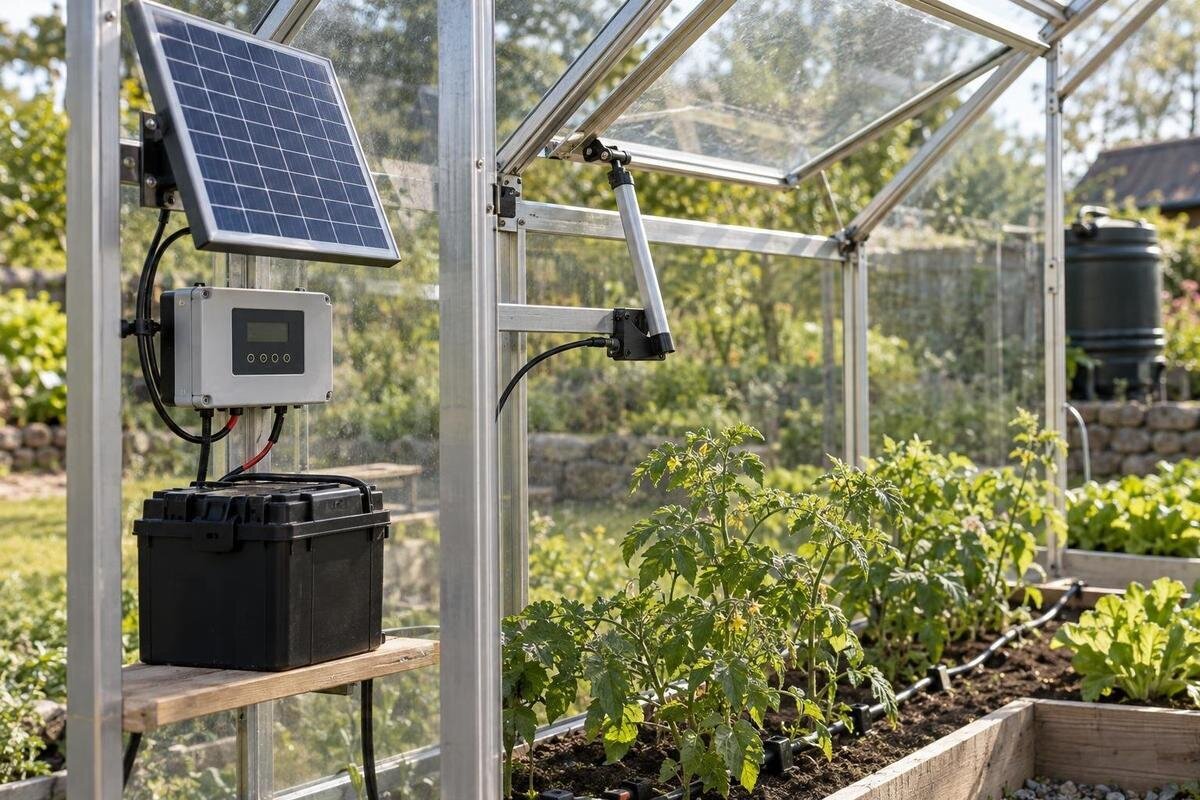
Solar-powered equipment is off-grid, but it is not passive. A panel supplies electricity to a control or pump, and some systems use a battery or other storage so they can operate when generation is low. Shade, changing sunlight, dirty panels and the device’s own demand can all affect whether the system has enough energy. A solar pump and a solar sensor have different jobs and requirements; the presence of a panel does not establish that either will run continuously. Check how the proposed equipment behaves when its available power falls, rather than treating solar as an unlimited supply.
Ask the supplier for the operating limits of the complete setup, including the controller, storage and any pump or valve it will run. Find out what happens after a low-power interruption: does the device stop, retain its schedule or restart in a particular state? Check whether the expected performance applies to the conditions at your site and whether the panel can be positioned and maintained as instructed. Avoid sizing a system from a general rule of thumb when the equipment’s specifications are available. For fixed electrical work or a complex installation, use a suitably qualified professional.
Plan the water supply as carefully as the power
A greenhouse without mains electricity may still have a mains-fed tap, but electricity and water are separate supply questions. If there is no convenient tap, stored rainwater or a filled tank may be an option. Decide how the supply will be replenished, how much water is realistically available and whether the tank can be reached for filling and cleaning. Automated irrigation can only deliver water that is present and accessible. A pump adds an electrical load; a valve and timer still require a compatible source of flow and pressure. Put the water route into the plan rather than treating it as a late accessory.
Gravity-fed systems can avoid a powered pump when the tank position and delivery equipment are designed for gravity, but gravity alone does not make watering automatic. Flow can vary along a line, and emitters or valves may have stated operating requirements; check those against supplier information instead of assuming a kit will work from any tank. The Spacious Greenhouse listing spans 47 to 70 m², a footprint you can mark out when considering where watering zones might go. That area does not determine crop water needs. Plant mix, containers and growing conditions matter, as does the effort required to refill the supply.
04
Test irrigation before relying on its schedule
Checking irrigation means looking at what reaches the plants, not just watching a timer switch on. Run the system with the intended water source and collect water at several points along each line; compare the amounts reaching near and far containers, then inspect the growing medium. Look for blocked or kinked lines, leaks, uneven flow and pots that dry at different rates. A timer duration is not a measure of water delivered, because the result depends on the equipment and supply. Make changes only within the manufacturers’ instructions, then check the delivery again.
Keep a simple log of settings, water use, battery changes, tank refills and any manual watering needed. That record helps distinguish a useful reduction in routine work from a system that adds more checks than it removes. Test after changing the layout, replacing a component or adjusting the water source; a previous result may no longer apply. Do not assume one schedule suits every crop or container. The aim is to find out what your setup actually delivers and how much attention it needs, not to make a timer’s schedule stand in for observation.
Keep manual access and a fallback
Plan for ordinary failures: a tank runs low, a battery loses charge, a line blocks or a vent sticks. For each automated task, know how to check it and what you can do by hand if it stops. Depending on the equipment, that might mean being able to operate a vent, stop water flow or water containers manually. Ask how the device behaves when it loses power and whether it has a manual control; do not assume every model does. Keep the route to valves, controls and vents clear enough to reach them without shifting growing equipment.
Remote alerts can be helpful only when the sensor, power supply and communications link are all working. They do not replace a visit to inspect the greenhouse, and a connection problem can prevent an alert from reaching you. The Aluminium Greenhouses range is listed from 3.77 to 28.08 m²; whichever size you consider, include access to manual controls in the layout. Consider what an alert would require you to do: inspect a stuck vent, refill the water supply or switch to manual watering. Keep that response simple enough to carry out when the automated equipment is unavailable.

05
Keep watering zones and controls manageable
More devices do not automatically make a greenhouse easier to manage. Different plants or containers may need different watering attention, while a single timer follows one schedule unless the system supports separate zones. Group plants with similar needs where practical, then decide whether separate control is worth the additional valves, settings and checks. For ventilation, one temperature-responsive opener may solve a specific task without adding a powered controller. Start with the repetitive job that matters most and keep the arrangement understandable enough to inspect and adjust.
Each extra sensor, battery, filter, valve or pump adds another item to maintain and another possible point of failure. Compare that upkeep with the time the device is expected to save. The Lean-to Greenhouse range is listed from 3.69 to 14.34 m²; mark the exact layout before deciding whether it needs one watering zone or more. Put the proposed crop groups on that plan, then identify which could share a schedule and which need separate attention. This gives each proposed control a clear purpose, rather than adding automation simply because there is room for another device.
Plan equipment placement and supplier checks
Think about where equipment will sit before choosing it. A temperature sensor needs to follow the maker’s placement guidance and should represent the conditions you want to monitor; a solar panel needs a suitable position for its intended use. Keep controls and water equipment accessible, and avoid putting them where routine work will obstruct vents or walkways. The Limited Edition Aluminium Greenhouses range is listed from 3.77 to 28.08 m². Mark the exact size and layout you are considering, then show the supplier where you expect vents, controls, growing areas and water equipment to be located.
Before buying, ask which openings the proposed vent control fits, what power source and accessories it needs, what valve or pump it can operate, and what flow requirements apply. Confirm what is included and what must be sourced separately; a greenhouse listing alone does not establish that automation equipment is supplied or compatible. Ask how the device is operated by hand and what maintenance the manufacturer expects. Where the plan involves fixed electrical work, plumbing or structural mounting, seek advice from a qualified professional rather than improvising. Clear answers make it easier to compare equipment on what it can actually do.
Frequently asked questions
Can a greenhouse be fully automated without mains electricity?
Some jobs can be automated, but a complete hands-off system should not be assumed. Passive vent openers need no electrical supply, while battery and solar controls depend on their power source, compatible equipment and maintenance. Water still needs to be available, and someone needs to check for faults and respond when conditions change.
Do automatic greenhouse vents need batteries?
A common wax-cylinder vent opener operates mechanically and does not need a battery. Motorised or electronic controls are different and need a suitable power source. Check the instructions for the specific opener and confirm that it fits the vent you intend to operate.
Will gravity-fed irrigation work without a pump?
It can work when the tank position and irrigation components are designed for gravity-fed delivery. Flow and distribution still depend on the system, so check the equipment’s requirements and test water at different points. Gravity alone does not provide timed control; a compatible timer or manual operation is still needed.
How often do battery controls need new batteries?
There is no reliable interval that applies to every controller. Battery life depends on the device, its settings and how it is used. Check the manufacturer’s estimate, look for a clear low-battery warning, and test that the controller retains its settings after a battery change.
Can a solar-powered pump be relied on in cloudy weather?
Not without checking how the complete system is designed to operate when sunlight is limited. Some setups store energy; others may not. Ask the supplier about the pump’s requirements, energy storage and operation during low generation, then test it at your site rather than assuming a solar panel will provide continuous power.
An off-grid greenhouse setup is most practical when each automated job has clear operating requirements, compatible equipment and a workable manual fallback. Let passive ventilation handle the opening it is fitted to, use battery or solar controls for defined tasks, and check water delivery at the plants. Record what needs refilling, recharging or cleaning. If a failed timer or empty tank would cause a serious loss, reduce dependence on unattended operation rather than simply adding another device. Automation can remove a routine chore; observation remains part of growing.
