
Drip Line or Soaker Hose for Greenhouse Beds?
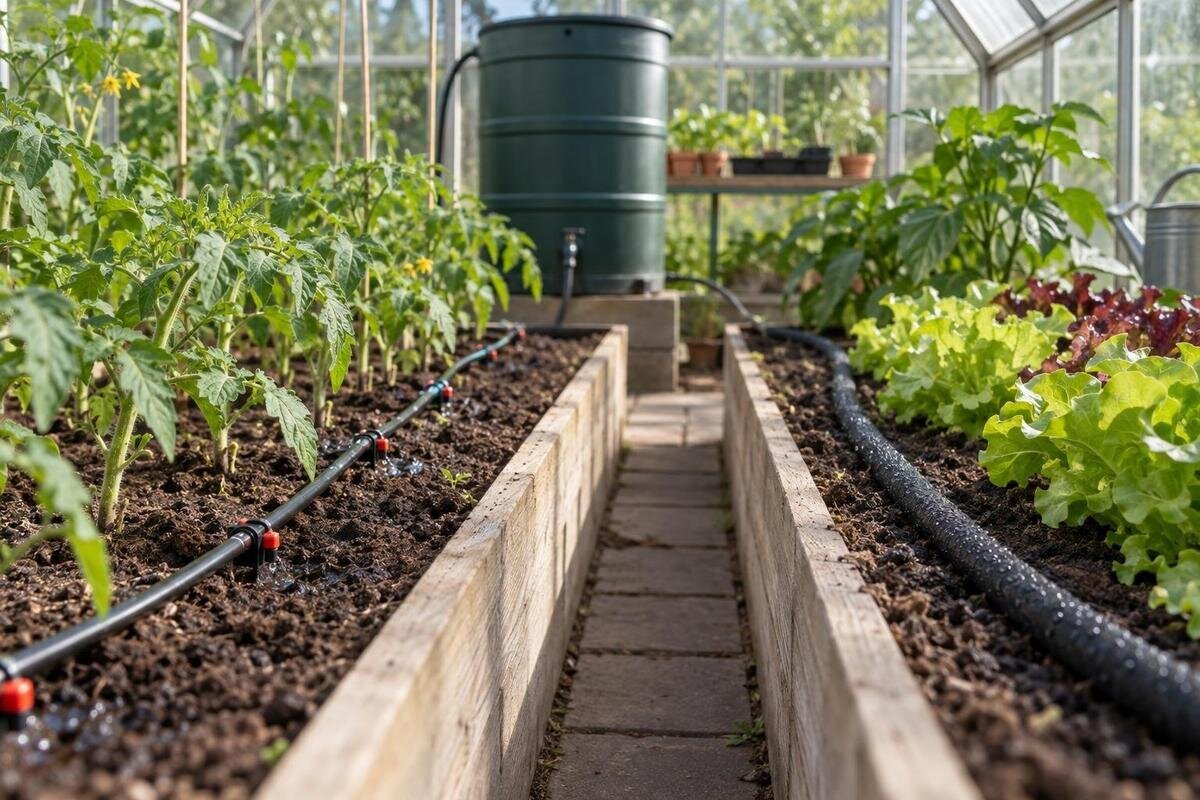
Greenhouse watering
Dripline and soaker hose both deliver water close to greenhouse-bed roots, but neither guarantees an even soak on its own. Dripline releases water through spaced emitters; a soaker hose seeps through a permeable length. The practical choice depends on bed shape, planting pattern, pressure and flow at the line, water cleanliness, soil and the checks you can maintain. Test the full run in your own beds before settling on a method.

How dripline and soaker hose release water
A dripline is a tube fitted with outlets at set intervals; each emitter releases water at a rate specified for the product and its operating pressure. Water arrives at separate points, so emitter spacing and plant position matter. Products vary in outlet spacing, flow, pressure range and pressure compensation; those details are not interchangeable. A soaker hose releases water through a porous wall, or through fine openings depending on the design, creating a longer strip of wetting rather than separate outlet points. Its flow also depends on pressure, run length, hose construction and surrounding soil. Neither label alone tells you the final wetting width or how much water reaches each plant.
In a covered greenhouse, rain does not normally reach the beds, so the line layout needs to cover the growing area rather than fill gaps left by rainfall. One dripline can leave dry strips between rows, while a soaker hose can wet an uneven band. Sketch bed edges, rows, paths and the route from the water source before choosing, and measure the actual run rather than the greenhouse length; bends and unplanted gaps change it. The catalogue’s Aluminium Greenhouses range is listed from 3.77 to 28.08 m², a reminder to work from the selected floor plan and bed lengths rather than a category name.
How evenly does each line water a bed?
Uniformity has two parts: how consistently water leaves the line, and whether it reaches the roots evenly. A well-matched dripline can place outlets beside a row, but pressure loss, blocked emitters, a kinked feed or unsuitable spacing can make delivery vary. Pressure-compensating emitters, when fitted and used within their specified range, may reduce variation along a line; they cannot correct every blockage or installation issue. A soaker hose can wet continuously along a row, yet the amount released may taper along a long run or change with pressure and position. Soil texture also affects how far water spreads sideways.
Test the full length rather than judging the first section. For dripline, collect water from emitters near the inlet, in the middle and at the far end in similar containers for the same measured interval. Compare the amounts and repeat if the result seems inconsistent. A soaker hose cannot be assessed by counting drops, so check the soil beside it at equivalent points, then across the bed, using the same method each time. Where storage is part of the greenhouse plan, keep its footprint separate from the growing-bed map; check the selected Limited Edition Aluminium Greenhouses with Storage option before setting line lengths.
Match the line to bed shape and planting pattern
Rows of evenly spaced plants can suit dripline if the emitter positions and flow match the crop layout. The number and position of lines depend on bed width, plant spacing, soil and the product instructions; there is no reliable universal count for every bed. If emitters sit between plants, water must spread through the soil to reach the roots. Check that the wetting pattern reaches across the planted area instead of assuming each emitter waters a fixed-width circle. As plants grow or rows change, positions that once worked may no longer match the planting.
A soaker hose can be placed along a continuous row, but one hose may leave the edges of a wide bed dry, particularly where water does not spread far sideways. More lines or a different placement could be needed, but a test is the way to assess a particular hose in your soil. Tight turns and short, disconnected beds can also make a run less practical. The Spacious Greenhouse is listed in sizes from 47 to 70 m², but floor area alone does not set the number of irrigation lines; map each bed and its actual length separately.
Check pressure, flow and run length
Check pressure and available flow where the irrigation will connect, using the supply arrangement you intend to run. A tap, stored water and a gravity-fed setup can provide different operating conditions, and a product designed for one pressure range may not work as intended on another. A regulator can help control pressure when the supply is higher than a line’s specification, but it cannot create pressure or flow that is not available. Compare the required pressure, flow per emitter or length, and any stated maximum run with the manufacturer’s information. Do not assume a hose will perform as expected simply because it fits the tap.
Long runs and several lines open at once can reduce pressure at outlets, depending on the supply and layout. If the far end is consistently weaker, the cause might be the source, a restriction, a poor connection or the line’s design; increasing the watering duration before checking can make some patches too wet. Test a line on its own and in the configuration you plan to use. A Lean-to Greenhouse is listed from 3.69 to 14.34 m², but a floor-area range does not establish pressure or a permissible hose length. Use the irrigation product’s operating data for those decisions.

What filtration does each system need?
Filtration is particularly important to investigate with drip emitters, which can have narrow passages that sediment may obstruct. Some dripline products specify a filter and a particular mesh or micron rating. Follow that requirement; do not select a filter by guesswork or assume that a finer rating is automatically suitable. Soaker hoses can also be affected by particles or deposits in their porous wall, and their filtration requirements vary. Check the hose maker’s guidance rather than treating a porous hose as self-cleaning. The right filter depends on the irrigation product as well as the water source.
Water from a tank can carry grit, leaf fragments or other debris even when it looks clear, so consider the source as well as the line. Put any required filter where you can inspect and clean it without disturbing the beds. Keep its specifications with the irrigation instructions so you can refer to the required rating when buying a replacement. Include filter access in the greenhouse plan alongside the water connection and feed-line route. If you are comparing the Bloomcabin Prestige Greenhouse, plan these irrigation components separately; its greenhouse listing does not specify irrigation fittings.
Keep irrigation lines accessible and protected
Plan a serviceable route. Keep connectors and line ends accessible, and avoid crushing tubing under a board, kneeling pad or frequently used path. Sharp kinks can interrupt flow, so check bends and turns before fixing the layout. Confirm that connectors fit the specified line and that tees, end caps and valves are intended for that system; similar-looking parts are not necessarily compatible. Place dripline emitters in relation to the planting row. For soaker hose, follow the maker’s instructions, including whether the hose may be covered or buried. Do not assume the two types share fittings because their outside diameters look alike.
You will need to reach the line to inspect leaks, flush it as directed or reposition it when the crop layout changes. Leave enough access for hands and tools without placing the hose where it will routinely be stepped on. When comparing building options in the Limited Edition Aluminium Greenhouses range, trace the feed line, bed lines and access routes on the selected floor plan. Include the positions of connectors and line ends, not just the route of the tubing. Laying out the lines before watering can reveal an awkward turn or connector that would be hard to reach once the beds are in use.
Check moisture at root level
Judge moisture at root depth, not from the surface alone. A damp strip on the surface can mask dry soil a little way away, while one wet patch does not prove the full root zone is supplied. After running either system, compare soil beside and between the lines, at the start, middle and far end of the bed. Use the same sampling depth and method at each point; a small soil sample or a correctly used moisture meter is more informative than looking at the surface alone. Allow moisture to redistribute after watering, and use a consistent interval before comparing results.
Soil texture and structure shape the wetting pattern. Coarse, compacted or fine-textured ground can behave differently, and amended beds may vary within one greenhouse. A soaker hose’s wet band may extend sideways by different amounts along the same bed; drip outlets may form separate wetting zones that join or remain apart. Adjust line positions only after checking the root-zone pattern and the product’s permitted layout. If you are planning beds for a T-Model Orangery Greenhouse, mark the sampling points on your proposed bed plan. Include both planted areas and gaps between lines so the comparison covers more than the soil immediately beside an outlet.
Maintenance and common watering faults
Inspect the inlet, filter, connectors and line before operation, then look for the same fault patterns during a run. A dry patch at one drip emitter can point to a blocked or damaged outlet; a consistently weak far end can suggest a pressure or run-length issue. A sudden wet patch may indicate a loose joint or split hose rather than useful extra coverage. With a soaker hose, look for sections that stay dry relative to the rest, but confirm the pattern in the soil as well as on the surface. One symptom alone rarely identifies the cause.
Clean and flush only by the method approved for that product. Check the maker’s instructions before removing an end cap or applying any treatment; avoid needles, wire and unapproved chemicals that may enlarge emitters or harm porous material. Keep a brief note of what you found and what changed, so you can distinguish a repeat fault from a one-off kink. When considering a Pyramid Greenhouse, include access to line ends in your bed layout. Check whether you could reach a suspect connector or remove a line for maintenance without disturbing the planting, rather than assessing access only while the beds are empty.

Which option suits your greenhouse beds?
Dripline is a good candidate when the crop rows can be matched to the product’s emitter spacing, its pressure and filtration requirements are manageable, and you want water released at defined points. It can be harder to adapt if planting is irregular or emitters miss the root zone; a different spacing or position may help if the product permits it. A soaker hose is worth considering for a continuous row when its specified pressure and run length suit the supply and its wetting band reaches the intended roots. Neither is automatically the lower-maintenance choice: a blocked emitter and a partly obstructed porous hose both need attention.
Compare the manufacturer’s specifications before buying: operating pressure, flow, outlet spacing or porous-line guidance, permitted length, filtration, connector size, cleaning instructions and whether the line can be covered. Check that the product is intended for your water source; a timer, tank or fitting does not make an otherwise unsuitable line compatible. Consider how stable the planting pattern will be. Fixed rows may stay in place, while a bed replanted with different spacing may need a line that is easier to reposition. If the pressure or filtration requirements are unclear, ask the supplier for the exact information rather than choosing by broad claims such as even or gentle watering.
Test the system before setting a routine
Before settling on a regular watering routine, lay out the chosen line, filter and connections as specified, then run the system from its actual supply. Check for leaks, compare output along the line and inspect moisture in several places across each bed. Bring the output measurements and soil observations together: consistent delivery at the outlets and adequate moisture between lines are separate checks. Record the supply arrangement, which lines were open, the watering duration and the locations sampled. Repeat the checks at those locations after any adjustment. These notes give you a baseline for recognising changes in performance later, rather than relying on memory.
If the wetting is uneven, change one factor at a time: remove a kink, clean the filter as directed, reposition the line or alter its length if the product allows it. Then test again rather than assuming a longer watering time will fix a dry section; it may worsen wet patches elsewhere. If pressure, flow or compatibility remains unclear, ask the line maker or a qualified irrigation professional to assess the supply. The useful outcome is a system whose requirements match your water source and whose wetting pattern you have verified in your own soil.
Frequently asked questions
Is dripline always more even than a soaker hose?
No. Dripline can deliver consistently at its emitters when spacing, pressure and filtration suit the product, but blockages or pressure loss can change the output. A soaker hose wets along its length, though flow can vary with pressure, run length and soil. Check the far end as well as the inlet.
Does a soaker hose need a filter?
It depends on the product and water source. Some soaker hoses specify filtration, and particles can affect their porous wall. Follow the hose maker’s guidance rather than assuming that a soaker hose can handle unfiltered water.
Can either type run from a tank or gravity-fed supply?
Only if the irrigation product is designed for the pressure and flow that supply provides. Check its operating requirements and filter guidance, then test the actual setup. A timer controls when water flows; it does not correct a pressure mismatch.
How can I test a dripline for even output?
Collect water from emitters near the inlet, around the middle and at the far end for the same measured interval. Compare the amounts and repeat under the configuration you plan to use. Check the soil as well, because equal emitter output does not guarantee equal moisture at the roots.
How do I know whether the whole bed is getting wet?
After watering, compare soil at root depth beside and between lines, and at several points along the bed. Use the same sampling depth and method each time. A damp surface or one healthy-looking plant does not show whether moisture reaches every part of the bed.
Dripline offers defined emitter positions; a soaker hose delivers water along a permeable length. Those descriptions set expectations, not a guarantee of uniform moisture. Bed geometry, soil, pressure, filtration and access all affect performance. Compare the actual product requirements with your supply, lay out the lines around the planting, then check moisture at several points. The better fit is the method that meets its specifications and produces a pattern you can verify and maintain.
