
Why Greenhouse Eggplants Flower but Do Not Fruit
Greenhouse crop care
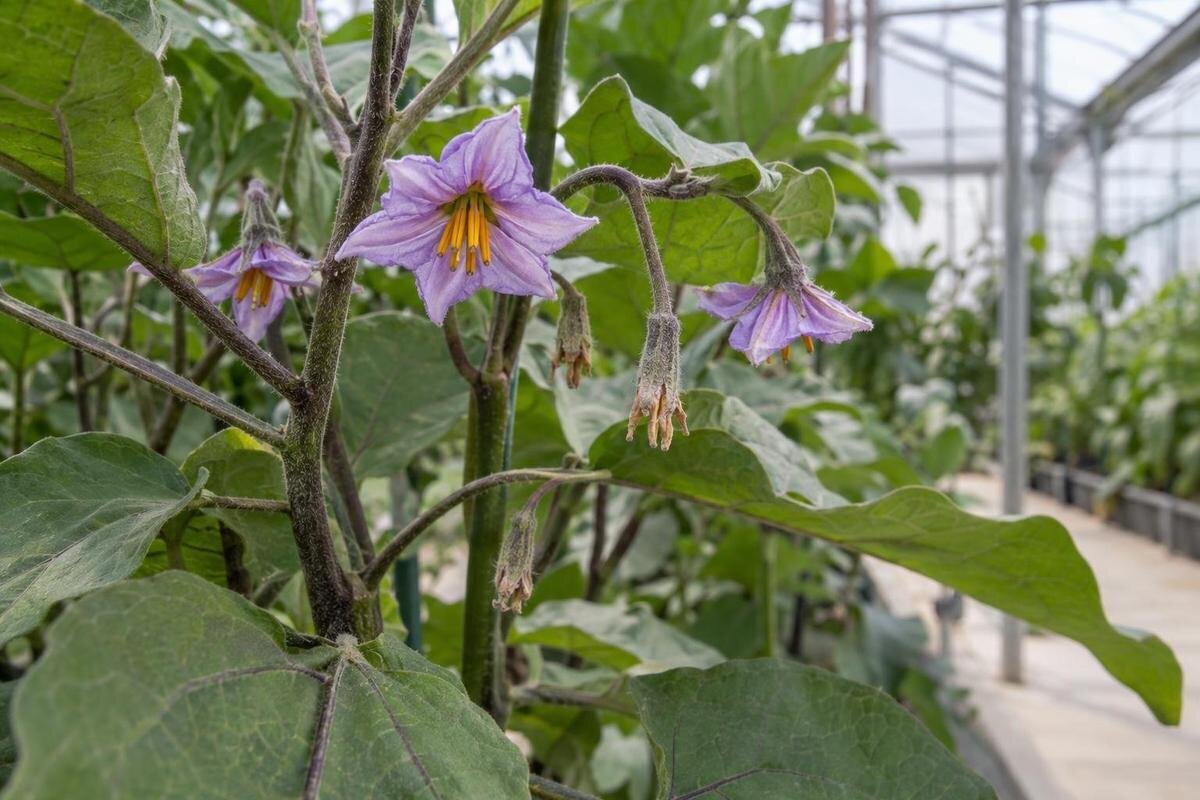
Greenhouse eggplants can flower well and still produce no fruit. That does not automatically mean pollinators are missing: each flower has both reproductive parts, but pollen still has to be released and reach the stigma under suitable conditions. First check whether a flower merely loses its petals or whether the small ovary at its base never grows. Then compare flower shape, day and night temperatures, airflow and plant health across several blooms before changing care.

01
How to tell whether a flower has set fruit
An eggplant flower has a small ovary at its base. After successful pollination and fertilisation, that green base remains attached and begins to enlarge; the petals can wilt and fall as this happens. A fading flower is therefore not proof that it has failed. A more useful sign is what happens to the ovary and stalk: if both drop without any swelling, fruit has not set. If a tiny fruit starts to grow and then yellows or falls, initial set may have occurred but the young fruit was lost later.
Check several flowers at different stages: unopened buds, fresh blooms and flowers whose petals have fallen. Note whether the stalk has dropped, whether the ovary remains attached, and whether nearby leaves are wilting or discoloured. Keep these observations separate: a bud that never opens is not the same as a flower that opens but fails to set. A cluster of losses after a hot spell suggests a different line of investigation from one isolated blossom. Take a whole-plant photo as well as close-ups so you can relate each flower to the plant’s condition. If losses repeat in one corner, mark the affected plants on a simple plan. For buyers considering a larger growing space, the Spacious Greenhouse range lists areas of 47–70 m². Use the proposed layout to identify separate beds, rows and access routes; the total floor area alone does not tell you which growing positions will be shaded or have little air movement.
Eggplant flowers can pollinate themselves
Eggplant flowers are bisexual and generally self-fertile: each flower has anthers that produce pollen and a stigma that receives it. There are no separate male flowers to wait for, as there are in some crops such as cucumbers. However, eggplant pollen is held in anthers that release it through small pores, so movement or vibration can help shake it free. A flower having both reproductive parts does not guarantee that pollen reaches a receptive stigma or remains viable in poor conditions.
If few insects enter a closed greenhouse, the lack of buzzing may remove one source of vibration, but it does not explain every dropped bloom. On a dry, open flower, gently tap its stalk or a nearby support; avoid pulling petals or shaking the whole plant. Try this on several flowers and note which ones you treated, then watch whether their ovaries enlarge over the following days. Where possible, also observe similar untreated flowers on the same plant. This gives you a more useful comparison than tapping every bloom and having no reference, although differences between flowers mean it is not a conclusive test. Improved set may suggest that pollen release was limiting; tapping cannot correct heat, cold or an unfavourable flower form. When planning access in a Limited Edition aluminium greenhouse, compare the selected dimensions with the space your plants and supports will occupy. You should be able to reach open flowers without pushing through neighbouring foliage.
02
Flower shape can reveal a pollination problem
Eggplant flowers do not all have identical proportions. In a fresh flower, the central style carries the stigma, surrounded by a cone of anthers. Growers describe long-, medium- and short-style flowers according to how far the stigma extends relative to that cone. In general, a long-style stigma projects beyond the anthers, a medium-style stigma sits near them, and a short-style stigma remains below. Long- and medium-style flowers are more likely to set fruit; short-style flowers often fail.
Inspect a fresh flower from the side and note the stigma’s position; do not pull the flower apart or touch the stigma, which can damage it. Compare several blooms at different points on the plant, because one plant can produce different flower forms and growing conditions can affect development. If the central parts are difficult to distinguish, record the flower as unclear rather than forcing it into a category. A side-on photograph is useful for comparing the stigma with the anther cone, whereas a view straight into the flower may make their relative positions harder to judge. Keep the photo associated with that flower’s later outcome: whether the ovary enlarges or the whole flower drops. A photograph cannot reveal pollen viability or confirm fertilisation. If many flowers have short styles, record that as a clue alongside temperature and plant-health observations, not as proof of a single cause.
Measure the temperature where the blooms are
Eggplant is a warm-season crop. As a broad guide, days around 21–29°C and nights around 15–21°C are often favourable for fruit set. Repeated daytime peaks above roughly 32–35°C or nights below about 15°C can interfere with pollen development or fruit set. These are warning ranges, not exact cut-offs: the duration of a spell, the cultivar, moisture and plant health all affect the response. Conditions while a flower is developing may matter as well as the temperature on the day it opens.
Use a min/max thermometer near flower height, shaded from direct sun and away from the glazing, then record daytime highs and overnight lows for several flowering days. Read and reset it consistently so each entry covers a clear period. Note when fresh flowers open and when they drop; an outdoor weather report does not show the temperature inside your greenhouse. Keep the readings alongside observations about the flowers rather than relying on a remembered hot afternoon. If you move the thermometer, record its new position so you do not mistake a change in measurement location for a change in conditions. Repeated extremes may also inform a future greenhouse purchase. When comparing the T-Model Orangery Greenhouse, examine the selected model’s glazing and ventilation details in relation to your site. Use your current temperature record to explain the problem you want to address, rather than assuming that a different greenhouse name or shape will prevent heat or cold stress.

03
Ventilation and pollination are related but different
Very humid air can make pollen less free-flowing, while hot, stagnant air can keep the canopy warmer. Extremely dry heat can also affect pollen viability, so simply opening a vent is not a complete diagnosis. Air exchange can reduce stagnant heat, but it does not necessarily create the vibration that helps release pollen from eggplant anthers. Insect visits are another possible source of vibration; openings or insect mesh may affect whether visitors can reach the crop.
Keep the flower zone from becoming crowded and stagnant, and use the greenhouse’s existing ventilation without exposing warm-season plants to a sudden cold draught. Note which doors or vents were open during the period covered by your temperature readings. This helps distinguish conditions in a closed greenhouse from those after ventilation, rather than treating both as one situation. If you have a suitable humidity meter, record its readings alongside temperature and flower symptoms; humidity alone cannot identify the cause. Also note whether insects can reach the flowers, keeping that observation separate from air movement. For a future purchase, compare the Pyramid Greenhouse with your proposed crop layout using explicit ventilation details. Consider whether you can reach and operate the openings once plants are fully grown, and whether foliage or stored items would obstruct access. That is a practical layout check, not evidence that a particular structure will solve poor pollen release.
Check moisture around the roots
Both dry roots and waterlogged soil can stress an eggplant and contribute to flower or young-fruit drop. The surface can be misleading: the top may look dry while the root zone is still wet, or the surface may look moist while a pot has dried out lower down. Containers can dry at a different rate from garden beds, especially during warm, sunny weather. A plant that wilts in a dry medium may need water; one that wilts while the medium is persistently wet may have a drainage or root problem instead.
Check moisture below the surface in the root zone and make sure containers drain freely. Aim for reasonably even moisture without keeping roots saturated; avoid repeated drying out or watering by a fixed calendar when conditions change. Check individual pots rather than assuming every plant needs the same amount. In your notes, distinguish a dry pot from a persistently wet one, especially if both plants are wilting. Record which container you checked and when you watered it so later flower losses can be compared with its own moisture history. Make sure your layout allows you to inspect the medium and drainage without repeatedly moving plants. If considering the Limited Edition greenhouse with built-in storage, measure the planting, storage and access areas separately. Plan where watering equipment will go and how you will reach each container; the overall footprint is not the same as the area available for plants.
04
Lush foliage can point to a feeding imbalance
A vigorous plant can still fail to set fruit. Excess nitrogen can encourage rapid shoots and abundant leaves, sometimes at the expense of a balanced flowering crop; a dense canopy can also shade blooms and hold damp air. Weak growth from poor nutrition, damaged roots or depleted growing medium may also leave flowers vulnerable. Dark leaves or a large canopy are clues to investigate, not a diagnosis on their own, since low light and other growing conditions can produce similar signs.
Review the fertiliser type, recent applications, potting mix or soil, and any existing soil-test results before changing feed. Record what was applied and which plants received it; a vague recollection of feeding is less useful than a clear history. If affected and unaffected plants have had different treatment, note that difference without assuming it proves the cause. Adding phosphorus or another nutrient just because flowers are dropping will not solve poor pollen transfer or a stressful temperature. Follow guidance appropriate to the growing medium rather than relying on a single remedy. For a new growing space, such as a Bloomcabin Prestige Greenhouse, decide whether the eggplants will be in beds or individual containers and record the medium used in each. Keep that planting information separate from the greenhouse specification. It gives you a usable basis for feeding decisions and helps prevent plants in different media from being treated as though their root conditions were identical.
Light and plant spacing affect flowering
Eggplants need good light to support steady growth and fruiting. A greenhouse can appear bright while neighbouring plants, a nearby structure or dense foliage shade the flowers for much of the day. Low light can contribute to weak growth and poor set, while an overheated canopy is a separate problem to check with a thermometer. Do not assume that more sunlight alone will fix flowers dropping after a hot spell; assess light and temperature together.
Watch which blooms receive direct light and whether leaves overlap heavily around them. Look at more than one time of day: a brief sunny view does not describe the whole flowering period. Note whether shade comes from the plant’s own canopy, neighbouring crops or something outside the greenhouse. Compare plants in open and shaded positions, and check whether poor set follows a particular row or corner. Keep temperature readings with these observations so a sunnier position is not automatically treated as a better one. If you are choosing among the Aluminium Greenhouse size options, the listed areas range from 3.77 to 28.08 m². Sketch the proposed rows, mature plant positions and neighbouring crops within the selected footprint. Check that plan against the site’s aspect and surrounding shade; a larger floor area alone does not establish how much light will reach the eggplants or whether their foliage will overlap.

05
Inspect for pests and keep a photo record
Inspect buds, open flowers and the undersides of leaves for signs of damage. Thrips can scar flowers, while aphids may cluster on tender growth; stippling or webbing on leaves can point to other pests. These signs are more informative than flower drop alone, which is not a specific pest symptom. Use a magnifier if needed, and look across several parts of the plant to see whether damage is localised or widespread.
Take dated photographs of the whole plant, a fresh flower from the side, the ovary at its base and any affected leaves. Use consistent views so you can compare changes rather than having a series of unrelated close-ups. Include a clear image of visible insects or damage where possible, but keep any identification tentative if the detail is insufficient. Record the plant’s position, temperature readings and watering around the same time. Photos can show visible damage or flower shape, but cannot reveal pollen viability or the temperature inside a flower. A sketch of the crop relative to walls and vents can help identify a location pattern. When planning a Lean-to Greenhouse layout, include access to plants beside the wall as well as those near the aisle. You need to be able to inspect leaf undersides and flowers throughout the crop, not just photograph the most accessible plant.
Why a young eggplant may drop after setting
If the ovary begins to enlarge before the young fruit yellows or falls, some initial pollination and fertilisation probably occurred. That shifts the investigation towards conditions after set: changes in root-zone moisture, a hot day or cool night, root damage, pests or a plant that is already struggling. A damaged or soft fruit also needs inspection for injury or decay; pollen transfer alone would not explain those signs.
Compare the affected fruit with other young fruit on the same plant and note whether the problem affects one branch, one container or the whole crop. Record when enlargement was first visible and when yellowing or drop followed. This separates losses soon after set from fruit that has been growing for longer, rather than grouping every fallen fruit together. If only the newest fruit drops while older fruit is growing, the plant’s overall condition and recent weather still matter; do not assume that adding more pollination will help. Choose an adjustment that addresses an observed problem, such as an uneven watering pattern, rather than changing feeding, watering and ventilation all at once. Assess the next flowers and young fruit as well as those already affected. Keep the same observations before and after the change so you have a reasonable basis for judging whether it helped.
Frequently asked questions
Do greenhouse eggplants need bees to produce fruit?
Not necessarily. Eggplant flowers are generally self-fertile, but vibration from a buzzing insect or gentle movement can help release pollen from the anthers. Few bee visits may be part of the problem, but temperature, flower form and plant stress can also prevent fruit set.
Is it normal for eggplant flowers to fall off?
The petals can wilt and fall after the ovary has begun to swell; that can be normal. If the flower and stalk drop before the ovary enlarges, fruit has not set. An occasional failed flower is less informative than a repeated pattern.
What temperatures should I check?
As a broad guide, warm days around 21–29°C and nights around 15–21°C are often favourable for fruit set. Repeated daytime peaks above roughly 32–35°C or nights below about 15°C can be stressful. Treat these as warning ranges, not exact cut-offs.
Can I pollinate eggplant flowers by hand?
You can try gently tapping the stalk or nearby support while several flowers are open and dry. Eggplants do not usually need pollen brushed between separate male and female flowers. Watch whether the ovaries enlarge, but remember that tapping will not fix temperature or plant-health problems.
Should I add more fertiliser when flowers do not set?
Not without checking the growing medium and plant. Excess nitrogen can encourage leafy growth, while extra fertiliser will not resolve poor pollen transfer or temperature stress. Check feeding history and, where appropriate, use a soil test before changing the fertiliser.
Work from the sequence you can observe: whether the ovary ever swells, what the flower looks like, and what the temperature and root zone were doing around flowering. A bloom that never sets points you towards pollen transfer, flower form and conditions at flowering; a tiny fruit that starts growing and then drops calls for a check after set. Several dated observations are more useful than trying a succession of untested fixes on one fallen flower.
