
Greenhouse Fans: Circulating Air or Extracting It?
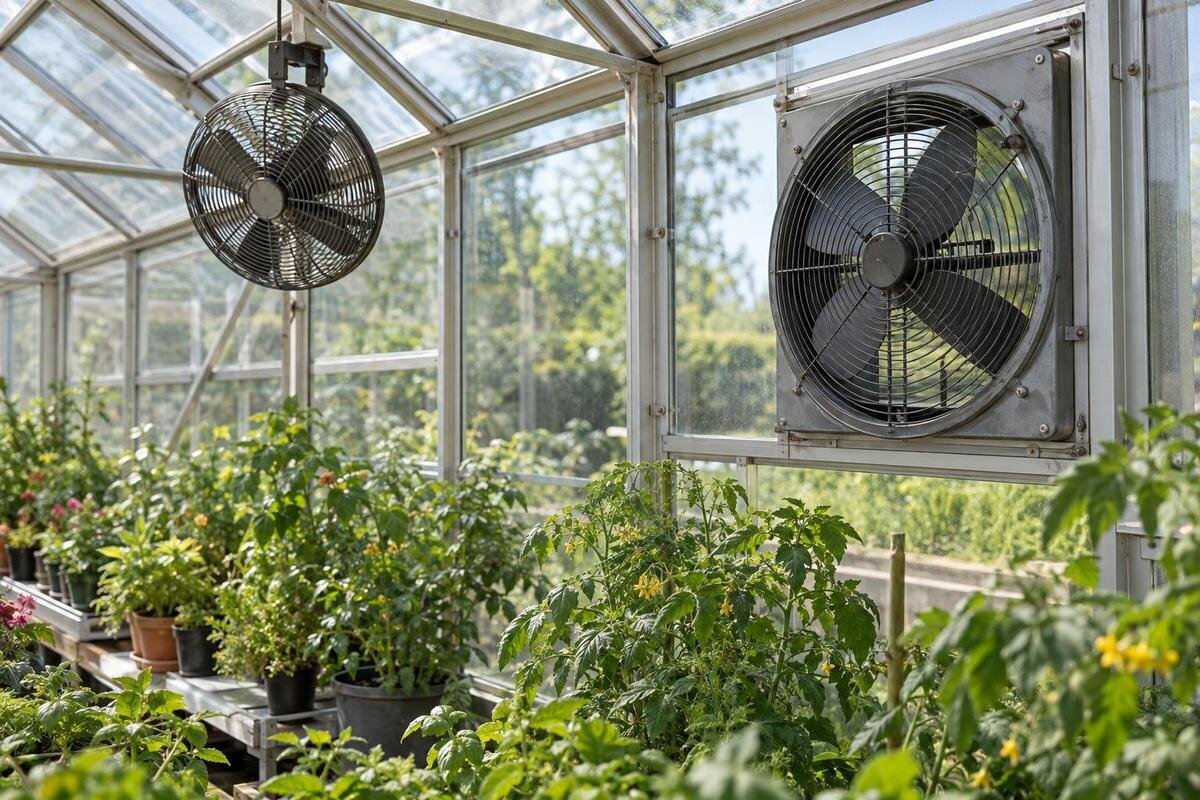
Greenhouse ventilation
Greenhouse fans are often grouped under the same label, but circulation and extraction solve different airflow problems. One moves air already inside; the other sends air outside and needs replacement air to enter. Confusing them can leave a greenhouse feeling breezy yet still hot, or let an extractor draw air straight from an inlet without sweeping the crop. Start with observations, then sketch how air can travel through the actual structure.

01
Circulation and extraction serve different purposes
A greenhouse circulation fan moves air that is already inside the enclosure. It can stir a stagnant pocket, mix some temperature differences between levels and carry air around benches, but it does not create an outlet to the outdoors. The same air remains inside unless it also passes through an opening. A breeze across foliage or a visibly spinning blade is not proof that warm air has been removed. An extraction fan does a different job: it pushes indoor air outside, so replacement air has to enter through openings or a designed inlet. Its effect depends on where that air comes from and whether it crosses the crop before reaching the outlet.
Identify the problem you can observe before comparing equipment. Still air in one corner points to a distribution question; high temperatures across the greenhouse point to a heat-removal question, particularly when outside air is cooler. A circulation fan may make readings more uniform without lowering the overall temperature. Extraction can carry heat out, but it cannot reliably cool the space below the temperature of its incoming air. When comparing the Aluminium Classic Greenhouse sizes, keep the selected size separate from the ventilation decision: the listed range of 3.77 to 28.08 m² is not a fan specification. Write down whether your priority is movement within the crop, exchange with outside air, or both. This gives you a clear basis for comparing equipment and avoids buying an extractor to solve a sheltered patch, or a circulation fan to solve a greenhouse-wide heat problem.
What circulation fans do inside the greenhouse
Circulation fans create movement within the enclosure, helping to mix air that might otherwise sit in separate pockets around benches, shelves or dense growth. Their purpose is distribution, not exchange. Air moving along an aisle may not reach the crop behind a bench, and movement near the fan does not prove that the far end of the greenhouse is being reached. Look at the places where plants are actually growing, not just the area around the equipment.
A fan aimed directly at one bed can produce a strong local stream while leaving quieter spaces elsewhere. Consider the full path: where the air travels after leaving the fan, what might block it and where it can return. On your sketch, distinguish a direct stream from the wider area you want it to reach. That makes it easier to describe a problem such as movement along the aisle but little movement behind a bench. When considering the Lean-to Greenhouse options, use your planned growing arrangement rather than the model name to judge where internal circulation needs attention. Record the position and direction of each circulation fan, then compare the areas beside, beyond and behind the main obstructions. Recheck as plants grow or benches are rearranged. The useful question is whether air reaches the growing space, not whether the fan produces an obvious breeze at close range.
02
What extraction fans can and cannot change
An extraction fan moves indoor air out of the greenhouse. For that air to be replaced, an inlet or another suitable opening must be available. If air cannot enter freely, the fan may not deliver the expected exchange. If replacement air enters close to the exhaust, it can take a short route straight back out, leaving more distant parts of the greenhouse less affected. The fan label alone says nothing about whether the complete route works.
Extraction can help remove heat when incoming air is cooler than the air being expelled, but it does not produce cool air. It may also exchange water vapour with the outside, though the humidity result depends on outdoor moisture and temperature. Keep those two results separate when assessing performance: a change in temperature does not, by itself, establish how much moisture has left. For a larger option in the Spacious Orangerie range, listed from 47 to 70 m², floor area alone still cannot establish the number or capacity of extraction fans required. Describe the intended exchange route as part of your enquiry, including where replacement air enters and which growing areas it should pass through. This gives the supplier or a qualified professional a more useful starting point than an area figure alone, while keeping the discussion focused on extraction rather than internal air movement.
Map the route from air inlet to exhaust
Sketch the greenhouse from above and mark the openings that will actually be available while the fan runs. Include doors, windows, vents and any other intended inlets and outlets, then add benches, shelves, partitions and dense crop areas. Draw an arrow from each inlet towards the exhaust. The route should pass through the area you want to ventilate rather than bypass it along an easy, empty path. Note openings that are sometimes shut or blocked; they cannot be treated as dependable inlets for every operating condition.
A second sketch from the side can help show how air might move between low and high openings, but do not assume that warm air rising will solve every layout problem. Wind and the position of open vents can change the path. If you are comparing the T-Model Orangery Greenhouse range, draw the openings shown for the version you are considering rather than copying a route from another greenhouse. Label each opening by its intended role and note whether it will be open during extraction. Keep separate sketches for arrangements that use different doors or vents, so the arrows do not imply that every opening is available at once. If a route runs from inlet to exhaust without crossing the crop area, mark that bypass clearly. The sketch should reveal gaps in the proposed route, not just show an arrow connecting two pieces of equipment.

03
Plan circulation around areas of still air
Use your sketch to mark where air seems still, especially behind obstructions or within a dense crop canopy. Then consider whether a circulation fan can move air through that area and back into the wider space. The aim is a useful internal loop, not simply a breeze in the aisle. Take account of the fan’s stated direction and use guidance in its manual; avoid assuming that pointing a fan at every quiet patch will create even movement throughout the greenhouse.
Check the crop area from more than one position. A stream may pass above low plants, stop at a solid barrier or leave a sheltered pocket on the far side of a bench. Give each problem area a recognisable description, such as the rear of a bench or the space behind a shelf, so you can return to the same place after an adjustment. If you are planning an Oasis Pyramid Greenhouse, add your intended benches and plants to the layout before considering fan direction; the product name and listed area do not describe that growing arrangement. Change one fan position or direction at a time and note whether the previously sheltered area receives movement without simply shifting the quiet patch elsewhere. This comparison is more informative than judging the strongest stream alone. Keep the circulation route distinct from the inlet-to-exhaust arrows, since the two sketches answer different questions.
Give replacement air a clear path
An extraction fan needs replacement air as well as an outlet. Mark the intended inlet on the same route map and check that it can remain open when the fan operates. Mesh, screens, louvres, closed doors or other obstructions may affect how freely air can enter, so check the relevant equipment documentation rather than assuming an opening is unrestricted. An inlet placed too close to the exhaust may also allow air to leave without sweeping through the greenhouse.
There is no single inlet position that suits every structure. The best route depends on which openings exist, where the crop sits and how the manufacturer intends the equipment to be used. When reviewing the Limited Edition Aluminium Greenhouse options, identify the intended replacement-air opening alongside the proposed exhaust position. Note any dependence on someone opening a door or vent: a route that is available only occasionally is different from one available whenever the extractor runs. Include screens and other restrictions in your description rather than recording only the opening’s location. These details help you discuss the complete exchange route with the supplier, instead of comparing an extractor in isolation. Confirm the fan’s stated requirements for the chosen arrangement, and have mounting and electrical work assessed by a qualified professional. Follow the instructions for the specific equipment rather than treating a general layout sketch as installation guidance.
04
Use temperature and humidity logs to test a layout
A short, consistent record is more useful than a single reading taken wherever a sensor happens to be. Note temperatures and humidity at representative crop-level positions, including a suspected warm or still area and a point nearer the inlet or exhaust. Record outdoor conditions at the same time. Keep sensors out of direct sun, away from glazing and out of a direct fan jet, so a local stream or warmed surface does not dominate the reading.
Also note whether the extraction and circulation fans were running, which openings were available, and any change in sunlight or internal layout. Give each sensor location a fixed name on your sketch and use the same names in the log. A useful entry records the time, indoor and outdoor readings, fan status and open vents together, rather than leaving you to reconstruct the setup later. If you are considering a Limited Edition greenhouse with built-in storage, record the growing layout you intend to use in the selected version; the catalogue range is not a description of your sensor positions or airflow route. Compare like with like before and after changing one part of the setup. Label periods when several conditions changed as less useful for direct comparison. Relative humidity can shift with temperature even when the amount of water vapour has not changed, so it is not a direct measure of moisture removal.
Read the pattern before changing equipment
Compare readings from several positions rather than relying on the sensor nearest the fan. If a local area remains warmer or more stagnant while other readings are similar, the problem may be how air is distributed through that area. If readings are high across the greenhouse, check whether replacement air can reach the crop and whether the exhaust route is clear. A lower reading near the outlet alone does not show that the rest of the space is receiving the same exchange.
Humidity readings need the same care. Circulation may mix air and make local readings more alike, but it does not remove water vapour from the enclosure. Extraction exchanges indoor air with outdoor air, and the result depends on the incoming air as well as temperature. Take photographs from consistent positions, showing fans, openings, benches and any barriers, and record the conditions alongside them. Include a wider view that connects the suspected problem area to the inlet or fan, rather than photographing only the equipment. Match each photograph to a dated log entry so you can distinguish a layout change from a change in operating conditions. Photos can help you notice a blocked path or a changed layout; they do not measure airflow. Taken together, the route sketch, readings and photographs help you explain whether the unresolved issue concerns internal movement, exchange with outside air, or both, without relying on the appearance of a running fan.

05
Choose fans using the layout and equipment manuals
Before comparing fans, confirm whether each one is designed for circulation or extraction. Check the manufacturer’s stated airflow information, the conditions under which it applies and any requirements for openings or installation. Ratings for different fan functions may not be directly comparable. A higher number on a label does not guarantee that air will reach the crop or travel through the greenhouse as intended.
Floor area is only one part of the picture. Height, internal obstructions, available openings and the route between them also affect the setup, so do not use a single area figure to choose a fan or calculate a system. If the Prestige Greenhouse options are on your shortlist, record the precise version alongside the proposed equipment rather than treating the whole size range as one installation. Bring together the layout sketch, the problem you want to solve and the relevant fan information. Compare candidates against the same requirements: internal distribution for circulation, or a complete inlet-to-exhaust route for extraction. Keep unanswered questions specific, such as whether a stated airflow figure applies to the proposed arrangement or whether the mounting position is suitable. Ask the greenhouse supplier or a qualified professional to assess unclear capacity, mounting or electrical requirements before choosing equipment on the strength of a headline rating.
Keep controls and checks specific to each fan
If both fan types are installed, treat their functions separately in the controls. Circulation may be useful when internal air is still; extraction is relevant when an exchange with outside air is needed. Use readings from representative crop-level positions rather than placing a control sensor directly in an inlet stream or beside an exhaust. Follow the controller’s own instructions for sensor placement and settings, and check that the chosen settings respond to the conditions you are trying to manage.
Recheck the route after moving benches, adding shelving or allowing crops to grow, as a previously clear path may become obstructed. Inspect and clean equipment as its manual directs, and pay attention to changes in airflow or unusual operation. Do not improvise alterations to a fan or its wiring. Use a qualified professional for electrical work, mounting questions or faults that the manual does not cover. These checks help keep the system aligned with the actual greenhouse rather than relying on the assumption that a fan is working well simply because it is switched on.
Frequently asked questions
Can a circulation fan cool a greenhouse?
It can mix air and reduce local temperature differences, but it does not remove heat from the greenhouse by itself. For heat removal, air needs to leave and be replaced; that can help when the incoming air is cooler. A circulation fan alone may make conditions feel less stagnant without lowering the overall temperature.
Do I need both circulation and extraction fans?
Not automatically. The need depends on what your observations show. If air is still in particular parts of the crop, circulation may address that. If the greenhouse stays hot and an exchange with cooler outside air is possible, extraction may help. Some layouts need both functions, but one should not be treated as a substitute for the other.
Should an extraction fan sit opposite an air inlet?
The important point is a clear route from an available inlet to the exhaust, passing through the space you want to ventilate. Opposite ends can suit some layouts, but the right positions depend on the actual openings, obstructions and manufacturer guidance. Avoid a route that lets replacement air go straight to the fan.
Why does the humidity reading stay high when a fan is running?
A circulation fan redistributes air; it does not remove water vapour from the greenhouse. An extraction fan exchanges indoor and outdoor air, but the humidity result depends on both the moisture content and temperature of the incoming air. Compare readings at consistent locations and times rather than relying on one relative-humidity reading.
Can I choose a fan using greenhouse floor area alone?
No. Floor area does not describe the greenhouse height, air volume, openings, screens, internal obstructions or the route air must take. Check the selected model’s documentation and the fan manufacturer’s stated performance for the intended use. Ask a qualified professional to help with sizing and installation where needed.
A useful fan layout begins with a clear distinction: circulation moves air within the greenhouse, while extraction exchanges indoor air with the outside. Map the route, note where the crop sits, and use consistent temperature and humidity readings to see what changes when equipment runs. That evidence can show whether the problem is a local stagnant area, an incomplete exchange route or a combination of the two.
