
When Greenhouse Glazing Seals Need More Than Cleaning
Greenhouse repair
Greenhouse glazing seals can look clean while their material has already split, flattened or pulled out of position. Washing can remove dust, pollen and surface film, but it cannot restore a seal that no longer fits its channel. The important distinction is between removable dirt and physical deterioration—and, before ordering anything, between a seal fault and another problem in the glazing or frame. This guide explains what to look for without disturbing the panes, why a manufacturer-matched profile matters, and what details help a supplier or installer identify the correct part. It also covers when a seal-only repair is not enough.

01
Cleaning can reveal wear, but cannot repair it
Begin by cleaning because dirt can make an intact strip look stained or hide a small split. Follow the greenhouse manufacturer’s care instructions and use only products allowed for its surfaces; a cleaner that seems suitable for glass may affect the seal or leave residue on the frame. Remove loose debris gently and allow the area to dry, so moisture does not obscure the edge. The purpose is to reveal the seal, not to restore it. Cleaning can lift surface deposits, but cannot replace missing material, return a deformed profile to shape or close a crack running through the seal.
Once dry, inspect the same stretch again. If the mark has lifted and the seal remains continuous, evenly seated and free of visible damage, staining alone is not a reason to replace it. If a gap, split, missing length or distorted section remains, further washing will not correct the fit. Colour change by itself is a weak guide: material can discolour without a clear failure, while a darkened surface can also conceal wear. Check both ends of the visible run and any nearby join, because a clean centre does not show whether an end has pulled back. If you cannot tell whether a line is a crack or a join, photograph it rather than scraping at it.
Signs that the glazing seal has deteriorated
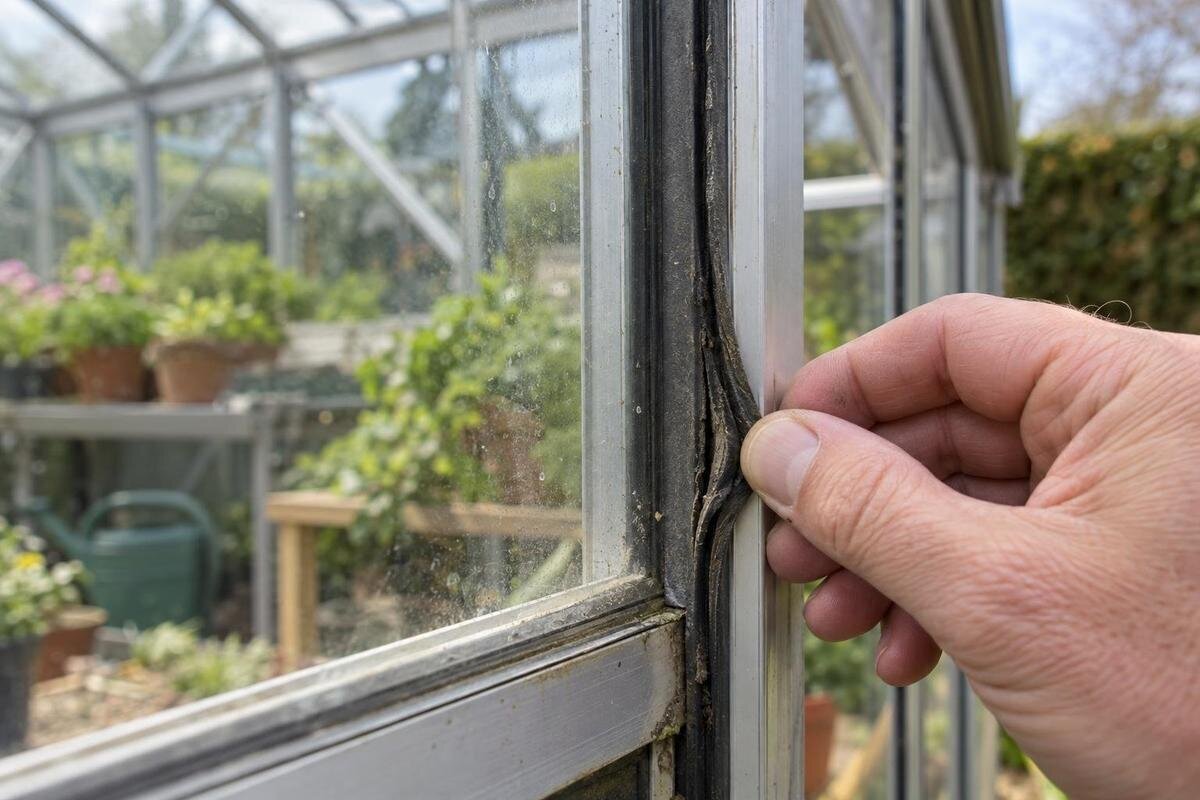
Look for cuts, cracks, splits or short breaks, particularly at corners, joins and places where the strip turns. A small opening at an end can become more obvious when the seal has shrunk back from the frame; a section may also be missing altogether. Surface dirt sits on top of the material, while a split changes its outline or reveals an open edge. Do not tug on a damaged section to see how far it will tear. If it is already crumbling or coming away, photograph it as found and leave it for the manufacturer’s or installer’s assessment.
Other signs include an edge that has become hard, curled, ragged or permanently compressed, or a length that no longer reaches the joint it once covered. A flatter shape is not automatically a fault: seals may be compressed as part of their intended fit, and one section cannot be judged against a different profile elsewhere. Compare like with like along the same glazing edge, looking for sudden changes in shape, gaps or lost continuity. Avoid pushing a pane or bending the strip to test it. If a line might be a moulded feature rather than a crack, compare it visually with another section of the same profile or ask the manufacturer to identify it.
02
Inspect the seal without disturbing the glazing
Inspect the seal where it meets the glazing and frame, following the accessible edge from one end to the other. Look for a raised end, a section shifted out of line, a visible gap, a twist or an interruption at a join. A continuous line is more informative than one close-up: note where the seal changes and whether the issue is confined to one pane or appears at several. A difference between a roof edge and a wall edge may reflect a different profile, not damage; compare like sections only. Greenhouse systems vary, so do not assume every visible strip has the same job or shape.
Observe from a stable, accessible position; do not peel out a strip, loosen a retainer or reach across a roof to inspect it. If a pane is cracked, visibly loose or moving, stop and ask a qualified greenhouse installer to assess it rather than exposing the seal. An inaccessible edge should be left for someone with the right equipment and experience. Note whether the concern extends beyond one strip, since damage to the frame or several components changes the scope of the repair. If you are separately weighing a complete greenhouse with built-in storage, the Limited Edition Aluminium Greenhouses with Storage page is a model listing for that wider decision.
A leak near a pane does not identify the fault
A leak, draught or rattle near glazing can justify an inspection, but none confirms a failed seal on its own. Water may travel along a joint before appearing elsewhere, and condensation on a pane is not the same thing as water entering through an edge. A shifted pane, frame joint, retainer or nearby opening may also explain a symptom. Record where and when the problem appears, and whether a visibly damaged seal is at that point. A general note that the greenhouse leaks is less useful than a description of the location and conditions. If the symptom comes and goes, record each occurrence so the supplier or installer has more than a single observation to work with.
Do not cover the area with silicone, tape or another sealant simply to make the line look closed. An unapproved product may hide the original condition or interfere with a channel or later repair; ask the manufacturer what treatment, if any, is compatible. If inspection suggests damaged glazing or frame components rather than one replaceable seal, get an installer’s view before comparing complete greenhouses. If that wider conversation follows, the Bloomcabin Prestige Greenhouse page identifies a complete model for a separate comparison.

03
Why the replacement profile must match
Seal profiles are not interchangeable just because they are flexible strips of similar colour or apparent width. The cross-section may include a lip, groove or retaining shape that determines how it sits; material and dimensions can also differ by glazing system. The side hidden from view may have a different shape from the exposed face. A near-match can prevent the seal from seating correctly, leave a gap or interfere with the fit of the glazing. Do not choose by a short sample or a listing described only as a universal greenhouse gasket. Use the manufacturer’s identification for the specific greenhouse and glazing position, even if two pieces look alike in a photograph.
Check the manual, parts list or manufacturer support for a part code, profile drawing and any model or glazing restrictions. Roof, wall and door edges may not use the same component, even when they look alike from outside. Ask whether the manufacturer calls the part a seal, gasket or glazing strip; terms alone may not identify the correct profile. If the original number is missing, send photographs and ask for confirmation rather than ordering by guessed measurements. Keep replacement-parts enquiries separate from comparisons of new structures: the Spacious Greenhouse listing identifies a complete greenhouse, not a compatible seal for your existing one.
Record the greenhouse’s exact model
Begin a parts enquiry with the greenhouse’s identity, not only a description such as glass greenhouse or aluminium frame. Look for the original order confirmation, manual, parts sheet, nameplate or another product label. Record the exact model name and any version, size or configuration shown; add a serial or order reference if available. A broad catalogue name such as Aluminium Greenhouses is not enough by itself to identify the specific unit or seal. Keep a photo of any label with your notes, and do not dismantle glazing to search for a hidden one.
Record where the seal sits: for example, which side of the greenhouse, the roof or wall area if known, and the pane or frame section. Note whether it is a single short run or repeated around several panes, and whether any section is already missing. If the greenhouse has been relocated, altered or bought second-hand, say so; original paperwork may be important, and its present appearance may not establish the original model. Note the approximate purchase year only if you cannot confirm it, and label it as an estimate. Keep uncertain details clearly marked rather than turning a guess into a part number.
04
What to include in a replacement-parts enquiry
Ask the supplier to confirm the exact replacement seal profile and part identifier for the recorded model, version and glazing location. Include the details that distinguish your greenhouse, then ask whether the identified part is intended for that particular edge and glazing system. If the structure has more than one seal type, request a diagram or clear description of where each belongs so a part for a roof section is not confused with one for a wall or opening. A catalogue name such as Lean-to Greenhouse can be included when it matches your paperwork, but the precise version still needs confirming.
Send a wide image showing the greenhouse and the area concerned, then a clear close-up of the seal in place, including a nearby corner or join for orientation. Put a ruler beside the visible section only if this can be done safely without pressing on the glazing; describe any measurement as approximate, not as a profile match. If a fragment is already detached, keep it labelled and photograph its cross-section, but do not remove an intact piece to obtain a sample. Include a photo of the model label or relevant paperwork, masking personal details if needed.
When a seal-only repair may not be enough
A seal-only repair is more plausible when the visible damage is localised and the surrounding glazing and frame do not show an obvious problem. That is not a structural assessment: if a pane moves, the frame appears damaged or other parts are missing, ask an installer to review the greenhouse before ordering. If similar wear appears along several edges, or more than one profile is affected, ask whether the parts and work should be considered together. Replacing one strip may address a local wear point without resolving other faults; replacing every seal because one has split may also be unnecessary.
Compare the confirmed parts and installation work with the greenhouse’s overall condition, including the glazing, frame, fittings and availability of matched components. Ask for the proposed work to distinguish a seal replacement from any additional repairs, so you can see what each option includes rather than compare guesses. Avoid choosing a new structure solely because cleaning has failed, or buying several generic seals because they look alike. If complete replacement is under consideration, include the Limited Edition Aluminium Greenhouses range in that separate comparison, rather than treating a new greenhouse as the automatic answer to a worn strip.

05
When to involve a qualified installer
Use a qualified greenhouse installer or manufacturer support when glazing is cracked, displaced, difficult to access or held by a system you cannot identify. The same applies if the seal may be part of a retaining arrangement or removing it could affect how the pane is held. An installer can consult the greenhouse instructions and assess whether the work is limited to a seal or includes a pane, retainer or frame. Do not remove glass, force a strip out or improvise a substitute based on a generic profile.
Before agreeing to work, ask which exact part is proposed, where it belongs and whether any other damage has been found. Confirm who will supply the part and whether the installer needs the manual or model details, then keep that information with the repair record. Ask whether the original profile has been identified or an approved alternative is being proposed; those are different answers. If the assessment leads to a full replacement discussion, consider the T-Model Orangery Greenhouse as a complete greenhouse option. Its model name does not establish compatibility with seals or components from your existing structure.
What to do if the seal cannot be matched
If the manufacturer cannot match the part from model details and photographs, do not choose the closest-looking gasket or cut a substitute to fit. Ask whether another reference, a revised part identifier, an approved equivalent or a repair option exists for that specific system. For an older greenhouse, support may need an original manual, order record or dimensions from a detached piece; never dismantle sound glazing just to create a sample. State clearly what has and has not been confirmed. A clear answer that the profile is not yet identified is safer than ordering an unverified part.
Once a match is confirmed, follow the manufacturer’s written replacement procedure or have a qualified installer complete the work; appearance alone is not an installation guide. Keep the part identifier and final photos with the greenhouse records. If no supported part is available and you decide to replace the whole unit, the Pyramid Greenhouse page identifies a separate product model to discuss. At later routine cleaning, look for a new gap or displaced end; if one returns, ask for another assessment instead of adding improvised filler.
Frequently asked questions
Can a greenhouse seal look dirty but still be sound?
Yes. Dirt or a change in colour alone does not show that the profile has failed. Clean it using a method permitted by the manufacturer, let it dry, then look for splits, gaps, missing material, a shrunken end or a section that is no longer seated. If it remains continuous and in place, staining alone is not a reason to replace it.
What are the clearest signs a glazing seal needs replacing?
A split, torn or crumbling edge, a missing length, permanent flattening, shrinkage, hardening or a section pulled out of position are stronger signs than surface grime. Confirm the exact part with the manufacturer before ordering. A leak or draught can justify an inspection, but it does not identify the seal as the cause.
Can I use a universal greenhouse glazing seal?
Only if the manufacturer confirms that it suits your greenhouse model, glazing system and the particular edge where it will be fitted. Similar-looking strips can differ in profile, dimensions or material. A seal that appears close to the original may not sit correctly, so do not rely on appearance or a generic product description alone.
Is it safe to replace the seal myself?
Follow the greenhouse manufacturer’s instructions and only consider work that they identify as suitable for the owner to do. Do not remove or force a strip if a pane is cracked, loose, high up or held by a system you cannot identify. Ask a qualified greenhouse installer to assess the work if the seal may affect how the glazing is held.
What should I send when asking for a replacement?
Provide the exact model and version if known, any order or serial reference, the seal’s location, and clear photos showing both the wider greenhouse and the damaged area. Include an approximate purchase year only if it is clearly labelled as an estimate. A measurement or already detached fragment may help, but neither confirms a match by itself.
Cleaning is worthwhile, but its role is limited: it lets you see the seal more clearly. A strip that remains split, permanently flattened, shrunken or out of position warrants a replacement-parts enquiry, while a leak alone does not identify the failed component. Record the model and location, provide useful photos, and ask for confirmation of the exact profile. If the glazing or frame is affected, involve an installer. The aim is to choose a supported replacement—or make a separate, considered decision about the greenhouse as a whole—rather than rely on appearance or a generic match.
