
Greenhouse Grow Bags: Root Volume, Drainage and Support
Greenhouse growing guide
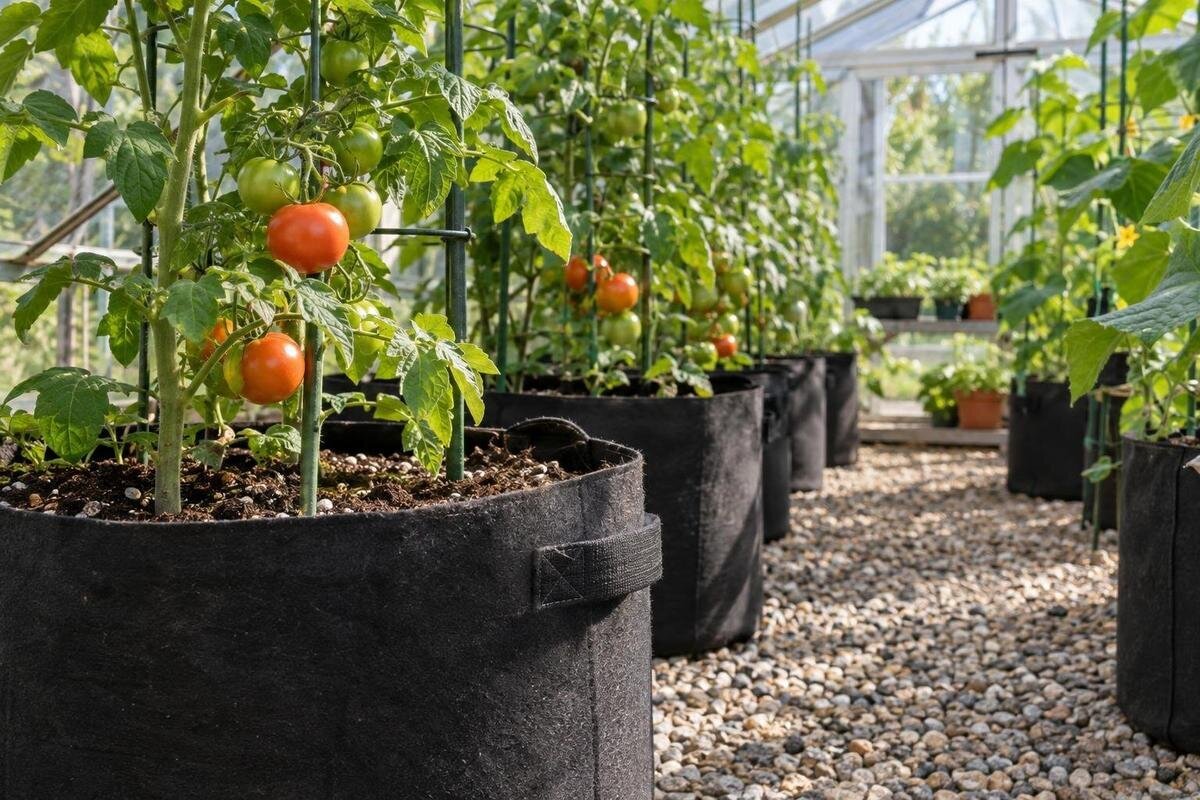
Grow bags can make a greenhouse layout easier to change, but a row of containers is not automatically an efficient growing area. Compare the growing-mix volume each crop can access, how surplus water leaves, and whether filled bags can stay upright as plants grow. Set those needs alongside the floor area for a fixed bed, a clear path and independent crop supports. A worked layout shows how equal litre totals can still create different growing spaces.

How much root space does a grow bag provide?
A bag’s printed litre figure is a starting point, not a complete measure of root room. Check whether it refers to the bag’s capacity, the amount of growing mix supplied or the filled container, then compare it with guidance for the crop and variety you intend to grow. A container can hold the stated volume but still be too shallow or narrow for the root zone required. Roots need a suitable balance of air and moisture, and the volume that works depends on the crop, mix and growing conditions. There is no single litre-per-plant figure that suits every greenhouse crop.
Shape matters as much as total volume. A deep, narrow bag and a broad, shallow one with equal capacity take up different floor areas and give roots different room to spread. Look at the filled dimensions rather than an empty, folded bag, and allow space to reach each container once plants grow. If you plan more than one plant in a bag, use crop-specific spacing advice instead of dividing the label volume by the plant count and assuming each plant gets an independent share. In a fixed bed, roots can share the continuous growing mix; in separate bags, each root system meets a container boundary.
Calculating bag and bed volume
If a bag has no reliable capacity figure, estimate the volume of the space it will hold when filled. For a rectangular bed, multiply its internal length by its internal width and by the depth of growing mix. The answer is in cubic metres; multiply by 1,000 to convert it to litres. Measure the growing space inside the bed, not the outside of its frame, and use the intended fill depth rather than the full height of the edging. This gives a useful comparison with bag labels, though an irregularly shaped container is not a perfect box.
Treat that total as gross volume, not a guarantee that every litre is available to every root. A bag may collapse, have an uneven fill or need some space left at the top, so a supplier’s stated capacity and the filled dimensions both matter. You can divide total litres by the number of planting positions to compare plans, but do not treat the result as a crop recommendation. The calculation does not account for plant spacing, growing-mix properties or whether roots can share space. Keep depth and width in view alongside the total. For a useful buying comparison, record the same details for each option: stated capacity, intended fill depth, filled width and number of plants. Keep the amount of mix you need to buy separate from the container’s advertised capacity. If your intended fill level differs from the supplier’s, note that difference rather than comparing two litre figures as though they describe identical growing spaces.
A worked layout: twelve bags or one fixed bed
For a simple comparison, assume a greenhouse has 3.0 m by 2.4 m of clear internal floor and a central route from the doorway that is 0.8 m wide. Picture 12 bags, each holding a nominal 30 litres and occupying a 0.45 m square once filled. Those bag dimensions are assumptions for this example, not product specifications. Put six bags in a row along each long side: each row uses 2.7 m of length, and the two 0.45 m-deep rows plus the path use 1.7 m of width. That leaves 0.7 m, or 0.35 m at each outer side if the rows are centred. The bags hold 360 litres altogether. This sketch accounts for the containers, not the mature plants. Add their expected spread and the position of each support before deciding that all twelve growing positions are practical. Also mark where you would stand to tend the bags at the far end. Space left beside a row is not necessarily usable access space, particularly if reaching it means passing between plants.
A fixed bed with internal dimensions of 3.0 m by 0.6 m and 0.2 m of growing mix also holds 0.36 cubic metres, or 360 litres. The totals match, but the floor use does not: the bed covers 1.8 square metres, while the assumed bag footprints cover about 2.43 square metres before allowing for the path. Roots in the bed share one continuous volume; each bag has a separate boundary. When translating this sketch into a real greenhouse, the Classic aluminium greenhouse range is listed from 3.77 m² to 28.08 m². Use the exact option’s internal dimensions rather than treating a listed area as a floor plan.
When a fixed bed makes more sense
A fixed bed suits a plan built around a defined, continuous planting area. Its growing-mix volume follows its internal length, width and fill depth, and the bed stays in place as crops change. That stability can make a layout simpler to maintain, but the space is committed: changing where you grow means working within the bed’s boundaries or shifting the bed’s contents. Allow for access to the edges when you draw the layout. A bed that looks generous on paper can be awkward if it leaves no comfortable route for planting, watering or tending crops.
Bags offer more flexibility before they are filled, since you can change their positions or remove them to open up the floor. Once full, however, they may be heavy and less stable to move, so do not count on rearranging them mid-season. If you are considering a Lean-to greenhouse option, its listed area range is 3.69 m² to 14.34 m²; compare the chosen model’s internal dimensions with the fixed bed and path you have drawn. The area range alone does not show where either will fit.

Plan where drainage water will go
Grow bags need a route for surplus water to escape, but that route depends on their design. Some have drainage openings; others drain through their material. Follow the bag supplier’s instructions and keep the intended openings clear of the floor, folded material and debris. A tray can collect runoff, but check it regularly and empty it rather than leaving the bag standing in water. Do not assume that all bags drain in the same way just because they look similar.
In a covered growing space, include runoff in the floor plan. Decide where excess water will go before bags, trays and other equipment fill the available area, and avoid creating a pool beside a bed or greenhouse base. If the floor has an existing drainage route, keep it accessible; get a qualified professional’s advice before altering a floor or adding a drain. The Limited Edition aluminium greenhouse range is listed from 3.77 m² to 28.08 m². Mark any collection trays on your layout and allow room to lift or empty them without moving the crop supports. Check the surfaces and drainage arrangements for the option you are considering, including whether you can reach the places where runoff collects.
Water each bag according to its root zone
Separate bags can dry at different rates, even when they contain the same mix. Bag volume, plant size, position and growing conditions all affect how quickly moisture is used. Check the mix at root depth rather than judging only by the surface, and pay attention to individual bags instead of assuming one container represents the whole row. Smaller volumes can have less room to buffer changes in moisture, but the right watering routine still depends on the crop and conditions. A fixed calendar may leave some bags too wet and others too dry.
Where different crops or bag sizes have different needs, group them so you can check and water them separately. Make sure your method wets the intended root zone and that excess water can drain away; look for uneven delivery rather than assuming a hose or irrigation line reaches every bag equally. If you are planning several watering areas, the T-Model Orangery range is listed from 16.52 m² to 30 m². On the plan for your selected option, mark which bags belong to each watering group and where you will reach them. Leave hose routes clear of the walking path, and keep any delivery points accessible for inspection. For hand watering, check that you can reach the mix without stretching across neighbouring plants. For an irrigation system, identify which bags each line serves so that changes to planting positions do not leave a container overlooked. These details turn a row of bags into a manageable watering layout.
Support tall crops independently of the bag
A grow bag holds the roots, but it should not automatically be treated as a secure anchor for a tall or climbing plant. As a crop grows, its support needs can change, and a stake inserted into a bag may shift or disturb roots. Plan a suitable support for the crop before planting, and keep it accessible for tying and tending. A broad base and level placement help keep bags upright, but no bag shape or fill volume by itself confirms that a support will remain stable.
Do not assume a greenhouse frame or glazing can take the load from a crop support. Check the manufacturer’s guidance before attaching anything to the structure, and ask the supplier or a qualified professional if the approved fixing points or capacity are unclear. The Pyramid Greenhouse range is listed from 5.53 m² to 18.9 m²; use the chosen model’s dimensions to plan crop positions, then verify support arrangements separately rather than inferring them from the model name or area.
Keep paths, doors and storage space clear
Draw more than the bag footprints. Mark the door opening, the route you will walk, and the space needed to reach each bag without stepping over plants or leaning across a crowded row. Allow for the plant canopy as it grows, not just the bare container at planting time. Check that you can reach windows or vents you expect to use, and leave room to carry in growing mix or remove a bag. A narrow gap between two rows may exist on the plan but still be difficult to use in practice.
Also set aside space for tools, a watering can or hose, empty containers and harvested crops. A built-in storage feature may affect how much floor you can devote to growing, but its position and dimensions need to be checked for the exact model. The Limited Edition greenhouse with built-in storage range is listed from 5.52 m² to 28.08 m². Do not count the entire listed area as bag space: check the selected layout and leave the path and working area clear.

Matching greenhouse dimensions to your layout
A headline floor-area figure is useful for comparing options, but it does not tell you whether your chosen arrangement will fit. The shape of the internal space, the doorway and any fixed features affect where bags, beds and paths can go. Use a dimensioned plan for the specific option, mark each filled container and support, then check that you can reach the growing area without blocking an opening. The Prestige greenhouse with metal foundation is listed from 3.77 m² to 28.08 m²; compare its chosen option’s dimensions with your sketch rather than relying on the area range alone.
Check that the layout still works when plants are established and when you need to carry supplies through the greenhouse. Trace the route from the doorway to each growing area, including where you would turn while carrying a filled container. Keep somewhere to put supplies down without blocking that route. If you plan to use a raised bench or shelf, do not assume it can support filled bags; verify its capacity with the supplier or a qualified professional. Include the bench’s footprint in the drawing rather than counting the floor beneath it as freely available working space. A small amount of space kept clear for access and maintenance can be more useful than squeezing in another container that makes every other task difficult.
Combine bags and beds where each has a purpose
You do not have to choose one system for the whole greenhouse. A fixed bed can provide a continuous growing area, while a smaller group of bags can keep a temporary or separately managed crop in its own root zone. This mixed arrangement still needs a clear division between growing space and access space; otherwise, bags can simply make a fixed bed harder to reach. For a larger zoned plan, the Spacious Greenhouse range is listed from 47 m² to 70 m². That is a catalogue area range, not a reason to choose a particular size: compare the exact option with a drawing that includes beds, bags and working room.
Before buying bags, confirm that the material is intended for the crops you want to grow and check the supplier’s guidance on drainage, cleaning and reuse. Do not infer material suitability or lifespan from appearance. Inspect seams and the filled shape, and replace a bag that no longer holds its contents or drains as intended. In a mixed layout, decide which growing positions are intended to remain in place and which you want to clear between crops. Plan how you would remove the contents of those bags without obstructing access to the fixed bed. This makes the flexibility of bags a specific part of the arrangement, rather than a benefit you may never use. It also helps you decide whether to buy a small group of bags for a defined purpose or commit more of the greenhouse to containers.
Frequently asked questions
How do I calculate a grow bag’s volume?
Use the filled dimensions where possible. For a rectangular space, multiply length by width by media depth to get cubic metres, then multiply by 1,000 for litres. A bag’s shape may make a supplier’s stated capacity more reliable than treating it as a perfect box.
How many plants should go in one grow bag?
There is no single number for every crop or variety. Check crop-specific spacing and root-volume advice, then consider the bag’s filled depth and width as well as its litre capacity. Dividing the bag’s volume by the plant count is only a rough comparison, not a spacing recommendation.
Do grow bags need drainage holes?
They need a way for surplus water to escape, but the design varies: some bags have openings and others drain through their material. Follow the supplier’s instructions and keep drainage routes clear. A tray can collect runoff, but do not let the bag sit in standing water.
Are grow bags better than a permanent greenhouse bed?
Neither is automatically better. Bags make it easier to change the layout before planting, while a fixed bed provides a continuous area of growing mix. Compare root volume, access, drainage and how often you expect to rearrange the growing space.
How should I support tall greenhouse crops?
Plan a suitable stake or trellis for the crop and do not rely on the bag alone to hold it upright. Check with the greenhouse supplier before attaching supports to the structure; its frame or glazing should not be assumed to carry crop loads.
The useful comparison is not simply bags versus a bed, or one volume label versus another. Match the crop’s root-space needs to the filled container or measured bed, then check the floor plan for drainage, access and support. In the worked example, 360 litres can sit in separate bags or one continuous bed, but the root space and floor use differ. Once those differences are visible on a drawing, it is easier to choose a growing system that fits the greenhouse and the way you plan to use it.
