
Overwintering Oleanders in a Greenhouse
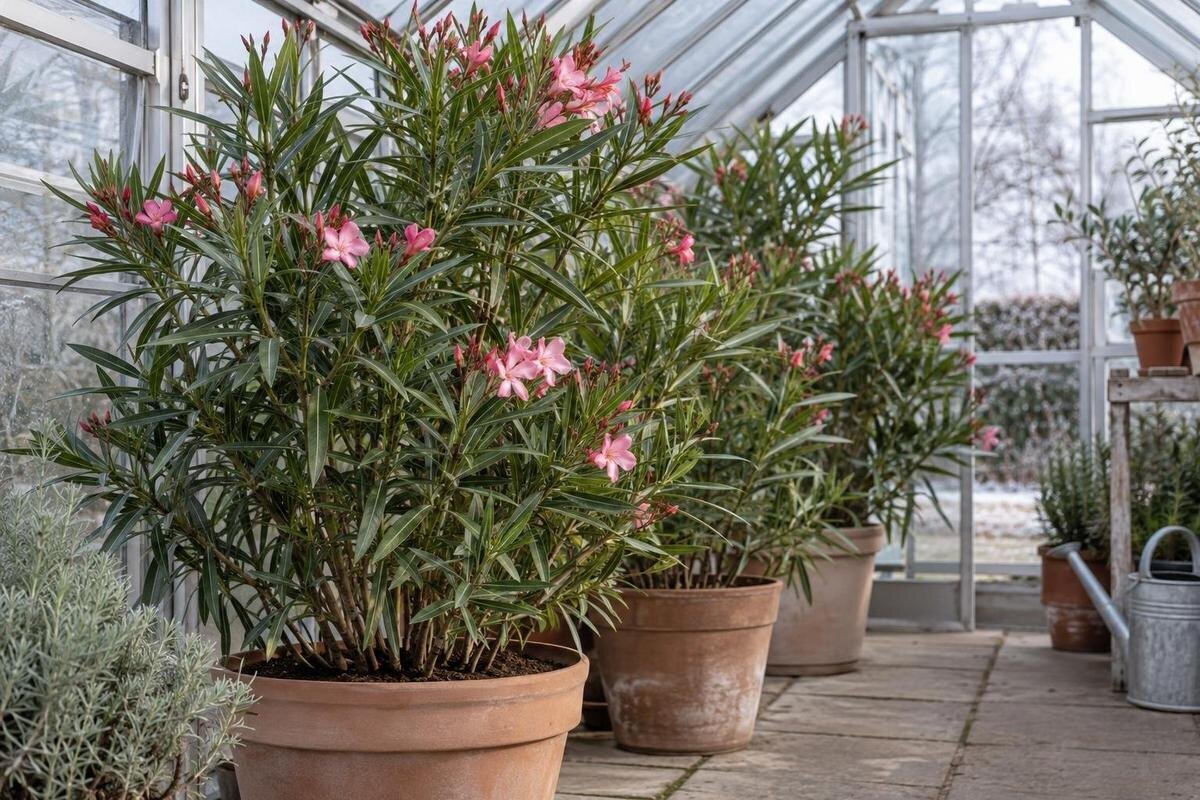
Oleander winter care
Overwintering an oleander means keeping it in cool, bright conditions, not putting the pot away until spring. Its evergreen foliage still needs light, while a container can be more exposed to cold than an established shrub in garden soil. A greenhouse may offer shelter, but an unheated one can cool sharply overnight and warm quickly in winter sun. This guide covers temperature checks, light, watering, ventilation and pest monitoring, alongside sensible precautions for moving and handling this poisonous plant.

Oleander growth in winter
An oleander (Nerium oleander) remains evergreen in a suitable winter setting. Shorter days and cool air slow its growth, but it is not a dormant bulb that can be put away in a dark shed. Existing leaves remain on the shrub and still need light, even if little new growth appears. A potted specimen has a different exposure from one planted in the ground: cold air reaches more of the rootball, and the container gets less buffering from surrounding soil. A hardiness label or an established shrub’s outdoor performance is not automatically a safe target for every container. Cultivar, pot size and previous acclimatisation all matter.
A greenhouse is useful as a sheltered place, not a promise of warmth. In an unheated structure, overnight air can approach outdoor conditions, while winter sunshine can raise the daytime temperature quickly. The reading beside the plant matters more than the temperature at the house or the forecast’s daytime high. Keep a record over several nights and sunny days before settling on the winter spot. Compare the coldest and warmest positions if you have several pots. Look at the pattern across the whole day: daytime warmth followed by a sharp overnight drop can be missed if you only visit at midday.
Keep it cool, bright and above freezing
For a container oleander, a cool, bright winter position around 5–10°C is a useful practical guide. Treat it as a management range, not a guaranteed survival limit: cultivar, prior acclimatisation, root health, how wet the mix is and how long the cold lasts can all affect the outcome. Keep it frost-free rather than relying on the plant’s reputation for tolerating some cold. If your greenhouse repeatedly falls below freezing, move the pot to a brighter protected place or use another reliable arrangement. A warm room is not automatically better; warmth can keep growth going when winter light is limited.
Measure both overnight lows and sunny-day highs at the height of the foliage. A single midday reading misses the coldest part of the cycle, and a sensor in direct sun can overstate air temperature. Take readings where the pot will stand, especially near a door or perimeter that may differ from the centre, and check during a cold spell rather than relying on an average. The Bloomcabin Prestige Greenhouse listing identifies a metal foundation and sizes from 3.77 m² to 28.08 m²; neither the foundation name nor the floor-area range establishes an overnight minimum at your site. Assess the actual winter conditions in the chosen position.
Give the evergreen foliage plenty of light
Oleander prefers plenty of light, and its evergreen leaves should not spend winter in a dim corner simply because the plant is resting. Put it in the brightest position available, where daylight reaches the whole canopy; a wall, neighbouring evergreen or overhead eave can cast a longer shadow in winter than in summer. If the greenhouse is partly shaded, observe the light at different times of day rather than judging from one sunny visit. Avoid crowding leaves against another plant or a wall, where lower foliage receives little light and is harder to inspect. If the plant loses leaves, check light alongside temperature and root moisture instead of assuming one cause.
Floor area alone will not tell you how bright a greenhouse will be. The Lean-to Greenhouse listing gives sizes from 3.69 m² to 14.34 m², which can help compare footprints, but winter light also depends on orientation, nearby shade and the pot’s position. For a wall-adjacent greenhouse, check where the winter sun falls and whether the building or stored items will shade the canopy. A smaller bright position can be more useful to this evergreen shrub than a larger, heavily shaded corner.
Measure the plant and the route into the greenhouse
Measure the whole plant before moving it: height from the floor under the pot to the top of the foliage, the widest point of the canopy, and the pot’s diameter and height. Include the route through the greenhouse door, any turns in the path, and space to reach the pot once it is in place. Oleanders can become large shrubs, so today’s compact outline may not represent a mature plant. The leaves should not be pressed against glazing or obstruct an opening, and an aisle should remain clear enough for routine checks. A heavy container is easier to move before it is saturated; use a stable trolley or get help rather than risking a lift over other pots.
The Limited Edition Aluminium Greenhouses range is listed from 3.77 m² to 28.08 m². Use that as a footprint comparison, not a substitute for checking clear height, doorway width and the layout of the selected size. Allow room for the crown to grow and for you to turn the pot or inspect the back of the plant without crushing leaves. If you plan to overwinter more than one container, draw the pot footprints and a walking route on the floor plan before deciding that the available area is enough.

Adjust watering as growth slows
Water use usually falls as an oleander’s growth slows in cool, lower-light conditions, so summer watering habits can leave the winter mix too wet. Do not water by a fixed weekly calendar. Check the potting mix just below the surface as well as judging the pot’s weight: water when the upper root zone has begun to dry, then moisten evenly and let excess drain away. Do not leave the container standing in a full saucer or tray, where cool, saturated roots can suffer. Equally, do not let the whole rootball dry hard for an extended period, especially if the greenhouse warms up and the leaves continue to lose moisture.
A warm sunny day may increase water use, while a cold spell may slow it further, so recheck after changes in weather rather than repeating the same amount. Avoid routine winter feeding while growth has slowed; resume when active growth returns, following the fertiliser label. The T-Model Orangery Greenhouse is listed in sizes from 16.52 m² to 30 m². When checking any layout, consider the route for carrying water and removing runoff as well as the pot’s footprint.
Ventilate without exposing the plant to a cold blast
Cold weather is not a reason to keep every greenhouse opening shut for weeks. On mild days, exchange stale, damp air and avoid leaving foliage surrounded by persistent condensation; keep the plant’s leaves dry where practical. At the same time, do not leave a door or vent open into a freezing wind overnight. A clear winter day can make a greenhouse much warmer than the outside air, so ventilation is also a way to manage daytime heat. Watch the actual readings and adjust openings before the temperature becomes unsuitable, rather than using one opening schedule for every day.
Air movement depends on the openings and their position, not just on the greenhouse’s footprint. The Pyramid Greenhouse listing spans 5.53 m² to 18.9 m²; for any model, inspect the selected configuration’s vent locations and how you can reach them. Check whether air can circulate around the oleander without forcing you to leave it exposed to cold for long periods. If leaves stay wet or condensation persists, reduce crowding and improve routine air exchange; do not try to solve the problem by placing a potted oleander directly in a cold draught.
Check for pests before and during storage
Inspect the oleander closely before bringing it into a greenhouse, then keep checking through winter. Look under leaves, along the midrib, at young shoot tips and where leaves join the stems. Scale insects on oleander can appear as small fixed bumps; aphids gather on soft growth, mealybugs look cottony, and spider mites may cause fine pale stippling or webbing. Sticky residue can point to sap-feeding insects, but a symptom alone does not identify the pest. Use a hand lens if needed and compare several leaves and stems. Catching a small population early is easier than discovering it after neighbouring pots have become crowded around the plant.
Check at least weekly while you are learning the plant’s winter pattern, and more often if you have seen a pest. Isolate an affected oleander from other plants, remove fallen leaves and identify the insect before choosing a control. Do not assume a general household spray is suitable for a greenhouse or this plant; follow the product label and use only a treatment labelled for the intended use. The Limited Edition Aluminium Greenhouses with Storage listing identifies built-in storage and sizes from 5.52 m² to 28.08 m². Check the plan to distinguish storage from growing space; do not count it as pest isolation unless it is genuinely separate.
Leave room to inspect and isolate plants
With several plants under cover, leave gaps between canopies so you can see leaf undersides and stems, and so an infestation is less likely to be hidden in a dense mass. Keep new arrivals apart while you inspect them, and give any suspect plant a separate position rather than sliding it between healthy pots. A small gap may not be enough if leaves touch as they grow or pots need to be moved. Plan a clear route to water, inspect and temporarily isolate a plant; quarantine means effective separation, not simply placing two pots at opposite ends of a shared, crowded bench.
The Spacious Greenhouse is listed from 47 to 70 m², a useful footprint reference when comparing larger structures, but floor area alone does not guarantee separate air space or a quarantine area. For any layout, mark where the oleander will stand, where other plants go, and whether an affected pot can be moved without brushing foliage. Check actual doors, vents and clearances in the selected plan rather than assuming that a larger footprint solves crowding. Keeping space for inspection can make the winter routine more reliable than filling every available surface with pots.

Handle oleander prunings safely
Every part of oleander is poisonous if eaten, so take care when shifting, pruning or cleaning around it. Keep children and pets away from the plant and from fallen leaves, seed pods or cuttings. Wear gloves and long sleeves when handling stems; eye protection is sensible when pruning because sap may splash. Avoid touching your face, and wash your hands and tools after the job. Do not handle oleander clippings like ordinary garden waste simply because it is a familiar garden shrub. If sap gets on exposed skin, wash it off promptly, and do not leave plant material where a child or animal can reach it.
Prune only where necessary, such as removing damaged growth or managing a branch that obstructs safe access; a hard cut just to force an overgrown plant into a small winter space is not a substitute for adequate room. Collect cut material straight away and keep it out of reach. Never burn oleander prunings, as the smoke can be harmful. For disposal, follow your local council’s green-waste guidance rather than leaving clippings loose or assuming they belong in a home compost heap.
Prepare for a gradual move outdoors
At the end of winter, return the oleander outdoors in stages rather than moving it from a sheltered greenhouse straight into strong sun, wind or cold nights. Use local forecasts and conditions at your site; wait until the cold risk is manageable for a container plant, then begin in a sheltered position and increase exposure gradually over several days. Greenhouse-grown leaves can be tender after a low-light winter, so a sudden change to intense sunshine may scorch them. Bring the pot back under cover if conditions turn sharply cold, and continue checking moisture as airflow and sunlight increase.
Keep the exit route clear throughout winter, even as other pots and equipment accumulate. The Aluminium Greenhouses listing covers sizes from 3.77 m² to 28.08 m²; when comparing layouts, allow for moving the oleander back outdoors, not just fitting it inside. Before the move, clear any shelves, tools or containers that obstruct the path, and arrange help or a stable trolley for a heavy pot. This avoids lifting the plant over other foliage or squeezing its branches through a crowded doorway.
Frequently asked questions
What temperature is suitable for an oleander over winter?
For a potted oleander, around 5–10°C is a useful guide for a cool, bright winter rest, not a guaranteed survival limit. Keep it frost-free where possible and check the minimum temperature beside the plant. The pot, cultivar, acclimatisation and length of a cold spell can all affect how it copes.
Can an oleander stay in an unheated greenhouse?
It can if the greenhouse stays bright and the plant’s position remains frost-free, but an unheated structure may approach outdoor temperatures overnight. Use a min–max thermometer through cold spells. If readings fall below freezing, move the pot to a more suitable protected place rather than assuming the greenhouse will keep it safe.
How often should I water an oleander in winter?
There is no reliable fixed schedule: check the mix and the pot, because water use changes with temperature, light and growth. Water when the upper root zone has started to dry, then let excess drain away. Avoid both persistently soggy mix and leaving the whole rootball dry for an extended period.
Why is my oleander losing leaves indoors?
Leaf loss can have several causes, including insufficient light, temperature swings, a rootball that is too wet or too dry, or stress from moving the plant. Inspect leaves and stems for pests as well. Check the plant’s actual conditions before settling on one explanation; a single symptom does not identify the cause.
How should I handle or prune oleander safely?
No part should be treated as safe to eat. Keep children and pets away, wear gloves and long sleeves when handling stems, and wash your hands and tools afterwards. Do not burn prunings, as the smoke can be harmful. Keep cuttings out of reach and follow your local council’s guidance for disposal.
A successful winter routine for oleander is measured and responsive: keep the plant bright and cool, check the temperature where it stands, adjust water to the mix and make time for pest inspections. A greenhouse is useful only when its actual conditions and layout suit the potted shrub. Safe handling matters throughout, from moving the plant to dealing with its prunings.
