
Growing Peaches or Nectarines in a Greenhouse
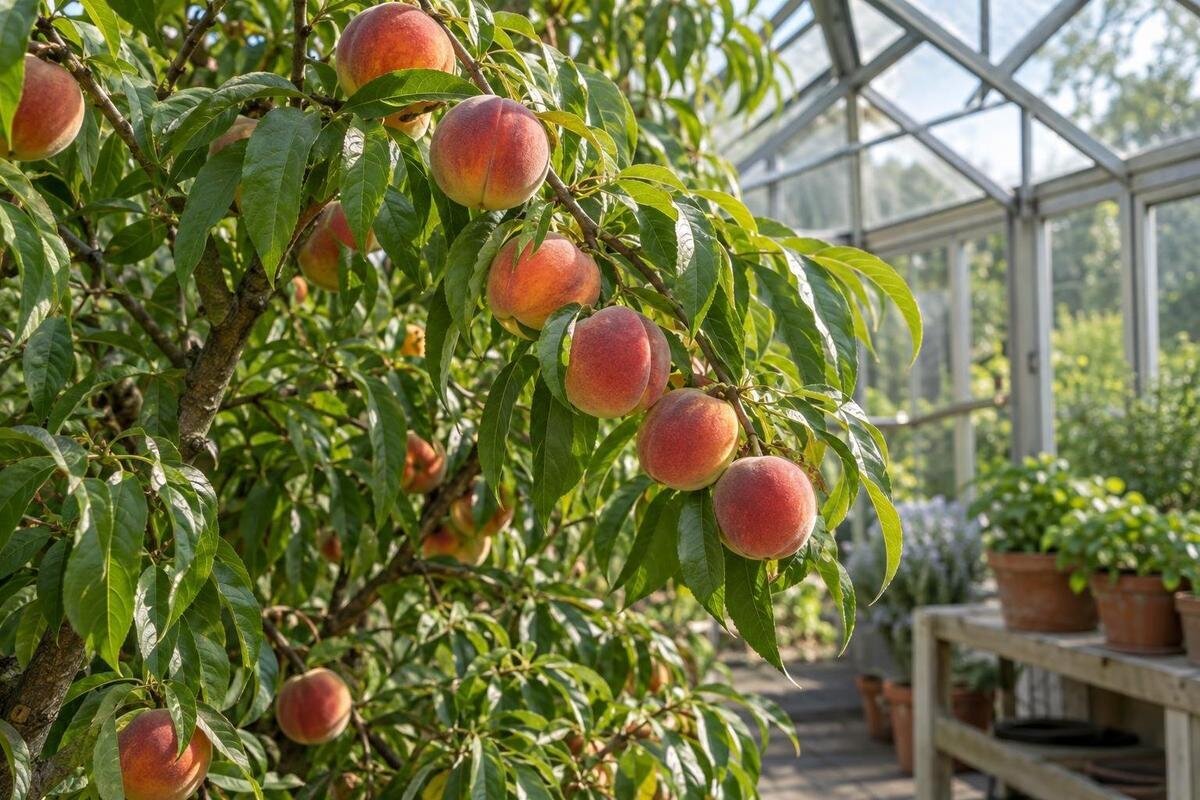
Fruit trees under glass
Growing a peach or nectarine under glass is a long-term fruit-tree project, not simply a way to bring a summer crop forward. The tree needs an appropriate winter chill period, a cultivar suited to your site, reliable pollination and room for its mature canopy. A greenhouse may shelter blossoms and fruit, but can also stay too warm in winter or overheat in summer. Check the cultivar, training plan and available space together before planting.

01
Planning greenhouse space for a permanent fruit tree
Peaches and nectarines are deciduous fruit trees, not seasonal greenhouse crops that can be cleared away at the end of summer. A tree occupies the same ground for years and needs winter dormancy, spring flowering, summer growth and regular pruning in that space. Glass can shelter blossoms and developing fruit from some wind and rain, but it also changes temperatures, excludes rainfall and may limit insect access. Those effects are not automatically beneficial: protection from one weather problem does not make the enclosure suitable for the tree’s full annual cycle. The question is whether it can support the tree through every season without unsuitable heating or repeated severe pruning.
Begin by identifying what you want the greenhouse to achieve. If your main aim is to grow a fruit tree, an outdoor position may be a better fit when local conditions suit the cultivar. If growing under cover is important, decide how much of the greenhouse you can dedicate to a permanent planting rather than seasonal crops. As one catalogue comparison, Bloomcabin Prestige Greenhouse has listed area options from 3.77 m² to 28.08 m². Use the selected plan to separate the proposed tree space from paths and other growing areas. A sapling can be deceptive: the productive tree needs room to spread and to be reached for pruning and picking. Think about which existing uses you would be willing to give up as it grows. This makes the choice a long-term allocation of space, rather than a decision based on where a young tree happens to fit.
Winter chill is a cultivar requirement
Peaches and nectarines need winter chill before they resume growth, but the amount varies by cultivar. If chilling is insufficient, buds may open unevenly, flowering may be poor and the crop can be unreliable. A greenhouse can be warmer than the surrounding garden, especially during sunny spells, so an unheated structure does not automatically provide the same winter conditions as an outdoor tree. Adding heat through winter may reduce cool exposure further; it is not a general way to make any variety succeed. Treat the cultivar’s chill requirement as a first filter, rather than a detail to sort out after planting.
Conditions vary by district and from one site to another, so ask a local fruit-tree nursery which cultivars have performed well in comparable conditions. Find out how the nursery describes the chill requirement and whether it is suitable for your location. If the winter conditions inside the greenhouse are uncertain, record temperatures at the planned tree position over winter and use those observations when seeking advice. Note whether the greenhouse was open, closed or heated during that period, so the observations describe how you actually intend to use it. Outdoor climate information may not describe a sheltered greenhouse accurately. Keep the distinction between winter chilling and protection during flowering clear: meeting one need does not establish that the other has been met.
02
Choose the cultivar and rootstock together
Peaches and nectarines share most of the same planning constraints; the fruit’s smooth or fuzzy skin does not determine whether a tree suits your greenhouse. Cultivars differ in chill needs, flowering and harvest timing, pollination requirements and growth habits. Rootstock also affects vigour and eventual size, though it cannot provide a precise promise of the final canopy. Ask for the cultivar’s name and rootstock, its expected mature dimensions, whether it is self-fertile and what kind of training it suits. These details help you decide whether the tree can fruit in your conditions and whether you can manage it in the space available.
Keep the label after planting, and avoid choosing a tree on fruit description alone. A local nursery can help relate its expected size and seasonal timing to your site and greenhouse conditions. Take your proposed training form and available planting space into that discussion, rather than asking only whether the tree can be kept small. If you are still comparing footprints, Limited Edition Aluminium Greenhouses are listed with area options from 3.77 m² to 28.08 m². Use that range to identify layouts to examine, not to select a cultivar by floor area. Record the nursery’s advice alongside each tree’s name, including its rootstock, likely spread and pollination needs. Comparing those details together makes it easier to distinguish a tree that suits the plan from one that would require you to change the plan substantially.
Choose a training form before planting
Decide how the tree will be trained before it goes into the ground. A fan-trained tree spreads its main branches in a relatively flat plane, while a less constrained, open-centred tree needs room around its canopy. The best form depends on the cultivar’s vigour, available light and the space left for pruning and picking. If you are comparing a lean-to layout, the Lean-to Greenhouse listing spans 3.69 m² to 14.34 m². Examine the wall position and the clearance in front of the proposed fan, rather than treating a flat training form as taking up no space. You still need to reach the branches and work beside them. Sketch the intended branch arrangement on the plan and consider where you would stand to tend it. The product name alone does not establish the wall’s orientation or its suitability for that arrangement.
Peaches and nectarines produce fruit on shoots that grew during the previous season, so pruning needs to maintain a supply of suitable young wood. Simply clipping the outside of a crowded canopy can remove productive shoots without solving the underlying space problem. Plan how you will renew branches, reach the fruit and keep the tree within its intended shape. Use locally appropriate pruning advice, including guidance on timing. Do not assume greenhouse glazing or its frame can support a loaded tree or training wires; check the manufacturer’s specifications and ask a qualified installer if you are considering an attachment.

03
Plan pollination inside a closed greenhouse
Many peach and nectarine cultivars are self-fertile, but that does not mean pollination is unnecessary or that every cultivar has the same requirements. Check the nursery label or ask whether the tree needs a compatible pollinating variety. If it does, confirm that the varieties flower at the same time and that there is room for both mature canopies. Do not buy a second tree simply on the assumption that any peach or nectarine will pollinate the first one; compatibility and overlapping bloom matter.
A closed greenhouse can restrict visits from insects that would otherwise move pollen between flowers. Where conditions allow, opening the greenhouse during flowering may give insects access, but it is not a guarantee of fruit set. For a self-fertile tree whose blossoms are hard for insects to reach, gently transferring pollen between open flowers with a soft, clean brush may help. This cannot compensate for insufficient winter chill, frost-damaged flowers or other poor growing conditions. If a second variety is required, hand pollination with pollen from the same tree will not provide the missing compatibility.
Manage heat, light and airflow
A greenhouse can heat up quickly in bright weather, even when the air outside feels mild. Excessive heat and restricted airflow can stress a tree, its flowers or developing fruit. Make ventilation part of the growing plan: the canopy must not block access to vents or doors, and you need to be able to respond to changing conditions. A greenhouse is not automatically frost-free either. Cover may alter exposure, but do not assume it will protect every blossom from cold or make a tender flowering period risk-free.
Give the tree a well-lit position and consider how its growing canopy will shade nearby plants as the seasons progress. Assess the greenhouse with the tree in leaf, not only as a bare winter framework. The Aluminium Greenhouses listing gives area options from 3.77 m² to 28.08 m², which can help with an initial footprint comparison. When examining a particular plan, locate the openings and check that you could still reach and operate them with the canopy in place. Keep the space used to manage ventilation separate from the space occupied by branches or neighbouring pots. Also consider whether tending other crops would require pushing through the tree. These checks connect light and airflow to everyday use of the greenhouse, rather than assuming that a larger floor area will make any planting arrangement workable.
04
Allow for roots, soil and watering
Decide whether the tree will grow in the ground or in a container. In-ground planting gives roots access to the available soil, but the site still needs suitable drainage and enough room for the rootstock and canopy. A container can be useful where planting directly into the ground is not practical, but it does not make a large-growing tree compact. Restricted roots also mean the tree depends more closely on the container’s growing conditions and regular care. Check that the cultivar and rootstock are appropriate for the approach you choose before bringing the tree home.
Greenhouse cover usually means the planting area receives little direct rainfall, so watering needs to be part of your routine. Aim to keep conditions suitable for the tree rather than letting the soil remain saturated or dry out for long periods; a container may need closer attention than an in-ground bed. Decide how you will reach the soil or container to check it and water it without having to move other crops each time. For a footprint reference, the T-Model Orangery Greenhouse is listed with area options from 16.52 m² to 30 m². On the selected plan, distinguish the planting bed or container from the surrounding access space. The overall area is not a measure of root space. A watering arrangement that is convenient for a young tree should also remain practical once branches occupy more of the greenhouse.
Fruit thinning, routine care and shared growing space
A young tree can set more fruit than you want to leave crowded on its branches. Where fruit has set heavily, thinning overcrowded fruits can reduce rubbing and leave more room for those remaining to grow. The amount and timing depend on the tree and its condition, so use advice suited to the cultivar. Inspect leaves, shoots and fruit regularly for signs of pests or disease. Protected growing does not make a tree pest-free, and a dense canopy can make problems harder to spot. Clear fallen fruit and leaf debris and maintain airflow as part of routine care.
The tree also changes how you can use the greenhouse. As its canopy fills out, it may shade crops that need more light, while paths and working space still need to remain clear. Review your crop calendar with the tree’s leafy canopy in mind: a space that is available beside bare branches may not remain useful throughout summer. Storage, pots and tools also need an allocated place. If you are comparing a model with storage, Limited Edition Aluminium Greenhouses with Storage are listed from 5.52 m² to 28.08 m². Check how the selected plan divides storage from growing space, and where frequently used tools would be kept. Avoid relying on the future canopy area as overflow storage. Decide which crops or functions can share the greenhouse, which need a different position and which you would give up before committing to the permanent tree.

05
Space for the mature canopy
Use the expected size of the chosen cultivar and rootstock, together with its intended training form, to map the tree’s space. Include both height and spread, as well as room to inspect branches, prune and pick fruit. Keep the doorway, path and ventilation points accessible, and consider how much light the canopy will leave for other plants. Pruning can guide a tree, but an undersized greenhouse can force constant cutting and crowding. Allow for the tree’s productive size, not just its appearance when newly planted or bare in winter.
The Spacious Greenhouse listing gives area options from 47 to 70 m², offering a different catalogue footprint to compare. Use the actual dimensions of the selected layout to draw the proposed canopy and working areas to scale. Include existing benches or beds, rather than sketching the tree into an otherwise empty greenhouse if that is not how you intend to use it. Check height as well as the floor plan: an outline viewed from above cannot show every clearance issue. Where the tree’s expected size is given as a range, consider the larger end rather than assuming the smallest outcome. There is no single greenhouse area that suits every peach or nectarine, because cultivar vigour and training form change the space required. A clear layout helps you see where the proposal depends on keeping branches within a particularly tight boundary.
Decide whether growing under glass is worthwhile
Weigh the benefit of shelter against the tree’s year-round needs. If the cultivar’s chill requirement is a poor match for the greenhouse, or the mature canopy would take over a space you need for other crops, an outdoor position may be more sensible where local conditions allow. Heating also adds a management commitment and does not remove the need to meet the tree’s biological requirements. Consider the tree alongside your existing crop calendar: its flowering and harvest timing depend on the cultivar and site, and a greenhouse can alter the conditions that influence those stages.
If growing under glass still looks worthwhile, bring the separate decisions together before choosing the structure or planting the tree. The Pyramid Greenhouse listing has area options from 5.53 m² to 18.9 m²; assess the selected layout alongside your tree plan rather than treating the range as evidence of crop suitability. Write down the cultivar’s chill and pollination requirements, expected mature dimensions, planting method and training form. Add the greenhouse uses you intend to retain and the seasonal care you can realistically provide. This gives you a concise brief for comparing options without losing sight of why you wanted the tree under cover. If an essential requirement remains incompatible with the proposed space or winter conditions, reconsider the planting location instead of relying on severe pruning or extra heat to make the tree fit.
Frequently asked questions
Can I grow a peach tree in an unheated greenhouse in New Zealand?
Possibly, if the cultivar receives enough winter chill at your site and the greenhouse does not stay too warm. An unheated structure still changes temperatures, so ask a local nursery about cultivars that fruit reliably in your area rather than assuming the cover will suit any tree.
Do I need two peach or nectarine trees for fruit?
Not always. Many cultivars are self-fertile, but check the specific tree’s label. If it needs a compatible pollinating variety, ask whether their flowering times overlap. In a closed greenhouse, also consider how pollen will reach the flowers.
Will a tree fruit without bees inside the greenhouse?
It may, but a lack of insect visits can limit pollination. For a self-fertile cultivar, gently transferring pollen between open flowers with a soft, clean brush may help. It cannot make up for unsuitable winter chill or damaged blossoms, and it does not replace a compatible pollinating variety where one is needed.
Can I keep a peach or nectarine small by pruning?
Training and pruning can guide the canopy, but they do not make every rootstock naturally compact. Choose a tree with a suitable expected vigour and plan its mature spread. Repeated severe pruning is not a reliable substitute for enough space.
Is a container a good way to save greenhouse space?
A container may suit a tree if its cultivar, rootstock and ongoing care are appropriate, but it still needs room and regular attention. Restricted roots do not remove the need for reliable watering, light and access for pruning. Compare container and in-ground planting before you decide.
A successful greenhouse peach or nectarine begins with the cultivar’s winter needs, not the warmth of the structure. Choose a suitable rootstock and training form, plan for pollination, and make sure the mature canopy will leave room for light, airflow and access. If the tree fits only while young, or depends on unsuitable heating to thrive, an outdoor position or a different use for the greenhouse is likely to be the better choice.
