
Greenhouse Planning With Pets: Access, Plants and Equipment
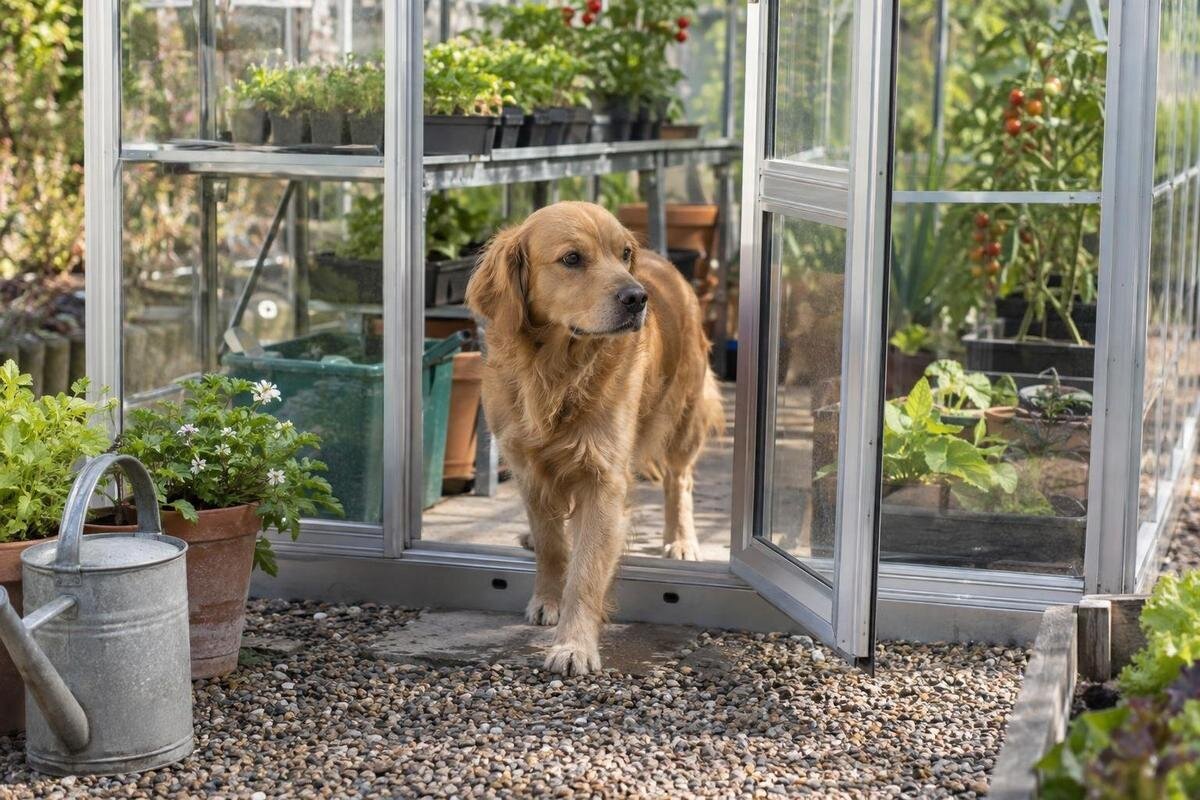
GREENHOUSE PLANNING WITH PETS
Greenhouse planning with pets is mainly about controlling access, not finding a single pet-safe door or a universal plant list. A greenhouse can bring seedlings, tools, water and garden products together, while a door or vent may be open during ordinary jobs. Decide whether pets may enter, then plan the site, boundary, storage and daily routine around that rule. Check each plant and piece of equipment on its own terms, using veterinary and manufacturer guidance rather than assumptions. The result should be a practical setup that keeps access controlled without asking household members to remember a different rule each time.

Decide whether pets may enter
The first decision is whether pets are ever meant to enter. A dog that stays close to its owner presents a different access problem from a cat that climbs, an animal that pushes at doors or a small pet able to fit through narrow gaps. Note what your pet can reach, open, chew, climb or squeeze past rather than relying on breed, size or usual obedience. Choose a clear household rule—no entry, or supervised entry—so everyone opening the greenhouse knows what to do. A rule that depends on remembering each time is weaker than a layout that supports it.
Treat the greenhouse as a plant workspace, not a pet sleeping place. Conditions inside an enclosed growing area can change, and people may bring in products or equipment that need careful handling. If pets accompany you outside, plan where they wait while you open doors, water, carry trays or use garden products; keep that place separate and secure. Include visitors, children and anyone caring for the garden while you are away in the routine. Revisit the plan if your household or your pet’s behaviour changes. The boundary needs to work during ordinary jobs, not just when you have time to manage it carefully.
Map the routes around the greenhouse
Draw the greenhouse onto a simple garden plan with the house door, pet door, gates, fences, paths, hose tap, compost and rubbish points. Mark where the pet usually waits when someone works outside and where it can approach without being noticed. Include the route you take carrying trays or a watering can; if that route crosses the pet’s usual run, you may need a separation point away from the greenhouse itself. Check the space beside and behind the structure as well as the entrance. A boundary only works if the pet cannot walk around it through another garden opening.
If a Lean-to Greenhouse is on your shortlist, compare the chosen configuration’s dimensions with the routes on your plan. Request a drawing from the supplier if you need one to check the site and approach. Mark the gate position, clear space around the entrance and the route your pet might take. Consider what happens when a gate needs to stay open while you carry in supplies or deal with a delivery. Plan where the pet will be during that task, and ask which dimensions and openings apply to the exact version you are considering.
Allow room for a separate access boundary
A floor-area figure is not the same as free working room. Reserve space for growing areas, a walkway, room to turn while carrying a tray, and a clear approach to the door. Add an outside buffer where a person can close a gate or pause with a pet before entering. Check how the door opens and whether the route has a threshold or other feature that affects everyday access. Do not let the only practical path depend on stepping over tools or squeezing past plants. If pet separation relies on a garden fence, include its line in the layout rather than treating it as spare space.
The Oasis Pyramid Greenhouse listing covers variants from 5.53 m² to 18.9 m². That range helps you compare listed floor areas, but it does not show how much clear approach space your site needs or where a boundary can go. Check the chosen variant’s dimensions and entrance details, then sketch the growing areas, shelving, supplies and pet boundary together. Keep the plan practical when plants are mature as well as when the greenhouse is newly set up; a walkway that starts clear may narrow as pots and trays accumulate.
Control access while the door is open
Decide what keeps the pet out while the greenhouse door is open for carrying supplies or providing airflow. A garden gate, a separate entry barrier or keeping pets indoors may suit different situations. A physical barrier needs to resist your pet’s attempts to jump over it or push past it; keeping pets indoors requires everyone to follow the same routine. Test the arrangement against ordinary moments: one hand holding trays, a hose across the route, or someone being interrupted. Position barriers without obstructing a person’s exit or access to the main door. If a screen, latch or barrier attaches to the greenhouse, ask the supplier or installer whether it is compatible before altering the frame.
For the Bloomcabin Prestige Greenhouse, the listed range runs from 3.77 m² to 28.08 m²; neither the model name nor area range confirms the door position or whether supplementary barriers will fit. For the exact size you are considering, request the relevant plan and operating information. Check the door’s opening direction and measure any proposed outside gate with the door open and a person carrying supplies. Ask how a barrier could affect access to the entrance. This is a layout check, not a claim that a particular product is pet-proof.

Include vents in the access plan
Include ventilation openings in your access plan, not just the entrance. Look at each opening used for airflow and consider whether your pet could reach it, squeeze through it or interfere with its operation. Make this check with the opening in the positions you expect to use, rather than judging it only when closed. A covering added to stop a pet entering may reduce airflow or interfere with how an opening works, so do not assume a screen or mesh is suitable. Ask the manufacturer or a qualified installer whether the proposed covering is compatible with the ventilation system before changing the design.
When checking a Limited Edition Aluminium Greenhouse, review the ventilation details for the particular configuration. Confirm whether it includes vents or opening panels, where they are and how they operate; photographs and a range name do not establish those details. Then work through the routine for opening and closing them. Secure the pet elsewhere before opening a door or adjusting ventilation, and restore the access boundary before moving on to another job. If your pet climbs or squeezes into small spaces, explain that behaviour when discussing possible barriers with the supplier or installer, so the advice addresses both access control and intended ventilation.
Check each plant against veterinary guidance
Build a plant list before bringing seedlings into an area a pet can reach. Record the botanical name as well as the common name: similar common names may refer to different plants, and a nursery label or search result may not answer the safety question for your animal. Ask a veterinarian or an animal-poison advice service that provides guidance for pets about the exact plant and pet species. Ask whether the advice applies to the plant parts and type of exposure you are concerned about. If you cannot identify a plant confidently, keep it out of reach until you receive reliable advice; do not treat a general online list as an all-clear.
Include more than established plants in your checks. Seeds, bulbs, cuttings, seedlings, prunings and discarded leaves may be accessible during planting or cleaning, and a plant being edible for people does not establish that it is suitable for pets. Keep a label or photo linked to the botanical name, and update the list when you replace a crop. Check ornamental varieties, herbs and propagated plants individually rather than applying one rule to a whole group. If an animal has chewed or swallowed an unidentified plant, contact a veterinarian or an appropriate animal-poison advice service for case-specific guidance rather than relying on a forum or home remedy.
Keep garden products out of reach
Store fertilisers, pesticides, slug or insect-control products, seed treatments, cleaning products and other garden supplies as though a curious animal might find them. Keep them in their original labelled packaging and follow the manufacturer’s storage and use directions. Put them behind a barrier the pet cannot open or reach. Do not decant them into food or drink containers, or leave a measured amount, sprayer or treated tool on the floor when you stop work. Include compost additives and products awaiting disposal in your inventory. If product-specific storage or handling is unclear, ask the manufacturer; seek animal-specific advice from a veterinarian rather than guessing.
The Limited Edition Aluminium Greenhouses with Storage listing describes built-in storage, but that does not confirm a lockable closure or suitability for products needing controlled storage. Check the compartments, closure and capacity of the exact option, and do not assume it is a pet-secure place for chemicals without clear confirmation. A separate secure cupboard may be needed. Keep clean tools and empty pots apart from products that need special handling, and return supplies to their designated place after each job rather than leaving them beside the entrance.
Keep equipment, water and waste off pet routes
Small equipment matters to the access plan too. Put sharp hand tools, secateurs, stakes, plant ties and loose fittings away after use, especially if the door is open. Store long items so they cannot fall into a walkway. Keep hoses and leads out of routes where pets move, and position buckets, trays or other water containers where an animal cannot fall in or reach the contents. Empty, cover or relocate containers as appropriate to their use and the pet. Clear away offcuts and green waste so the floor does not become an area for an animal to investigate while you are working.
The Aluminium Classic Greenhouse range is listed in sizes from 3.77 m² to 28.08 m², but area alone cannot tell you whether the chosen layout leaves equipment and water outside a pet’s route. Mark the storage, clear path and watering equipment before settling on a variant. If you plan to use a fan, pump, heater, lighting or other powered equipment, follow its instructions and ask a qualified electrician about installation; do not improvise connections or run leads through an access area. For fixed plumbing or water systems, seek suitable professional advice rather than relying on a greenhouse product name.

Make the access routine easy to repeat
Make the routine easy for everyone to follow. Before opening the greenhouse, put the pet in its agreed separate area or confirm that another person is managing it. Check that gates and doors are back in their intended position after carrying plants, watering or cleaning. Agree who is responsible when visitors, children or a house-sitter are present, and what to do if a delivery, maintenance visit or interruption leaves an entrance open. Keep the plant list and product-storage arrangements easy for household members to find, so they do not have to guess when you are not there.
The Spacious Greenhouse listing spans 47 to 70 m². A floor-area range does not show whether a person at the doorway can see all work areas, so assess sightlines in the selected layout before relying on supervision. If shelves, walls or tall crops could block the view, decide how to keep the pet outside rather than treating the whole space as supervised by default. Check whether someone working at the far end would need to leave a door unattended to fetch a tool or supply. If the plan depends on a second person, make that part of the household routine.
Check the chosen configuration before ordering
Before ordering, write down five answers: which pets may approach; whether entry is prohibited or supervised; how the boundary works when doors and vents are open; which plants and products need restricted access; and where tools, water and waste will sit. Ask the supplier for the dimensions and drawings of the exact variant, information about its openings and ventilation, and whether any proposed barrier or accessory is compatible. For plant choices, use veterinary guidance; for electrical work, fixed plumbing or alterations, consult an appropriately qualified professional. Keep these answers with the details for the model you are considering.
One option to compare is the T-Model Orangery Greenhouse, listed in variants from 16.52 m² to 30 m². Use the chosen variant’s documented measurements to check the route, storage and separation plan, then ask about any feature not specified in the information available to you. Apply the same checklist across products rather than choosing by area, style or a phrase such as built-in storage alone. A suitable plan still needs to work during routine tasks and interruptions; if it depends on perfect timing, revise the layout or keep pets outside the work area.
Frequently asked questions
Can I make a greenhouse completely pet-proof?
Do not assume a greenhouse will contain a pet just because its door is closed or a product is described by a particular style or name. Whether an arrangement works depends on your pet, the openings and the boundaries around the site. Check how the pet could get past each barrier, including when doors or vents are open, and ask the supplier whether any proposed additions are compatible.
How do I check whether a plant is safe for my pet?
Identify the plant by its botanical name and ask a veterinarian or an animal-poison advice service that provides guidance for pets. Give them the animal’s species and ask whether the advice applies to the particular plant parts and type of exposure. If you cannot identify the plant, keep it out of reach until you have reliable advice.
Can my dog or cat wait in the greenhouse while I work?
A greenhouse is a growing space, not a reliable resting place for a pet. Its temperature and air conditions can differ from outdoors, and tools or garden products may be in use. Arrange a separate, secure place for your pet while you work. If your pet enters the greenhouse, keep access controlled and supervise it.
Is built-in greenhouse storage enough to keep garden products away from pets?
Not necessarily. The word storage does not confirm that a compartment can be locked or that it suits products requiring controlled storage. Check the details for the exact option, keep products in their original labelled packaging and use a separate secure cupboard if needed.
What should I check when choosing a greenhouse size?
Look beyond the floor-area figure. Check the selected model’s dimensions and door arrangements, allow clear space for people carrying supplies, and map where a pet boundary could go. Also consider where equipment and products will be stored and whether the access routine is workable when doors or vents are open.
Pet-safe greenhouse planning comes down to practical boundaries: know which animals can approach, where they could get in, which plants and products need restricted access, and how the space is used while a door or vent is open. Confirm plant choices with appropriate veterinary guidance and handle equipment according to its instructions or advice from a qualified professional. A greenhouse that fits your garden is a better fit for a pet-owning household when its access and storage routines remain workable every time it is used.
