
When Should You Replace Greenhouse Polycarbonate Panels?
Greenhouse repair and replacement
Polycarbonate can look older without being ready for replacement. A gradual colour shift or hazy surface does not, by itself, show that a greenhouse panel has stopped doing its job. Cracks, holes, loose edges, poor fit or damage across several sheets call for closer attention. The useful test is whether the panel remains intact, securely fitted and suitable for the greenhouse—not whether it looks new. This guide explains what to check, when one-panel replacement may be enough, when the whole structure needs assessment, and what details to collect before requesting an approved spare.

Appearance alone does not tell you when to replace a panel
Polycarbonate panels do not have a single visible-age threshold that tells you when to replace them. A gradual colour shift, haze, fine scratching or dull finish may be noticeable without showing whether the sheet is still intact or properly retained. The reverse is also true: a panel can look clear while a crack or split edge is easy to miss. Appearance can be affected by surface dirt, wear, exposure and light, so it cannot give a dependable remaining-life estimate on its own. Treat a change as a reason to inspect the panel, not an automatic replacement date, unless the manufacturer gives a specific interval for your greenhouse.
Ask what has changed in practical terms. Is there a hole, an edge lifting out of place, visible movement, or a loss of cover where the greenhouse should be enclosed? Has the sheet stopped serving its intended purpose, or is the concern mainly cosmetic? Compare it with nearby panels in similar positions, while allowing for differences in exposure and cleaning. If the other sheets remain fitted and intact, one discoloured panel does not automatically mean that all the glazing is due for renewal. Decide panel by panel, using the manual and supplier guidance rather than a general rule based on colour or age. Note whether the change is isolated or appears across several panels.
Inspect the panel and note its position
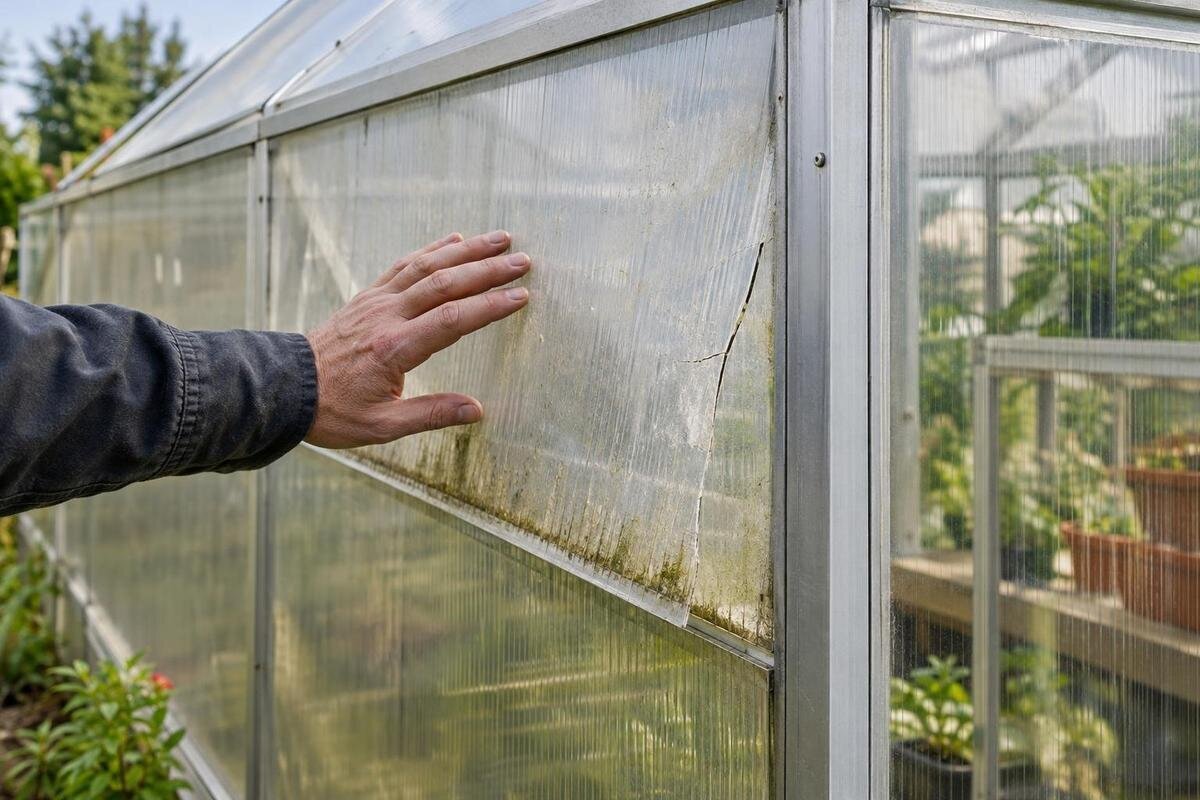
Inspect the greenhouse in daylight from ground level or another safe, stable position. Look at both faces if they can be seen without climbing, leaning over glazing or reaching across a roof. Record whether the sheet is on a roof, side wall, door or another section, and mark its position on a simple sketch or a wider photo. Take close-ups of cracks, edges, joints and nearby retaining parts, then date them. A repeated photograph from a similar angle can show whether a visible change is progressing, although it cannot identify the cause. Do not press, lift or remove the panel to test it; forceful checking can make damage worse.
Look beyond the sheet itself. A retaining strip, clip, seal or frame section may be the part that has moved or deteriorated, while the polycarbonate remains unbroken. Record gaps, displaced edges and any visible change in the surrounding frame, but do not try to straighten or re-secure components as a diagnostic test. Identify the greenhouse from its original paperwork, label or manual rather than choosing the closest-looking model online. A broad listing such as Aluminium Greenhouses is not an identifier for every older or variant greenhouse in that category. Your exact model name or part code is more useful when looking for an approved replacement.
Cracks, holes and split edges affect function
Cracks, punctures, split edges and missing pieces are stronger evidence of functional damage than a colour change. Their position matters: damage near an edge or joint may affect how the panel sits, while a hole interrupts the greenhouse enclosure. Do not judge severity only by the visible length of a crack. Note whether it is spreading, whether loose fragments are present, whether the sheet remains retained, and whether an opening lets outside conditions through. If the panel moves or leaves a gap, stop treating the issue as cosmetic and arrange a closer assessment. A small visible mark can still matter if it is in a vulnerable part of the panel.
Give priority to an exposed opening, a loose panel or damaged material overhead. Keep people clear of any area where a panel could move, and contact the supplier or an experienced greenhouse installer for advice. Avoid filling a split with an unapproved adhesive, drilling a new fixing point or fastening the sheet with whatever is to hand; those measures can affect the panel or its retention. Tell the installer whether the damage appeared suddenly or was noticed gradually. If several panels are affected, ask whether the whole greenhouse needs assessment as well as the damaged sheets. Only if that assessment points towards replacing the greenhouse does comparing a complete model such as the T-Model Orangery Greenhouse become relevant.
Haze and colour change need context
Cloudiness, yellowing, surface marks and loss of shine are common reasons people consider replacing polycarbonate, but they do not all point to the same cause. Dust and deposits can make a sheet appear dull; cleaning may show whether some of the change was on the surface or within the material. Use the cleaning method in the greenhouse or panel instructions. Avoid abrasive pads, sharp tools and unfamiliar solvents, which may damage the surface or make later assessment harder. If care guidance is unavailable, ask the supplier what is suitable for that panel rather than experimenting with a strong cleaner.
After cleaning, compare the same panel in consistent light with nearby sheets, and note whether the change is even or concentrated in one area. A uniform colour shift with no crack, opening or fit problem may be cosmetic, while reduced clarity may still matter for how you use the greenhouse. Do not use plant growth alone as a test: crop health also depends on variety, season, watering and other conditions. If the main concern is reduced light or visibility, ask the manufacturer whether the observed condition is acceptable for that product. There is no universal visual threshold that applies to every greenhouse panel.

Poor fit may involve more than the panel
An intact panel that sits poorly deserves attention, even if its surface looks clear. Signs include an edge outside its channel, a gap that has appeared, rattling, repeated movement or a sheet that no longer lies as it did. These observations show that the assembly needs checking; they do not prove the sheet is the cause. A retainer, seal, frame section or incorrectly matched panel may be involved. Photograph the exact edge and neighbouring frame, and note whether the problem affects one panel or several. Record when you first noticed the change, but do not repeatedly move the sheet to see whether it shifts.
Do not push the sheet back, trim it to fit, add new holes or alter the frame to make a replacement panel sit. A panel that appears too large or too small may have been identified or measured incorrectly, or the retaining system may need attention. Ask the manufacturer or a qualified installer to identify the part that needs work before ordering. Keep that repair decision separate from any change to the greenhouse layout. If you are considering a Lean-to Greenhouse as a complete replacement, compare its full product details with your space and access requirements rather than using its appearance to judge the fit of an existing panel.
When replacing one panel may be enough
Replacing a single panel may be a proportionate option when the damage is local, the remaining sheets appear sound, the surrounding frame and retaining components are in suitable condition, and an approved spare is available for the exact model and position. Confirm those conditions rather than relying on a quick glance: an installer may need to check the panel edge, channel and related parts. Ask whether the replacement is intended for a roof or side position and whether the existing retaining components remain suitable. Similar-looking sheets are not necessarily interchangeable, and a generic panel should not be treated as an approved substitute without confirmation.
Compare the scope of a one-panel repair with any wider work that may be needed. Diagnosis, access, associated retainers or seals and fitting all belong in the discussion; a low panel count does not guarantee a simple repair if the sheet is difficult to reach. If you are also considering a complete greenhouse, compare the two options on their full scope rather than the price of a sheet alone. For example, the Pyramid Greenhouse listing belongs in a comparison of complete models, while a panel enquiry concerns the parts needed to keep your current greenhouse in use. Establish what the repair would resolve before deciding whether replacing the whole structure is proportionate.
When to assess the whole greenhouse
Consider a whole-greenhouse assessment when damage affects several panels, faults recur after a repair, or the frame and retaining parts show concerns alongside the sheets. Replacing panels one by one may not address the problem if their seating or the surrounding assembly is involved. Conversely, an older-looking greenhouse is not automatically beyond repair if its frame is sound and exact spares remain available. When damage is repeated or widespread, ask an installer to assess the affected area and identify the scope of work, rather than requesting a quote for new sheets alone. The result may still be panel replacement, but it should be based on the condition of the assembly.
For a complete replacement, compare the existing greenhouse with the space and use you want: footprint, access, layout and future growing plans are separate from panel dimensions. The Spacious Greenhouse listing covers complete greenhouse areas from 47 to 70 m². Use that range when comparing whole-greenhouse footprints, not when identifying a replacement sheet. Review the full product details against your available space, and have concerns about the existing base or structure assessed rather than assuming a new model will suit it unchanged. This separates two questions: whether the current greenhouse can be repaired, and whether a different greenhouse would better suit your needs.
Match a replacement to the exact greenhouse
Start a spare-parts search with the exact greenhouse model and any variant, production year, order reference or part number shown in your paperwork. Then identify the panel’s position and orientation. Ask the supplier which properties must match there, such as panel type, thickness, length and width, edge profile, cell arrangement or the side that faces out, where relevant. These details differ between products, so treat them as questions for the manufacturer rather than a universal specification to assemble yourself. Measure only if you can do so safely and follow the manual’s reference points; a rough visible measurement is not a substitute for a part code.
Do not choose a sheet because it has a similar colour, apparent thickness or overall size. Its edges, channels, orientation and retention method can be equally important, and an unsuitable panel may not fit or stay in place as intended. Confirm that the proposed spare is approved for the exact greenhouse and location, and ask whether seals or retaining pieces must also be replaced. A listing such as Limited Edition Aluminium Greenhouses with Storage identifies a complete product range, not the replacement-panel specification for a particular build. Use the parts documentation or supplier confirmation to establish compatibility.

Safe access for roof panels and awkwardly placed sheets
Panel replacement can involve overhead work, awkward access and damaged edges, especially when the sheet is on the roof or has loosened from its frame. Do not climb on greenhouse glazing or reach across a loose panel. If safe access is not straightforward, if the panel may move, or if you cannot identify how it is retained, leave the work to an experienced greenhouse installer. This matters particularly where taking out one sheet could disturb neighbouring panels or the frame. The aim is not simply to make the greenhouse look tidy; the right part needs to be assessed and fitted without creating another fault.
Before work begins, check the product manual and any applicable purchase or warranty terms, and ask the installer to explain what will be replaced: the sheet only, retainers, seals or other components. Ask how they confirmed that the part matches the model and whether the frame or nearby panels need attention. This gives you a clear description of the proposed repair and helps you understand whether it addresses the problems found during inspection. If the recommendation is to replace the structure instead, use complete-product details such as those for the Bloomcabin Prestige Greenhouse for a separate model comparison. A new greenhouse purchase should not be confused with a quote for repairing the existing assembly.
Prepare a clear spare-parts enquiry
Make an enquiry easier to answer by including the greenhouse model, any serial or order reference, purchase documentation and the relevant page of the manual. State how many panels are affected and where each one sits—roof or side, and near which end—using a sketch if helpful. Include a wide photo of the greenhouse, a close-up of the damage, and clear images of the panel edges and surrounding frame from a safe position. If you have measurements, label them as approximate and say how they were taken. Do not remove a panel just to find a marking or measure hidden edges.
Ask the parts team or manufacturer to confirm the approved panel for that exact model and position, whether associated seals or retainers are required, and whether the frame should be assessed before ordering. If an original part number is unavailable, ask for an approved alternative rather than substituting a generic sheet based on appearance. If no suitable spare can be confirmed, ask whether a full greenhouse replacement enquiry is more appropriate. In that case, use a listing such as Limited Edition Aluminium Greenhouses to identify the complete range you want to discuss, while keeping the existing greenhouse details in your repair enquiry. Keep the reply with your greenhouse records so the part identification and proposed work remain clear.
Frequently asked questions
Does hazy polycarbonate always need replacing?
No. Haze or colour change alone does not show whether a panel has stopped functioning. Clean it only as the product instructions allow, then check for cracks, openings, loose edges and poor fit. If clarity is important to how you use the greenhouse, ask the manufacturer whether the panel’s condition is acceptable.
When does a crack mean a panel should be replaced?
A crack, hole or split edge needs closer attention if it leaves an opening, affects how the panel sits or leaves pieces loose. The location and condition of the surrounding frame also matter. Ask the manufacturer or an experienced installer to confirm the right repair and approved replacement.
Can I replace just one greenhouse panel?
Often, if the damage is local, the surrounding frame and retainers are in suitable condition, and an approved spare matches the exact greenhouse and panel position. Confirm those details before ordering; a single replacement sheet may not resolve a fault in the frame or retaining components.
Are polycarbonate replacement panels interchangeable?
Do not assume they are. Panels can differ in the properties that affect fit and installation, including their edges, profile or orientation. Use the greenhouse manual, part number or supplier confirmation to check that a proposed replacement is approved for your exact model and location.
Can I replace a roof panel myself?
That depends on safe access, the panel’s condition and the manufacturer’s instructions. Do not climb on greenhouse glazing or work around a loose panel. If it is overhead, difficult to reach or not clearly retained, ask an experienced greenhouse installer to assess and fit it.
A panel’s condition and fit matter more than its colour or age alone. A careful inspection, the exact greenhouse model and confirmation of an approved spare help distinguish a cosmetic change from damage that needs repair. If the frame or retaining parts are also in question, have the complete assembly assessed before deciding whether to replace one panel or the greenhouse. Leave loose or difficult-to-reach panels to an experienced installer rather than attempting an improvised fix.
