
Power Cuts in a Heated Greenhouse: A Frost Backup Plan
Greenhouse heating and winter energy
Heating a greenhouse through winter does not remove the risk of a power cut. If heating stops during a cold night, the temperature around plants can fall while you wait for power to return. A useful frost plan sets an early warning, ranks plants by cold sensitivity, identifies what you can move or cover, and defines which backup equipment is safe for that setting. Build it from observed greenhouse conditions and documented equipment limits, not from a promised hold time.

Why a power cut needs its own frost plan
A power cut removes heat input, but it does not mean every plant will be damaged immediately. How quickly the temperature falls depends on outdoor conditions, how warm the greenhouse was before the cut, heat loss through the structure and the length of the interruption. A cold forecast is useful context, not a reading of conditions around your plants. The thermostat setting on a working heater tells you what it is trying to maintain; it does not tell you how long the greenhouse will stay above a plant’s limit without power.
Build the response around a warning and actions you can take, rather than a fixed promise about how many hours the space will remain warm. Keep separate notes for a forecast frost while power is available and a power cut with an uncertain restoration time. The first may call for checking your heater and alert system; the second also requires decisions about which plants to move or cover, and which backup equipment, if any, is safe to use. One mild night cannot establish a reliable outage duration. Put the plan somewhere everyone responsible for the greenhouse can find it. Identify who receives alerts, who can attend and who makes decisions if the usual gardener is unavailable. A short written plan should make those responsibilities clear without requiring someone to reconstruct your thinking in the middle of the night.
Rank plants by their cold tolerance
Before winter, list each plant or crop group, the lowest suitable temperature advised for it, its growth stage and whether it is in a pot or a bed. Use reliable plant-specific growing information rather than applying one temperature rule across the greenhouse. Seedlings, newly acquired plants and cold-sensitive varieties may need attention ahead of established, cold-tolerant crops, but the plant’s own growing guidance should determine the order. Include plants you particularly want to preserve, while keeping urgency distinct from monetary value. Record practical constraints beside each entry: a container may be too heavy for one person, or a bed-grown crop may need protection where it stands. Label the plants or mark their positions on a simple sketch so a helper can identify the priority group without needing to recognise every variety.
Sort the list into first-to-move, protect-in-place and lower-priority groups. Note where each group is and what action is practical: moving a pot to a suitable sheltered space, gathering containers together or laying frost cloth over a crop. Keep a clear route for carrying pots. If you are choosing or changing a greenhouse, compare the exact floor plan with the group you want to protect. The Lean-to Greenhouse size options are listed from 3.69 to 14.34 m²; that floor-area range does not show whether plants, covers and access will fit, or how warm the space will remain.
Measure how your greenhouse cools
Log night-time readings through normal winter conditions before relying on an alarm. Put a minimum-and-maximum thermometer or temperature logger near plant-canopy height, away from a heater outlet, direct sun, doors and vents that could distort a reading. Record the outdoor conditions, greenhouse temperature, heater operation if you can observe it safely, and whether doors or vents were opened. If beds or corners seem noticeably different, compare more than one representative point instead of treating a single sensor as a map of the whole space. Label each sensor location and use consistent times and units in your notes. Distinguish the overnight minimum from a reading taken when you arrive in the morning. If you move a sensor or rearrange benches, record the change so you do not mistake a different measuring position for a change in the greenhouse’s cooling pattern.
Use the records to see when the coldest monitored area approaches your chosen alert point, but treat each night as evidence rather than a guarantee. Wind, cloud, air leaks and how the greenhouse is used can change the result. Floor area helps define the space you need to manage, but does not reveal its full heat loss. Bloomcabin lists the Spacious Greenhouse in sizes from 47 to 70 m². That range identifies available floor areas; it is not a prediction of overnight warmth or heater performance.
Set alerts that leave time to act
Set the low-temperature warning above the lowest advised limit for the plants you want to protect. Allow for sensor accuracy and the time needed to reach the greenhouse, move pots or arrange help; do not wait for an alarm to show the temperature at which damage may occur. If plants have different limits, make the alert serve the most vulnerable group or use separate warnings for distinct growing zones. There is no universal frost-alarm temperature for every crop and greenhouse.
Check what still works when the mains supply fails. A remote alert may rely on power to a router or on mobile coverage, so find out which parts have battery backup and whether the system gives a local warning as well. Test the notification and check or recharge batteries before winter. Confirm that the intended recipient notices the warning, including overnight, and knows which greenhouse or sensor it refers to. Decide what to do if a reading stops updating: a missing signal is not confirmation that the plants are warm. Keep the alert system’s support details with the plan so faults can be addressed before a cold spell. Place sensors at relevant plant height and in cold-prone areas, rather than directly above a heater. The Classic Aluminium Greenhouses range is listed from 3.77 to 28.08 m²; use the selected size and layout, not that range alone, to decide where readings are useful.

Reduce heat loss before winter
Deal with avoidable heat loss before the forecast becomes urgent. Check that doors close properly, look for damaged glazing or obvious gaps, and repair problems with methods and materials appropriate for the greenhouse. During a cold spell, keep doors shut and close vents if conditions and equipment instructions allow. Do not leave vents closed indefinitely, as plants still need suitable ventilation. Note which vents you normally open and how you will return to that routine when the cold weather passes.
Consider greenhouse-specific thermal screens or insulation only after checking their effects on light, ventilation, condensation and access. Keep materials clear of heater inlets, outlets and controls, and away from hot appliances unless their instructions allow the required clearance. A product name does not confirm what insulation or ventilation features are available. Use the Limited Edition Aluminium Greenhouses listing to check the actual specification and compatible options for a chosen model, rather than assuming a screen, vent or particular heat-retention level is included.
Respond safely when the power goes off
When an alert arrives, confirm the reading and whether power has failed without opening electrical equipment or handling wet connections. Check outage information through a reliable channel. If it is safe and appropriate, limit door openings, close vents for the short cold period and move the first-to-move pots to their preselected sheltered location. Gather nearby containers into a manageable group. Frost cloth or a supported cover may reduce direct exposure, but it is not a guaranteed heat source; keep covers clear of heater parts and anything that may become hot when power returns. Note the time, temperature and actions taken, even if only in a brief phone note. If another person takes over, tell them which plants have moved, which vents have closed and whether any backup equipment is running. This avoids repeating work or leaving a temporary arrangement unnoticed.
A protected group is useful only if the actual layout lets you reach it and keep covers clear of equipment. The Pyramid Greenhouse range is listed from 5.53 to 18.9 m²; check the selected configuration against your own layout before deciding what can be grouped. Floor area does not indicate that a warmer zone exists. Avoid candles, barbecues, camping stoves and other improvised flames as emergency heat, and never operate a generator inside the greenhouse.
Choose backup heating for its approved setting
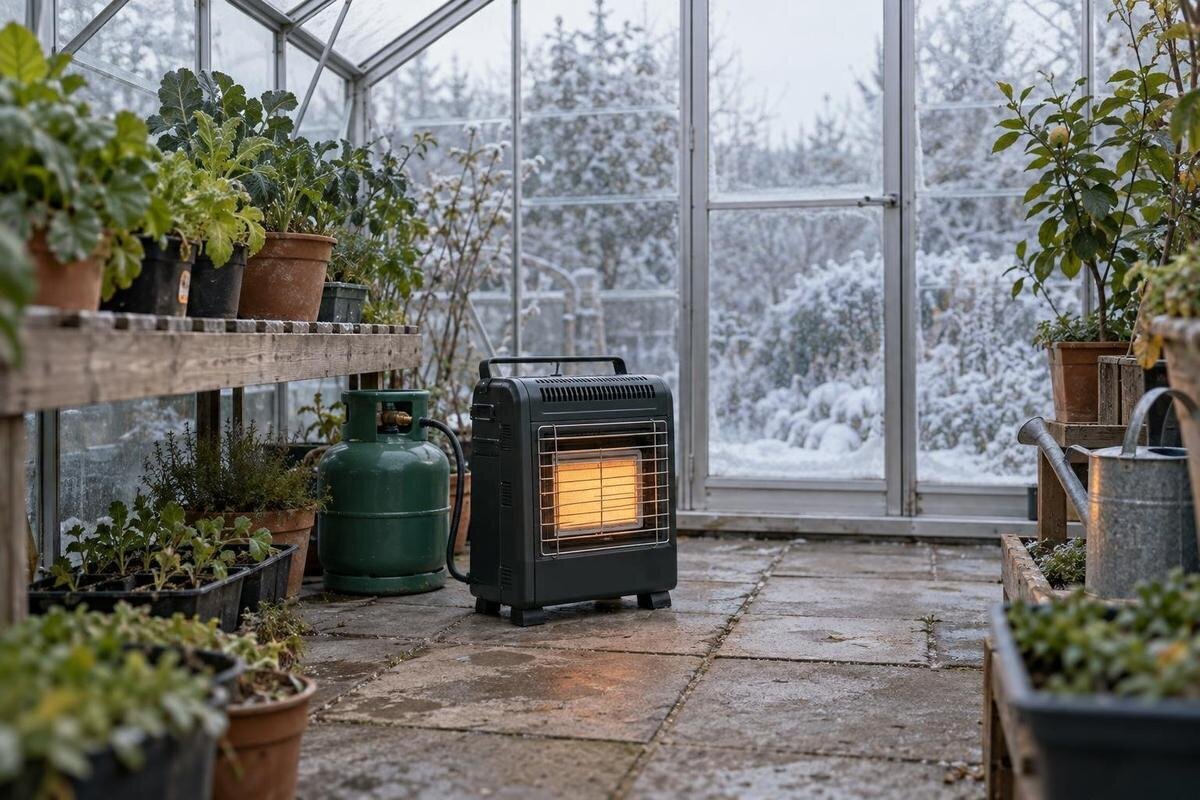
Treat a backup heater as equipment for a defined setting, not as a universal emergency fix. Check the manufacturer’s documentation for the precise greenhouse or damp environment, required ventilation, safe clearances, control behaviour and permitted power source or fuel. Use a combustion appliance inside only if its manufacturer explicitly approves that exact use and all stated ventilation conditions can be met. A patio heater, barbecue or camping stove is not a substitute for greenhouse-approved heating. Follow any instructions about supervision or unattended operation.
Match the appliance to the greenhouse as actually built and to its heat-loss conditions, rather than selecting it from floor area alone. The T-Model Orangery Greenhouse is listed in sizes from 16.52 to 30 m²; this is a size range, not a heater rating or temperature promise. Ask the heater supplier or a suitably qualified professional what documented capacity and controls suit the specific enclosure. Check what the appliance does after power returns and how to monitor it without placing sensors too close to the heat source.
Keep alarms and backup power safe
Separate backup for monitoring from backup for heating. A small battery supply may keep an alarm or communications device running without being suitable for a heater. For a battery, inverter or generator, check documented compatibility, supported load, expected runtime and weather protection with the equipment supplier. Do not rely on a runtime claim that does not match your actual equipment, or improvise a circuit. Operate a generator outdoors in a suitable location away from the greenhouse and its doors, windows and vents, following the manufacturer’s instructions.
Leave fixed wiring, changeover arrangements, protective devices and permanent greenhouse supplies to a qualified electrician who can assess the site and local requirements. Do not connect a generator to household or greenhouse wiring with a makeshift lead. The Prestige Greenhouse with Metal Foundation is a greenhouse product identity, not evidence of an earthing arrangement or generator compatibility. Do not infer that electrical equipment or a power connection is suitable from a metal-foundation product name.

Plan for an outage that lasts longer
Make a second plan for an interruption that continues beyond your first visit. Decide which plants can move to a suitable frost-protected space, who can help if you are away and how pots can be transported before the temperature is already falling. Keep the priority list, gloves, plant covers, a torch and a charged phone accessible. Check outage updates, but do not base plant survival on an estimated restoration time. If you cannot get to the greenhouse promptly, agree in advance who can follow the plan for you. Confirm that your helper can access both the greenhouse and the intended destination for the plants. Set an order for further moves if the interruption continues, rather than trying to relocate everything at once. Include a fallback if the first destination is unavailable, and distinguish tasks a helper can carry out from equipment decisions that need specialist advice.
If you store backup supplies in or beside the greenhouse, check that each item is permitted in that location and follow its manufacturer’s storage instructions. The Limited Edition Aluminium Greenhouses with Storage range is listed from 5.52 to 28.08 m², but a storage label does not establish that the space is suitable for batteries, fuel or a heater. Keep fuel and powered equipment as directed by their manufacturers, away from ignition sources where required. Do not assume built-in storage is an approved store for emergency equipment.
Rehearse the response and review it
Practise before the coldest part of the season without deliberately exposing plants to frost. Use the sensor’s test function, confirm that the alert reaches you, check batteries and walk the route for moving the highest-priority pots. Make sure everyone who may respond knows where covers are kept, which plants come first and how to use approved equipment. Ask a helper to work through the written plan with you present. Note any unclear plant labels, inaccessible supplies or instructions that depend on knowledge only you have. Revise those details while there is time to do so calmly. Keep appliance manuals and relevant contact details accessible without relying on a phone that may be flat. Check the plan again if the greenhouse layout, plant collection or equipment changes.
After an actual outage, note the minimum temperature, how long the power was off, what actions you took and how the plants responded. Compare those observations with the logger record, and set an earlier warning if the available response time proved too short. Review the response as well as the temperature: did the message arrive promptly, could you find the priority plants, and was the planned destination ready? Update the relevant part of the plan rather than adding more instructions everywhere. Before relying on a heater again, follow its restart instructions and check that its controls and required ventilation are working as expected. This review makes the next cold-night response more realistic without turning one past reading into a promise.
Frequently asked questions
What temperature should I set the greenhouse alarm to?
Use the lowest suitable temperature for the most vulnerable plants you intend to protect, based on reliable plant-specific advice. Set the warning above that point so there is time to respond, allowing for sensor accuracy and the time it takes to reach the greenhouse. There is no single alarm temperature that suits every crop.
How long will a greenhouse stay warm after a power cut?
There is no dependable universal holdover time. Cooling depends on the weather, the greenhouse’s heat loss, its starting temperature and how long the power is off. Keep temperature records through normal cold nights to understand your own space, but treat them as evidence rather than a guarantee for a future outage.
Can I use a camping stove or portable gas heater in the greenhouse?
Do not use a barbecue, camping stove or other improvised flame as emergency greenhouse heating. Use a combustion heater inside only if the manufacturer explicitly approves that exact use and you can meet its ventilation and clearance instructions. Generators must operate outdoors, away from greenhouse openings, and according to their instructions.
Will a battery backup keep my greenhouse heater running?
Do not assume it will. A battery supply may support an alarm or communications device without being suitable for a heater. Check documented compatibility, load and runtime with the equipment supplier. If the arrangement involves fixed wiring or a permanent connection, ask a qualified electrician to assess it.
Should I close the vents during a power cut?
On a cold night, temporarily closing vents and doors may help limit heat loss if it is appropriate for the plants and equipment. Do not leave the greenhouse sealed indefinitely: ventilation still matters, and conditions change. Note which vents you close and reopen them when the cold spell has passed, following relevant equipment instructions.
A practical backup plan is built around a warning you can receive, plants ranked before the cold arrives and safe actions you can take when power is unavailable. Use your own temperature records to refine it, and keep any heater, battery or generator within its documented purpose. That leaves you prepared to respond without assuming the greenhouse will stay warm on its own.
